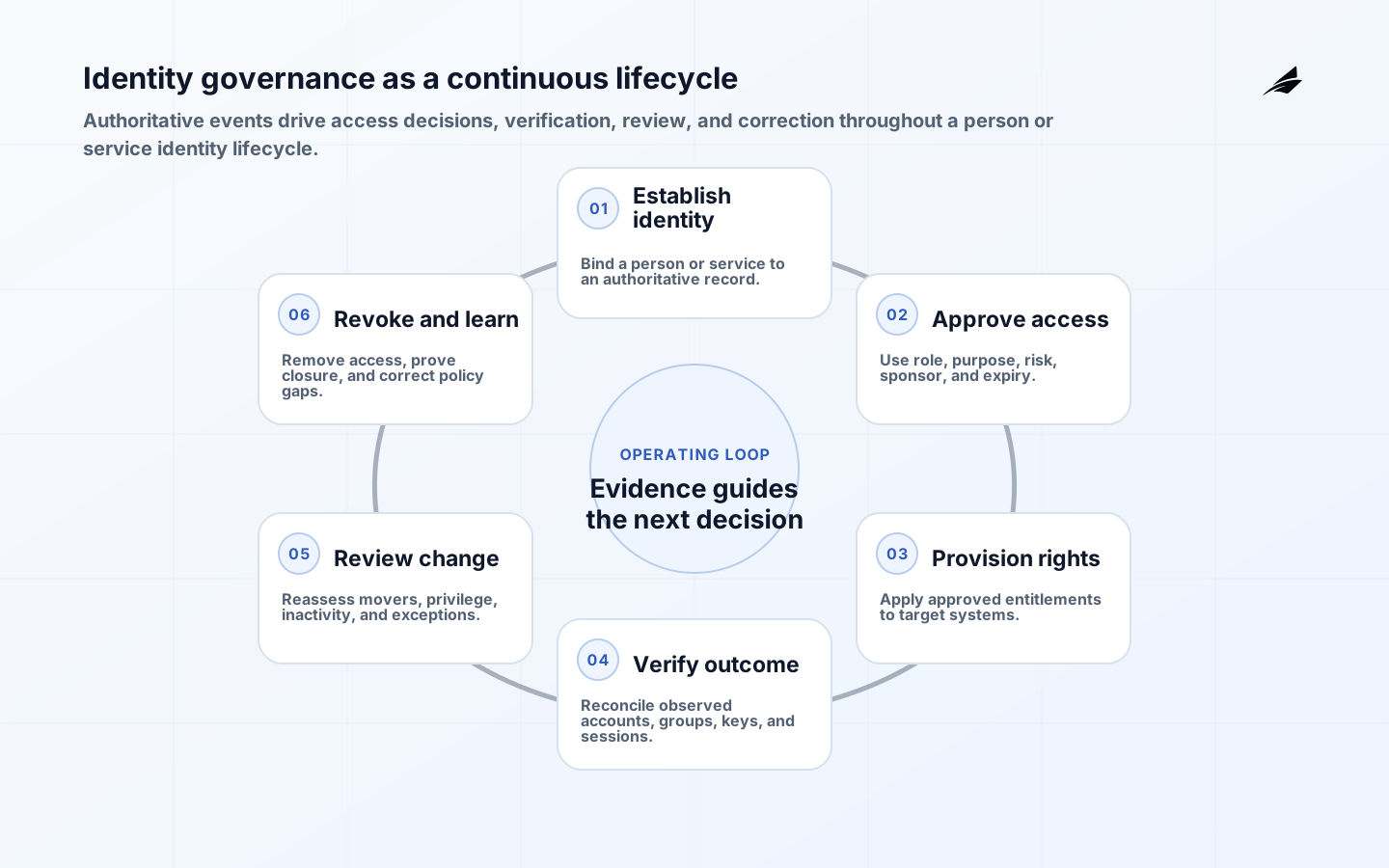
Identity governance for teams answers a business question that becomes urgent as a company grows: who should be able to reach which customer data, production systems, financial tools, and administrative actions, for what reason, and until when? Authentication proves something about an identity at sign-in. Governance decides whether that identity exists legitimately, whether its access still matches a current role, who approved an exception, and how quickly access disappears after a change. Founders do not need a heavyweight committee to begin, but they do need an authoritative workforce record, named application owners, a repeatable joiner-mover-leaver process, stronger handling for privileged access, and evidence that revocation actually reached the systems that matter.
Define the risk boundary before buying a tool
A useful first inventory is small and specific. List the identity provider, source-code host, cloud consoles, production database path, customer-support tooling, finance platform, and any vendor portal that can administer those systems. For each, record the accountable business owner, technical owner, normal users, privileged roles, and the consequence of an incorrect grant. This separates a routine collaboration account from an administrator who can reset another employee's authentication factor. It also prevents a familiar failure: treating a spreadsheet of users as governance while service accounts, integration tokens, and break-glass accounts remain outside the review.
| Area | Founder decision | Evidence to retain |
|---|---|---|
| Scope | Start with customer data, money movement, production administration, and systems that create new accounts or credentials. | A dated inventory with one accountable owner per system. |
| Identity source | Choose the authoritative record for employment, contractor engagement, and role changes rather than asking each application to infer status. | Named source, synchronization owner, and exceptions list. |
| Privilege | Separate ordinary use from powers that export, impersonate, delete, approve, or administer. | Role descriptions and a list of privileged groups. |
| Review | Set a cadence based on impact and a trigger for role, vendor, or architecture changes. | Completed decisions, overdue items, and exception expiries. |
Build an operating model around lifecycle events
The joiner, mover, leaver process is more valuable than a quarterly cleanup because it handles change close to when it happens. A joiner receives a role through a defined request and approval path. A mover loses permissions that belonged to the old job before gaining those required for the new one. A leaver's interactive access, sessions, recovery methods, and standing privileged groups are removed promptly, while evidence is retained according to the company's policy. Contractors need the same lifecycle logic with a fixed end date. Automate only after the source data and owner decisions are trustworthy; automation that copies a bad organizational record merely distributes the mistake faster.
- Give each critical application a business owner who can explain whether a role still supports current work.
- Use groups or roles for recurring work; direct grants should be exceptional, attributed, and time-bounded.
- Treat service identities as first-class inventory items with an owner, purpose, credential location, and rotation or retirement path.
- Require a second decision for sensitive actions such as exporting tenant data, changing payment details, or administering identities.
- Make an emergency route narrow, logged, periodically tested, and removed once the incident or maintenance window ends.
Make access reviews decisive rather than ceremonial
Access reviews should ask a reviewer to make a decision they are qualified to make. A manager can usually confirm that an employee still needs a normal business application; a system owner is better placed to judge a database administrator group; security or engineering leadership may need to approve a temporary production exception. Show reviewers the account, role, resource, last relevant activity where appropriate, business purpose, and requested outcome. The available choices should be retain, modify, revoke, or escalate. A review that only measures click-through completion creates a neat report but does not establish that permissions remain justified.
Design evidence and exceptions for a future question
Retain enough context for a colleague to reconstruct an access decision without storing credentials or unnecessary personal information. A practical record includes the subject, system, entitlement, requester, approver, reason, decision time, effective time, and expiry when relevant. Exceptions deserve extra care because they often become invisible permanent access. Record the exact scope, compensating control, accountable risk owner, and end date. When an exception expires, remove it automatically where possible and verify removal. Evidence should be retrievable by the people handling a customer question, audit request, or incident, not locked in a former employee's inbox.
| Signal | What it may reveal | Useful response |
|---|---|---|
| Unowned account | A person, service, or integration has no accountable sponsor. | Disable or constrain it until an owner and purpose are confirmed. |
| Repeated direct grants | The role catalog does not fit real work, or an approval path is too slow. | Examine the pattern before creating a broader role. |
| Late review decisions | Reviewers lack context, authority, or time to decide. | Change the reviewer, evidence, scope, or cadence rather than sending more reminders. |
| Dormant privileged access | A high-impact role may no longer be required. | Validate the business need and remove or time-limit the grant. |
Measure the health of the decision process
Good measures describe the state of access, not merely activity. Track the percentage of in-scope privileged accounts with a named owner and current review decision; the age of temporary grants; the number of leaver accounts disabled within the agreed service level; and the share of applications connected to the authoritative identity source. Pair these with samples: select a recent hire, transfer, contractor end date, and emergency access event, then trace what happened. The sample shows whether data, workflow, enforcement, and evidence agree. A sudden drop in a metric might represent a real improvement, a broken integration, or a change in scope, so record the explanation alongside the number.
Reconcile intended access with access that actually exists
Current NIST SP 800-63-4 covers identity proofing, authentication, federation, and lifecycle risk; it does not replace authorization design. NIST SP 800-207 frames zero trust around subjects, resources, policy decisions, and continually evaluated access. The CISA Zero Trust Maturity Model reinforces identity as one pillar within a wider operating architecture. NIST SP 800-53 Rev. 5 provides access-control and audit control families, while the NIST CSF 2.0 gives leadership a broader governance and risk vocabulary.
| Lifecycle event | Required action | Measure that matters |
|---|---|---|
| Joiner | Create one attributable identity and role-based baseline | Time to ready access without manual overgrant |
| Mover | Add new access and remove incompatible prior access | Stale entitlement count after role change |
| Leaver | Disable sessions, accounts, keys, and recovery routes | Time to verified high-risk revocation |
| Exception | Record sponsor, purpose, scope, and expiry | Expired exceptions still active |
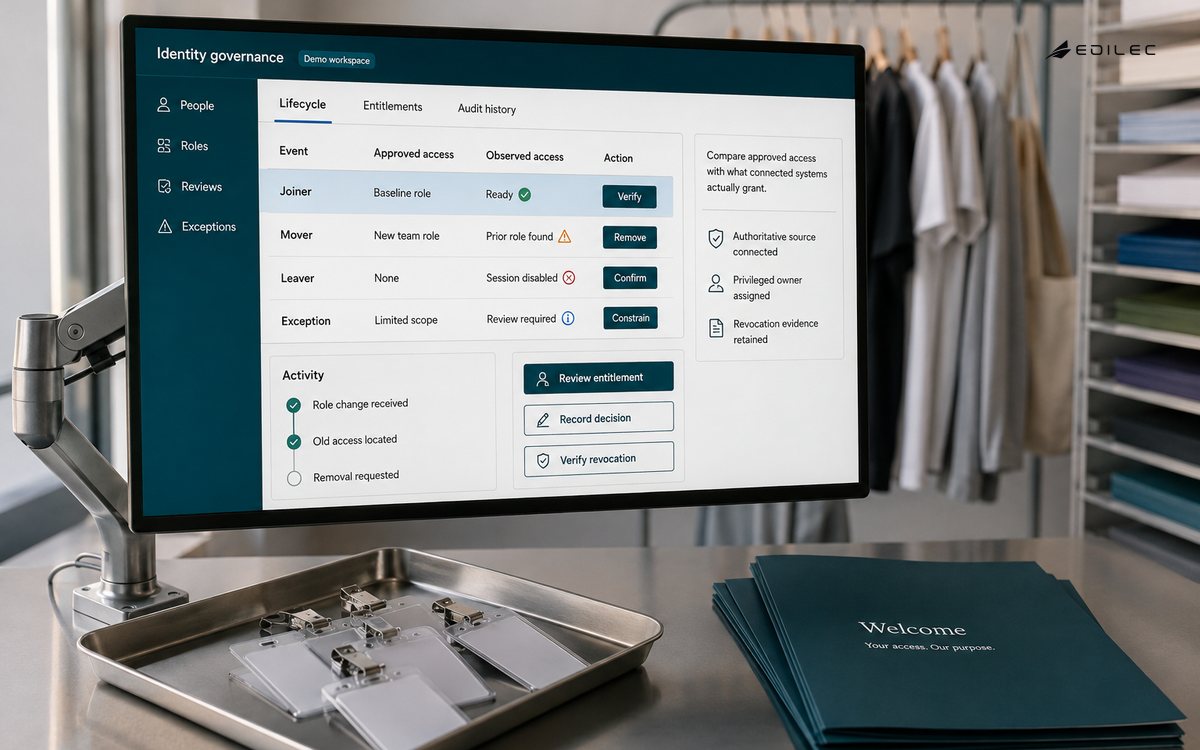
Maintain two views: the approved entitlement and the observed entitlement in each connected system. Provisioning can fail, local administrators can create accounts, group nesting can expand scope, and API keys can survive the employee who requested them. A reconciliation job should identify orphan accounts, unmatched identities, direct grants that bypass groups, inactive privileged credentials, and memberships inconsistent with the authoritative role. Assign each discrepancy a due date and owner. For departures, measure complete revocation across high-risk systems rather than closure of an HR ticket. For movers, remove old access as deliberately as new access is added. Service accounts need an owner, purpose, credential policy, environment, and review date; assigning them to a fictional employee simply hides a different lifecycle.
Related implementation guidance
Edilec's permission review workflow covers review design in detail. The least-privilege security review helps teams challenge broad entitlements, and the audit log architecture guide explains the evidence needed to investigate access decisions.
Plan the first ninety days
In the first month, identify critical systems, owners, and privileged groups. In the second, establish lifecycle handling for new starters, role changes, departures, and contractors, then run a focused review on one system. In the third, fix the most important gaps, document the exception path, and schedule the next review. This is intentionally less dramatic than a wholesale migration, but it gives the company durable answers to the questions that matter. It also creates clean inputs for permission review workflows as the number of applications and people grows.
Run a practical operating exercise
Use this identity governance for teams exercise with a real quarterly change rather than a hypothetical audit. Select one recently hired engineer, one person who changed teams, one contractor whose engagement ended, and one service account used by an integration. For each subject, compare the authoritative people or service record with the identity provider, the high-impact applications, privileged groups, recovery factors, active sessions, and access-review evidence. Ask the business owner to explain each remaining grant in terms of a current task. Ask the technical owner to show where the grant is enforced and how it would be removed. The gaps are usually concrete: an old group, an unowned automation identity, a contractor account with no end date, or a manager who cannot see enough context to decide. Turn each gap into a bounded change with an owner and due date. Repeat the exercise after the next organizational change. This small routine gives founders evidence that lifecycle controls operate in the real company, including systems that are easy to overlook when a team grows quickly.
Key takeaways
- Identity governance for teams starts with accountable ownership of high-impact systems and permissions.
- Lifecycle events are the backbone: do not wait for a quarterly review to remove old access.
- Reviews need qualified decision-makers and enough context to retain, change, revoke, or escalate.
- Service accounts, vendors, and emergency routes need the same ownership discipline as employee accounts.
- Evidence and metrics should help someone explain a real decision later.
Frequently asked questions
Conclusion
Identity governance for teams becomes credible when every important permission has a business purpose, an accountable owner, a lifecycle path, and a decision record. Begin with the systems that could materially harm customers or the company, test the process through real joiner and leaver events, and use the gaps to improve the next cycle. That is a stronger foundation than a policy document that nobody can operate under pressure.