RBAC meaning in software matters to service businesses operating regulated or high-consequence workflows. In practical terms, it is an authorisation approach that grants permissions to defined roles and assigns people or service identities to those roles, instead of creating a unique set of permissions for every account. That definition is more useful than a product label because it points to decisions a team can test: what the boundary is, what information is trusted, which failure conditions are acceptable, and who responds when the normal path breaks. The related concerns of least privilege, separation of duties, access review should be designed as part of the operating model, not appended after an initial launch.
What RBAC meaning in software means
RBAC meaning in software should be explained in the language of responsibilities and observable behaviour. A role is a durable job function or responsibility, not a convenient label for every person. RBAC becomes fragile when roles mirror individual exceptions or blend unrelated duties. It also does not remove the need for tenant, resource, attribute, or contextual checks where a role alone cannot express the rule. A useful definition therefore includes the information that crosses the boundary, the actors allowed to change it, the evidence retained, and the conditions in which the system refuses to proceed. That gives practitioners a way to challenge vague requirements before they become fragile implementation assumptions.
Architecture decisions to make first
The architecture is not a diagram of components alone. It is the set of contracts that lets service businesses operating regulated or high-consequence workflows operate the capability repeatedly. Make the following decisions explicit before choosing a platform feature or writing an integration. Each one affects the likely failure mode, the test plan, and the people who will need evidence later.
| Decision | What to define |
|---|---|
| Protected action | List the data and operations that require an explicit permission decision. |
| Role definition | Create roles around stable responsibilities with a documented business owner. |
| Permission granularity | Use the smallest useful action and resource scope, avoiding broad wildcard grants. |
| Conflict rule | Identify incompatible duties, approval thresholds, and emergency access controls. |
Implementation path
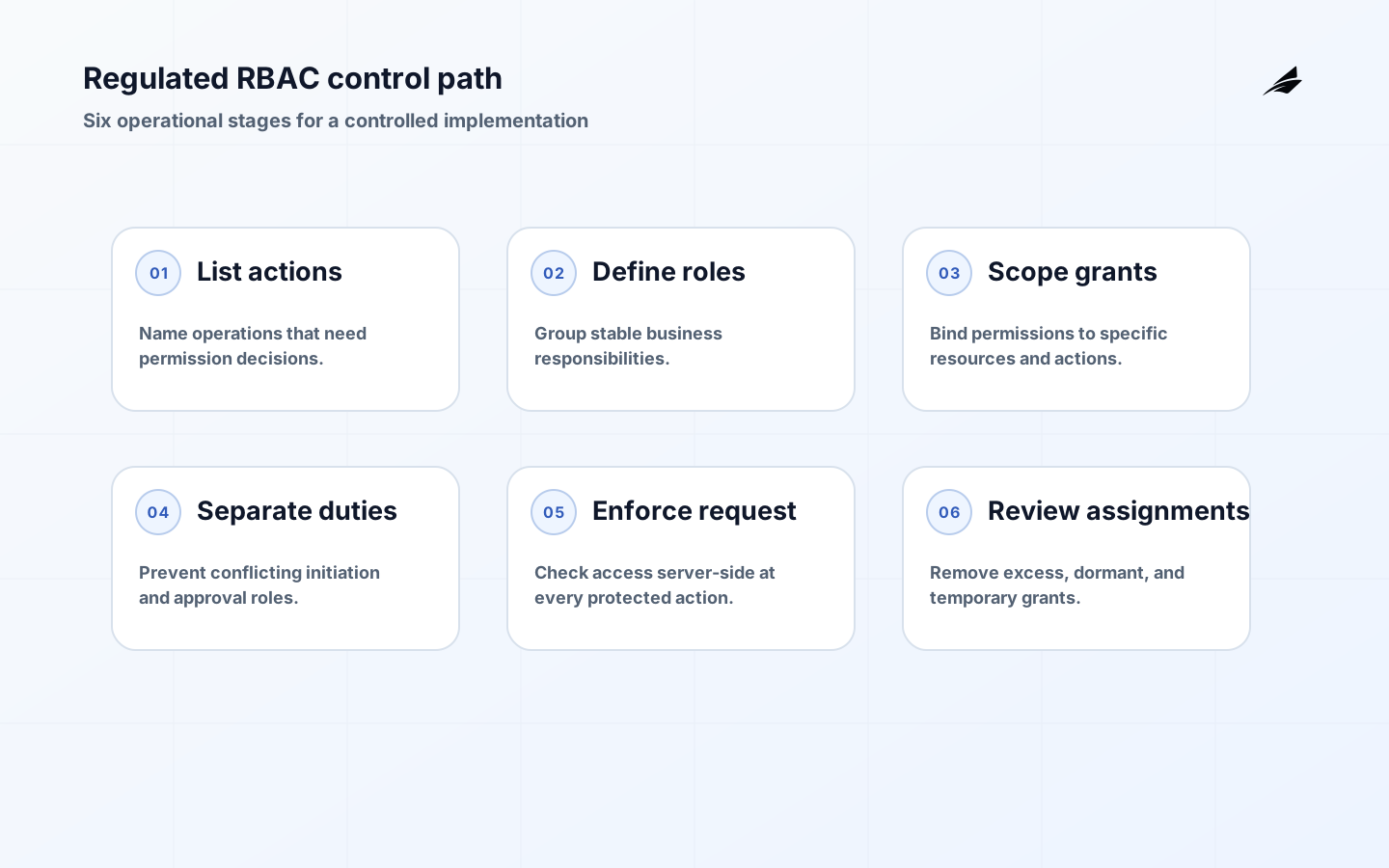
- Catalogue sensitive business actions and the records each action may affect.
- Group repeatable job responsibilities into a small, reviewable role set.
- Assign permissions to roles with explicit resource scope and deny-by-default behaviour.
- Add separation-of-duties rules where one person must not initiate and approve the same outcome.
- Provision roles through accountable lifecycle processes rather than informal tickets alone.
- Review assignments, dormant roles, and emergency grants on a stated cadence.
Build a thin, inspectable path first. It should include the unpleasant cases as well as the demonstration case: a missing identifier, a delayed message, an expired credential, a rejected record, or an unavailable dependency. Give that path named inputs and outputs, a clear retry or escalation rule, and a way to prove what happened. This is where least privilege becomes operational rather than aspirational.
Risks and controls
A role name is not a control unless the system enforces it at the point of action. Check authorisation server-side for every protected operation, including bulk endpoints, exports, background jobs, and object-level access. “Administrator” should not become a substitute for design: keep everyday administration separate from exceptional support, require a reason for elevated grants, and leave evidence for reviewers.
| Operating signal | What it shows |
|---|---|
| Excess-access findings | Permissions or role assignments that exceed documented job need. |
| Role assignment review completion | Completion and remediation rate for scheduled access reviews. |
| Separation-of-duties conflicts | Detected conflicting role combinations and time to resolve them. |
| Emergency-access expiry | Whether temporary elevated access ends automatically as scheduled. |
Review and measurement
Measurement should tell the team whether RBAC meaning in software is still meeting its contract, not merely whether infrastructure is running. Review the signals in the table with the owner who can change the workflow. Look at trends, samples of failures, and the gap between detected and resolved issues. When a metric changes, follow the evidence back to the contract, implementation version, and real user or device behaviour before declaring a fix.
- Set a service objective for the consequence that matters, not only a technical average.
- Sample successful and failed cases to verify that separation of duties is understandable.
- Make a named owner responsible for triaging exceptions and publishing the resolution.
- Review access, configuration, and retention choices whenever the process or fleet changes.
- Use controlled tests to rehearse recovery before an incident requires improvisation.
Operational scenario
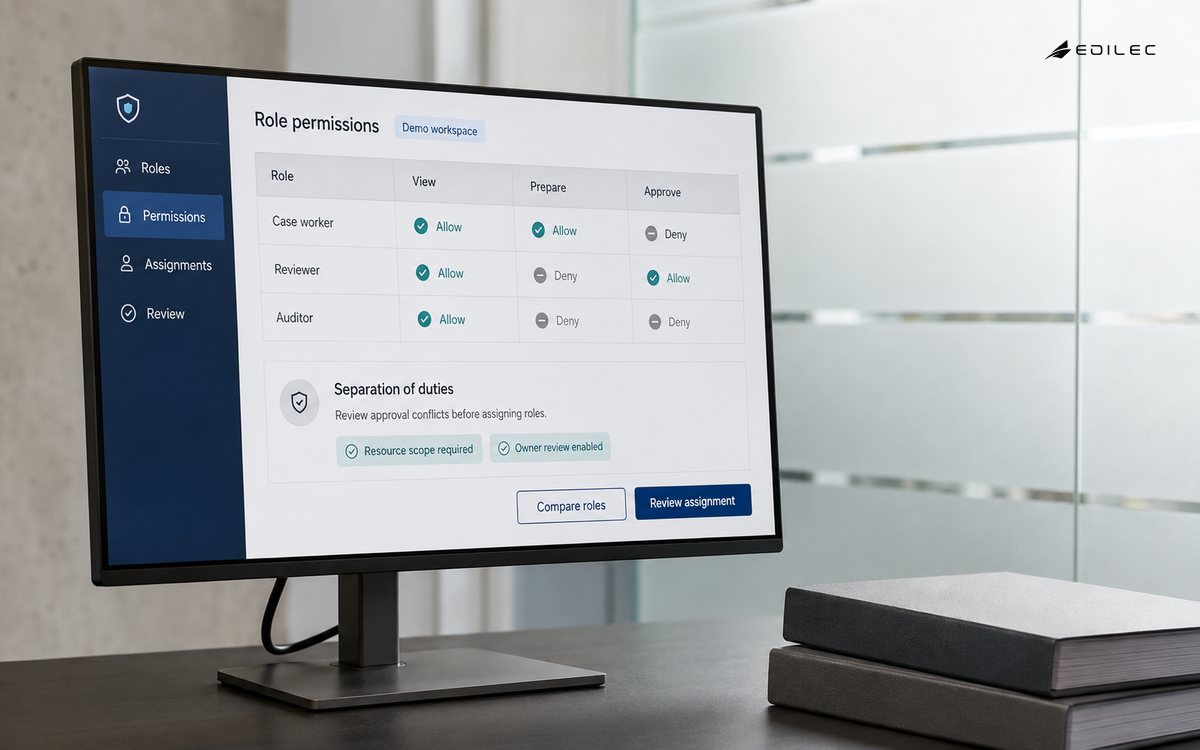
In a regulated service workflow, an intake specialist can create a case, a reviewer can assess the evidence, and a supervisor can approve a final decision. Giving all three people a broad “case user” role makes the interface simpler but destroys the separation that the process needs. Create roles around those duties and specify which resource states each role may affect. The audit trail meaning guide then provides the evidence needed to explain a denied or approved action.
Evidence and testing
Maintain a role catalogue that names the business owner, purpose, permissions, affected systems, incompatible roles, assignment route, and review interval. Use a test matrix covering each protected endpoint or action with allowed and denied identities; do not rely on menu visibility as enforcement. For critical approvals, test direct API calls, batch operations, exports, and asynchronous jobs. The documented role should match the permissions actually enforced, or reviewers will be approving a policy that production does not follow.
Design review questions
Review role changes alongside process changes. A new report, integration, or self-service action can create a permission that does not fit the existing model, tempting a team to grant an administrator role as a shortcut. Ask whether the new duty is stable, whether it conflicts with an approval responsibility, and whether a limited temporary grant is safer while the model is updated. Good RBAC stays understandable because exceptions are visible and expire rather than quietly becoming permanent.
Practical operations
Make access decisions reviewable by pairing every role with a short business description and a small set of tested actions. When a manager requests a role, the approver should understand the responsibility it conveys rather than approving a technical code. Automate provisioning where possible, but keep the approval, assignment, expiry, and removal evidence intact. For service identities, roles should be even narrower: an integration that reads invoices does not need the same authority as a person who approves refunds. This separation limits the impact of a compromised token or a mistaken configuration.
Limits and tradeoffs
Least privilege is a continual balancing act, not a promise that no one is inconvenienced. A role may need adjustment when a job changes, an incident requires time-limited access, or a new service is introduced. Make those changes explicit, time-bounded where possible, and visible in review. The alternative is permission debt: old exceptions accumulating until nobody can explain why a broad role exists. A healthy model makes the normal path simple and the exceptional path accountable.
- Name the accountable owner before adding another integration or policy.
- Keep a representative failure test beside the normal acceptance test.
- Record the version of the contract, configuration, or rule in use.
- Use evidence from real operations to improve the next release.
- Make temporary exceptions visible, approved, and time-bounded.
- Review the boundary whenever the business process or fleet changes.
Adoption and change management
Reorganisations, new product functions, temporary project work, and audit findings are the moments when role definitions must remain legible. Prepare for them with a small change record that names the proposed change, contract or policy version, expected operational effect, affected owners, test evidence, rollout window, and reversal decision. Give users and support teams a plain-language explanation of the behaviour that will change, especially where a new denial, warning, or data-quality status can be mistaken for a defect. Monitor the first production cases closely and compare them with the pre-change baseline. When an exception appears, decide whether it is a valid new requirement, a training issue, a data defect, or a control that must remain firm. This practice keeps RBAC meaning in software connected to the people who operate it. It also prevents a series of urgent local fixes from becoming an undocumented alternate system. Retire obsolete rules and integrations deliberately, preserve the evidence needed for a later review, and update runbooks so the next team member inherits a working explanation rather than a collection of historical assumptions.
Key takeaways
- RBAC meaning in software is a contract between technical components, people, and operations.
- Define boundaries and ownership before optimising a tool or interface.
- Treat separation of duties as a first-class output, with evidence for failure and recovery.
- Make exceptional conditions testable and visible to an accountable owner.
- Revisit the contract as customers, devices, data, or regulations change.
Frequently asked questions
When should RBAC be combined with other controls?
Combine it when role membership cannot answer the entire question. A clinician role may permit viewing records, while tenant, patient relationship, location, time, or case state determines which record is appropriate. RBAC supplies the broad responsibility layer; other policies add necessary context.
What is role explosion?
Role explosion occurs when an organisation creates many narrowly different roles to encode every exception. It makes review and change difficult. Prefer stable roles, carefully scoped permissions, and an explicit policy mechanism for the few contextual exceptions that remain.
Conclusion
RBAC is most useful when it describes real responsibility and is continuously governed. Start from protected actions and business duties, enforce decisions where requests execute, and keep enough evidence to show that access remains justified as people and processes change.