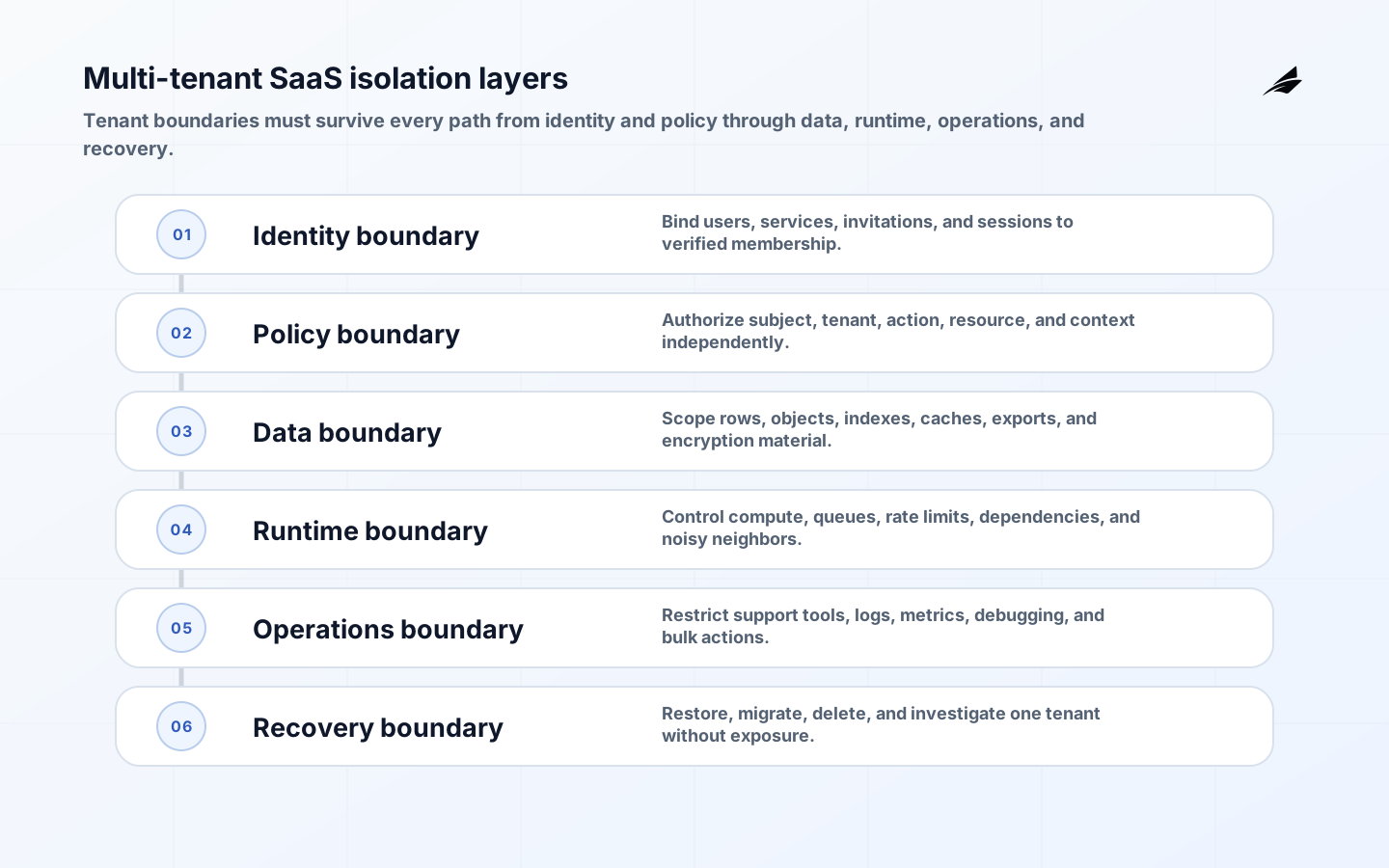
Multi-tenant SaaS means one software service supports multiple customer organizations while preserving an explicit tenant boundary. Customers may share application processes, databases, queues, caches, networks, or deployment infrastructure, but they must not gain unauthorized access to data or operations belonging to another tenant. Multi-tenancy is therefore an architecture and operating model, not simply a database choice. The right design depends on consequence, scale, customization, regional obligations, performance, and recovery needs.
Treat multi-tenant SaaS meaning as an accountable path, not a feature request. Define the tenant boundary before product features create shared-data assumptions. A decision-ready scope names the trigger, the authorized actor, the records in scope, and the result that a user can rely on. It also names what is deliberately out of scope. That restraint helps a team learn from genuine use before it turns a narrow improvement into an unowned layer between people and the work they are trying to complete.
What multi-tenant SaaS meaning means in practice
The practical purpose is to support actions such as create an organization, invite a user, store a scoped record, configure a feature, or support an approved cross-tenant task. The path should have a discernible starting condition, an observable state while work is in progress, and an outcome that can be checked later. A useful implementation makes the normal route easy without obscuring exceptions. It should be possible for an affected person to understand what happened and for an owner to locate the supporting evidence. That is the difference between a convenient interface and an operational commitment.
Authority belongs with the tenant identity and policy layer that determines organization ownership and permitted user actions. Other tools can display, cache, summarize, or relay that information, but they should not silently redefine it. This distinction matters whenever a new screen, service, or integration is introduced. An attractive experience does not prove that a value is current, that the actor has permission, or that a correction will reach the system where it matters. Naming authority early turns later architecture choices into reviewable trade-offs instead of assumptions.
Define the boundary before choosing a solution
Write the boundary in concrete language: when this event occurs, this role may perform this action against this scope, and this owner handles incomplete or disputed cases. That statement gives design a model, engineering a test target, and operations a service boundary. For multi-tenant SaaS meaning, it is more helpful than a promise to make everything seamless. It also provides a fair way to assess future expansion requests, because each new source, role, or action can be tested against the same accountable terms.
| Boundary question | Decision-ready answer | Warning sign |
|---|---|---|
| Who starts the path? | A named role, event, or service identity | Any person can initiate it |
| What may change? | A defined record or approved output | The action affects whatever appears related |
| Where is authority? | A named system and business owner | Several copies are treated as final |
| What happens on failure? | A visible exception and repair route | Someone must reconstruct the event from email |
Choose controls that fit consequence
The essential controls are tenant identifiers, object and row scoping, roles, delegated access, isolated secrets, audit logs, backups, and support authorization. They should be designed into normal work rather than appended as a compliance ritual. A person should see the confirmation or denial when it matters, an operator should see the exception, and an owner should be able to find evidence without relying on personal memory. The right control profile depends on consequence: a read, an irreversible change, and an external disclosure are different decisions even when they appear in the same workflow.
Defining multi-tenant SaaS for founders requires a control profile tied to the actual action. Use the likely harm of an incorrect outcome to decide where identity checks, validation, approval, and durable evidence belong. Exercise the ordinary case alongside a denied, incomplete, conflicting, and corrected case; those less tidy paths show whether the capability is safe to rely on. Avoid adding friction everywhere while the few irreversible actions remain under-specified. Proportionate controls are clearer for users and easier for teams to operate.
| Design choice | Use it when | Trade-off |
|---|---|---|
| Narrow initial scope | Evidence is needed before expansion | Some requests remain manual |
| Structured approval | A decision has material impact | A named reviewer may slow the path |
| Automated execution | The rule and inputs are stable | Monitoring and rollback are required |
| Human exception route | Context changes the right result | Owners need capacity and response expectations |
Operate multi-tenant SaaS meaning as a service
Review isolation test results, missing tenant keys, authorization failures, configuration drift, noisy-neighbor effects, and recovery outcomes with people who can change the underlying process. These signals should separate normal variation from a broken rule, missing source field, access problem, or training gap. A growing dashboard does not improve the service by itself. Each alert needs an owner and an expected response. Over time, the operational record becomes a valuable source of product insight because it exposes the conditions that users cannot resolve through the intended path.
For multi-tenant SaaS meaning, keep a concise change record that is useful to the next operator. Capture why the change was made, the policy or contract affected, the users and records in scope, the expected signal, and the rollback or repair route. This helps a founder designing one product for several customer organizations evaluate a change as a decision, not merely as a technical adjustment. It also prevents a seemingly small edit from becoming an undocumented change to work another team depends on.
Make a proportionate implementation decision
The first release should usually be a constrained path with representative users and real but limited data. Test the normal outcome, invalid input, interrupted request, denied action, and correction. Measure both the work saved and the new work introduced. Define the tenant boundary before product features create shared-data assumptions. Expanding only after those checks keeps the team from making a permanent commitment before it knows whether the process, data, and ownership model can support it.
Before scaling, ask whether the organization can explain a result to the person affected by it. Can staff identify the source, the rule, the owner, and the next step? Can they stop or reverse an outcome when evidence changes? If not, scale will amplify ambiguity. The first improvement is usually a clearer decision rule or repair path, not another feature. This is particularly important for multi-tenant SaaS meaning, where an apparently small exception can have a disproportionate operational or trust cost.
Common failure modes to avoid
A recurring failure is assuming an account field creates isolation without enforcing it in queries, caches, exports, queues, and support tools. Another is allowing a temporary workaround to become an invisible dependency: a manual export, shared account, spreadsheet override, or verbal approval may quietly join the production process. Surface those dependencies and decide whether to formalize, retire, or monitor them. Teams also underestimate change. A new field, role, policy, or customer segment should trigger an intentional review of the path rather than an assumption that existing behavior will stretch without consequence.
Choose an isolation model per resource
Isolation is rarely one uniform choice. A product may use shared stateless compute, tenant-scoped database rows, separate encryption keys for higher-risk data, dedicated search indexes for some plans, and isolated deployments for regulated customers. Record the model per resource and request path. Every lookup, mutation, job, cache key, file path, message, log query, export, and support tool needs a tenant context that cannot be replaced by untrusted input.
| Resource | Possible isolation model | Control to verify |
|---|---|---|
| Application compute | Shared processes with tenant context | Authorization is enforced at each resource operation, not only in the interface |
| Relational data | Shared schema, separate schema, or separate database | Queries cannot omit tenant scope; migrations and backups preserve boundaries |
| Object storage | Tenant prefix, bucket, account, or key separation | Signed access and lifecycle rules bind the requested object to the tenant |
| Queues and jobs | Shared workers with typed tenant identity or dedicated queues | Retries, dead letters, and operator tools preserve tenant context |
| Observability | Shared telemetry with scoped views and redaction | Logs, traces, alerts, and support searches cannot expose another tenant |
NIST defines resource pooling and rapid elasticity as cloud characteristics, but shared resources do not remove customer-isolation obligations. Attribute-based access control can combine subject, object, action, and environment attributes; the NIST ABAC guide is useful when tenant, role, resource, and context all influence access. The authorization decision should be independently enforceable and consistently applied to synchronous requests, background work, exports, and administrative operations.
Continue with Edilec explanations of single-tenant SaaS, SaaS tenancy models, and multi-tenant SaaS architecture. These comparisons help founders decide where shared infrastructure creates leverage and where stronger isolation is worth the operational cost.
The NIST definition of cloud computing explains resource pooling, which provides context for shared SaaS infrastructure without prescribing a tenant-isolation design. Use NIST SP 800-53 to consider access control, audit, configuration, contingency, and system-integrity outcomes, and the OWASP Application Security Verification Standard to turn application-security requirements into verifiable checks. The architecture must show where each control is enforced for every tenant-sensitive path.
Key takeaways
- Multi-tenant SaaS meaning should be defined by an accountable business decision, not by a feature label.
- Start with one bounded path and make authority, permissions, and exceptions explicit.
- Test denied, incomplete, and correction cases along with the happy path.
- Treat isolation test results, missing tenant keys, authorization failures, configuration drift, noisy-neighbor effects, and recovery outcomes as operating signals with owners, not decorative reporting.
Frequently asked questions
Is multi-tenant SaaS meaning only for large organizations? No. Smaller teams often benefit earlier because a few people carry a great deal of process knowledge. The scope should still be narrow and consequential. Should it replace human judgment? Only where the rule is stable and the cost of error is understood. Where context changes the right answer, the design should prepare a timely human decision with the relevant evidence rather than attempting to conceal uncertainty.
Conclusion
Multi-tenant SaaS meaning earns its place when it gives a specific person a clearer and safer way to complete real work. Define the boundary, preserve authority, select proportionate controls, and operate the result with evidence. That foundation is more durable than a broad technology promise, and it lets the team expand only after the first decision path is genuinely working.