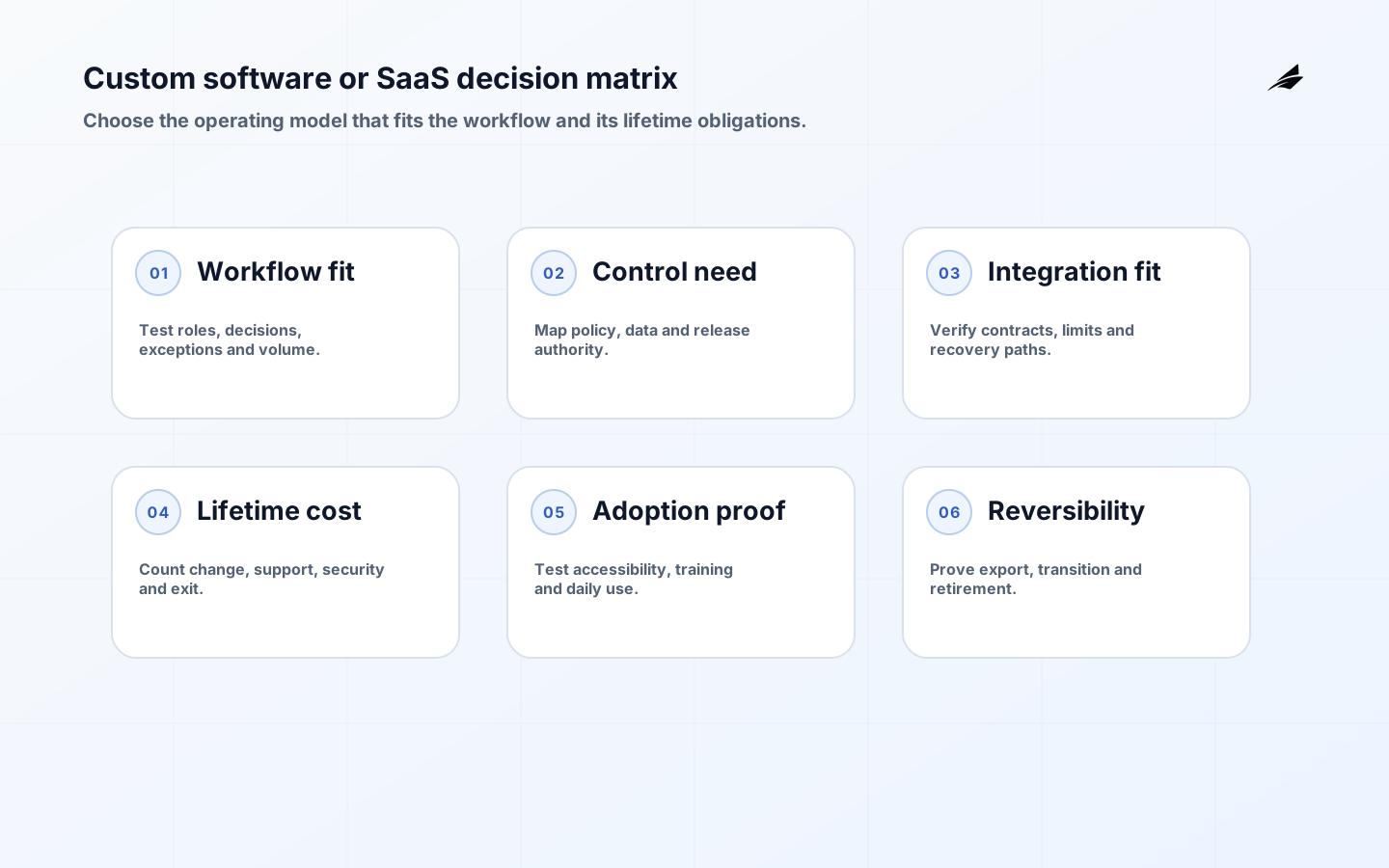
Custom software vs SaaS is a decision about operating responsibility. A SaaS product can shorten time to value by providing a maintained capability and shared upgrade path. Custom software can encode a differentiating workflow and give the buyer direct control over interfaces, data and release priorities. Either choice can fail when a team compares feature lists but ignores integration, policy, accessibility, change management, support and exit obligations.
This guide complements Edilec's explanations of trusted business intelligence, APIs as business contracts and workflow automation. Use those deeper guides to test whether the proposed product fits the decisions and handoffs that actually matter.
What custom software vs SaaS means
SaaS delivers a configured service shared across many customers. The provider normally runs the platform, releases changes, and sets the boundaries of extension. Custom software is designed or assembled around an organisation's chosen processes, data model, and interfaces; it may still use managed cloud services and packaged components. The useful distinction is not whether engineers write every line. It is whether the organisation can deliberately shape the domain model, release timing, integration contracts, and operational controls that make the capability valuable. A low-code workflow with a clear owner can be more custom in this sense than an expensive application trapped behind a vendor's configuration limits.
Use a decision model before comparing feature lists
Write five or six representative cases, including the unhappy path: a normal request, an exception, a policy change, a customer dispute, an integration outage, and an audit question. For each, record the decision-maker, data source, action, evidence required, and acceptable recovery time. Then ask whether a product supports the case without hidden spreadsheets, privileged manual edits, or an unsupported integration. This turns a vague build-versus-buy discussion into testable evidence. It also reveals when a mixed approach is best: retain a standard system for commodity records, then build a bounded integration or operator tool where the business genuinely needs distinctive behaviour.
Compare lifetime obligations, not licence and build cost
A subscription can reduce initial delivery effort, but it does not remove the cost of implementation, data migration, identity management, training, process redesign, integration monitoring, and exit planning. Custom delivery similarly includes discovery, engineering, hosting, support, security maintenance, and planned renewal. Put these on one time horizon and name the accountable owner for each line. Include the cost of delay when a vendor cannot change a critical rule, and the cost of concentration when a small internal team alone understands a custom system. The credible comparison has ranges and assumptions rather than a single precise total that pretends uncertainty has disappeared.
Decide where authority and control must sit
The more consequential the workflow, the more important it is to define authority explicitly. Ask who can change a policy, approve a release, export sensitive information, correct a record, or disable an integration. A SaaS supplier may provide strong platform controls while leaving role design, configuration review, and data stewardship to the customer. A custom solution gives more design latitude but also requires an intentional security and verification practice. NIST's secure development guidance is useful here because it treats secure work as a set of organisational practices, not a final testing activity. The selection should leave a clear route for access review, incident response, change approval, and evidence retention.
Treat integration fit as a production test
Do not accept an integration claim at the architecture-slide level. Test a small, representative flow through the available interface: authenticate with the intended identity model, create or update a record, handle a duplicate, receive an error, retry safely, and reconcile the final state. Check rate limits, export boundaries, versioning policy, event delivery, and the information visible in operational logs. A product that technically has an API may still be a poor fit if the API omits the needed event, cannot represent the necessary state, or makes recovery dependent on support intervention. Conversely, a modest custom integration can preserve a sound system of record and remove hours of brittle copying.
Make adoption and accessibility release criteria
A system that only works for the project team has not solved the operating problem. Include the people who enter information, investigate exceptions, approve changes, and use assistive technology in acceptance testing. WCAG 2.2 provides a practical reference for perceivable content, keyboard operation, focus, error identification, and understandable interaction; it is not a substitute for observing real work. Ask whether the vendor configuration or the custom interface can meet the needed criteria, including exported documents and embedded workflows. Also test the work at peak volume and during handover. The right option is the one that lets accountable people complete the task accurately without inventing an unofficial side process. Topic-specific implication: Selection research should include a controlled proof rather than a generic trial.
Signals that favour each path
| Signal | SaaS is often stronger | Custom software is often stronger |
|---|---|---|
| Process fit | The process is stable and common across the market. | The process is a differentiator or constrained by local rules. |
| Change | Roadmap timing is acceptable and configuration is sufficient. | Critical rules must change on the organisation's timetable. |
| Integration | Standard connectors cover the needed records and events. | The capability needs a tailored domain contract or orchestration layer. |
| Operations | A provider-operated service reduces a real internal burden. | Control, evidence, or hosting constraints require direct accountability. |
These are hypotheses, not automatic answers. A common-looking workflow can be high risk because its exceptions carry financial or regulatory consequences. A distinctive workflow can still be served well by a product if its extension model is governed, supported, and demonstrably sufficient. Score the signals with the people who will operate the service, then challenge the highest scores using a live proof of concept. The question is not whether custom software is more sophisticated. It is whether the chosen boundary produces a service that remains understandable and changeable under normal pressure.
Set an acceptance plan for the chosen option
| Acceptance area | Evidence to request | Decision consequence |
|---|---|---|
| Data | Migration sample, ownership map, retention and export test. | Prevents a launch with unverified record quality. |
| Security | Roles, privileged actions, logs, and remediation route. | Shows who can act and how activity can be investigated. |
| Delivery | Release process, rollback path, support hours, and change lead time. | Makes operational promises testable. |
| Exit | Export format, contract terms, and dependencies inventory. | Avoids treating portability as an afterthought. |
Implementation notes for custom software vs SaaS
Selection research should include a controlled proof rather than a generic trial. Load a small, masked migration sample; configure one representative role; run a real integration sequence; and ask an operator to complete a normal task and an exception. Record every supplier dependency required to make that demonstration succeed. For a custom route, use the same discipline: prototype the uncertain domain rule, confirm the data source, and establish who will maintain the release and support runbook. The result is decision evidence, not an elaborate prototype that obscures the unresolved work.
Governance should also cover exit from day one. Identify the export format, usable identifiers, document attachments, configuration history, and reports required to continue operations elsewhere. Test an export before committing to a long-term path. Exit readiness is not a prediction that the relationship will fail; it is a practical test of whether the organisation still understands and owns its operational information. A system that cannot produce a meaningful record of its own work makes later change unnecessarily costly.
Run a reversible build-or-buy decision
Treat the decision as a short evidence program. Select one high-value workflow and prepare the same acceptance scenarios for each viable SaaS option and the custom design. Include ordinary cases, permission boundaries, missing data, integration outages, audit retrieval, accessibility, peak volume and offboarding. The purpose is not to force unlike solutions into identical interfaces; it is to expose which obligations are handled by the supplier, which remain with the customer and which require custom work regardless of the commercial label.

| Decision area | SaaS evidence | Custom software evidence |
|---|---|---|
| Workflow fit | Configured scenario with real roles and exceptions | Prototype covering the smallest complete workflow |
| Control | Contract, configuration, audit export and roadmap terms | Architecture, policy enforcement and release ownership |
| Integration | Documented APIs, limits, events and failure behavior | Versioned contracts, reconciliation and support model |
| Lifetime cost | License, implementation, add-ons, support and exit | Delivery, hosting, security, support and continuing change |
| Reversibility | Export test, deletion proof and transition support | Portable data, documented interfaces and maintainable code |
Use NIST SP 800-53 to turn security and privacy expectations into controls that can be allocated between customer and supplier. If the custom path remains viable, the NIST Secure Software Development Framework supplies a useful lifecycle baseline. For both paths, the OWASP Application Security Verification Standard and WCAG 2.2 help make application security and accessibility testable acceptance criteria rather than procurement statements.
Record a decision horizon and explicit reversal triggers. A growing company may buy now to learn the workflow, then build a narrow differentiating layer later. It may also retire a custom tool when a mature product satisfies the need. Review the choice when volume, regulation, pricing, integration dependence or strategic differentiation changes. Good governance preserves evidence and optionality; it does not defend an earlier decision after its assumptions have expired.
Key takeaways
- Select a capability boundary, not a fashionable technology label.
- Test exceptions, integrations, and recovery before relying on vendor claims.
- Price ownership, governance, and change over the full service life.
- Make accessibility and operator adoption part of acceptance.
Frequently asked questions
- Is SaaS always faster? It is often faster to procure, but configuration, migration, controls, and integration still require delivery work.
- Can a hybrid approach be sensible? Yes. Keep a proven commodity system where it fits and build only the bounded capability that needs differentiation.
- How much customisation is too much? It is too much when upgrades, support, or verification become dependent on opaque one-off changes without an owner.
Conclusion
A durable custom software vs SaaS decision is made in the operating model. Define the cases that matter, test the control and integration boundaries, and name the people who will own change. That produces a choice that is easier to defend now and easier to revise when the business changes.