Multi-tenant SaaS meaning is not simply “many customer accounts in one database.” It is an operating and architectural choice to serve separate customer organisations from shared software or infrastructure while preserving each tenant’s data, configuration, access, and commercial boundaries. The useful planning question is therefore not whether the system has a tenant field. It is which layers are shared, where isolation is enforced, how a request becomes associated with the correct organisation, and how the business can prove a mistake did not expose or alter another customer’s work. Answer those questions before a product has too many customers to migrate safely.
What multi-tenant SaaS meaning means in practice
A tenant is the organisational boundary to which people, data, configuration, entitlements, and usage are attached. Multi-tenancy can share application code, compute, databases, queues, or operations while isolating records and decisions through carefully designed controls. Isolation is not a single mechanism. It must hold in the user interface, API, background jobs, search indexes, object storage, logs, analytics, support tools, backups, and administrative workflows. A product can be technically shared yet commercially differentiated; plan how tenant-specific settings are represented so they do not turn into unreviewed forks of business logic. The aim is dependable separation with a service model that remains operable as customer count and complexity grow.
Define scope, ownership, and the authoritative boundary
Define the tenant model before modelling the data. Decide whether a tenant represents a legal customer, a business unit, a reseller, or another boundary; whether a user may belong to multiple tenants; and what happens when organisations merge, split, or change ownership. List the data classes that must never cross the boundary, the configuration a tenant may control, and the operations that platform staff may perform. Treat support access as part of scope, not an afterthought. A first launch may reasonably limit cross-tenant users and custom configuration, but it should still specify onboarding, suspension, deletion, export, billing measurements, and account recovery. These lifecycle decisions determine the identity and data contracts the software must preserve.
| Decision question | Decision-ready answer | Risk if omitted |
|---|---|---|
| What is the protected outcome? | A defined business result supported by multi-tenant SaaS meaning. | The build optimises a feature instead of the operating decision. |
| Who owns the rule? | A named business owner approves policy while technical owners operate the service. | Technical configuration silently becomes business policy. |
| Where is authority? | A documented source record or policy decision is authoritative; displays and copies are not. | Teams resolve disagreement by choosing the most convenient screen. |
| What proves completion? | An observable result, record, and exception route are agreed before release. | A successful request is confused with completed business work. |
| Who repairs failure? | A named queue and response expectation handle failed, disputed, or delayed work. | Staff rely on inboxes, spreadsheets, and undocumented overrides. |
Design the operating path and evidence
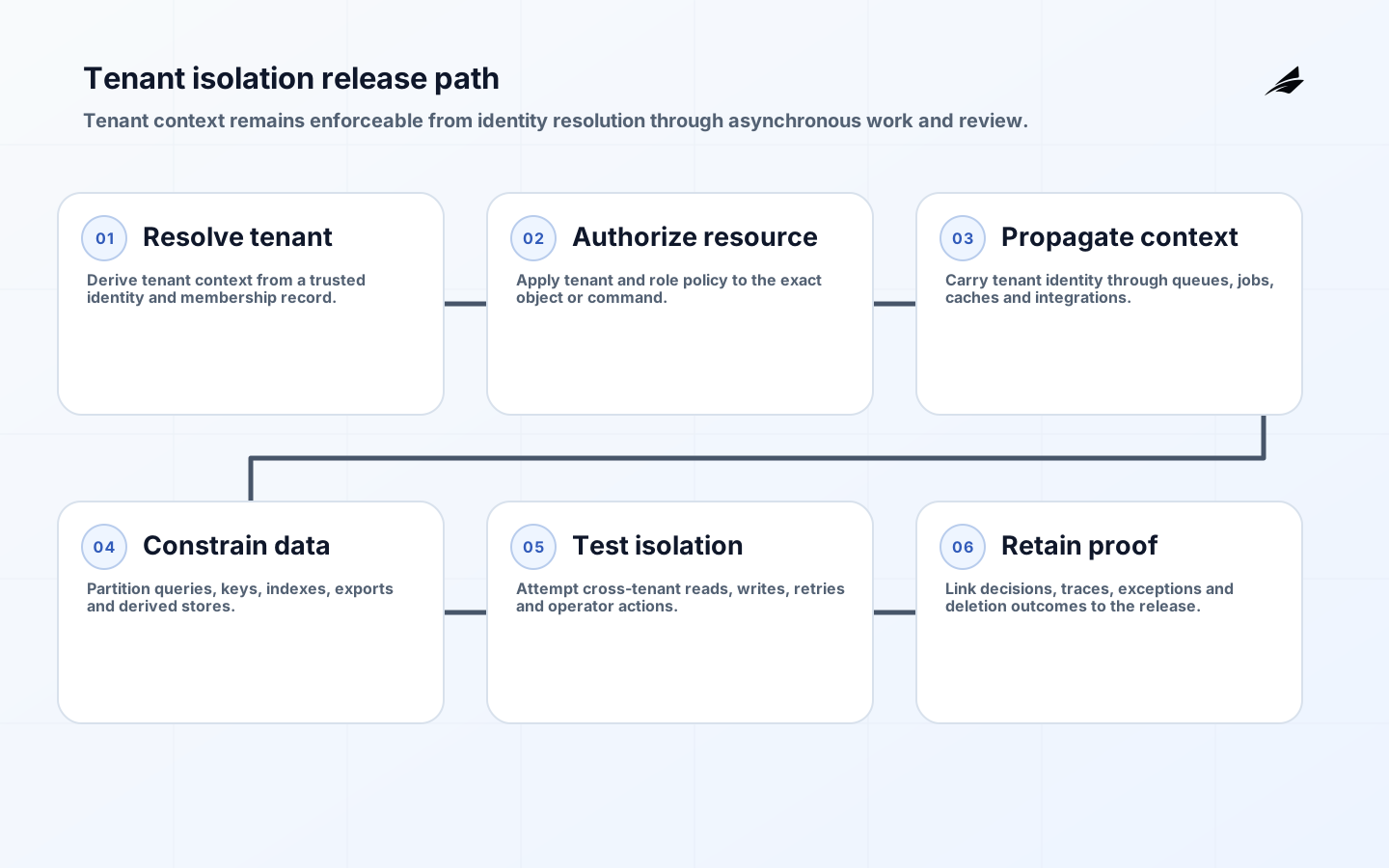
Carry tenant context from authenticated request to every protected operation. Derive it from trusted identity and membership data rather than accepting a client-supplied identifier as authority. At each access point, enforce both tenant membership and action permission; a query filter alone is insufficient if an export, cache, or background consumer can bypass it. Partition storage and queues according to the sensitivity and scale requirements, and record the reasoning. Shared tables can be viable when row-level or application enforcement is complete and testable; dedicated resources may suit stronger isolation, performance, or contractual needs. Design identifiers, logs, and traces so operators can investigate a tenant case without exposing unrelated tenants.

Build controls and exception handling into the work
Use defence in depth for tenant isolation. Authorise at the server-side action, test negative cases that attempt cross-tenant reads and writes, and prevent bulk operations from defaulting to an unrestricted scope. Give internal support personnel narrow, time-bound, logged access with customer-safe views. Separate tenant configuration from platform policy, validate uploads and integrations, and ensure asynchronous workers restore the correct tenant context. Encrypt data and protect keys according to the information risk, but do not mistake encryption for authorisation. Backups, replicas, and analytics require the same boundary analysis as the production database. A recovery process that restores data to the wrong tenant is still an isolation failure.
| Condition | Required response | Operating evidence |
|---|---|---|
| Required information is missing | Hold or decline the work with an actionable reason. | Validation result, source context, and named follow-up owner. |
| An automated step fails | Preserve context, apply a safe retry rule, and route unresolved work. | Correlation identifier, attempt history, and queue status. |
| Authority is unclear | Do not infer permission; escalate to the accountable owner. | Decision request, approver, and policy reference. |
| A material correction is needed | Correct through a governed path without obscuring the original state. | Reason, actor, effective time, and before-and-after record. |
| A control is bypassed | Contain impact, record the exception, and conduct follow-up review. | Exception evidence, expiry or remediation action, and outcome. |
Deliver a thin, operable first release
Pilot the tenant model with two deliberately different customer scenarios, such as a simple single-team organisation and an organisation with delegated administrators. Test onboarding, invitation, role change, data import, export, suspended access, and support escalation. Add automated isolation tests to every release and include a tenant identifier in operational telemetry without placing unnecessary customer data in logs. Run a tabletop exercise for a suspected cross-tenant access event: identify the owner, preserve evidence, contain access, notify affected parties according to policy, and correct the underlying control. Expand customisation only after its policy, ownership, and data effect are clear; convenience options can quietly become a multi-tenant security boundary.
Measure the operating result, then review it
Track tenant isolation test coverage, cross-tenant authorisation denials, support-elevation use and expiry, onboarding completion, data export success, background-job failures by tenant, and time to investigate a tenant-specific incident. Review a sample of admin actions and bulk jobs. Strong isolation has to survive the operational paths that normal product tests often miss.
Use governance and procurement evidence to make the decision durable
A multi-tenant product decision should include a tenant-isolation review before a customer contract assumes a particular control level. Ask the delivery team to demonstrate an attempted cross-tenant API request, background job, search result, support session, export, and restore procedure. Each should produce a denied outcome or controlled evidence, not merely a hidden navigation item. Record the intended service boundary and any dedicated-resource commitments in customer-facing terms. Where the first version uses shared infrastructure, document the enforcement mechanism, test coverage, incident response route, and limits of tenant customisation. This preparation gives product, security, and commercial teams a common vocabulary when a larger customer asks whether its data or configuration requires a different operating model.
Make tenant-boundary tests part of release acceptance, including destructive operations and data recovery. The quality bar is that a team can prove isolation under normal traffic, administrative support, asynchronous work, and failure handling, not only during a demonstration of the happy path.
Key takeaways for multi-tenant SaaS meaning
- Define the tenant as a business boundary before modelling tables.
- Derive tenant context from trusted identity, not client input.
- Enforce tenant and action permissions at every server-side boundary.
- Include support tools, jobs, backups, and analytics in isolation design.
- Test cross-tenant denial paths continuously.
- Rehearse investigation and recovery for an isolation event.
Frequently asked questions
Does multi-tenant mean all customers share one database?
No. Multi-tenancy describes the shared service model; storage can be shared, partitioned, or dedicated depending on risk, scale, and contractual requirements.
Can an employee work across tenants?
Yes, but cross-tenant membership should be explicit, least-privileged, and visible in audit evidence. It should not arise from a broad administrator default.
What is the first isolation test to automate?
Attempt the same protected operation with a valid identity from a different tenant. Cover reads, writes, exports, APIs, and background processing rather than testing only the user interface.
Require tenant-isolation evidence at release
A tenancy design is credible only when a release can demonstrate how tenant context reaches every consequential component. Keep a small evidence pack for each material change: the identity claim used to resolve the tenant, the policy or query that constrained access, a negative cross-tenant test, and the trace that links an asynchronous job to its originating tenant. Include caches, search indexes, object storage, exports, queues, analytics, and operator tools. Those paths often sit outside the request handler where the original tenant decision was made. The AWS tenant-isolation guidance correctly separates ordinary authentication from isolation; a valid user can still receive another tenant's resource when context is lost downstream. Release review should therefore follow the data and command, not stop at a successful sign-in.
| Release check | Failure it exposes | Evidence to retain |
|---|---|---|
| Cross-tenant read and write | Tenant filters or policies are missing | Denied request, policy decision, and resource identifier |
| Background job propagation | Queue consumers lose tenant context | Message metadata and correlated execution trace |
| Cache and search isolation | Shared keys or indexes leak results | Tenant-scoped key or filter test |
| Support impersonation | Operator access becomes invisible or overbroad | Reason, approval, session scope, and audit event |
| Tenant deletion | Copies remain in derived stores | Inventory, deletion result, and bounded exceptions |
Teams deciding how much to share can compare this release evidence with the broader multi-tenant SaaS guide. The RBAC guide helps separate tenant membership from role authority, while the zero-trust planning guide shows how to enforce each resource request without assuming that network location or a successful login proves access.
Conclusion
Multi-tenant SaaS becomes a useful planning concept when it is connected to a real decision, an accountable owner, a protected operating path, and evidence that a reviewer can understand. Do not begin with a vendor feature list or a generic architecture diagram. Start with the outcome that must be dependable, test the awkward cases with the people who will run the work, and make the first release small enough to observe. That approach gives a client team a clearer basis for investment and a service it can improve without losing control of the business facts that matter.