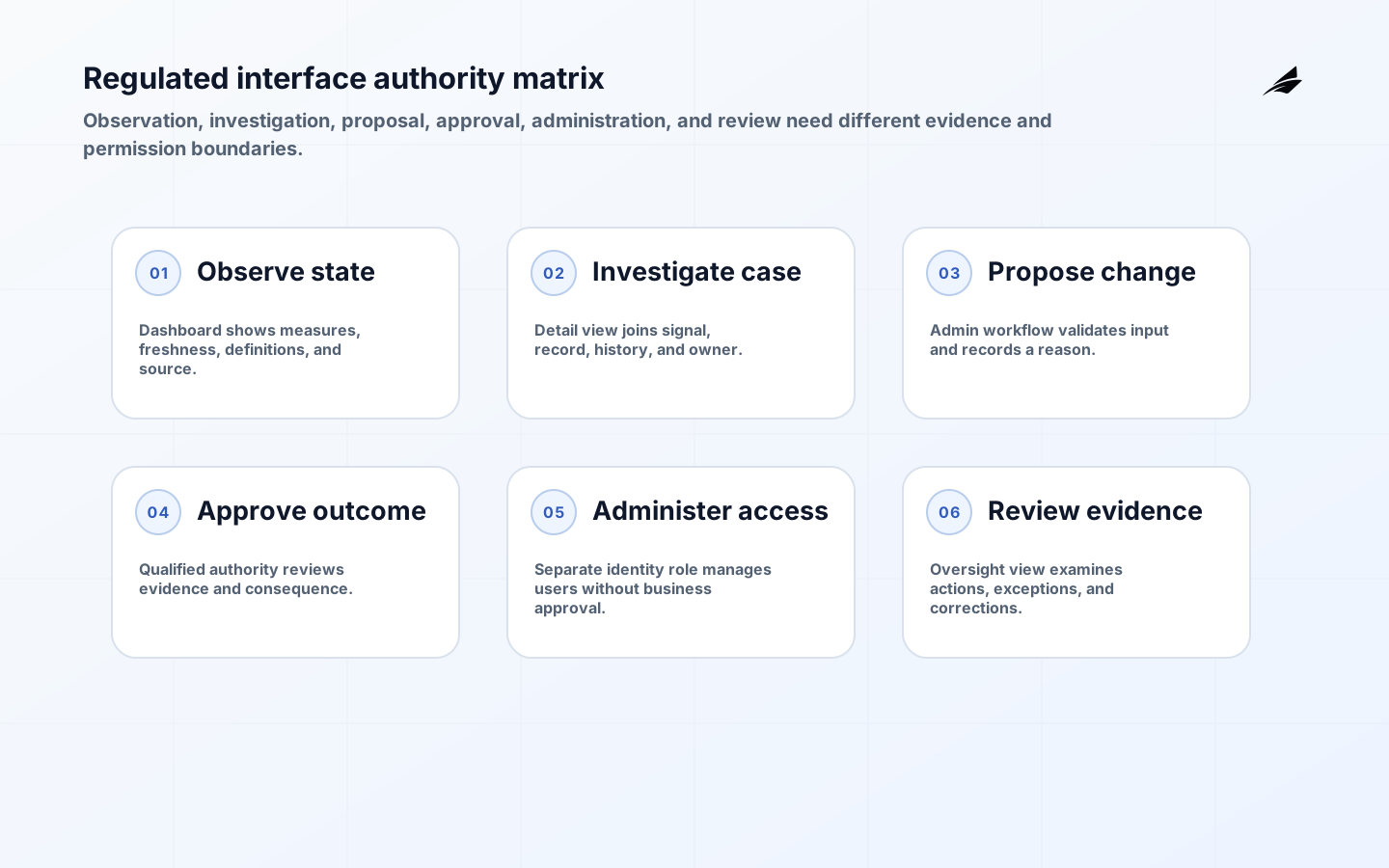
Admin panel versus dashboard is an authority decision disguised as a screen-design question. A dashboard helps someone understand state, trends, exceptions, and service health. An admin panel lets an authorised person change configuration, records, access, or workflow state. Regulated operations often need both, but combining them carelessly can make a chart behave like a command surface or make a privileged action appear to be an ordinary filter. The design should start with decisions, consequences, and separation of duties: what users may observe, what they may propose, what they may approve, and what the system must preserve as evidence. This guide provides a practical model for choosing the surfaces and proving that the resulting workflow remains usable, accessible, and accountable.
Four primary references shape the control boundary: WCAG 2.2 for accessible interaction, NIST SP 800-63-4 for digital identity, the OWASP Authorization Cheat Sheet for request-level permission enforcement, and the NIST Privacy Framework for data-processing risk. They complement the Edilec explanations of system-of-record boundaries, client portal responsibilities, and workflow automation definitions.
What admin panel versus dashboard means in practice
In practical terms, admin panel versus dashboard connects a known input to a bounded operational result. A clear definition includes the scope of the work, the accountable owner, the information that is authoritative, and the limits of automated or delegated action. It also states what the capability does not decide. That negative boundary matters because it prevents adjacent systems and informal workarounds from taking on authority by accident. Write the definition so that an operator can test it against a real case and a technical team can derive interfaces, controls, and support measures from it.
Turn the term into a decision model
Begin planning with an ordinary case and then add cases that reveal risk: incomplete information, a sensitive request, a changed rule, duplicated input, an unavailable dependency, and a demand for historical evidence. For each case, agree what must be true before the capability proceeds, which person may resolve uncertainty, and what result counts as safe. This approach turns a vague request into a decision contract. It also keeps delivery honest: a successful happy path is not enough when a dashboard may become an ungoverned administrative surface.
Set the authority and data boundary
Assign an explicit owner to the operational surface. Identify the authoritative system, durable identifier, lifecycle states, change process, and retention rules. Copies, notifications, reports, and caches can be useful, but they should not become accidental places to correct the underlying fact. When information crosses a boundary, describe whether the receiving system has a read-only projection, a working copy, or separate authority. This distinction lets teams reconcile differences, investigate a dispute, and alter the design without silently changing the meaning of a record.
Match controls to the consequence
Controls should be chosen for the consequence of the action, not added as a final checklist. Verify operator role, authorize the precise resource and function, validate inputs, and apply limits where repetition could cause harm. Test denied requests and malformed input as deliberately as the expected route. When the result is difficult to reverse, require confirmation, approval, or an explicit exception path. A good control explains a safe reason for refusal and gives legitimate users a way to correct the request rather than forcing them into an unofficial channel.
Make evidence and recovery part of the service
Build operational evidence into the first release. Capture a correlation identifier, source, relevant rule or policy version, result, time, and accountable actor or service. Protect sensitive values and retain only what the purpose justifies, but keep enough context for a support team to reconstruct what happened. Decide how a partial failure is detected, whether the case record can be retried safely, and how state is reconciled after recovery. This evidence is not decorative compliance work. It is what makes an incident explainable and what gives leaders a factual basis for improvement.
Design the exception path
Common failure modes deserve a visible operating route. A stale configuration, changed source meaning, duplicate message, revoked permission, slow dependency, or unexpected exception should enter a named queue with priority, owner, and service target. Avoid automatic retries that amplify a bad instruction. Where certainty is weak, choose a bounded fallback such as holding for review, abstaining, or showing a last confirmed state with a warning. The objective is not to promise that nothing fails; it is to make failures safe, understandable, and recoverable. Topic-specific implication: Keep observation and administration visibly separate even when they are adjacent.
Decision criteria at a glance
| Question | Decision | Evidence |
|---|---|---|
| What is protected? | Define the intended operational outcome. | A real case with expected result. |
| Who may act? | Apply a bounded role and operator role. | Positive and negative access tests. |
| What changes? | Record a controlled case record. | Trace, status, and reconciliation path. |
| How is harm contained? | Route uncertain or failed work for review. | Named owner and recovery rehearsal. |
Use this table as an interview guide, not a scorecard that replaces judgement. Strong answers are backed by a working example, a named owner, or a test. Weak answers rely on an assurance that another team will resolve the issue later. Resolve the weak answers before broad rollout. In regulated business processes, ambiguity around authority or recovery is expensive because it surfaces exactly when a client, operator, or reviewer needs an immediate answer.
A six-stage implementation sequence
| Stage | Outcome | Review question |
|---|---|---|
| Define outcome | Name the decision and protected result. | What is the useful business boundary? |
| Assign authority | Confirm owner and authoritative information. | Who may change the rule or record? |
| Build narrow path | Implement one end-to-end case. | What is deliberately out of scope? |
| Verify controls | Exercise positive and negative paths. | Can the system refuse safely? |
| Operate and recover | Observe outcomes and rehearse correction. | Can support explain a failure? |
| Review and improve | Use evidence to change the design. | What should be retained or retired? |
Release with an acceptance threshold
Implement the smallest end-to-end version that can demonstrate the outcome. Establish the authoritative input, one valued use case, access controls, an operational trace, and a correction route. Connect a real user or downstream service, observe the work, and measure both successful and exception cases before expansion. Maintain a decision log that records why a rule exists, who approved it, and what evidence supports it. That log prevents future maintainers from treating deliberate constraints as accidental defects and makes changes easier to review. For this guide, the implementation focus is regulated processes need a correction pattern that does not erase history.
Implementation notes for admin panel versus dashboard
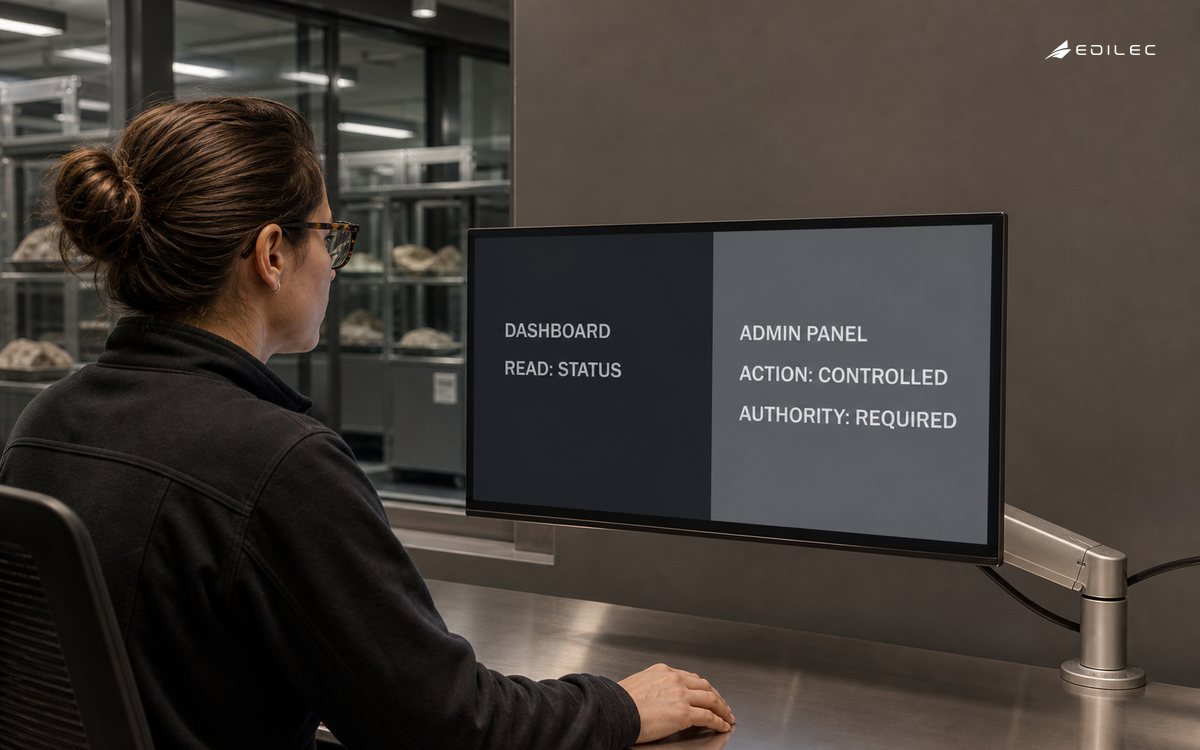
Keep observation and administration visibly separate even when they are adjacent. A dashboard can show an exception count, trend, freshness indicator, and link to the relevant case. The case or admin surface should then show the permitted actions, validation requirements, reason capture, and prior history. This arrangement lets a manager notice a pattern without granting them hidden authority to alter records. It also gives an auditor a simpler question to answer: which user saw a signal, which user changed state, and what evidence linked the two events?
Regulated processes need a correction pattern that does not erase history. When a user changes a status, replaces an amount, or reverses a decision, retain the prior value, actor, time, reason, supporting evidence, and applicable approval. Use a distinct correction or reversal event rather than silently overwriting a record. Review the most common reversals and denied actions as product signals. They may indicate unclear labels, missing policy guidance, an over-broad role, or a data-quality problem that the interface should reveal earlier.
Walk through a regulated exception from signal to closure
Consider a quality team that monitors batches approaching a temperature-excursion limit. The dashboard should show which batches are affected, data freshness, the applicable threshold, and the source behind the signal. It should not quietly let any viewer rewrite the threshold or disposition a batch. Selecting an exception can open a case in the admin surface, where role and record state determine the available actions. A qualified reviewer may request evidence, place the batch on hold, or record a disposition; a platform administrator may manage identities but should not make the quality decision. That separation makes each screen easier to explain and prevents broad technical privilege from becoming unintended business authority.
Acceptance testing should follow the entire path with realistic roles and failure conditions. Verify keyboard access and focus order against WCAG 2.2, ensure an expired or downgraded session cannot retain a privileged action, and test what happens when data is stale or an update conflicts with another reviewer. The resulting evidence should join the dashboard signal, case identifier, policy version, actor, approval, committed state, and correction. NIST SP 800-63-4 helps teams reason about digital identity and authenticator assurance, while the OWASP Authorization Cheat Sheet reinforces deny-by-default and permission checks on every request. Neither document chooses the interface for you; together they make clear that visual concealment is not an access control and that an admin action must be enforced at the service boundary.
| Workflow moment | Best surface | Required control |
|---|---|---|
| Monitor volume and risk | Dashboard | Freshness, definitions, filters, and source lineage |
| Investigate one exception | Dashboard linked to case detail | Stable record identity and evidence context |
| Propose a correction | Admin panel | Role check, validation, reason, and preview |
| Approve a consequential change | Admin panel with separated authority | Step-up authentication, policy and approval record |
| Review service performance | Dashboard | Outcome measures, queue age, and access-limited detail |
| Change system-wide policy | Dedicated administration workflow | Dual control, versioning, rollout and rollback |
Key takeaways
- Define admin panel versus dashboard through the decision and consequence it supports.
- Assign clear authority to records, rules, and exceptions.
- Test denied, incomplete, duplicated, and failed cases before scale.
- Treat evidence, accessibility, and recovery as release requirements.
Frequently asked questions
- Is admin panel versus dashboard mainly a technology choice? No. Technology supports the design, but ownership and controlled operation determine whether it works.
- Who owns it? A business owner is accountable for the outcome and policy; technical owners are accountable for secure, reliable implementation.
- What belongs in a first release? One valuable end-to-end case, a meaningful exception route, access controls, useful evidence, and a review measure.
Operating review considerations
Reporting and governance stakeholders should receive a compact evidence view rather than unrestricted administration. Show control performance such as pending approvals, denied actions, correction volumes, stale data, and exception ageing, then link each measure to the accountable process. This lets leaders ask focused questions without inviting informal edits to sensitive configuration. It also makes control burden visible: if exceptions rise after a rule change, the organisation can decide whether the policy, data quality, training, or interface needs attention before the queue becomes normalised.
Conclusion
A credible admin panel versus dashboard implementation makes responsibility clearer for everyone involved. Readers should be able to identify the protected outcome, authoritative information, rule that governed the action, and route for correction. That is a better standard than a vendor-specific feature list. Build a narrow, evidence-backed capability, review it with the people who operate it, and extend it only when normal work and meaningful exceptions remain understandable.