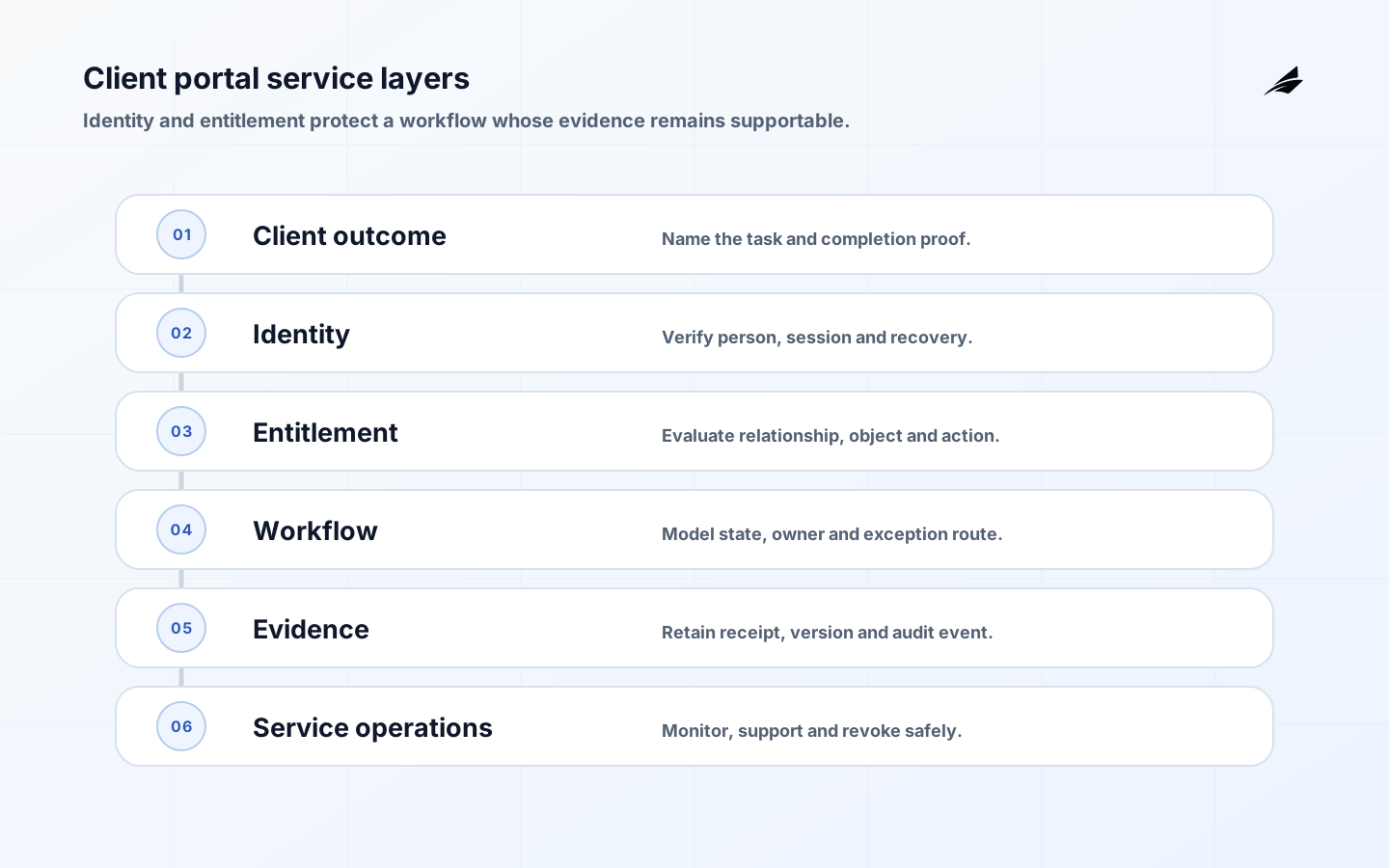
A client portal is an authenticated digital workspace where an organization and its clients exchange information, complete agreed actions and inspect the current state of a relationship. It is more than a private website or a document folder. A useful portal connects identity, client entitlements, business records, workflow, communication and support so a client can complete a real task without exposing another client’s information. The practical meaning therefore depends on the service boundary: which records are authoritative, which actions are permitted, what confirmation is produced and how an exception reaches a person. This guide turns “build a portal” into a set of architecture and operating decisions that multi-team delivery can test.
For connected implementation decisions, see API Meaning for Business Teams: A Launch Decision Guide, System of Record Basics: A Decision Guide for Internal Operations, Workflow Automation Definition: A Decision Guide for Client-Facing Work, and Admin Panel vs Dashboard: A Decision Guide for Regulated Operations. These guides are most useful when their controls are adapted to the same records, owners and consequences rather than applied as independent checklists.
Define the client-facing service contract
Start identity design from the consequence of a compromised account, not from a preferred login widget. NIST SP 800-63-4 frames identity proofing, authentication and federation as risk-based choices and adds continuous evaluation measures. If the portal uses delegated authorization, RFC 9700 is the current OAuth security best practice: restrict token privileges, protect redirect flows and avoid deprecated patterns. Authentication establishes who presented a credential; the application must still decide whether that identity may view or change this particular client, matter, invoice, file or request.
Authorization belongs on every request. The OWASP Authorization Cheat Sheet recommends least privilege, deny by default and permission checks for every request. Test object-level isolation with two real client structures, delegated users, expired relationships and reassigned work. Apply the NIST Privacy Framework to data purpose, collection, retention and disclosure, and use WCAG 2.2 to test the complete responsive journey, including authentication, errors, uploads, status messages and reauthentication.
What client portal meaning means in practice
In practical terms, client portal meaning connects a known input to a bounded operational result. A clear definition includes the scope of the work, the accountable owner, the information that is authoritative, and the limits of automated or delegated action. It also states what the capability does not decide. That negative boundary matters because it prevents adjacent systems and informal workarounds from taking on authority by accident. Write the definition so that an operator can test it against a real case and a technical team can derive interfaces, controls, and support measures from it.
Turn the term into a decision model
Begin planning with an ordinary case and then add cases that reveal risk: incomplete information, a sensitive request, a changed rule, duplicated input, an unavailable dependency, and a demand for historical evidence. For each case, agree what must be true before the capability proceeds, which person may resolve uncertainty, and what result counts as safe. This approach turns a vague request into a decision contract. It also keeps delivery honest: a successful happy path is not enough when a client may gain access to another client's data or be unable to complete an important task.
Set the authority and data boundary
Assign an explicit owner to the client entitlement. Identify the authoritative system, durable identifier, lifecycle states, change process, and retention rules. Copies, notifications, reports, and caches can be useful, but they should not become accidental places to correct the underlying fact. When information crosses a boundary, describe whether the receiving system has a read-only projection, a working copy, or separate authority. This distinction lets teams reconcile differences, investigate a dispute, and alter the design without silently changing the meaning of a record.
Match controls to the consequence
Controls should be chosen for the consequence of the action, not added as a final checklist. Verify user identity, authorize the precise resource and function, validate inputs, and apply limits where repetition could cause harm. Test denied requests and malformed input as deliberately as the expected route. When the result is difficult to reverse, require confirmation, approval, or an explicit exception path. A good control explains a safe reason for refusal and gives legitimate users a way to correct the request rather than forcing them into an unofficial channel.
Make evidence and recovery part of the service
Build operational evidence into the first release. Capture a correlation identifier, source, relevant rule or policy version, result, time, and accountable actor or service. Protect sensitive values and retain only what the purpose justifies, but keep enough context for a support team to reconstruct what happened. Decide how a partial failure is detected, whether the service request can be retried safely, and how state is reconciled after recovery. This evidence is not decorative compliance work. It is what makes an incident explainable and what gives leaders a factual basis for improvement.
Design the exception path
Common failure modes deserve a visible operating route. A stale configuration, changed source meaning, duplicate message, revoked permission, slow dependency, or unexpected exception should enter a named queue with priority, owner, and service target. Avoid automatic retries that amplify a bad instruction. Where certainty is weak, choose a bounded fallback such as holding for review, abstaining, or showing a last confirmed state with a warning. The objective is not to promise that nothing fails; it is to make failures safe, understandable, and recoverable. Topic-specific implication: Portal information architecture should follow client tasks, not internal department charts.
Decision criteria at a glance
| Question | Decision | Evidence |
|---|---|---|
| What is protected? | Define the intended operational outcome. | A real case with expected result. |
| Who may act? | Apply a bounded role and user identity. | Positive and negative access tests. |
| What changes? | Record a controlled service request. | Trace, status, and reconciliation path. |
| How is harm contained? | Route uncertain or failed work for review. | Named owner and recovery rehearsal. |
Use this table as an interview guide, not a scorecard that replaces judgement. Strong answers are backed by a working example, a named owner, or a test. Weak answers rely on an assurance that another team will resolve the issue later. Resolve the weak answers before broad rollout. In multi-team delivery, ambiguity around authority or recovery is expensive because it surfaces exactly when a client, operator, or reviewer needs an immediate answer.
A six-stage implementation sequence
| Stage | Outcome | Review question |
|---|---|---|
| Define outcome | Name the decision and protected result. | What is the useful business boundary? |
| Assign authority | Confirm owner and authoritative information. | Who may change the rule or record? |
| Build narrow path | Implement one end-to-end case. | What is deliberately out of scope? |
| Verify controls | Exercise positive and negative paths. | Can the system refuse safely? |
| Operate and recover | Observe outcomes and rehearse correction. | Can support explain a failure? |
| Review and improve | Use evidence to change the design. | What should be retained or retired? |
Release with an acceptance threshold
Implement the smallest end-to-end version that can demonstrate the outcome. Establish the authoritative input, one valued use case, access controls, an operational trace, and a correction route. Connect a real user or downstream service, observe the work, and measure both successful and exception cases before expansion. Maintain a decision log that records why a rule exists, who approved it, and what evidence supports it. That log prevents future maintainers from treating deliberate constraints as accidental defects and makes changes easier to review. For this guide, the implementation focus is client lifecycle events need explicit treatment.
Implementation notes for client portal meaning
Portal information architecture should follow client tasks, not internal department charts. A client trying to approve a milestone needs the current item, what is being asked, supporting material, deadline, and confirmation of the submitted decision. They should not need to understand which internal team owns the database. Test each important path with keyboard-only navigation, small screens, error recovery, and a user who did not attend the implementation meetings. Accessibility and plain status language reduce service demand because they make progress visible without a support call.
Client lifecycle events need explicit treatment. When an organisation changes a contact, merges accounts, ends a contract, or receives a new delegated administrator, the portal must update entitlement safely. Build a reviewable invitation, approval, removal, and recovery process rather than treating access as a one-time setup task. Document what happens to shared documents and outstanding requests after access changes. These details are where a portal becomes a dependable service boundary instead of a thin, fragile window onto internal systems.
Trace a document request from invitation to acceptance
Imagine an advisory firm requesting evidence from a client. A coordinator creates a request against the correct engagement, chooses the required document type and assigns a due date. The invited client signs in, sees only engagements to which they are entitled, uploads a file and receives a durable confirmation. The portal validates type and size before storage, scans the object, records who supplied it and keeps the business record separate from the storage URL. A reviewer can accept the evidence, ask for a replacement or mark the request not applicable without losing the earlier submission.

The difficult path is more revealing. If an invitation is forwarded, the recipient should not inherit the original user’s relationship. If malware scanning is delayed, the interface must show a quarantined state rather than implying the file is ready. If the client leaves the organization, access should end without erasing the engagement history. If a reviewer requests a replacement, notifications, audit records and the client’s next action must agree. This single journey exercises identity, entitlement, workflow, file handling, accessible feedback and operational support more effectively than a feature list.
| Portal layer | Design decision | Proof before release |
|---|---|---|
| Identity | How is the person verified and the session protected? | Assurance decision, recovery test and session controls |
| Entitlement | Which client objects and actions are allowed now? | Cross-client negative tests and relationship expiry |
| Workflow | What state and owner follow each action? | Normal, denied, delayed and replacement cases |
| Evidence | What receipt explains the transaction later? | Actor, object, time, version and result |
| Support | How can a client recover without bypassing policy? | Accessible error path and accountable escalation |
Key takeaways
- Define client portal meaning through the decision and consequence it supports.
- Assign clear authority to records, rules, and exceptions.
- Test denied, incomplete, duplicated, and failed cases before scale.
- Treat evidence, accessibility, and recovery as release requirements.
Frequently asked questions
- Is client portal meaning mainly a technology choice? No. Technology supports the design, but ownership and controlled operation determine whether it works.
- Who owns it? A business owner is accountable for the outcome and policy; technical owners are accountable for secure, reliable implementation.
- What belongs in a first release? One valuable end-to-end case, a meaningful exception route, access controls, useful evidence, and a review measure.
Operating review considerations
Portal performance is also part of access. A correctly authorised user who cannot load a case, open a document, or recover from a timed-out session may turn to insecure email or an internal contact. Set service measures for critical paths, monitor failure by client and browser where appropriate, and make planned maintenance visible. When support intervenes, record the reason rather than simply completing the action on behalf of the client. Repeated assistance requests are valuable design evidence for improving content, identity recovery, or the task flow.
Conclusion
A credible client portal meaning implementation makes responsibility clearer for everyone involved. Readers should be able to identify the protected outcome, authoritative information, rule that governed the action, and route for correction. That is a better standard than a vendor-specific feature list. Build a narrow, evidence-backed capability, review it with the people who operate it, and extend it only when normal work and meaningful exceptions remain understandable.