An audit trail matters to product leaders responsible for client-facing changes, approvals, and service evidence. In practical terms, it is a chronological, protected record that lets an authorised reviewer reconstruct a meaningful action: the actor, target, time, outcome, relevant context, and where applicable the reason or approval. That definition is more useful than a product label because it points to decisions a team can test: what the boundary is, what information is trusted, which failure conditions are acceptable, and who responds when the normal path breaks. The related concerns of event integrity, accountability records, and retention policy should be designed as part of the operating model, not appended after an initial launch.
What audit trail meaning means
An audit trail should be explained in the language of responsibilities and observable behaviour. An audit trail is not a verbose dump of application logs. Diagnostic logs help engineers troubleshoot; audit records support accountability. The latter should be intentionally designed around consequential business events, with access, retention, and tamper-resistance appropriate to the risk. A useful definition therefore includes the information that crosses the boundary, the actors allowed to change it, the evidence retained, and the conditions in which the system refuses to proceed. That gives practitioners a way to challenge vague requirements before they become fragile implementation assumptions.
Architecture decisions to make first
The architecture is not a diagram of components alone. It is the set of contracts that lets product leaders responsible for client-facing changes, approvals, and service evidence operate the capability repeatedly. Make the following decisions explicit before choosing a platform feature or writing an integration. Each one affects the likely failure mode, the test plan, and the people who will need evidence later.

| Decision | What to define |
|---|---|
| Auditable event | Choose actions whose history changes accountability, rights, money, data, or client outcomes. |
| Required context | Record actor, target, action, time, result, correlation identifier, and relevant before-and-after state. |
| Evidence protection | Restrict read and write access, preserve integrity, and separate operational administration from review. |
| Retention rule | Set retention and deletion based on legal, contractual, risk, and investigation requirements. |
Implementation path
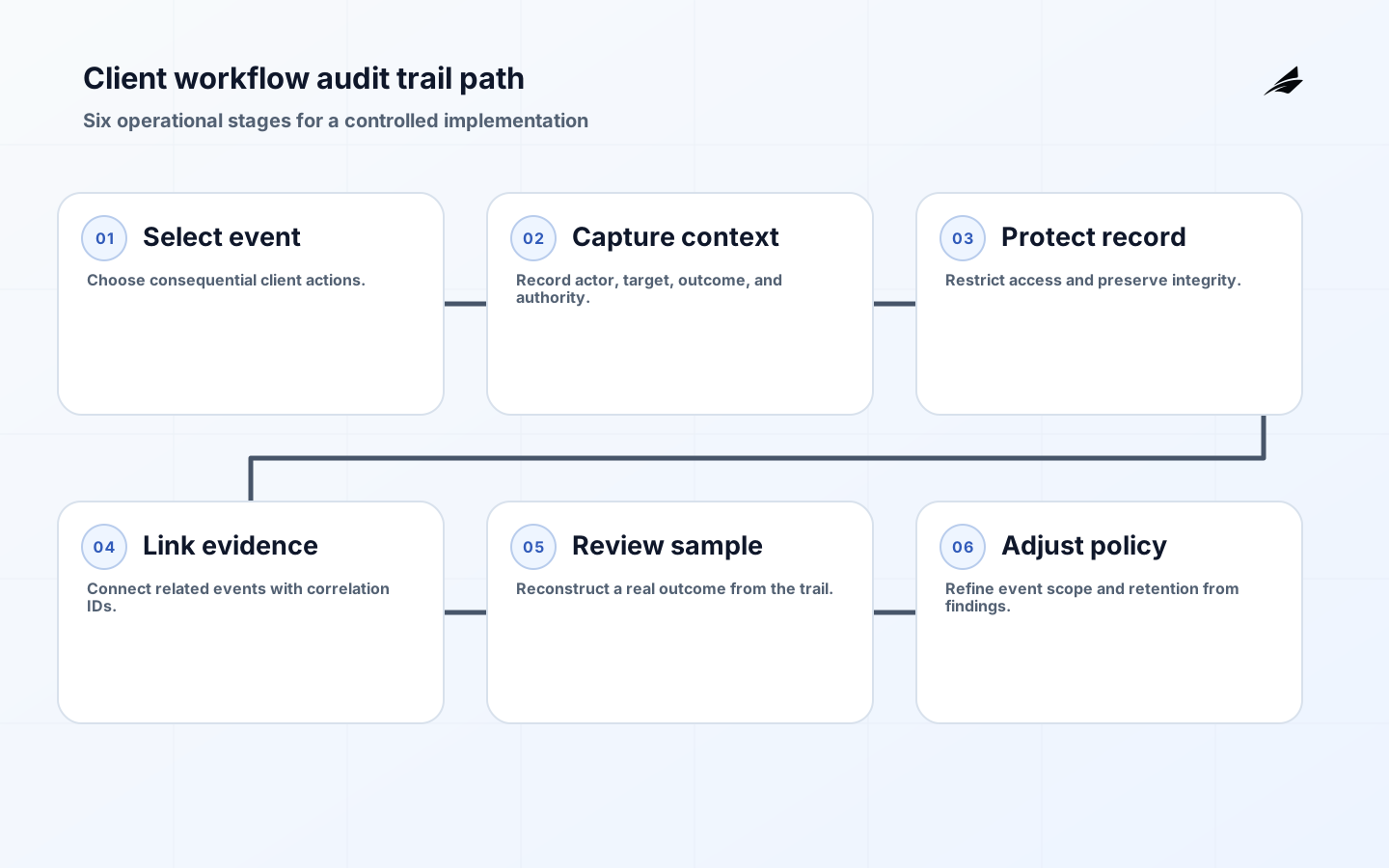
- Map client actions that create, approve, disclose, alter, or revoke something important.
- Define a stable event vocabulary rather than logging unstructured sentences.
- Capture trusted server-side identity and target identifiers at the decision point.
- Store only the necessary contextual values and protect sensitive content.
- Link related events with a correlation identifier for a coherent review trail.
- Test whether an authorised reviewer can answer what changed, by whom, when, and under which authority.
Build a thin, inspectable path first. It should include the unpleasant cases as well as the demonstration case: a missing identifier, a delayed message, an expired credential, a rejected record, or an unavailable dependency. Give that path named inputs and outputs, a clear retry or escalation rule, and a way to prove what happened. This is where event integrity becomes operational rather than aspirational.
Risks and controls
An audit record loses value when it is easy to alter, impossible to interpret, or so broad that it exposes private information. Record an outcome for denied as well as successful sensitive actions, but do not write credentials, secrets, or entire unfiltered request bodies into an audit store. Time synchronisation, append-oriented storage, separation of duties, and monitored access all help preserve the evidence chain.
| Operating signal | What it shows |
|---|---|
| Event completeness | Share of defined consequential actions that produce the required record. |
| Review reconstruction time | Time for an authorised reviewer to trace a sampled client outcome. |
| Integrity exceptions | Attempts or failures to modify, delete, or read protected evidence. |
| Sensitive-data findings | Audit-record privacy defects found during sampling or security review. |
Review and measurement
Measurement should tell the team whether audit trail meaning is still meeting its contract, not merely whether infrastructure is running. Review the signals in the table with the owner who can change the workflow. Look at trends, samples of failures, and the gap between detected and resolved issues. When a metric changes, follow the evidence back to the contract, implementation version, and real user or device behaviour before declaring a fix.
- Set a service objective for the consequence that matters, not only a technical average.
- Sample successful and failed cases to verify that accountability records are understandable.
- Make a named owner responsible for triaging exceptions and publishing the resolution.
- Review access, configuration, and retention choices whenever the process or fleet changes.
- Use controlled tests to rehearse recovery before an incident requires improvisation.
Operational scenario
A client asks why a service request changed from approved to cancelled. A useful audit trail lets the reviewer see the request identifier, the authorised actor, the prior and resulting state, the rule or approval that permitted the change, and the related notification. It should not force the reviewer to infer the story from raw debug messages. The system of record guide helps distinguish the authoritative business state from the supporting evidence that explains its history.
Evidence and testing
Define an event catalogue with a stable event name, actor type, target identifier, outcome, time, correlation identifier, and retention class. For sensitive changes, include the approval or reason reference rather than copying free-form sensitive material. Perform a quarterly reconstruction exercise using a real or representative case. The reviewer should be able to follow the sequence without direct database access, while an engineering investigation should be able to join the audit record to safely retained technical context.
Design review questions
Review access to audit evidence separately from access to the underlying workflow. An operator who can correct a client record does not necessarily need the ability to delete or alter the history of that correction. Consider who can export the trail, how legal holds or contractual retention apply, and how timestamp sources are monitored. Where records move between services, preserve correlation identifiers and the event version so a later reviewer can distinguish a product change from a suspicious inconsistency.
Practical operations
An audit trail design should begin with a review question, such as “who released this client document?” or “why did access change?” Work backwards to the minimum facts required to answer it. This avoids both vague “log everything” requirements and evidence gaps around approvals, exports, and delegated actions. Define how service identities are represented, how a user acting on behalf of another party is recorded, and how a retry relates to the original attempt. Sample real workflow histories with compliance, support, and engineering stakeholders before locking the event vocabulary.
Limits and tradeoffs
Evidence has boundaries as well as value. Retaining detailed records indefinitely can conflict with privacy, storage, and contractual obligations, while deleting them too soon can prevent a fair investigation. Classify events by consequence and determine retention, restricted access, redaction, and legal-hold rules with the appropriate policy owners. The audit system should make a review possible without broadly copying client content into every downstream log or analytics tool.
- Name the accountable owner before adding another integration or policy.
- Keep a representative failure test beside the normal acceptance test.
- Record the version of the contract, configuration, or rule in use.
- Use evidence from real operations to improve the next release.
- Make temporary exceptions visible, approved, and time-bounded.
- Review the boundary whenever the business process or fleet changes.
Adoption and change management
Client disputes, internal quality review, and investigations after a surprising change are the moments when evidence design proves its value. Prepare for them with a small change record that names the proposed change, contract or policy version, expected operational effect, affected owners, test evidence, rollout window, and reversal decision. Give users and support teams a plain-language explanation of the behaviour that will change, especially where a new denial, warning, or data-quality status can be mistaken for a defect. Monitor the first production cases closely and compare them with the pre-change baseline. When an exception appears, decide whether it is a valid new requirement, a training issue, a data defect, or a control that must remain firm. This practice keeps audit trail meaning connected to the people who operate it. It also prevents a series of urgent local fixes from becoming an undocumented alternate system. Retire obsolete rules and integrations deliberately, preserve the evidence needed for a later review, and update runbooks so the next team member inherits a working explanation rather than a collection of historical assumptions.
Key takeaways
- An audit trail is a contract between technical components, people, and operations.
- Define boundaries and ownership before optimising a tool or interface.
- Treat accountability records as a first-class output, with evidence for failure and recovery.
- Make exceptional conditions testable and visible to an accountable owner.
- Revisit the contract as customers, devices, data, or regulations change.
Frequently asked questions
Are audit trails required for every user action?
No. Start with actions that materially affect access, client data, approvals, financial state, or compliance obligations. Logging every click creates cost and noise without necessarily improving accountability. The event catalogue should explain why each event is retained and who may review it.
Can application logs serve as an audit trail?
Sometimes they contribute context, but they should not be assumed to satisfy the audit function. Application logs may be sampled, rotated quickly, editable by operators, or lack the actor and business target needed to reconstruct a decision.
Conclusion
An audit trail should make a consequential workflow explainable without turning the product into a surveillance system. Define the small set of events that need accountable evidence, protect that evidence, and regularly prove that reviewers can use it.