RBAC meaning in software is straightforward at its core: access is assigned through roles that represent responsibilities, rather than by attaching an unrelated list of permissions to every person. A role collects the actions needed for a defined function. Users or service identities receive one or more roles, and the application authorizes a requested transaction only when an active assignment permits it. This indirection makes access easier to understand and review, but it does not make permission design automatic. Poorly named roles, broad administrator bundles, permanent exceptions, and checks that exist only in the interface can turn an RBAC label into little more than a spreadsheet.
The NIST RBAC project describes core RBAC in terms of users, roles, permissions, sessions, and relations between them. NIST's current RBAC glossary definition emphasizes access authorizations received through an explicit or implicit role and notes that role hierarchies may carry inherited permissions. For a software team, the practical translation is to define protected resources and business actions first, then connect them to stable responsibilities. Authentication proves which subject presented a credential; RBAC contributes to the separate authorization decision about what that subject may do.
Understand the core RBAC model
A useful permission is more precise than a screen name. It combines an action with a resource boundary: refund an order in the assigned region, approve a purchase below a threshold, view a customer record for the current tenant, or rotate a credential for a named service. A role then groups permissions required for one responsibility. The role should remain meaningful even when people move between teams, while assignments change as employment, contracts, projects, and on-call duties change. Sessions determine which authorized roles are active for a particular interaction, allowing elevated duties to be invoked only when needed.

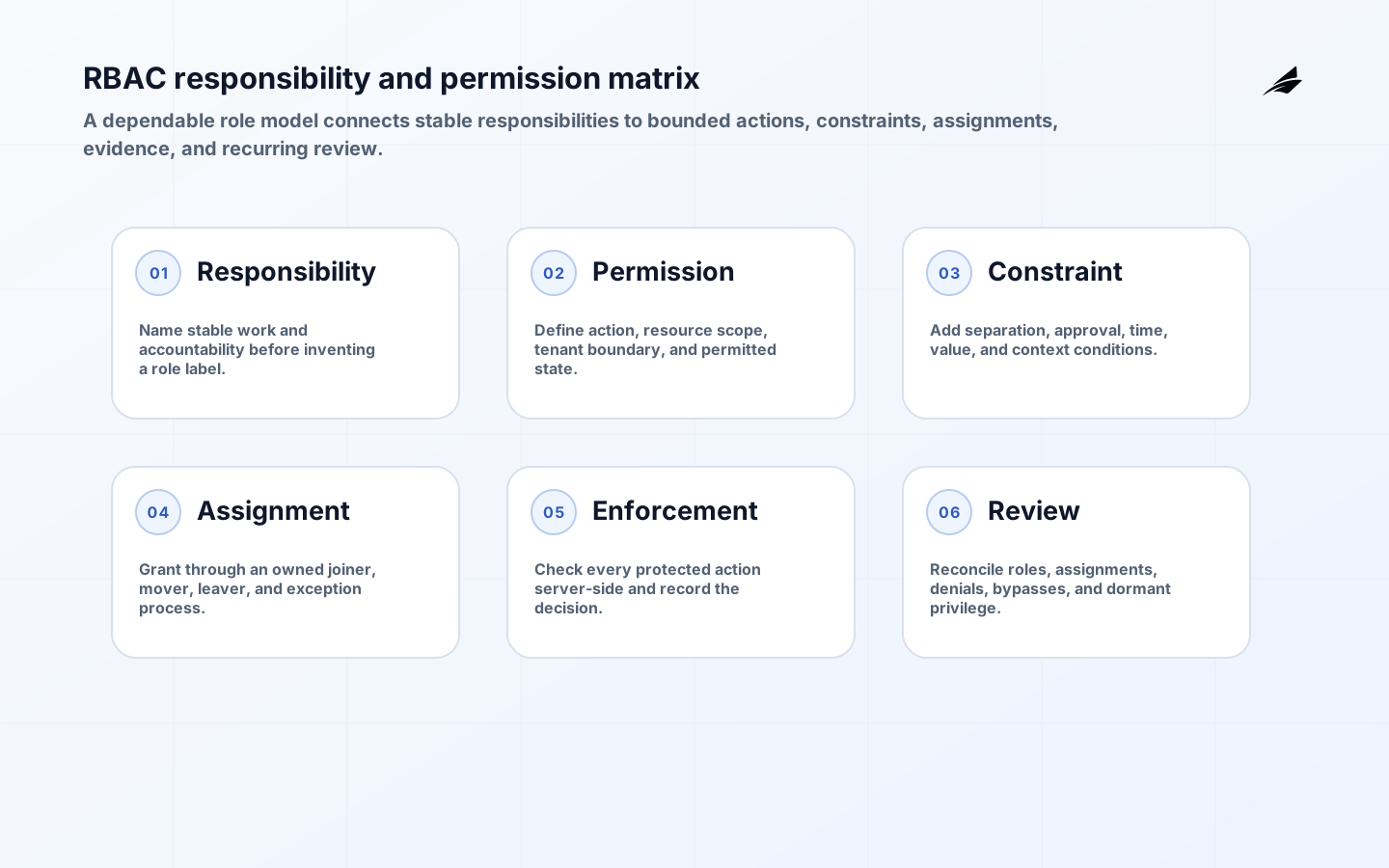
Constraints make the model fit real work. Static separation of duty can prevent one person from holding two incompatible roles, while dynamic separation can prevent the same person from exercising conflicting roles in one transaction. A hierarchy can reduce duplication when a senior role genuinely includes a junior role's permissions, but deep inheritance often hides privilege. Treat hierarchy as a design tool that must be explainable, not as an organization chart imported into code. The accompanying matrix links responsibility, permission, constraint, assignment, enforcement, and review so each layer has an owner and testable evidence.
| RBAC element | Software question | Example evidence |
|---|---|---|
| User or subject | Who is requesting the action? | Stable identity and current account state |
| Role | Which responsibility is being exercised? | Named purpose, owner, and approval rule |
| Permission | Which action on which resource is allowed? | Action-resource contract and negative tests |
| Session | Which authorized role is active now? | Activation event, assurance, and expiry |
| Constraint | Which combinations or conditions are forbidden? | Conflict rule, threshold, or contextual policy |
| Review | Why does the assignment remain necessary? | Usage evidence and recertification decision |
Engineer roles from real work, not job-title guesses
Begin with consequential workflows and interview the people who perform, supervise, and audit them. List the decisions and state changes, identify the authoritative record, and separate ordinary work from privileged administration. Job titles are useful discovery clues but weak security contracts: two operations managers may own different regions, one accountant may prepare payments while another releases them, and a support lead may view sensitive tickets without being allowed to export every customer record. Model those differences explicitly through resource scope, constraints, or separate roles instead of one expanding role called manager.
Role engineering also needs a naming and ownership convention. A name such as billing-refund-reviewer conveys more than role-17, but the catalog should additionally state purpose, permission set, prohibited combinations, eligible population, granting authority, maximum duration, and review cadence. Identify whether each assignment comes from an authoritative workforce system, a customer administrator, a project owner, or a temporary access workflow. This is where Edilec's guide to permission review workflows complements the conceptual model: the role definition and the assignment lifecycle must agree.
- Name roles after stable responsibilities, not individual people.
- Keep business permissions separate from infrastructure administration.
- Express tenant, region, account, and record scope explicitly.
- Document incompatible roles and approval thresholds.
- Prefer a small composable catalog over hundreds of near-duplicate roles.
- Give every role and every exceptional assignment an accountable owner.
Enforce authorization at every protected action
Hiding a button is a usability decision, not an authorization control. A client can be modified, an API can be called directly, and a background job may reach the same business function. The OWASP Authorization Cheat Sheet recommends least privilege, deny by default, validation on every request, and server-side enforcement. Centralize reusable policy decisions where practical, but keep the resource and business state visible to the decision. A generic gateway can verify a token and coarse scope; the application may still need to verify tenant ownership, record status, amount, or separation from a previous action.
Test both vertical and horizontal privilege boundaries. Vertical tests confirm that an ordinary user cannot perform an administrator action. Horizontal tests confirm that a user with the right action cannot operate on another tenant, region, customer, or case. Also test stale sessions, removed assignments, role changes during an active workflow, batch APIs, exports, webhooks, and alternate identifiers. A denial should fail safely and produce a stable reason code for support and monitoring without disclosing sensitive policy internals.
| Test case | Expected result | Operational signal |
|---|---|---|
| No matching role | Deny before business state changes | Authorization-denied reason |
| Right role, wrong tenant | Deny object access | Cross-boundary attempt |
| Expired temporary role | Deny and direct to renewal workflow | Expired grant usage |
| Conflicting duties | Block activation or transaction | Separation-of-duty violation |
| Assignment removed mid-session | Reevaluate at a defined boundary | Revocation propagation time |
| Emergency elevation | Allow only within scope and duration | High-priority review event |
Operate assignments, evidence, and exceptions
RBAC is not finished when roles are seeded in a database. Joiner, mover, and leaver events must add, change, and remove assignments through controlled paths. Temporary projects and support incidents need expiry. Customer-managed roles need tenant isolation and clear delegation. Emergency access needs stronger authentication, narrow scope, a short lifetime, visible use, and review after the event. Avoid direct database edits because they bypass approval, validation, notification, and evidence. If a manual repair is unavoidable, record it as an incident and reconcile the authoritative assignment store.
Log security-relevant events without turning logs into a second sensitive database. The OWASP Logging Cheat Sheet identifies authorization failures and higher-risk functionality as important events. For protected actions, retain subject, active role, action, resource reference, tenant, decision, policy version, reason code, time, and correlation identifier where lawful. Do not place credentials or unnecessary personal data in the event. NIST SP 800-53 provides a broader control catalog covering access enforcement, least privilege, separation of duties, account management, and audit.
Review RBAC with measures that reveal drift
A quarterly certification that asks a manager to approve a long list of unfamiliar role names is weak evidence. Give reviewers purpose, recent use, privileged actions, conflicts, assignment source, last change, and expected expiry. Prioritize high-impact roles, dormant privilege, shared or service identities, toxic combinations, frequent emergency use, and roles whose permissions changed since the last review. Reconcile the catalog against actual enforcement so a retired permission is not still accepted by an old API.
Treat permission-model changes as production changes. Before adding a role or moving a permission, identify affected users, sessions, APIs, automations, reports, and support procedures. Test old and new policy against representative recorded requests, publish the effective date, and monitor denial and bypass signals after release. Keep an emergency rollback for a policy error, but do not let rollback restore access removed for an incident or leaver event. For a large migration, evaluate the new policy in report-only mode, compare decisions, resolve unexplained differences, then enforce it by bounded workflow. This makes role refactoring safer without freezing an outdated access model.
Track orphaned roles, stale assignments, median removal time after a mover or leaver event, percentage of privileged grants with expiry, denied requests by reason, unused permissions, exception age, and recertification decisions. These measures describe control health, not merely catalog size. Teams implementing this model can use the deeper internal-tool RBAC checklist and zero trust application guide to connect role decisions to resource-level policy and operational identity.
Key takeaways
- RBAC assigns permissions through roles that represent stable responsibilities.
- Permissions should describe an action and resource scope, not merely a page.
- Role hierarchies and separation-of-duty constraints require deliberate design.
- Every protected action needs server-side authorization and negative tests.
- Assignments, exceptions, logging, and recertification are part of the product.
- RBAC works best alongside contextual resource rules rather than as the only access model.
Frequently asked questions
Is RBAC the same as attribute-based access control?
No. RBAC primarily grants permissions through roles. Attribute-based access control evaluates attributes of the subject, resource, action, and environment. Many practical systems use roles for stable responsibility and additional attributes for tenant, region, ownership, risk, or record state.
How many roles should an application have?
There is no universal number. Use enough roles to represent materially different responsibilities without creating a role for every person or small variation. If role count grows rapidly, move record scope and contextual conditions into explicit policy rather than duplicating the catalog.
Should roles live in the identity provider or the application?
Enterprise group membership and broad entitlement may originate in an identity provider, while the application remains responsible for its own business permissions and resource checks. Define one authority for each assignment and avoid silently combining conflicting stores.
Conclusion
RBAC gives software teams a disciplined vocabulary for connecting people and service identities to permitted work. Its value comes from the complete operating model: roles derived from responsibilities, precise action-resource permissions, explicit constraints, governed assignments, server-side enforcement, useful evidence, and recurring review. Build the first model around one consequential workflow, test every allow and deny boundary, and observe how assignments change in real operations. That creates access control people can explain and maintain instead of a growing collection of administrator switches.