Zero trust means that access is not granted merely because a person, device or workload is inside a familiar network or owned by the organization. Every request to a protected resource must be evaluated against explicit policy using the best available evidence. The phrase is often reduced to a slogan such as “never trust, always verify,” but a useful zero trust security model is more precise: identify the resource, authenticate the subject and relevant device or workload, authorize the requested action, enforce the result close to the resource, and keep enough telemetry to reassess risk.
That interpretation follows NIST SP 800-207, which moves security attention from broad network segments to users, assets and resources. It also explains why zero trust is not a single product. Identity services, device management, gateways, application authorization, service identities, logging and incident response may all contribute, but they are useful only when they support a coherent access decision. Product and engineering teams should connect this definition to Edilec's guides to single sign-on ownership, role-based access control and the broader zero trust architecture decision guide.
What zero trust means in practice
A zero trust architecture starts with protected resources and business workflows, not with a replacement shopping list. A customer record, payment approval, deployment control plane and production secret require different evidence and different responses to uncertainty. For each resource, name who or what may request access, the permitted actions, the context that changes the decision, and the consequence of an incorrect allow or deny. This turns an abstract principle into a policy that an application owner can review and an operator can test.
NIST distinguishes a policy decision point from a policy enforcement point. The decision function evaluates identity, resource policy and contextual signals; the enforcement function establishes, monitors or terminates the connection. An implementation may distribute those responsibilities across an identity provider, API gateway, service mesh and application. The design still needs one understandable decision path. If a gateway checks a token but the application accepts an unscoped tenant identifier, the protected action is not actually governed. Conversely, a denial that gives no useful reason can become an operational burden and drive users toward unsafe workarounds.
| Element | Question to answer | Useful evidence |
|---|---|---|
| Resource | What data, service or action is protected? | Owner, classification and business impact |
| Subject | Which user or workload is requesting access? | Authenticated identity and credential assurance |
| Context | Which device, location, time or risk signals matter? | Fresh, attributable signal with known limitations |
| Policy | Which action is allowed under these conditions? | Versioned rule and approved exception |
| Enforcement | Where can the decision be reliably applied? | Positive and negative test results |
| Review | What should change after events or incidents? | Decision logs, alerts and periodic access review |
Put resource policy before network location
Network controls remain valuable, but network location should not create implicit authority. A user on a corporate virtual private network may still be using an unmanaged device or attempting an action outside their responsibilities. A workload inside a trusted cluster may have an overbroad service credential. Resource policy should state the allowed operation and required assurance independently of where the request originated. Segmentation can then reduce reachability and blast radius without becoming the only authorization boundary.
Cloud-native systems make this distinction especially important. NIST SP 800-207A describes identity-tier and network-tier policies for applications and services across multiple environments. In practical terms, a service should present a verifiable workload identity, the receiving service should authorize the requested operation, and both should be observable. An IP address or cluster membership alone is weak evidence of business authority. The same rule applies to scheduled jobs, integration accounts, automation agents and emergency support tools.
Design the access decision, not just authentication
Authentication answers who or what presented a credential; authorization answers whether that subject may perform this action on this resource now. Mature zero trust designs keep those questions separate. They also define token audience, tenant boundary, action scope, session duration and reauthentication triggers. For a high-impact operation, recent phishing-resistant authentication, a managed device and an approved role may be required. For a low-risk read, fewer signals may be proportionate. The policy should explain why each signal changes the decision and what happens when the signal is stale or unavailable.
- Use stable user and workload identities rather than shared accounts.
- Issue credentials for a narrow audience, scope and lifetime.
- Authorize the business action and object, not only the route or screen.
- Treat device posture as one signal, not a substitute for user authorization.
- Make emergency access attributable, time-limited and reviewed after use.
- Return denials that support investigation without exposing sensitive policy detail.
Migrate one protected workflow at a time
A wholesale zero trust migration is rarely realistic. NIST SP 1800-35 documents multiple example implementations, while the NIST planning guide emphasizes stakeholder and risk-management work. Choose a workflow with a clear owner and measurable risk, such as privileged production access or export of customer data. Map current access, introduce stronger identity and policy controls, observe the result, and remove legacy bypasses only after the new path is dependable. Running old and new controls indefinitely creates ambiguity, so each phase needs an exit condition.
| Migration step | Delivery decision | Exit evidence |
|---|---|---|
| Discover | Choose one resource and enumerate access paths | Owner confirms normal, privileged and emergency routes |
| Instrument | Collect identity, device, workload and resource events | Events can be joined to one request |
| Decide | Write allow, deny and step-up rules | Policy examples pass review |
| Enforce | Apply controls near the resource | Bypass and cross-tenant tests fail safely |
| Recover | Prepare outage and lockout procedures | Team completes a timed exercise |
| Retire | Remove obsolete network or shared-account trust | No unexplained legacy access remains |
Operate signals, exceptions and recovery
Continuous verification does not mean interrupting every user on every request. It means that trust is not permanent and that meaningful changes can cause reevaluation. A disabled account, compromised credential, unmanaged device, unusually sensitive action or changed workload identity may require denial, step-up authentication or a shorter session. Signals need owners, freshness expectations and failure behavior. If the device service is unavailable, the organization must consciously choose whether a workflow fails closed, becomes read-only, or follows a controlled temporary route.
Exceptions are part of the architecture. Record the requester, approver, resource, reason, compensating control and expiry. Review actual exception use rather than merely counting open tickets. Recovery also matters: overly strict policy can lock responders out during an incident, while permanent emergency accounts create a standing attack path. Rehearse a bounded break-glass flow that produces strong evidence and automatically removes temporary privilege. The CISA Zero Trust Maturity Model can help teams discuss progress across identity, devices, networks, applications and data without pretending every capability matures at the same rate.
Use a repeatable resource access loop
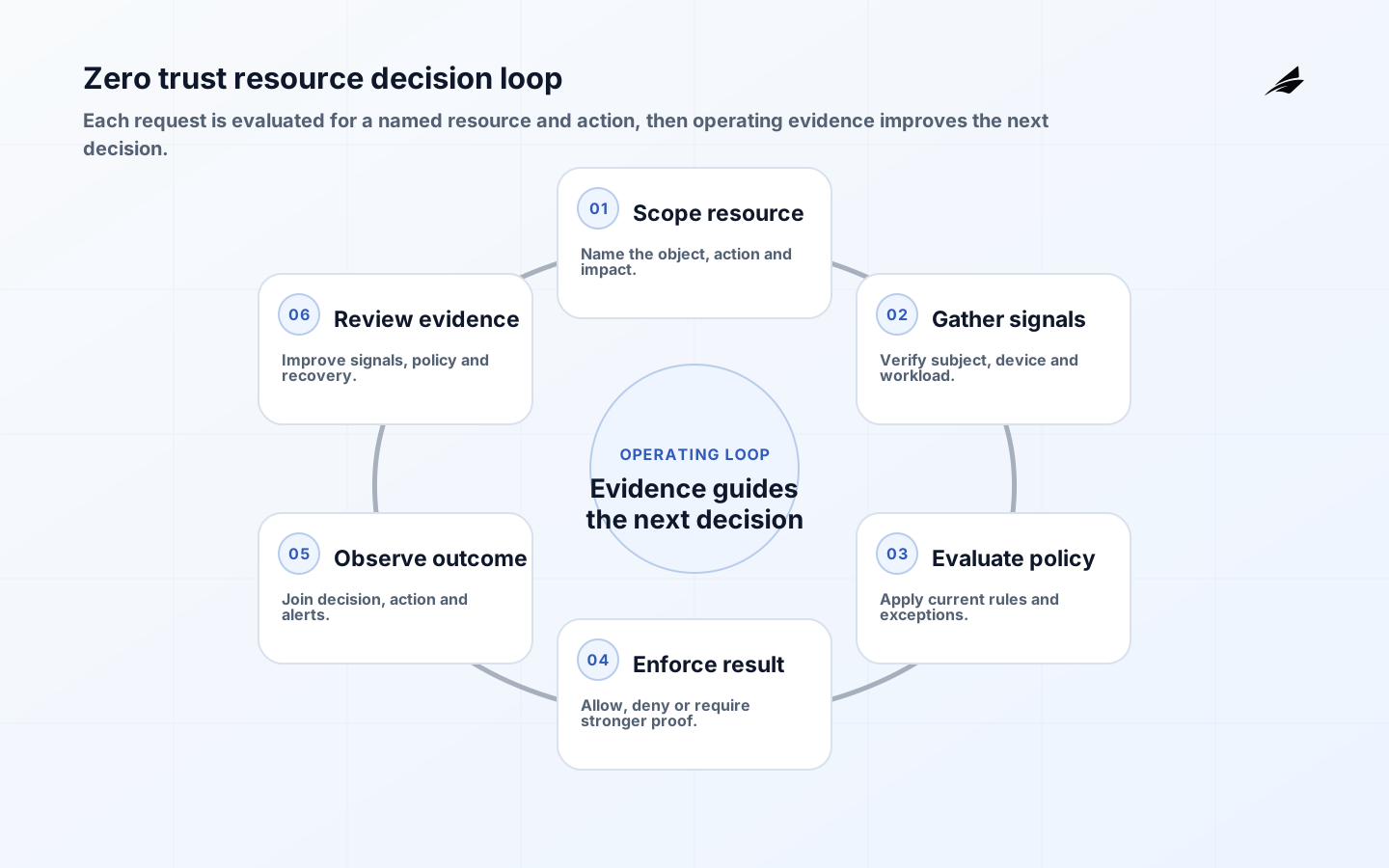
The diagram below organizes zero trust around one request. It begins with a protected resource and a named action, then gathers identity and posture evidence, evaluates a versioned policy, enforces the decision, observes the outcome and improves the rule. This sequence is deliberately circular: telemetry and incident findings should change policy and signal quality. A static deployment that never revisits decisions is access control, but it is not a complete zero trust operating model.

Measure security and usability together
Useful measures describe decisions and outcomes: percentage of sensitive resources with a named policy owner, privileged actions using phishing-resistant authentication, stale service credentials, unexplained policy bypasses, time to revoke access, false denial rate and completion time for emergency access. A dashboard that reports only enrolled devices or purchased licenses measures deployment, not protection. Segment measures by resource sensitivity and user population so a broad average does not hide a weak administrative path.
Review denial quality as well as allow decisions. Repeated denials may reveal an attempted attack, a broken signal, an outdated role model or a workflow that forces legitimate users toward informal channels. Give support teams a safe explanation code and escalation path, then use recurring patterns to improve policy without weakening the protected resource.
Key takeaways
- Zero trust protects resources through explicit decisions; it is not a product category or a network replacement.
- Authentication, authorization and enforcement are separate responsibilities that must align around the requested action.
- User, device and workload signals need freshness, ownership and defined outage behavior.
- Migration works best by bounded workflow, with evidence for retiring each legacy bypass.
- Exceptions, recovery and usability are part of the security architecture.
Frequently asked questions
Does zero trust mean removing the VPN?
No. A VPN may still protect traffic and reduce exposure. The change is that being connected to it should not automatically authorize every resource. Applications and services still evaluate identity, action and relevant context.
Must every request trigger a new login?
No. Systems can reuse appropriately scoped sessions while reevaluating risk at meaningful points. Sensitive actions, changed posture or expired assurance may trigger reauthentication without disrupting every low-risk interaction.
Where should a small team start?
Start with one sensitive workflow, usually privileged administration or customer-data export. Name the resource owner, eliminate shared credentials, write the allow and deny cases, add request-level evidence, and test emergency recovery.
Conclusion
The most useful zero trust meaning is operational: no subject receives lasting authority merely from location or ownership. Teams protect a resource by evaluating a specific action with explicit, proportionate evidence and by enforcing the result where it cannot be bypassed. Begin with one consequential workflow, instrument it, test both permission and denial, prepare for signal failure, and use real events to improve the policy. That approach turns a broad security principle into a system people can understand, operate and audit.