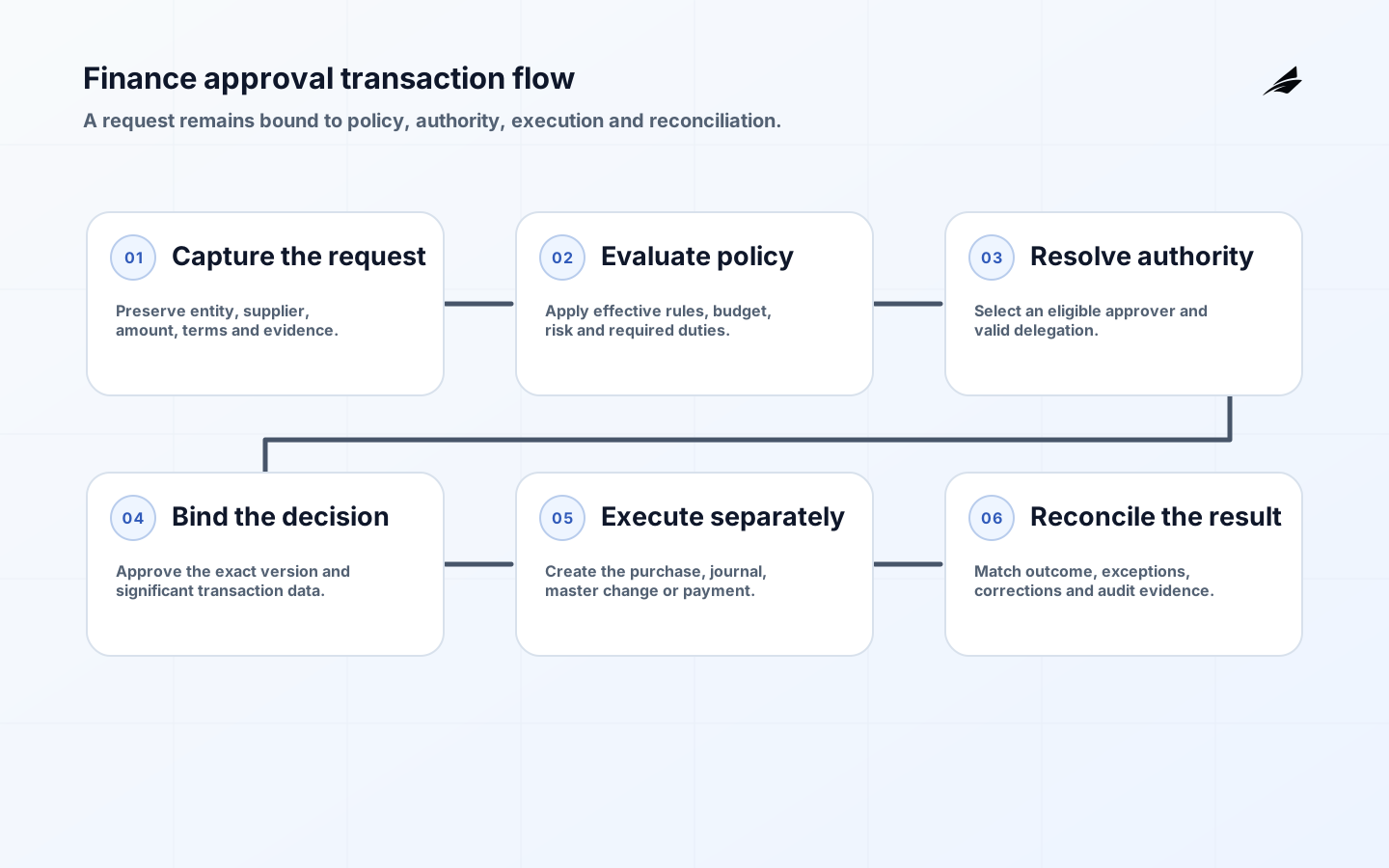
Finance approval systems turn policy and delegated authority into a reviewable decision before money, master data, or commercial terms change. Product leaders should treat them as transaction-control systems, not notification chains. The product must show an approver the exact material facts, select an eligible authority, prevent self-approval where required, preserve the reviewed version, and route exceptions without creating hidden workarounds. Done well, routine requests move faster because evidence and authority are clear; material changes receive the scrutiny they deserve.
Use this guide with Edilec’s approval workflow software guide, finance document-intelligence guide, and billing operations checklist. They connect request capture, document evidence, approval, and downstream reconciliation.
Define the operating outcome for finance approval systems
Treat the first design session as a working definition of completion. For a product-related spend or commercial approval process, completion means that a request is evaluated against policy and delegation, approved or declined by the right authority, and connected to the transaction it permits. Write the normal case in plain language, then include a changed request, an incomplete request, a duplicate, a rejected handoff, and a correction after downstream work begins. This prevents a technically successful message from being mistaken for a successful business result. Name the person who can accept the outcome, the teams that act on it, the customer or colleague affected by delay, and the evidence that will show what happened.
| Decision area | Practical rule | Evidence to retain |
|---|---|---|
| Business outcome | State how a request is evaluated against policy and delegation, approved or declined by the right authority, and connected to the transaction it permits. | Named outcome owner and acceptance examples. |
| Authoritative facts | Identify the source and permitted changes for request, business purpose, amount, currency, budget reference, supplier or customer, approval rule, approver, decision, and transaction link. | Fact register, identifiers, and effective dates. |
| Failure handling | Route exceptions caused by a polished approval screen obscures whether the approver had authority, the request changed after approval, or the payment used the approval at all. | Case identifier, queue owner, and disposition. |
| Access boundary | Apply the least access needed for the action. | Authorization decision and relevant audit event. |
Assign record authority before automating handoffs
Finance owns policy and delegation limits, the budget owner owns the business decision, and the system owner owns rule execution and evidence retention. Put that statement beside the field and state definitions, not only in an architecture diagram. Authority answers who can correct a fact, but it also answers whose validation applies when another system sends an update. Use stable identifiers and effective dates so receivers can distinguish a new fact from a late delivery or replay. Consumers may keep a local copy for performance or operational work, but they should record its source and freshness rather than quietly becoming a second authority.
Design the handoff contract and its boundaries
A material change to amount, supplier, scope, or payment terms invalidates the prior approval unless policy explicitly permits the variation. The contract should identify the event or command, required values, allowed states, source reference, freshness expectation, duplicate behavior, and response for rejection. Avoid a vague “sync everything” promise. It masks the difference between publishing a fact, requesting an action, and reporting a derived value. Use a correlation identifier across the path so support staff can move from a customer or employee question to the exact delivery, validation, decision, and result.
| Condition | Required system behavior | Accountable owner |
|---|---|---|
| Duplicate delivery | Recognize the request or event and avoid creating a second business action. | Receiving service owner |
| Invalid or incomplete data | Reject with a reason that the sending team can act on; do not silently discard it. | Source process owner |
| Dependency unavailable | Use a durable, monitored recovery route only when the business can tolerate delay. | Integration operations |
| Approved correction | Preserve prior context and propagate the authorized change deliberately. | Authoritative record owner |
Build for exceptions, not only the happy path
Separate request capture, eligibility checks, delegation lookup, approval decision, and payment or purchase execution; never treat them as one opaque status. A recovery queue is part of the product: it needs a business-readable reason, priority, owner, service target, and safe way to retry or correct. Do not give a background job unrestricted power to repair records. Recovery often changes a commitment, balance, entitlement, or access decision, so it should respect the same authority as the original workflow. Where automation makes a recommendation, make the rule version and inputs visible to the person who must decide.
Test the business result and the control evidence
Testing is complete when a representative user can get the right result and the organization can explain how it was reached. Retain the request version reviewed, policy and delegation in force, approver identity, decision time, and link to the resulting transaction. Include authorization failures, out-of-order messages, timeout recovery, manual intervention, and a rollback or cancellation where relevant. Check both directions of the handoff: a sender needs acknowledgement or an actionable rejection, while a receiver needs assurance that it processed the intended version exactly as its business rules allow. Keep test evidence with the release decision, not in an informal chat thread.
Operate with measures that lead to action
After release, review approval cycle time by risk tier, overrides, approvals returned for missing evidence, changed-after-approval requests, and unmatched transactions. Define each measure's population, period, exclusions, source, and owner before relying on it. Pair the numbers with a small sample of real cases, especially those that crossed teams or required repair. That combination catches a common failure: a green technical monitor alongside customers, staff, or finance teams who are still waiting for a business outcome. Each review should produce one owned improvement, whether that is a rule change, a data correction, a training update, or a service capacity decision.
Make finance approval systems tradeoffs explicit
Finance approvals must balance timely delivery against delegated control. A routine, well-evidenced request can move quickly; a changed supplier, amount, or scope deserves a new decision even when the requester is under pressure. Keep emergency handling narrow and reviewable instead of using it as an alternate normal path. The useful design shows why speed was appropriate, who accepted the residual risk, and whether the permitted transaction matched the reviewed request.
Translate policy into a versioned decision model
Represent approval rules as effective-dated policy: legal entity, request type, amount or risk band, budget, supplier status, contract state, submitter relationship, and required approver roles. Store which policy version evaluated the request. NIST SP 800-171 Revision 3 describes separation of duties as dividing functions and implementing the separation through access authorizations. In product terms, the person who requests, maintains a sensitive vendor field, approves, and executes payment should not collapse into one uncontrolled role.

| Control question | System evidence | Failure to prevent |
|---|---|---|
| What was approved? | Immutable request version and material fields | Approval reused after amount or supplier change |
| Who had authority? | Role, limit, entity, delegation dates | Ineligible or expired approver |
| Was duty separated? | Submitter, approver, executor identities | Self-approved or collusive path |
| What happened next? | Purchase, journal, payment, or master-data result | Approved request never reconciled |
| How was an exception handled? | Reason, temporary authority, expiry, review | Permanent bypass through urgency |
Bind authorization to the transaction
The OWASP transaction-authorization guidance emphasizes that a user should be able to identify and acknowledge significant transaction data. Show supplier, bank-account change, legal entity, amount, currency, budget, contract, payment terms, and unusual conditions in the approval surface. If a material field changes after approval, invalidate or re-evaluate the decision. Do not let an email button authorize a transaction whose current state can no longer be seen.
Model approval states and exceptions explicitly
Support submit, request change, approve, reject, delegate, reassign, recall, expire, and cancel as distinct events where policy allows them. Microsoft’s workflow action reference shows how originators, task assignees, decision-makers, and approvers can have different actions. A queue needs aging, escalation, absence delegation, and a visible owner. Emergency approval should use a stronger record and time-bounded authority, followed by retrospective review, rather than an undocumented bypass.
Protect master data as carefully as spend
A payment can be correctly approved and still be misdirected if supplier bank data changed through a weaker path. Microsoft’s vendor workflow documentation demonstrates proposed field changes remaining pending until approval. Treat vendor identity, bank account, tax data, credit limit, and chart-of-account mappings as controlled records. Reconcile approved requests to downstream postings and payment outcomes, and alert on mismatches rather than treating “approved” as completion.
Key takeaways
- Define success as a business outcome for a product-related spend or commercial approval process, not a successful screen load or API call.
- Name authority for request, business purpose, amount, currency, budget reference, supplier or customer, approval rule, approver, decision, and transaction link and make correction rights visible to every consuming team.
- Publish handoff rules for identity, state, validation, duplicates, delays, and rejection.
- Give exceptions a business owner, an evidence trail, and a safe route to resolution.
- Test changed, incomplete, duplicate, late, unauthorized, and corrected cases before release.
- Review approval cycle time by risk tier, overrides, approvals returned for missing evidence, changed-after-approval requests, and unmatched transactions with real cases and assign improvements to the people able to make them.
Frequently asked questions
Do we need to replace every connected system first? Thresholds alone do not create a finance control. An approval also needs a policy context, an eligible approver, a protected request version, and a way to show whether the authorised action actually occurred. The workflow should make each of those pieces inspectable.
What is the best starting point? Product leaders should design for the urgency that the business actually faces. A standard request can flow through routine checks, while an emergency path must capture a reason, temporary authority, later review, and a clear limit on what it can approve.
Conclusion: make finance approval systems accountable
Finance approval systems succeed when authority, transaction context, and downstream outcome remain connected. Make policy effective-dated, bind approval to the exact request, separate duties, design exceptions openly, and reconcile execution. Product leaders can then improve speed where risk is routine without weakening the decisions that protect the business.