HRMS workflow planning turns employee events into coordinated, effective and auditable actions across HR, managers, payroll, identity, finance, facilities and equipment. A hire is not complete because an HR record exists; the person needs the correct manager, pay setup, accounts, entitlements, device and first-day communication at the right time. A departure is not complete because status changed; access and obligations must end according to policy, assets must be reconciled and evidence retained. IT managers should design these workflows around authoritative records, effective dates, least privilege, exception ownership and verified outcomes rather than a chain of loosely connected notifications.
Key takeaways
- Model hire, transfer, leave, return and departure as distinct state transitions.
- Assign an authoritative source for identity, employment, manager, pay, access and assets.
- Use effective dates and idempotent integration so delayed or repeated events remain safe.
- Separate HR approval from downstream security and business authorization.
- Reconcile expected and actual outcomes, including exceptions and manual changes.
Define employee lifecycle events precisely
List events that materially change work: candidate conversion, hire, rehire, manager change, location change, legal entity transfer, role change, leave, return, contractor extension and termination. For each, define who initiates, required approvals, effective time, fields allowed to change, systems affected and the completion evidence. Do not force every event through one generic “update employee” flow. A future-dated transfer needs staged changes; an urgent termination needs immediate containment; a name correction should not re-provision every entitlement. The Edilec practical HRMS workflow guide provides a broader discovery model.
| Event | Timing concern | Critical verification |
|---|---|---|
| Hire or rehire | Accounts must be ready but not active too early | Identity, manager, baseline access and device |
| Transfer | Old and new duties may overlap briefly | Access removed and granted by effective time |
| Leave and return | Some access pauses while employment persists | Suspension, delegation and restoration |
| Departure | Urgency varies by reason and jurisdiction | Sessions, accounts, assets and downstream access |
| Data correction | Should not trigger unrelated lifecycle actions | Only intended fields and consumers changed |
Assign authoritative records and stable identifiers
Define the HRMS as authority for selected employment attributes, not automatically for every access decision. Identity may own the persistent person and account identifier; payroll owns pay results; asset management owns custody; line-of-business systems own specialist roles. Use a stable internal identifier rather than email as the join key because names and addresses change. The SCIM core schema defines standard User and Group resources and an externalId intended to help clients correlate records. The SCIM protocol defines create, read, replace, patch and delete behavior, but local policy still determines authorization and lifecycle meaning.
Design the lifecycle control flow
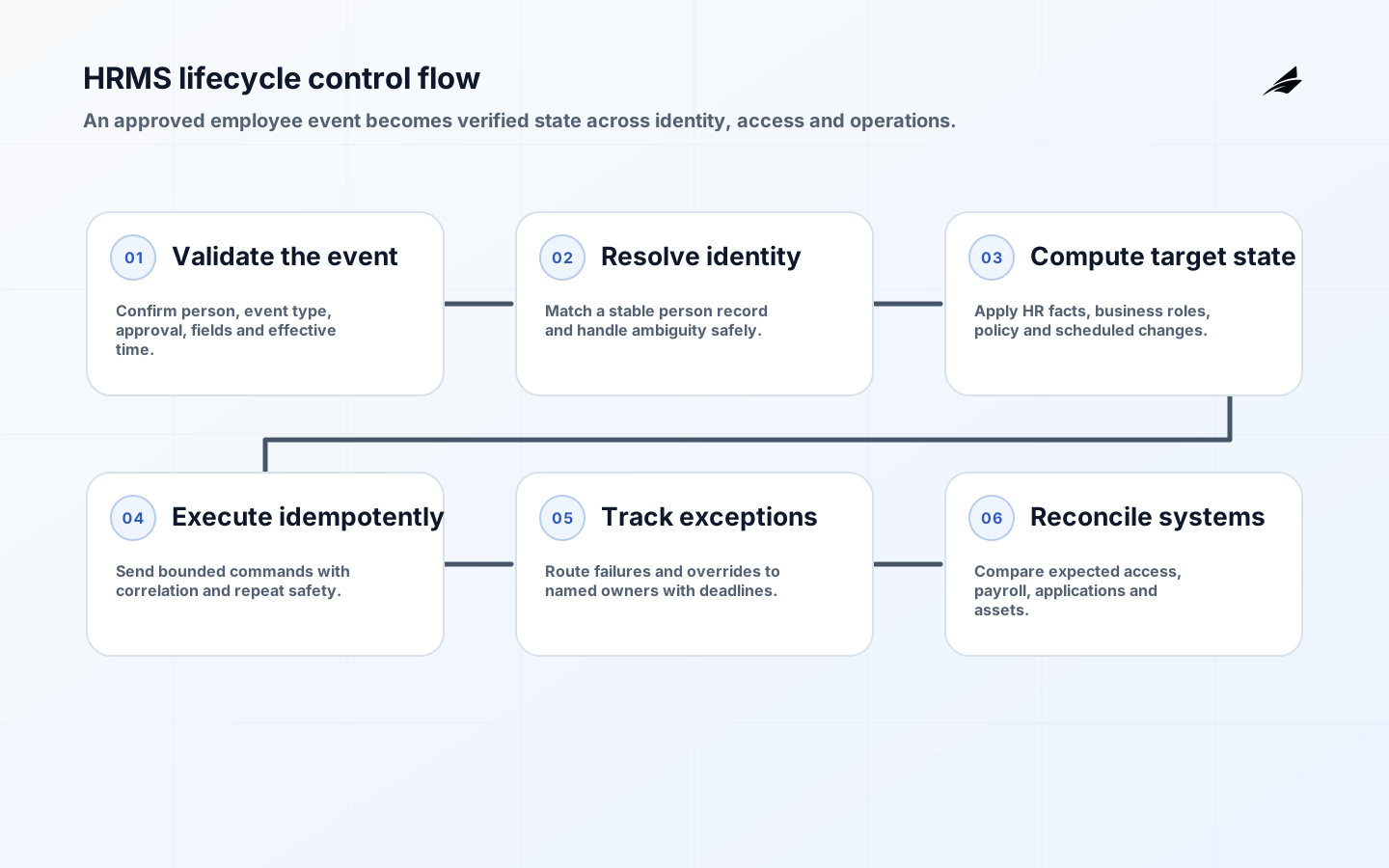
Validate the event and required fields, establish effective time, resolve the stable person, compute target state, create idempotent downstream commands, wait for results, then reconcile. Keep orchestration state durable so a timeout does not create duplicate accounts or lose a partial failure. Every connector should return an outcome tied to the source event. Queue unresolved work with owner, deadline and reason. A dashboard should distinguish scheduled, in progress, completed, failed, manually overridden and reconciled states. The multi-team HRMS checklist can support implementation review.

| Control point | Evidence | Exception owner |
|---|---|---|
| Source validation | Approved event, person ID and effective time | HR operations |
| Identity match | Unique identity correlation or reviewed ambiguity | Identity team |
| Authorization | Role or entitlement decision and policy version | Business and security owner |
| Downstream execution | Connector response and correlation ID | Application owner |
| Reconciliation | Expected state compared with actual state | Workflow operations |
| Appeal or correction | Reason, authority and resulting changes | HR or designated case owner |
Keep role and access decisions explicit
Employment attributes can inform access, but a title-to-permission mapping is rarely sufficient. Define baseline access by worker type and location, then add business roles with named owners, segregation-of-duties checks and expiry. NIST’s RBAC project explains role-based access as permissions associated with roles rather than directly with users. Use that model where responsibilities are stable, but handle contextual and exceptional access deliberately. For transfers, decide whether to remove old access before, at or after new access begins. Review residual groups, API tokens, shared secrets and active sessions, not only directory accounts.
Protect sensitive workforce data
Minimize attributes sent to each downstream system and document purpose, retention and access. Encrypt transfers, authenticate workloads, rotate credentials and restrict connector scopes. Avoid placing medical, disciplinary or compensation details into broad event payloads or logs. The GDPR’s data-processing principles include purpose limitation, data minimization, accuracy, storage limitation and integrity/confidentiality; apply relevant legal requirements with qualified counsel. NIST’s Digital Identity Guidelines can inform identity proofing, authentication and lifecycle controls. Preserve an audit trail without creating a second uncontrolled HR database.
Handle time, ordering and correction
Use an authoritative timestamp and timezone, and distinguish when a decision was recorded from when it takes effect. Events can arrive late or out of order; compare version or effective sequence before applying. A manager correction should supersede an earlier event without replaying unrelated actions. For scheduled departures, protect the event from broad visibility while ensuring access ends on time. For immediate containment, provide a security path that can suspend access before HR processing finishes, then reconcile the case. Test daylight-saving changes, payroll cutoffs, rehires with old accounts and overlapping contracts.
Reconcile outcomes and operate exceptions
Periodically compare active workers with identities, privileged roles, application accounts and assigned assets. Reconciliation should produce owned cases, not merely a report. Track provisioning latency, first-day readiness, deprovisioning completion, failed connectors, duplicate identities, residual access, manual overrides and correction time. Sample completed cases for accuracy. The HRMS security review adds threat scenarios for authorization, sensitive data and auditability. Exercise connector outage, partial completion and restoration so manual continuity does not bypass the evidence chain.
Roll out one event and population at a time
Begin with a well-understood worker population and one lifecycle event, often standard hires or departures. Run in report-only mode, compare proposed target state with current manual decisions, then automate bounded actions. Keep HR, identity and application owners in the feedback loop. Expand only after exception volume and reconciliation are supportable. Publish responsibilities and service targets so managers know where to correct source data and where to escalate a missed action.
Practical review checklist
- Create a field-level authority matrix before connecting systems. For every attribute, state who may originate, correct and consume it, and prevent downstream convenience updates from silently overwriting the authoritative value.
- Represent scheduled events separately from executed state. Managers and support staff should be able to see what will happen, what has happened and which dependent action is still waiting without exposing confidential reasons.
- Use synthetic employees and isolated downstream tenants to test hire, transfer, leave, return and departure. Include duplicate events, out-of-order delivery, connector timeout and a correction after partial completion.
- Require application owners to define account suspension, retention, ownership transfer and deletion behavior. A generic deprovision command cannot decide how customer cases, approvals, documents or shared resources survive a departure.
- Create an emergency termination path with tightly limited authority, rapid identity containment and later HR reconciliation. Exercise it outside office hours and verify active sessions and privileged non-directory credentials.
- Report first-day readiness and departure completion from actual downstream state, not from messages sent. Sample completed workflows and investigate recurring manual overrides as design signals.
A worked operating example
For a location transfer, the workflow might receive an approved future effective date from HR, preserve the employee’s stable identity, calculate the new manager and baseline access, and request specialist roles from their business owners. Before the date, it stages a device shipment and records pending changes without prematurely removing current access. At the effective time, it applies approved changes with idempotency keys, records each connector result and opens cases for failures. Reconciliation compares the expected identity, payroll location, application roles and asset custody with actual systems. If the event is corrected, the workflow creates a new version and changes only affected targets. This pattern avoids treating a transfer as a destructive departure and rehire, which can lose history or create duplicate identities. It also gives support a truthful view of partial progress instead of a sequence of emails that each claims the process is complete.
Frequently asked questions
Does SCIM solve HRMS workflow planning?
SCIM standardizes useful resource schemas and provisioning protocol behavior, but it does not define your employment events, role policy, effective dates, approvals, exception ownership or reconciliation. Treat it as an integration contract inside a governed lifecycle workflow.
Should departure delete every account?
Not automatically. Some records must be retained, ownership transferred or access suspended before deletion. Define the required end state per system and jurisdiction. The essential outcome is timely loss of unauthorized access plus traceable handling of retained records and assets.
Conclusion
Sound HRMS workflow planning makes employee changes complete across organizational boundaries. Stable identity, authoritative fields, explicit access policy, effective-time handling, idempotent connectors and reconciliation let IT managers automate safely without hiding exceptions. Begin with a bounded event, prove the outcome and expand from operating evidence.