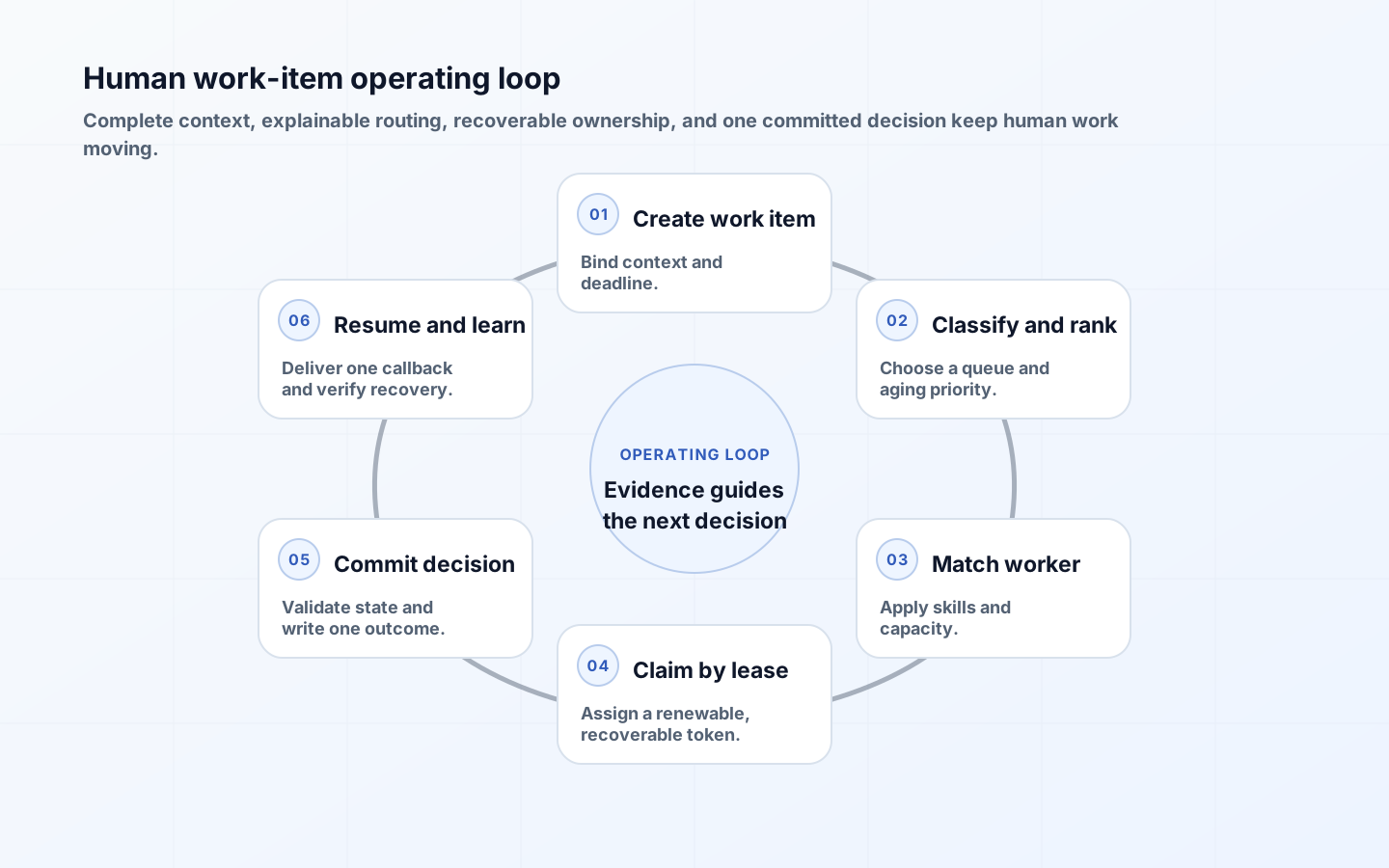
Human work queue automation coordinates cases that require judgment, authority, clarification, or recovery after automated processing stops. A shared inbox is not a queue design: it lacks stable identity, explicit ownership, priority policy, capacity awareness, safe claiming, reassignment, and evidence about completion. As volume grows, urgent work is cherry-picked while old or ambiguous cases quietly age.
Treat the queue as an operational product. Every work item should be complete enough to decide, routed to eligible people, claimed under a recoverable lease, measured against a business deadline, and closed with a structured outcome that resumes the workflow exactly once. Supervisors need controls for capacity and exceptions; workers need a fast, accessible interface that explains why the item is present and what decision is expected.
Define a complete and immutable work-item contract
Give each item a stable ID, business entity and workflow correlation, task type, reason, creation time, due time, priority inputs, required skills and authority, data classification, permitted actions, and current state. Include a concise summary and links or snapshots of decision evidence. Record the automation step that paused and the callback contract it expects. The worker should not reconstruct context from several systems before knowing what action to take.
Separate immutable facts from mutable routing fields. Source event, reason, policy version, and evidence digest remain historical. Queue, priority, assignee, lease, due date adjustment, and escalation state can change through recorded transitions. Avoid copying unrestricted sensitive data into the queue; retrieve protected details under the worker's authorization. Version the item schema so older open work remains readable after the interface or workflow changes.
| Work-item field | Purpose | Mutable? | Validation |
|---|---|---|---|
| Business and workflow IDs | Correlate decision to source obligation | No | Must resolve to one active or historical instance |
| Reason and evidence version | Explain why human judgment is required | Append evidence; do not replace history | Digest and source timestamp retained |
| Required skill and authority | Restrict eligible workers and actions | Yes through governed reroute | Current role checked again at claim and decision |
| Due time and priority inputs | Drive ordering and escalation | Policy-controlled | Timezone, calendar, and override reason recorded |
| Terminal disposition | Resume or close the business process | Write once with correction process | Allowed transition and idempotent callback |
Create queues around operating capability
Use a small taxonomy based on work ownership and skill, such as payment exceptions, identity review, contract data repair, or device support. Avoid one queue per application screen or every organizational subdivision; fragmentation hides shared capacity and complicates transfer. Also avoid one enterprise queue with hundreds of task types. Define each queue's accepted item types, hours, owning team, skills, authority, service objective, overflow route, and continuity procedure.
Classification determines the eligible queue before assignment selects a worker. Microsoft describes unified routing in these two stages: incoming work is classified, then prioritized and assigned using requirements, skills, capacity, availability, and related rules. Keep this separation explicit. A misclassified item should be corrected and the routing defect measured, rather than handled indefinitely by whoever happened to receive it.
Prioritize with explainable policy and aging protection
Calculate priority from business consequence, due-time proximity, customer vulnerability or contractual class where lawful, dependency blocking, and age. Store the component values, policy version, final band or score, and a short explanation. Do not let raw monetary value erase safety, regulatory, or customer deadlines. Use discrete bands for understandable operations and deterministic tie-breakers such as earliest due time, then oldest creation time.
Recalculate when relevant facts change, but preserve previous values. Add aging so lower-priority work eventually rises or escalates. Manual priority overrides require a reason, actor, expiry, and audit trail. Monitor priority inversion: high bands consistently filled with weakly urgent cases while older work breaches. A queue should expose due time and consequence, not use alarming colors without text or make workers guess why one item outranks another.
Match skills, authority, availability, and capacity
Eligibility is a hard constraint: skill, jurisdiction, language, certification, segregation-of-duties rule, data access, and decision authority. Ranking then considers capacity, workload, proficiency, continuity, and fairness. Presence alone is not capacity; a worker may be online but already own complex cases. Assign workload units by task type or estimate, and cap concurrent active leases. Let supervisors adjust capacity for a shift while preserving why and for how long.
Choose pull, push, or blended assignment deliberately. Pull gives workers autonomy but encourages cherry-picking unless list views and policy constrain selection. Push improves distribution but can overwhelm people and misroute unfamiliar work. A blend can push urgent or specialized items while permitting controlled picking from eligible queues. Microsoft documents FIFO, highest-capacity, round-robin, and custom prioritization approaches; test fairness and outcome, not only utilization.
| Assignment model | Strength | Risk | Control |
|---|---|---|---|
| FIFO pull | Simple and transparent | Workers may select around difficult items | Limit eligible views and track skipped or released work |
| Priority push | Fast response to urgent cases | Repeated interruption and worker overload | Concurrency cap and protected focus period |
| Round robin | Fair item count distribution | Ignores task complexity | Capacity units and skill eligibility |
| Highest capacity | Uses available workload headroom | Estimates may be stale or gameable | Reconcile estimates with actual handling effort |
| Continuity routing | Keeps related cases with a knowledgeable worker | Creates dependency on one person | Backup eligibility and age-based release |
Claim work with a renewable, recoverable lease
Assignment should create a lease, not an irreversible ownership flag. Atomically transition available to claimed with worker, claim time, lease expiry, and item version. The worker renews while active. If their session ends, they go off shift, or the lease expires without progress, the system returns the item to an eligible state after checking whether a decision already committed. This prevents work from disappearing in a personal list.
Protect against two workers acting simultaneously. Decision submission includes item ID, expected version, lease token, selected outcome, reason, and evidence. The server checks current authority and state, commits one terminal transition, and rejects stale attempts with the accepted result. Do not depend on a disabled button in the browser. Save drafts separately from decisions and make autosave visible so a lease recovery does not mistake typing for a committed business action.
Make reassignment and escalation first-class transitions
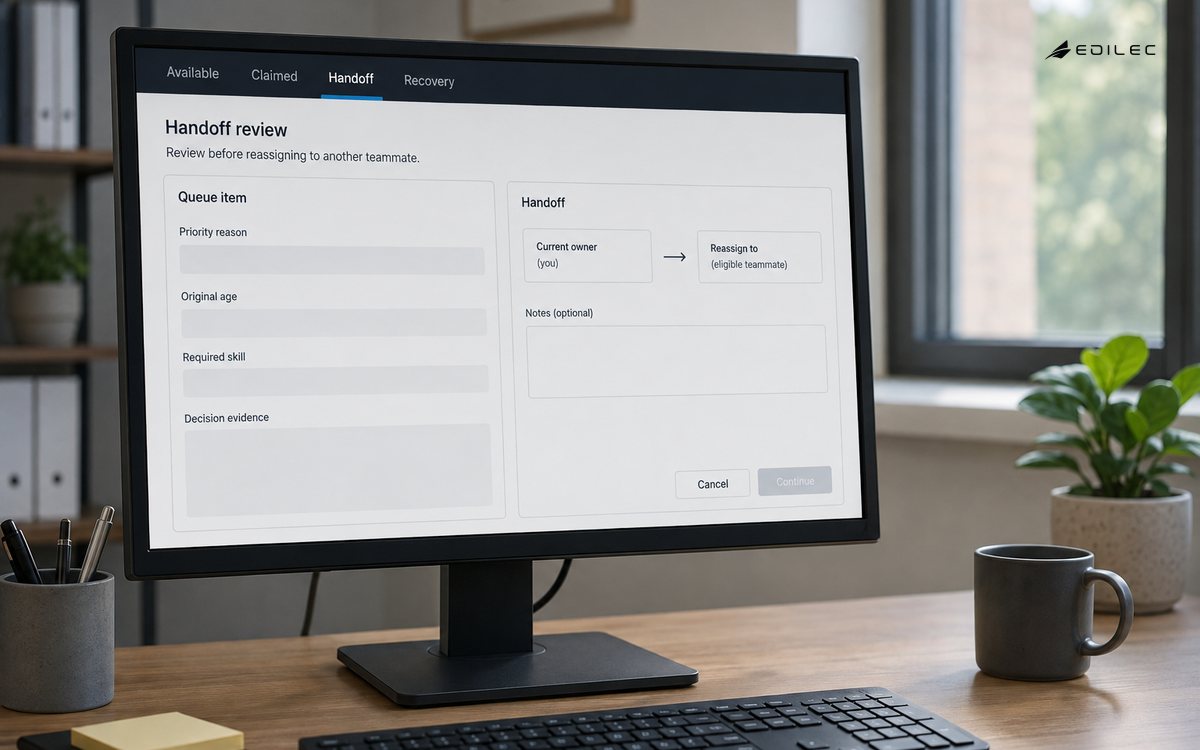
Support release by worker, supervisor transfer, skill-based reroute, shift handoff, absence recovery, and queue overflow. Every transition keeps the item identity and records from, to, reason, actor or rule, timestamp, notes, and retained draft policy. Transfer should not reset original age or erase a service breach. Require a concise handoff note for complex active work, but do not force narrative when the structured state is sufficient.
Escalation changes attention, authority, or route; it should not create duplicate items. Define reminders, supervisor alerts, priority changes, queue transfer, and executive or control-owner escalation as separate actions. Trigger them from time remaining and impact, not only elapsed age. When no eligible worker exists, surface a capacity exception immediately rather than cycling assignment silently. Maintain a continuity queue or manual procedure for platform outage.
Resume automation exactly once after a decision
A terminal human action should atomically close the task and create an outbox event or callback record containing task ID, workflow ID, decision, actor, policy version, and evidence reference. A relay can deliver it repeatedly with one stable event ID; the workflow handles duplicates idempotently. This avoids a gap where the item appears completed but the automation never resumes, or where a callback succeeds and the UI retries into a second effect.
If downstream resumption fails, show the item as decision completed, workflow recovery pending rather than reopening it for another judgment. Route the technical failure to a recovery queue with the accepted decision attached. A correction to a human decision should be a governed new action with authority and business consequence analysis, not a database edit. Preserve who decided what and what later changed.
Design an efficient and accessible worker experience
The main view needs stable columns for priority reason, due time, age, task type, customer or entity summary, current owner, and status, with filters and saved views. Keep layout stable during refresh and announce meaningful changes. For an interactive data grid, follow established keyboard focus behavior and accessible names. W3C's ARIA grid pattern explains that composite grids require managed focus and directional navigation; a plain semantic table may be better when cells are not interactive.
The decision view should put reason, requested action, key facts, evidence, and allowed outcomes before secondary history. Warn about material consequences in context, require reasons only where they serve policy, and confirm irreversible actions. Test with keyboard, screen reader, zoom, high contrast, long translations, and realistic queue volumes. Measure time spent searching and switching systems, because poor context design transfers automation effort to workers.
Measure flow, fairness, quality, and recovery
Track arrivals, completions, backlog, oldest age, age distribution, time to claim, active handling, waiting on dependency, decision-to-resume delay, breaches, transfers, releases, expired leases, and technical recovery. Segment by task type, impact, priority, skill, shift, and route. Report percentiles rather than averages alone. Distinguish working time from calendar age and external waiting so staffing and dependency problems are visible separately.
Review outcome consistency, correction rate, escalation, rework, and sampled decision quality without turning queue statistics into simplistic employee rankings. Compare allocation and outcomes for fairness where the process affects people. Audit excessive overrides, cherry-picking, stale ownership, inaccessible records, and systematic routing errors. Capacity planning should combine arrival rate, handling effort, absence, skill coverage, and burst scenarios, then test overflow before peak periods.
Key takeaways
- Give every human task stable identity, complete decision context, explicit allowed outcomes, and an immutable source history.
- Separate classification, priority, eligibility, and assignment so each routing decision can be explained and improved.
- Use capacity-aware leases and optimistic decision commits to prevent stranded or double-handled work.
- Escalate and reassign the same item without resetting age, duplicating the obligation, or losing handoff evidence.
- Close the task and enqueue workflow resumption together, then measure business recovery as well as handling time.
Frequently asked questions
Should workers choose their own items? Pull can work for similar low-risk tasks when eligibility and aging are enforced. Push or blended assignment is better when urgency, scarce skills, fairness, or continuity matter. Monitor selection behavior and business outcomes.
What happens when a lease expires? First check for an accepted terminal decision or active downstream effect. If none exists, return the item to eligible work with history preserved, notify or reconcile the previous worker's draft according to policy, and record the recovery transition.
Is an SLA breach a new priority? It may change priority or escalate authority, but keep the original due time and breach evidence. Resetting the clock on transfer or escalation hides service failure and makes capacity planning unreliable.
Conclusion
A human queue is part of the automation's control plane, not an inbox at its edge. Complete work records, explainable priority, qualified routing, recoverable leases, accessible decisions, and exactly-once resumption preserve accountability when people enter the process. Designed this way, the queue improves both throughput and judgment instead of merely collecting exceptions.