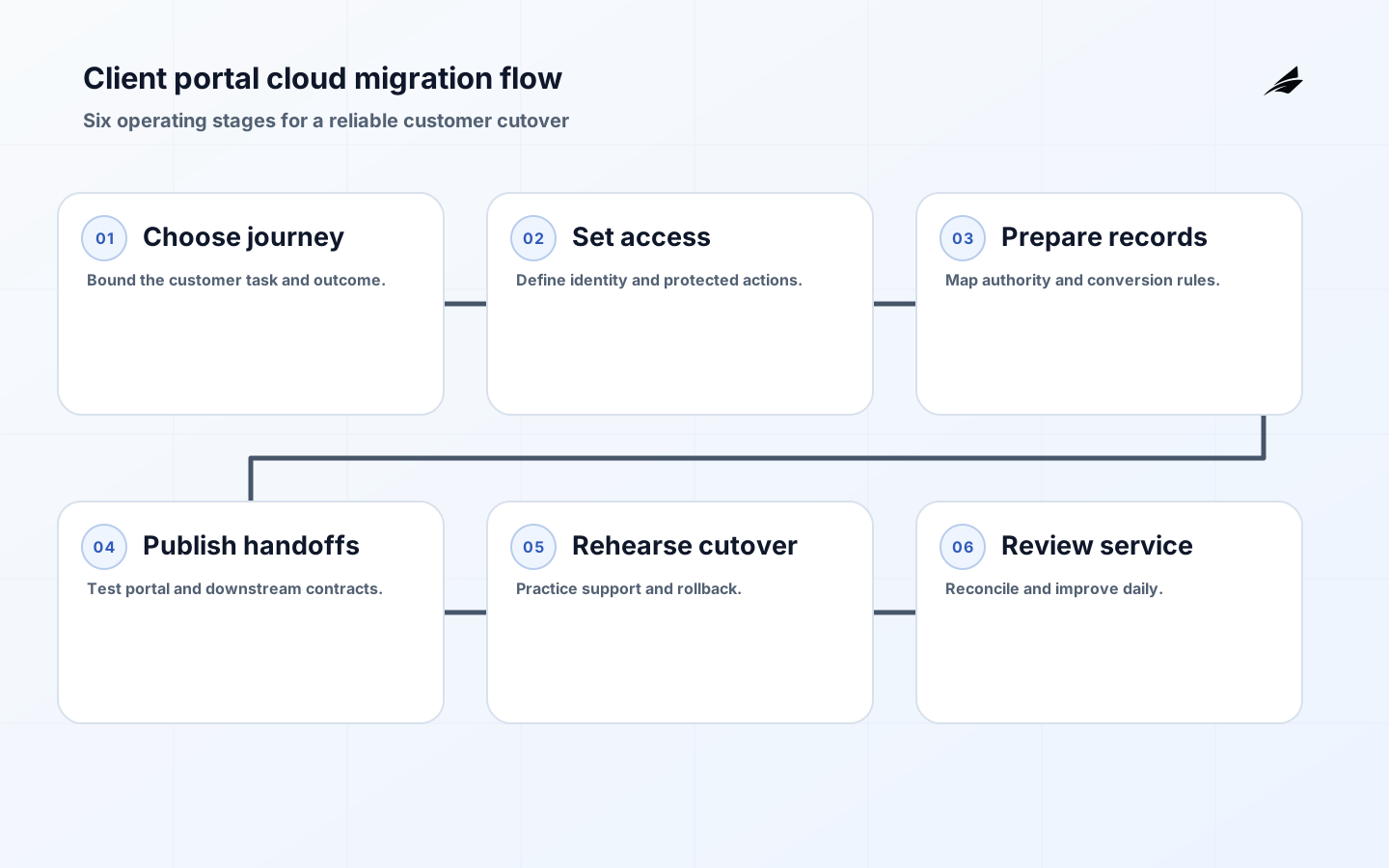
A client service portals checklist for a cloud migration starts with customer work, not the hosting destination. Follow a recent customer from sign-in through a request, an attachment, a status update, and a resolution. Record which identity proves access, which system owns each fact, which staff member may change it, and how a customer learns that work has moved. This exposes the compromises hidden in an old portal: shared accounts, emailed documents, copied status notes, and staff who repair failed requests by hand. A migration succeeds when the customer can still complete a meaningful task and the service team can explain, correct, and evidence every material step.
Scope one customer journey before selecting migration work
Choose a journey with genuine service value, such as submitting a change request and receiving a confirmed appointment. Define completion in business language: the right customer can submit the request, staff can verify it, the downstream system receives it once, and the customer sees a trustworthy outcome within a stated service target. Include routine, incomplete, duplicate, and unauthorized cases. Do not call page rendering or a successful API response completion. The accountable service owner should agree the outcome, while the technical owner documents dependencies, operational limits, and the evidence retained for later investigation.
| Journey decision | Migration rule | Evidence |
|---|---|---|
| Identity | Map each customer to one supported authentication and recovery path. | Sign-in, reset, and account-link test cases. |
| Record authority | Name the system allowed to correct contact, entitlement, and case facts. | Field ownership register and change history. |
| Customer notice | Define what status is safe to display and when it is fresh enough. | Timestamp, source, and plain-language status. |
| Service failure | Route a failed handoff to a monitored queue rather than an inbox. | Case identifier, owner, and response target. |
Design access and data boundaries
Access is an action decision, not a screen decision. Separate reading a case, uploading evidence, changing a delivery address, approving a charge, and exporting records. For each action, state the customer relationship required, the organization boundary, device or session constraints, and the result when the check cannot be made. Keep personal data out of a portal payload unless it is needed for that task. A customer may need a concise service status without seeing internal staff notes, risk flags, or another account's history. Log authorization decisions and sensitive changes in a form support staff can use without exposing secrets.
Prepare data and integrations for the cutover
Inventory data by purpose rather than exporting every old table. For each record, decide whether to migrate, archive with retrieval instructions, regenerate from the authoritative system, or retire. Preserve stable customer and case identifiers, effective dates, consent or notice context where relevant, and a clear link from an old reference to a new one. Publish an integration contract that names required fields, allowed states, duplicate behavior, time expectations, and the owner of rejection handling. Run a reconciliation that compares counts and material values between source and destination; sampling polished records alone will not reveal missing or incorrectly linked customer work.

| Cutover risk | Control before release | Owner |
|---|---|---|
| A customer has two legacy identities | Resolve or link identities under an approved matching rule. | Service data steward |
| A request is submitted twice | Use an idempotency key and show the existing request. | Portal engineering lead |
| A downstream system is unavailable | Accept only when durable queueing and a status explanation exist. | Integration operations |
| A migrated case is wrong | Provide a correction path that preserves the original evidence. | Service operations manager |
Rehearse service continuity with the people who answer customers
A cutover plan needs business rehearsal, not only infrastructure rehearsal. Ask agents to locate a migrated case, explain an ambiguous status, link a duplicate identity, and assist a customer whose request is delayed. Test a failed notification, a stale session, a missing attachment, and a rollback decision. Write down who can pause a workflow, where customers are directed during a disruption, and which records may be updated in each environment. The first operating days should have a named command rhythm: review aged requests, login failures, reconciliation differences, contact volume, and unresolved exceptions at predictable times.
Measure trust and operations together
Portal adoption alone can reward a confusing self-service experience. Pair usage measures with customer task completion, time to first meaningful response, correction rate, failed authorization rate, and aged handoffs. Define the population and exclusions before a dashboard is published. Review a small set of customer narratives beside the numbers, because a customer who starts in the portal and then calls may be signalling an unclear rule rather than low demand. Make measures actionable: a rising identity-link failure belongs with the team that owns matching, while an aged request belongs with the queue owner who can remove the block.
Release checklist
- Name the customer journey, its outcome, and its service owner.
- Test customer identity, authorization, recovery, and account-linking paths.
- Document field authority and reconcile migrated records to the source.
- Publish integration behavior for duplicates, rejection, delay, and correction.
- Rehearse support, outage communication, rollback, and exception ownership.
- Review customer outcomes and operational evidence daily after release.
Frequently asked questions
Should every legacy portal feature migrate? No. Migrate a feature when it supports a current customer task, has an accountable owner, and can be operated safely in the target environment. Retire functions that exist only because staff lack a documented process, but provide an alternative route before switching them off. A small, dependable first release is usually more valuable than a feature-complete portal with uncertain ownership.
How long should parallel running last? Use evidence, not a calendar, to decide. Maintain the old route only long enough to reconcile active work, verify identity and request handling, and prove support can recover normal failures. Parallel systems can create their own risk when staff update different records. State which system is authoritative during each phase and how late changes are captured.
Implementation evidence worksheet
- Portal migration checkpoint 1: Write the business outcome in one sentence and name the person who can accept that outcome on behalf of the organization.
- Portal migration checkpoint 2: List every material state, its entry condition, its permitted next states, and the evidence that proves a change is legitimate.
- Portal migration checkpoint 3: Create a field register for identifiers, effective dates, owner, sensitivity, source, consumer, and correction route before configuring automation.
- Portal migration checkpoint 4: Run a normal case and a deliberately incomplete case with the people who will operate the process; capture every manual step and undocumented decision.
- Portal migration checkpoint 5: For every handoff, state what the sender guarantees, what the receiver validates, how duplicate delivery is handled, and who owns a rejection.
- Portal migration checkpoint 6: Define a customer-safe or requester-safe status for each delay so frontline staff can explain progress without exposing internal notes or speculation.
- Portal migration checkpoint 7: Prepare a reconciliation that compares counts, material values, state, and age between the initiating record and the resulting operational record.
- Portal migration checkpoint 8: Choose thresholds that open owned work rather than merely sending alerts; record the queue, service target, escalation point, and recovery authority.
- Portal migration checkpoint 9: Test a failed dependency, an out-of-order update, an unauthorized action, and a correction after downstream work has begun; retain the resulting evidence.
- Portal migration checkpoint 10: Document which roles may read, change, approve, export, administer, or override the process, including temporary access and delegated authority.
- Portal migration checkpoint 11: Keep original context when a fact is corrected: prior value, source, time, actor or process, reason, approving authority, and correlation identifier.
- Portal migration checkpoint 12: Publish the smallest useful contract for each interface or report: purpose, scope, required inputs, freshness expectation, limits, owner, and support route.
- Portal migration checkpoint 13: Rehearse a support conversation around a confusing or delayed case so the communication path is as deliberate as the technical recovery path.
- Portal migration checkpoint 14: Inspect a sample of completed cases for evidence quality, not only elapsed time; a quick result that cannot be explained is not an operational success.
- Portal migration checkpoint 15: Set a release decision with explicit go, hold, and rollback criteria, and identify who can make each decision when information is incomplete.
- Portal migration checkpoint 16: Use a short post-release review cadence that pairs operational measures with a few real cases and records a single accountable improvement for each finding.
- Portal migration checkpoint 17: Version rules, definitions, mappings, and approval thresholds. Explain historical comparison breaks rather than silently replacing prior meaning.
- Portal migration checkpoint 18: Minimize the data carried into the workflow or view, and review access, retention, sharing, and export behavior against the stated business purpose.
- Portal migration checkpoint 19: Identify the workaround that experienced staff use today, then decide whether the target design should formalize, retire, or replace it with an owned exception.
- Portal migration checkpoint 20: Give every exception a stable identifier, severity, current state, next action, accountable owner, and a link to the business record it affects.
- Portal migration checkpoint 21: Confirm training with hands-on completion of a real task and an exception, rather than attendance alone; update the runbook from what the exercise reveals.
- Portal migration checkpoint 22: Review recurring overrides and repeated corrections as design evidence. They often signal unclear policy, bad data, missing capacity, or a brittle integration.
- Portal migration checkpoint 23: Protect audit and operating evidence from routine cleanup. Retention and retrieval instructions should let a future reviewer reconstruct a material decision.
- Portal migration checkpoint 24: End the implementation review by deciding what evidence would prove the next expansion is safe, useful, and supportable for the people doing the work.
Key takeaways
- Start with a customer outcome and a named service owner.
- Treat identity, data authority, and recovery as part of the portal design.
- Reconcile records and rehearse support before the production cutover.
- Measure completed customer work alongside technical availability.
Conclusion
Cloud migration becomes credible when client service portals continue to make customer work clear, bounded, and recoverable. Scope a real journey, preserve authoritative records, make access decisions explicit, and give service teams visible evidence when a handoff fails. That discipline lets an organization reduce legacy risk without asking customers or staff to absorb the uncertainty of the change.