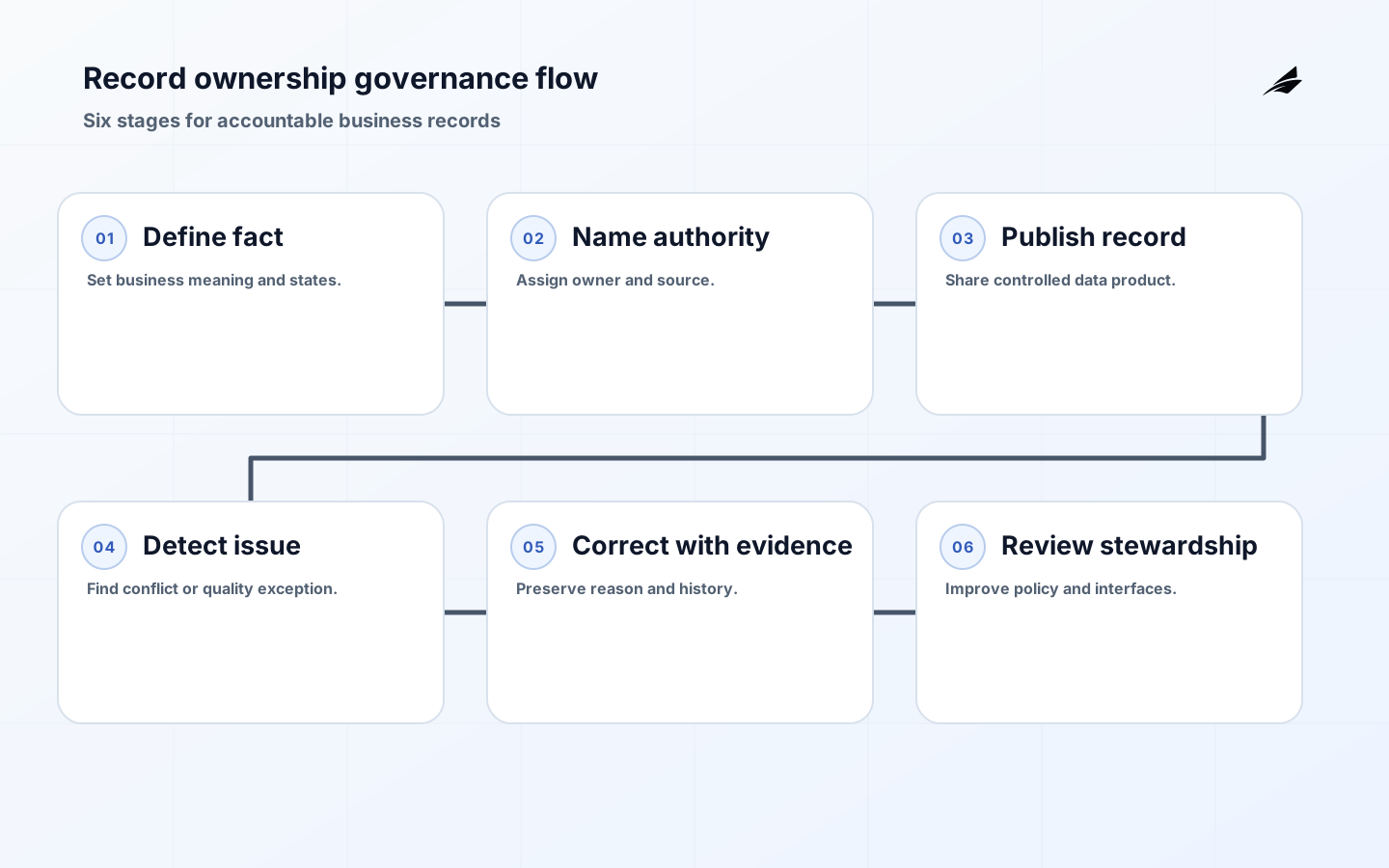
A record ownership models checklist for reporting and governance is a way to settle a practical question before it becomes a reporting dispute: who is allowed to say what a business fact means, change it, and explain how it reached a report? Ownership is not the same as application administration. A platform team can operate a database while a finance, service, or commercial steward owns the definition and correction of a record. Start with high-consequence facts such as customer, contract, product, employee, invoice, or entitlement. Follow one fact from creation through change, consumption, correction, and archival to find the true decision points.
Separate ownership dimensions
Assign distinct roles for business definition, technical custody, data quality stewardship, access approval, and reporting use. One person or team may hold more than one role in a small organization, but the responsibilities should remain distinguishable. The business owner defines what a valid customer or contract is; the technical custodian provides availability and change control; the steward resolves quality exceptions; an access owner approves protected use; and a report owner documents interpretation. This avoids the familiar escalation where an analyst is asked to fix a business definition or a service manager is asked to resolve a pipeline failure they cannot control.
| Ownership question | Named role | Operating proof |
|---|---|---|
| What does this record mean? | Business owner | Definition, state model, and permitted changes. |
| Where is the authoritative version? | System custodian | Source register and availability responsibility. |
| Who fixes a suspected error? | Data steward | Exception queue and correction decision. |
| Who can use sensitive detail? | Access owner | Policy, approval, and periodic review. |
Create an authority register at field and lifecycle level
A source register that says only 'CRM owns customer' is usually too broad. Customer legal name, service contact, billing address, consent status, credit terms, and marketing preference may have different authorities and effective dates. Document the source allowed to create, modify, approve, and retire each material field. Include how a downstream system proposes a correction without overwriting the authoritative fact. When systems must display a replicated value, label the freshness expectation and behavior when it is stale. This turns integration design into a governed publication model rather than a contest between teams with edit access.
Design correction and lineage as first-class work
Records are not trustworthy because they never change; they are trustworthy because justified change is visible. Preserve the prior value, source, actor or process, decision reason, effective time, and correlation identifier for consequential corrections. Avoid deleting the evidence needed to explain an invoice, entitlement, or regulatory decision. A correction workflow should distinguish a typo, a late-arriving fact, a disputed fact, and a policy override, because they need different authority and reporting treatment. Reports should be able to state which version they used and whether a later correction changes interpretation.

| Situation | Correction rule | Reporting treatment |
|---|---|---|
| Obvious data entry error | Authorized steward corrects with reason and history. | Restate only views whose definition requires it. |
| Late effective change | Record event and effective time separately. | Show as-of and current perspectives. |
| Conflicting sources | Protect authority and open a reconciliation case. | Flag affected report scope until resolved. |
| Policy override | Require delegated approval and evidence. | Expose override population for review. |
Govern reporting consumption without slowing useful work
Publish certified data products for recurring decisions, with an owner, intended use, refresh expectation, and known limitations. This does not prohibit exploration; it gives exploratory work a clear path before it is presented as official. For sensitive records, use minimum necessary attributes, aggregation, masking, or controlled drill-down. Keep a record of material extracts and sharing arrangements. When a team finds a new business question, let it create a candidate metric and source mapping, then review it with the relevant owners. Governance is strongest when it helps work move safely instead of forcing every question into an untracked spreadsheet.
Run stewardship reviews on real exceptions
A monthly committee that discusses abstract quality scores rarely changes a record model. Review a small set of recurring exceptions: duplicate accounts, conflicting entitlement dates, unexplained report movements, inaccessible customer records, or corrections that arrived too late. Ask which policy, identifier, interface, or training gap made the exception likely. Track the age and recurrence of open exceptions, the time to correction, and the number of manual overrides. Assign changes to owners and verify their effect in the next review. This establishes governance as an operating practice, not a document that appears only during audits.
Implementation checklist
- Name business, technical, stewardship, access, and reporting responsibilities.
- Document authority by material field and lifecycle action.
- Keep correction reason, actor, source, time, and prior value where consequences matter.
- Publish certified reporting products with scope and limitations.
- Use actual exception cases to improve the ownership model.
- Review access and authority when teams or systems change.
Frequently asked questions
Can one system be authoritative for every customer field? Sometimes, but assume this only after checking the lifecycle. A service system may be authoritative for delivery contact, while finance owns billing terms and a consent service owns communication preferences. The key is to make the boundary visible and give downstream teams a safe correction route.
Does ownership require a central data governance office? No. Central coordination can help with shared standards, but business owners and stewards must remain close to the work that gives a fact meaning. Start with the records that drive important decisions and build a lightweight register people use.
Implementation evidence worksheet
- Record ownership model checkpoint 1: Write the business outcome in one sentence and name the person who can accept that outcome on behalf of the organization.
- Record ownership model checkpoint 2: List every material state, its entry condition, its permitted next states, and the evidence that proves a change is legitimate.
- Record ownership model checkpoint 3: Create a field register for identifiers, effective dates, owner, sensitivity, source, consumer, and correction route before configuring automation.
- Record ownership model checkpoint 4: Run a normal case and a deliberately incomplete case with the people who will operate the process; capture every manual step and undocumented decision.
- Record ownership model checkpoint 5: For every handoff, state what the sender guarantees, what the receiver validates, how duplicate delivery is handled, and who owns a rejection.
- Record ownership model checkpoint 6: Define a customer-safe or requester-safe status for each delay so frontline staff can explain progress without exposing internal notes or speculation.
- Record ownership model checkpoint 7: Prepare a reconciliation that compares counts, material values, state, and age between the initiating record and the resulting operational record.
- Record ownership model checkpoint 8: Choose thresholds that open owned work rather than merely sending alerts; record the queue, service target, escalation point, and recovery authority.
- Record ownership model checkpoint 9: Test a failed dependency, an out-of-order update, an unauthorized action, and a correction after downstream work has begun; retain the resulting evidence.
- Record ownership model checkpoint 10: Document which roles may read, change, approve, export, administer, or override the process, including temporary access and delegated authority.
- Record ownership model checkpoint 11: Keep original context when a fact is corrected: prior value, source, time, actor or process, reason, approving authority, and correlation identifier.
- Record ownership model checkpoint 12: Publish the smallest useful contract for each interface or report: purpose, scope, required inputs, freshness expectation, limits, owner, and support route.
- Record ownership model checkpoint 13: Rehearse a support conversation around a confusing or delayed case so the communication path is as deliberate as the technical recovery path.
- Record ownership model checkpoint 14: Inspect a sample of completed cases for evidence quality, not only elapsed time; a quick result that cannot be explained is not an operational success.
- Record ownership model checkpoint 15: Set a release decision with explicit go, hold, and rollback criteria, and identify who can make each decision when information is incomplete.
- Record ownership model checkpoint 16: Use a short post-release review cadence that pairs operational measures with a few real cases and records a single accountable improvement for each finding.
- Record ownership model checkpoint 17: Version rules, definitions, mappings, and approval thresholds. Explain historical comparison breaks rather than silently replacing prior meaning.
- Record ownership model checkpoint 18: Minimize the data carried into the workflow or view, and review access, retention, sharing, and export behavior against the stated business purpose.
- Record ownership model checkpoint 19: Identify the workaround that experienced staff use today, then decide whether the target design should formalize, retire, or replace it with an owned exception.
- Record ownership model checkpoint 20: Give every exception a stable identifier, severity, current state, next action, accountable owner, and a link to the business record it affects.
- Record ownership model checkpoint 21: Confirm training with hands-on completion of a real task and an exception, rather than attendance alone; update the runbook from what the exercise reveals.
- Record ownership model checkpoint 22: Review recurring overrides and repeated corrections as design evidence. They often signal unclear policy, bad data, missing capacity, or a brittle integration.
- Record ownership model checkpoint 23: Protect audit and operating evidence from routine cleanup. Retention and retrieval instructions should let a future reviewer reconstruct a material decision.
- Record ownership model checkpoint 24: End the implementation review by deciding what evidence would prove the next expansion is safe, useful, and supportable for the people doing the work.
Key takeaways
- Ownership combines business authority with explicit technical and operational roles.
- Field-level authority prevents broad, misleading source-of-truth claims.
- Correction history and lineage make reports explainable.
- Exception reviews turn governance into measurable improvement.
Conclusion
Record ownership models make reporting and governance durable when each consequential fact has a visible meaning, authority, correction path, and lineage. Begin with a small set of material records, document the lifecycle decisions that surround them, and make exceptions owned work. The payoff is reporting that can be challenged and still answered with evidence.