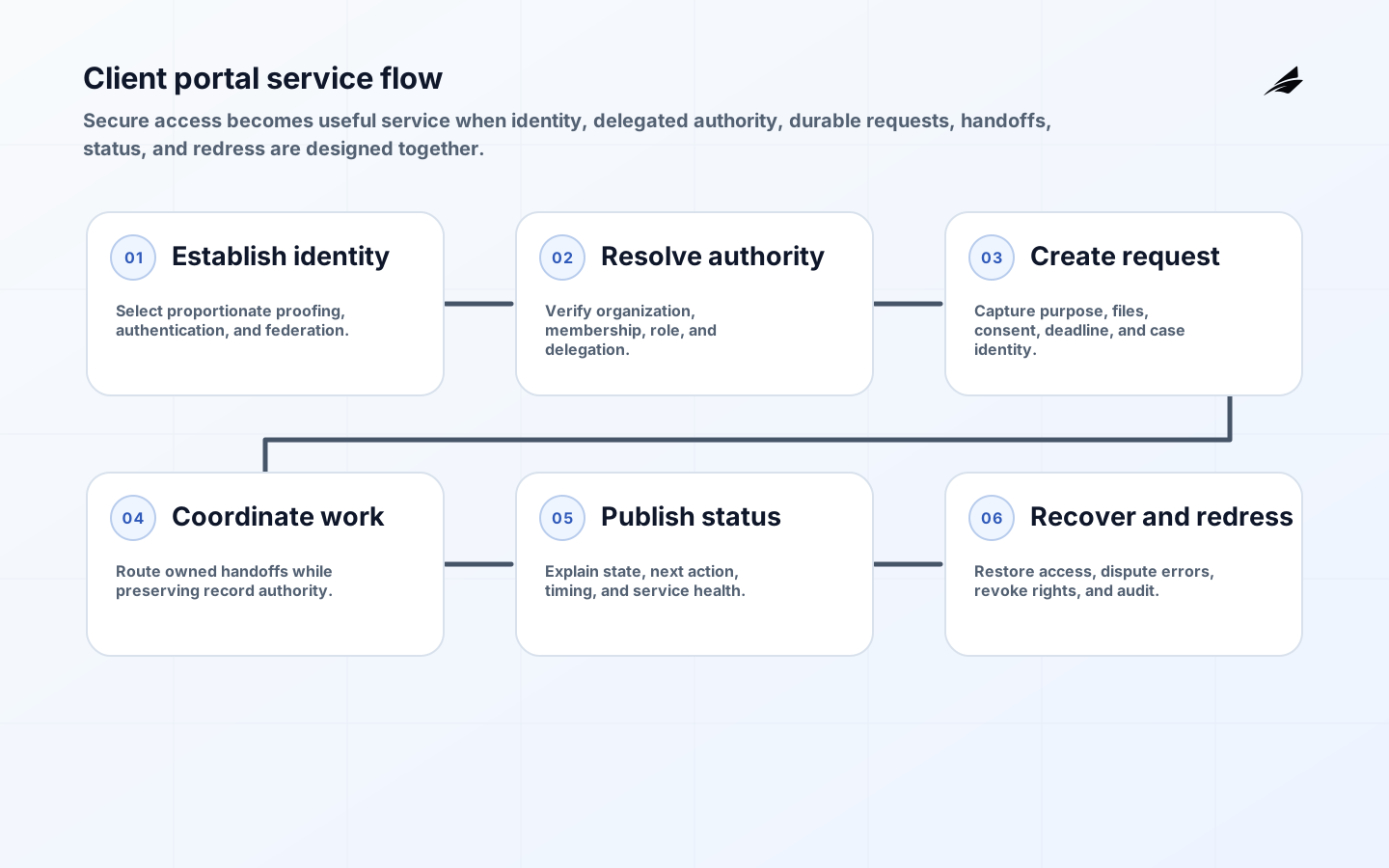
Client service portals are valuable only when they change a customer-facing request and status service in a way people can explain and operate. Start with the outcome: an authorized customer can submit or track a meaningful request, while staff can verify identity, route work, explain delay, and correct a record without exposing internal data. That framing keeps the work anchored in a real commitment rather than a collection of screens or APIs. Map the people, decisions, and records involved, including customer organization, user identity, entitlement, request, attachment, service status, staff note, notification, and audit event. Then ask what happens when a record is late, wrong, duplicated, or unavailable. The answer should name an owner and a visible recovery path. client service portals guide provides a useful companion for teams that need to turn those decisions into an implementation plan.
Define the operating outcome for client service portals
Treat the first design session as a working definition of completion. For a customer-facing request and status service, completion means that an authorized customer can submit or track a meaningful request, while staff can verify identity, route work, explain delay, and correct a record without exposing internal data. Write the normal case in plain language, then include a changed request, an incomplete request, a duplicate, a rejected handoff, and a correction after downstream work begins. This prevents a technically successful message from being mistaken for a successful business result. Name the person who can accept the outcome, the teams that act on it, the customer or colleague affected by delay, and the evidence that will show what happened.
| Decision area | Practical rule | Evidence to retain |
|---|---|---|
| Business outcome | State how an authorized customer can submit or track a meaningful request, while staff can verify identity, route work, explain delay, and correct a record without exposing internal data. | Named outcome owner and acceptance examples. |
| Authoritative facts | Identify the source and permitted changes for customer organization, user identity, entitlement, request, attachment, service status, staff note, notification, and audit event. | Fact register, identifiers, and effective dates. |
| Failure handling | Route exceptions caused by a portal makes a record visible to the wrong party or displays a reassuring status after the operational handoff has already failed. | Case identifier, queue owner, and disposition. |
| Access boundary | Apply the least access needed for the action. | Authorization decision and relevant audit event. |
Assign record authority before automating handoffs
The identity provider owns authentication, the service system owns request state, and the portal owns only the presentation and carefully limited customer actions. Put that statement beside the field and state definitions, not only in an architecture diagram. Authority answers who can correct a fact, but it also answers whose validation applies when another system sends an update. Use stable identifiers and effective dates so receivers can distinguish a new fact from a late delivery or replay. Consumers may keep a local copy for performance or operational work, but they should record its source and freshness rather than quietly becoming a second authority.
Design identity, delegation, and redress together
Enterprise clients rarely map cleanly to one person and one account. Model organizations, memberships, roles, delegated administrators, temporary access, and the separation between acting for a company and acting as an individual. NIST SP 800-63-4 frames digital identity through risk, identity proofing, authentication, federation, privacy, and customer experience; its digital identity model is a useful reminder that authentication establishes confidence in an identity, while the portal still has to make an application-specific authorization decision for each record and action.
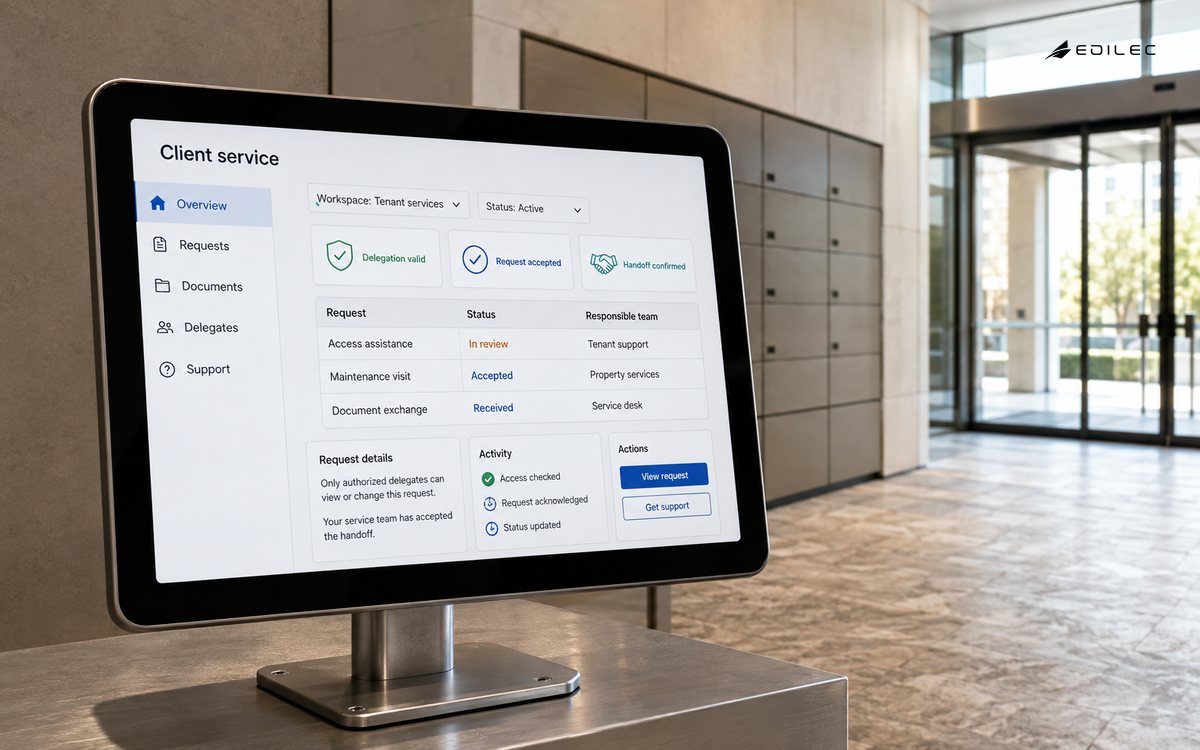
Account recovery and access disputes are part of the portal, not an external help-desk afterthought. Show how a user can challenge an incorrect organization link, revoke an administrator, recover after an authenticator loss, and obtain a record of consequential actions. Test these flows with the same care as sign-in. Edilec’s client portal architecture guide, portal planning guide, and customer portal buyer guide connect identity decisions with workflow ownership, procurement, and support.
Design the handoff contract and its boundaries
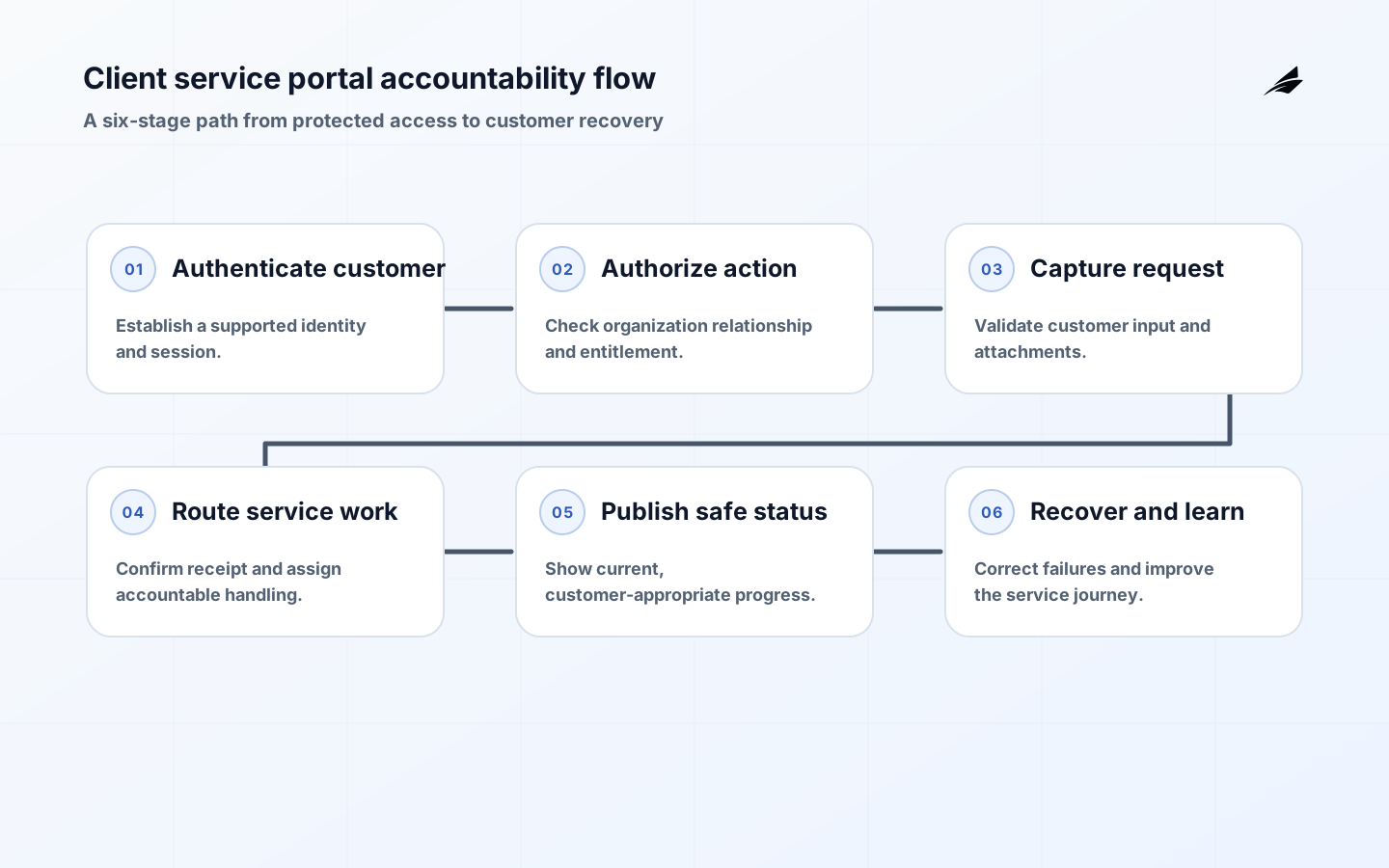
Portal access is evaluated per protected action and organization relationship; a successful sign-in alone does not authorize viewing, downloading, or changing every record. The contract should identify the event or command, required values, allowed states, source reference, freshness expectation, duplicate behavior, and response for rejection. Avoid a vague “sync everything” promise. It masks the difference between publishing a fact, requesting an action, and reporting a derived value. Use a correlation identifier across the path so support staff can move from a customer or employee question to the exact delivery, validation, decision, and result.
| Condition | Required system behavior | Accountable owner |
|---|---|---|
| Duplicate delivery | Recognize the request or event and avoid creating a second business action. | Receiving service owner |
| Invalid or incomplete data | Reject with a reason that the sending team can act on; do not silently discard it. | Source process owner |
| Dependency unavailable | Use a durable, monitored recovery route only when the business can tolerate delay. | Integration operations |
| Approved correction | Preserve prior context and propagate the authorized change deliberately. | Authoritative record owner |
Build for exceptions, not only the happy path
Design account recovery, delegation, attachment handling, duplicate submission, and unavailable-downstream behavior before the visual polish of the portal. A recovery queue is part of the product: it needs a business-readable reason, priority, owner, service target, and safe way to retry or correct. Do not give a background job unrestricted power to repair records. Recovery often changes a commitment, balance, entitlement, or access decision, so it should respect the same authority as the original workflow. Where automation makes a recommendation, make the rule version and inputs visible to the person who must decide.
Test the business result and the control evidence
Testing is complete when a representative user can get the right result and the organization can explain how it was reached. Test authorization boundaries and customer recovery paths, then reconcile portal submissions, queue receipt, staff action, and customer-facing status. Include authorization failures, out-of-order messages, timeout recovery, manual intervention, and a rollback or cancellation where relevant. Check both directions of the handoff: a sender needs acknowledgement or an actionable rejection, while a receiver needs assurance that it processed the intended version exactly as its business rules allow. Keep test evidence with the release decision, not in an informal chat thread.
Operate with measures that lead to action
After release, review completed customer tasks, failed authorization checks, duplicate requests, aged handoffs, status freshness, support contacts after portal use, and corrected records. Define each measure's population, period, exclusions, source, and owner before relying on it. Pair the numbers with a small sample of real cases, especially those that crossed teams or required repair. That combination catches a common failure: a green technical monitor alongside customers, staff, or finance teams who are still waiting for a business outcome. Each review should produce one owned improvement, whether that is a rule change, a data correction, a training update, or a service capacity decision.
Make client service portals tradeoffs explicit
A client portal should balance convenience with safe, comprehensible access. Showing a customer every internal note or making a self-service change irreversible can create more harm than a deliberate service handoff. Expose the smallest useful action and status, apply authorization at that action, and retain a human support route for ambiguity or recovery. This makes the portal a dependable extension of the service rather than a thin public view of internal work.
Key takeaways
- Define success as a business outcome for a customer-facing request and status service, not a successful screen load or API call.
- Name authority for customer organization, user identity, entitlement, request, attachment, service status, staff note, notification, and audit event and make correction rights visible to every consuming team.
- Publish handoff rules for identity, state, validation, duplicates, delays, and rejection.
- Give exceptions a business owner, an evidence trail, and a safe route to resolution.
- Test changed, incomplete, duplicate, late, unauthorized, and corrected cases before release.
- Review completed customer tasks, failed authorization checks, duplicate requests, aged handoffs, status freshness, support contacts after portal use, and corrected records with real cases and assign improvements to the people able to make them.
Frequently asked questions
Do we need to replace every connected system first? A portal is not a substitute for a service process. It should expose a bounded task with a clear result and support route. If the underlying team cannot explain ownership, status, and correction for a request, the portal will make that ambiguity more visible to customers.
What is the best starting point? The safest status is not always the most detailed status. Show information a customer needs to act or understand progress, with a source and freshness expectation, while keeping internal notes, risk flags, and other customers' data outside the response.
Conclusion: make client service portals accountable
Client service portals succeed when the organization can connect an important outcome to authoritative records, protected decisions, dependable handoffs, and a recovery path that people actually use. Begin with one high-value journey, make ownership and evidence concrete, and prove the behavior under normal and difficult conditions. Expand only after the first journey has stable measures and a named operating rhythm. That approach builds trust in the work rather than merely connecting more software.