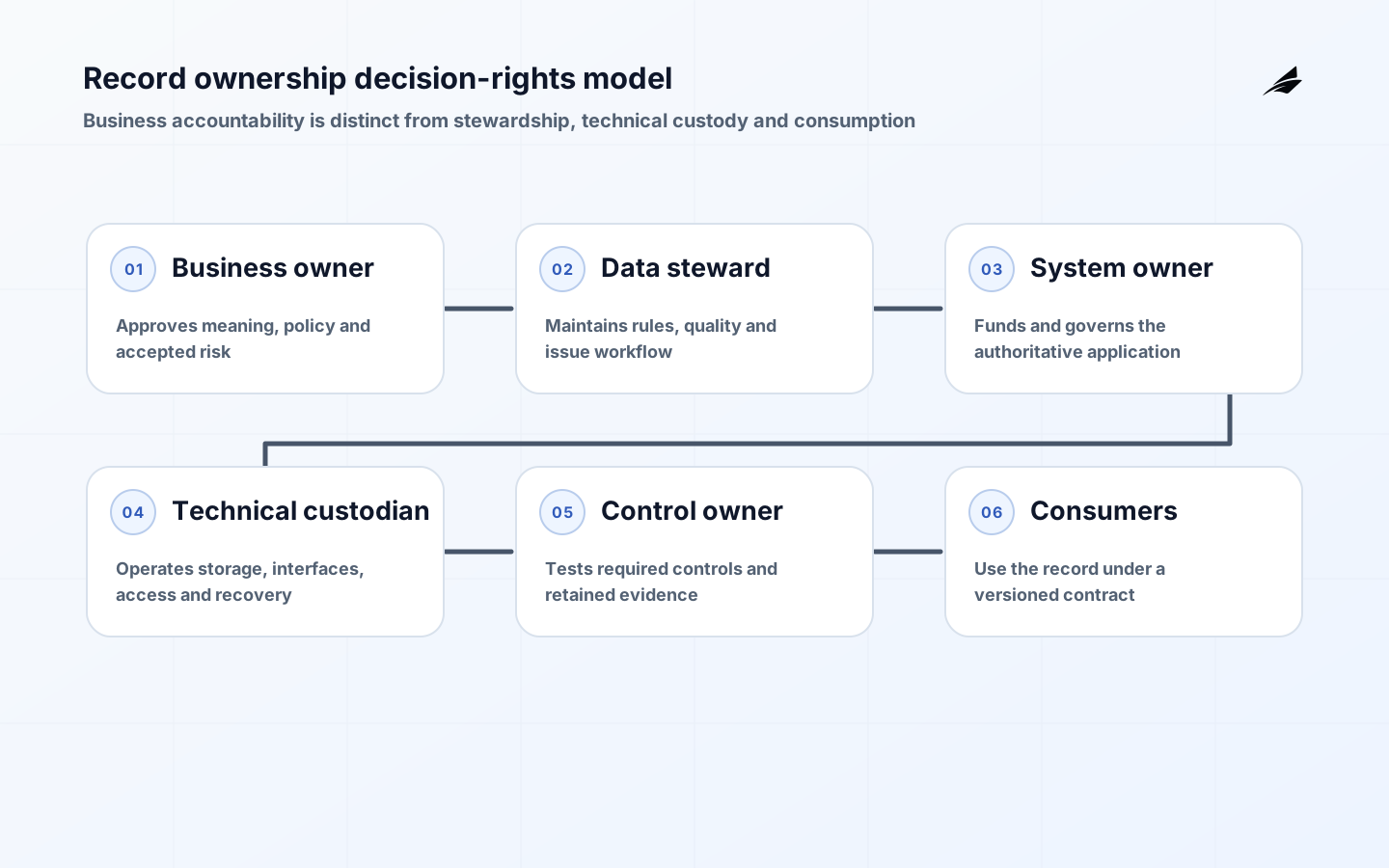
Record Ownership Models: Decision Rights for Trusted Enterprise Data starts with a deceptively simple question: what must the organization be able to decide, change and prove after delivery? For enterprise architects, data leaders, system owners, process owners and governance teams, the useful answer is not a product list. A record ownership model should make each important record authoritative, explainable and changeable through explicit decision rights. That requires an explicit service boundary, architecture decisions, control ownership, acceptance evidence and an operating loop. The guide below turns those concerns into a practical plan while leaving regulatory, contractual and risk conclusions to qualified owners in the relevant organization and jurisdiction.
Key takeaways
- Define scope through business definitions, source authority, create and update rights, validation, distribution, correction, retention, deletion and downstream use, not through a vendor catalog.
- Choose among central system-of-record ownership, domain-owned records with shared contracts, federated governance with a common control plane, golden-record mastering with survivorship rules according to risk, workload and retained ownership.
- Treat one accountable business owner per record domain, documented stewards and technical custodians, approved create, merge, correct and delete rules, lineage plus exception and quality workflows as design inputs and acceptance conditions.
- Require record-domain catalog, RACI for lifecycle decisions, authoritative-source and field matrix, quality rules with issue ownership, consumer contracts and lineage before declaring transition or implementation complete.
- Measure critical fields with named owners, quality exceptions within agreed age, unmapped downstream consumers, manual reconciliation demand, policy changes with completed impact review with stable definitions and named owners.
Define the capability and service boundary
Begin by mapping business definitions, source authority, create and update rights, validation, distribution, correction, retention, deletion and downstream use. The map should identify which team owns each decision, which system is authoritative, what information crosses the boundary and what happens when a dependency is unavailable. This prevents a familiar procurement failure: the statement of work names activities, but nobody can connect those activities to a user journey, business service or material risk. Scope representative flows end to end, including exception, recovery and retirement paths; the happy path alone cannot reveal where operational responsibility actually sits.

Write exclusions as carefully as inclusions. For every excluded component, record the dependency, continuing owner, required interface and escalation route. A boundary is credible only when adjacent teams agree with it. During discovery, separate confirmed evidence from assumptions and unresolved decisions. That distinction protects planning quality: an assumption can carry a due date and owner, while an undocumented guess silently becomes architecture. Use record-domain catalog and RACI for lifecycle decisions as early artifacts because they expose gaps before implementation cost and organizational commitment increase.
Choose architecture from explicit tradeoffs
The credible options are not “modern” versus “legacy.” They include central system-of-record ownership, domain-owned records with shared contracts, federated governance with a common control plane and golden-record mastering with survivorship rules. Evaluate each against isolation, failure containment, latency, consistency, data handling, operational skill, portability and change frequency. A design can be technically valid yet wrong for the operating organization. Record why an option was selected, what it makes harder, which assumption could invalidate it and who may revisit the decision. This turns architecture into governed reasoning rather than a diagram that ages without explanation.
For a record ownership model, design failure behavior before optimizing the normal path. Ask what is retried, what is idempotent, what can be partially completed, where state is authoritative and how an operator knows the difference between delayed, failed and absent work. Define capacity and dependency limits without inventing precision that available evidence cannot support. Representative tests should cover malformed input, stale identity, unavailable dependencies, duplicate requests and interrupted change. The goal is bounded behavior across business definitions, source authority, create and update rights, validation, distribution, correction, retention, deletion and downstream use: failures should be visible, diagnosable and recoverable without creating a second uncontrolled process.
Turn controls into enforceable behavior
Controls are useful only when the system and operating process make them observable. Start with one accountable business owner per record domain and documented stewards and technical custodians; then add approved create, merge, correct and delete rules and lineage plus exception and quality workflows. For each control, identify the threat or obligation addressed, enforcement point, accountable owner, evidence source, failure signal and exception path. Policy language such as “access is restricted” is incomplete. A testable statement names the protected resource, permitted actor, decision context, denied cases and retained audit event.
Apply least privilege throughout a record ownership model to people, workloads and support processes. Separate read, change, approval and emergency privileges; avoid shared accounts and permanent provider access. Sensitive production data should not be copied merely because it is convenient for troubleshooting. Define masking, sampling, retention and deletion rules before access begins. Logging must support investigation without becoming an ungoverned replica of secrets or personal data. Finally, test revocation, recovery and exception expiry against lineage plus exception and quality workflows: controls often look strongest at onboarding and weaken during change or offboarding.
| Control area | Implementation question | Proof to retain |
|---|---|---|
| Identity and authorization | Where are one accountable business owner per record domain and documented stewards and technical custodians enforced? | Positive and negative access tests plus reviewed assignments |
| Data handling | How does approved create, merge, correct and delete rules apply to collection, use and deletion? | Data flow, configuration and deletion verification |
| Change safety | How are validation, approval and rollback separated? | quality rules with issue ownership with correlated deployment records |
| Detection and response | How does lineage plus exception and quality workflows behave under a realistic scenario? | consumer contracts and lineage plus exercise actions |
| Exceptions | Who accepts, expires and rechecks a deviation? | Exception record with scope, owner, compensating control and review date |
Deliver in evidence-producing waves
A practical delivery plan moves through discovery, baseline, design, proof, controlled rollout and operational acceptance. Discovery validates scope and access. Baseline establishes current behavior with record-domain catalog and RACI for lifecycle decisions. Design records target decisions and control tests. A proof wave then exercises one representative path from implementation through failure and recovery. Only after that evidence is reviewed should the team expand to additional systems, tenants, feeds or workflows. This sequence reduces uncertainty early without pretending that a prototype proves fleet-wide readiness.
Each a record ownership model wave needs entry criteria, test data, change authority, rollback conditions and an accountable acceptance decision. Track dependencies and waiting time separately from active engineering effort so schedule discussions remain honest. When urgent exposure is found, route it through the incident or emergency-change process instead of waiting for the final report. At handover, use shadow and reverse-shadow work around consumer contracts and lineage: the receiving team first observes, then performs the task while the delivery team observes. Documentation is necessary, but demonstrated operation is stronger evidence of transfer.
| Stage | Primary work | Exit evidence |
|---|---|---|
| Discover | Confirm journeys, owners, systems, data and obligations | record-domain catalog |
| Baseline | Observe current configuration, behavior and failure modes | RACI for lifecycle decisions |
| Design | Record target decisions, controls and tests | authoritative-source and field matrix |
| Prove | Implement one representative path and exercise recovery | quality rules with issue ownership |
| Scale | Roll out in bounded cohorts while monitoring guardrails | critical fields with named owners and quality exceptions within agreed age |
| Accept | Revoke temporary access and demonstrate normal and emergency operation | consumer contracts and lineage |
Estimate cost and commercial scope responsibly
The cost of a record ownership model is driven by uncertainty and operating diversity more than by a generic label. Important drivers include the number and variety of in-scope flows, environments, identities, data classes, integrations, inherited components, control mappings and support windows. Documentation quality, automated tests, representative non-production environments and deployment repeatability can reduce discovery and validation effort. Conversely, unclear ownership across business definitions, source authority, create and update rights, validation, distribution, correction, retention, deletion and downstream use, undocumented interfaces and bespoke exceptions create work that a simple unit price cannot honestly represent.
For a record ownership model, separate discovery, implementation, validation, transition and continuing operation in the commercial model. State assumptions and customer responsibilities, including access, subject-matter participation, change windows and acceptance turnaround. Fixed scope can fit a bounded assessment or well-understood migration wave; uncertain remediation benefits from stage gates and refreshed estimates. Avoid incentives based only on tickets closed, findings counted or hours consumed. Payment milestones should correspond to quality rules with issue ownership and usable capability, while risk acceptance remains with an authorized organizational owner.
Operate with service and risk signals
Operating measures should answer whether the capability is dependable and whether exposure is changing. Use critical fields with named owners, quality exceptions within agreed age, unmapped downstream consumers, manual reconciliation demand and policy changes with completed impact review. Define every numerator, denominator, time window, data source and owner. A percentage without a stable population can improve merely because scope shrank. Pair aggregate trends with a short narrative about material exceptions and decisions. Teams should be able to move from a dashboard signal to the affected service, evidence and owner without assembling a manual investigation each reporting cycle.
For a record ownership model, balance reliability, security, delivery and user impact. A control that repeatedly blocks legitimate work may be bypassed; a performance optimization that removes authoritative-source and field matrix may weaken investigation; a change freeze that protects one metric may leave known vulnerabilities unresolved. Review critical fields with named owners, quality exceptions within agreed age, unmapped downstream consumers, manual reconciliation demand, policy changes with completed impact review together and agree guardrails before rollout. Incidents, support demand, rejected actions and near misses are learning inputs, not merely counts. Feed resulting actions into one prioritized backlog so reliability, product and risk work compete transparently for capacity.
Recognize delivery risks early
The most damaging risks in a record ownership model are often visible before implementation: ownership means database access, two authoritative sources, governance without workflow, untracked replicas. Wider warning signs include absent owners, unavailable test data, overbroad access and acceptance postponed until a final presentation. Treat those signs as delivery risks with owners and response dates. The table below turns them into evidence-based review prompts for the actual environment, not universal claims.
| Risk | Early signal | Response |
|---|---|---|
| Ownership means database access | Custody is mistaken for business authority | Separate accountable owner, steward, custodian and consumer roles |
| Two authoritative sources | Systems overwrite one another | Assign authority by record and field with explicit conflict rules |
| Governance without workflow | Issues are discussed but never resolved | Route exceptions to named owners with deadlines and evidence |
| Untracked replicas | Corrections do not reach consumers | Register distributions and test propagation and deletion |
Frequently asked questions
What should be completed first for a record ownership model? Complete the service boundary across business definitions, source authority, create and update rights, validation, distribution, correction, retention, deletion and downstream use, name decision owners and trace one representative end-to-end flow. Those artifacts expose hidden dependencies and let the team choose a proof wave. Buying or configuring technology before this point can accelerate activity while leaving the central responsibility question unanswered.
How much documentation is enough? Keep documents that support a decision, implementation, test or operating task. At minimum, retain record-domain catalog, RACI for lifecycle decisions, authoritative-source and field matrix, quality rules with issue ownership, consumer contracts and lineage. Prefer versioned artifacts close to the system and automate evidence collection where it remains understandable. A large static repository is not proof that the current system behaves as described.
Can a provider own all risk in a record ownership model? A provider can perform one accountable business owner per record domain, documented stewards and technical custodians, approved create, merge, correct and delete rules, lineage plus exception and quality workflows and accept contractual responsibilities, but the organization still needs authorized owners for business outcomes, regulatory interpretation, residual risk and priority. Shared responsibility should be decomposed into named decisions and evidence; the word “shared” alone does not assign work.
When is a record ownership model ready to scale? Scale after the representative wave passes functional, security, failure, recovery and operational acceptance tests, and after the team has observed critical fields with named owners, quality exceptions within agreed age, unmapped downstream consumers, manual reconciliation demand, policy changes with completed impact review. A successful demonstration on clean sample data is useful learning, but it does not establish production readiness across the diverse scope named in this guide.
Which related guides add useful context? See How to plan record ownership models before development starts, record ownership models checklist for reporting and governance, What technical decision makers should know about record ownership models, Master Data Management: Engineering Notes. These are published repository records selected for adjacent architecture, implementation, control or operating concerns; they are not evidence for claims in this guide.
Conclusion
Record Ownership Models: Decision Rights for Trusted Enterprise Data is ultimately an ownership and evidence problem expressed through technology. Define business definitions, source authority, create and update rights, validation, distribution, correction, retention, deletion and downstream use; choose architecture through explicit tradeoffs; implement one accountable business owner per record domain, documented stewards and technical custodians, approved create, merge, correct and delete rules, lineage plus exception and quality workflows; and accept delivery through record-domain catalog, RACI for lifecycle decisions, authoritative-source and field matrix, quality rules with issue ownership, consumer contracts and lineage. That discipline gives enterprise architects, data leaders, system owners, process owners and governance teams a common basis for procurement, engineering and operation. It also keeps improvement practical: each incident, exception and delivery wave can update the same service map, decision records, tests and backlog instead of creating a parallel governance exercise.