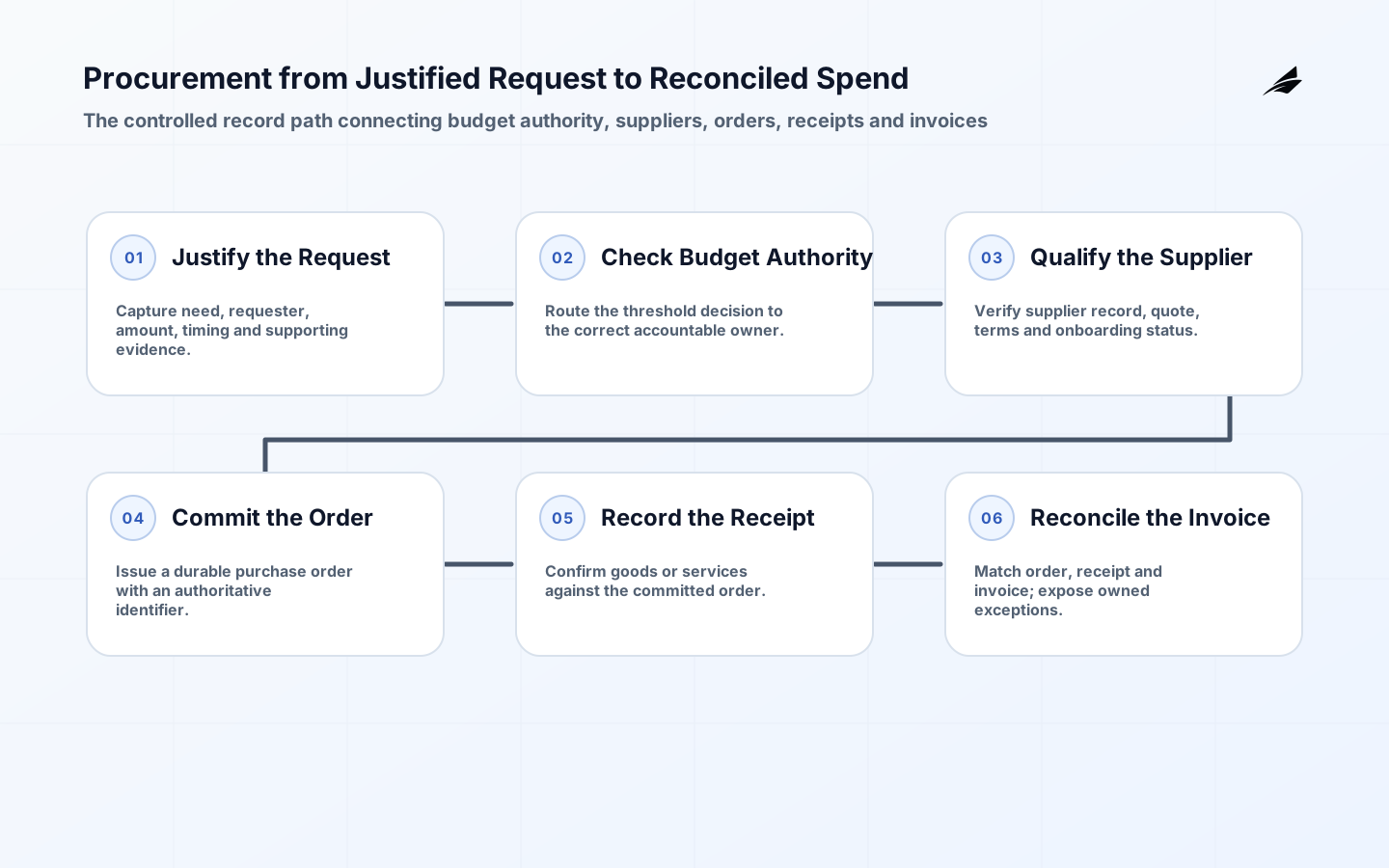
Procurement workflow software is an operating-design problem before it is a software-selection problem. Operations teams need a system that produces a justified purchase request, routes it for review at the right threshold, commits it to a supplier, and reconciles it with the receipt and invoice. That requires more than screens and routing rules: the team must agree on the record, the decision, the accountable owner, the evidence and the recovery path when a handoff fails. This guide explains how to make those choices before implementation makes them expensive to change.
Begin with five recent examples of real work, including an uncomfortable exception. Ask what initiated the case, which information was trusted, who changed the state, where people left the system and how the work was eventually closed. That small evidence set exposes the actual workflow better than an aspirational process map. It also stops procurement workflow software from becoming a request to reproduce every historical spreadsheet in a new interface. The planning conversation should stay anchored in the people who must correct, approve and support the work after launch. For this workflow step, name the accountable owner, supporting evidence, exception route, and next measurable check.
Define the operating outcome
Write the first-release outcome in observable terms: a purchase request that is justified, reviewed at the right threshold, committed to a supplier and reconciled with the receipt and invoice. The outcome statement should name the user or team, the completed business state and the evidence that proves it. Then record the boundary. The first release should include the normal path, a consequential exception, administration and support; it should explicitly defer adjacent requests that cannot yet be operated safely. This is particularly important here because the most expensive failures arise when a seemingly small handoff has no accountable owner. Within this decision boundary, name the accountable owner, supporting evidence, exception route, and next measurable check.
| Scope layer | Decision to make | Evidence before release |
|---|---|---|
| Business event | What begins the work and who can initiate it? | Example cases from current operations |
| Record boundary | Which system owns request, budget owner, supplier, quote, approval, purchase order, receipt, invoice and exception? | Field-level ownership and identifiers |
| State and decision | Who may move work forward, reject it or delegate it? | State model and decision rights |
| Integration | How does the process exchange information with ERP, expense management, contract repository, supplier master and accounts payable? | Contract, retry rule and reconciliation path |
| Control | How is approvals that are easy to bypass or too slow to support urgent but legitimate work prevented or detected? | Role check, review record or alert |
| Operation | Who monitors, supports and improves the process? | Runbook, owner and review cadence |
Model records, states and ownership
List the important objects before defining fields. For this workflow those objects include request, budget owner, supplier, quote, approval, purchase order, receipt, invoice and exception. For each, name the system of record, stable identifier, permitted editors, retention need and consumer systems. A system may display or cache a record without becoming its owner. That distinction prevents an integration project from turning into multiple competing copies of the same business fact. Treat this as a release criterion, not a documentation exercise: an operator should be able to find the relevant case and explain the next step. When implementing this part of the system, name the accountable owner, supporting evidence, exception route, and next measurable check.

For delivery teams working on procurement workflow software, this information boundary should connect workflow authority, system-of-record ownership, approvals, exceptions, reconciliation, and reporting to evidence an accountable owner can inspect. Next, model meaningful states rather than an undifferentiated “open” and “closed.” A state should answer what has happened, what may happen next, who owns that decision and what information is missing. Do not use a status to conceal a policy judgement. If a case needs an approval, exception or investigation, represent that work explicitly so users, managers and auditors can understand why progress paused. The design must give reviewers enough context to act without pushing them into a separate spreadsheet or private chat channel. In this operating review, move beyond the information boundary only after the owner can show the accepted result, the exception path, and the signal for another review.
Design the integration boundary
In procurement workflow software, delivery teams should make the relationship between workflow authority, system-of-record ownership, approvals, exceptions, reconciliation, and reporting explicit and reviewable. Integration should follow a business event, not a desire to keep every screen identical. Identify the event that a downstream system needs, the minimum fields needed to act, the authoritative timestamp and the expected failure behavior. The same event must not be reinterpreted differently by each consumer. Keep mappings versioned, log delivery attempts and give operations a way to see whether a message was delivered, rejected, retried or reconciled. A concise operational rule is more durable than a clever interface because it remains useful when the organization, volume or connected systems change. This operating review should close the integration boundary only when the result, unresolved exception, and next review condition are recorded.
A dependable procurement workflow software design makes workflow authority, system-of-record ownership, approvals, exceptions, reconciliation, and reporting visible to the owner responsible for this integration boundary. Choose synchronous calls when the initiating user truly needs an immediate answer; use asynchronous delivery when the work can complete reliably after the initial interaction. Either way, define idempotency, duplicate handling and a visible recovery queue. A retry without an owner is merely delayed failure. For related planning work, see Inventory and Operations Software for Service Businesses: A Practical Guide and Service Delivery Management Systems: A Practical Guide for Founders. That focus keeps the first release narrow enough to learn from while retaining the evidence needed for a later expansion decision. The next step in this operating review is justified when the team can trace the accepted outcome, the fallback route, and the owner of follow-up.
| Failure condition | Required system behavior | Operational evidence |
|---|---|---|
| Required data is absent | Keep the case in a recoverable state and identify the missing owner | Visible validation message and incomplete-work queue |
| Downstream system is unavailable | Avoid duplicate action; retry according to an agreed policy | Delivery attempt, correlation identifier and alert |
| Two systems disagree | Protect the source record and open a reconciliation case | Before-and-after values with decision owner |
| Approval is overdue | Escalate by policy without silently changing authority | Ageing report and escalation event |
| User access changes | Re-evaluate entitlement before high-impact action | Access review and decision trail |
| Unexpected volume occurs | Preserve service and make backlog visible | Capacity signal, queue depth and recovery plan |
Apply controls without blocking legitimate work
This operating decision for procurement workflow software is strongest when workflow authority, system-of-record ownership, approvals, exceptions, reconciliation, and reporting can be reviewed as one operating record. Controls should be proportional to the decision being made. Use least privilege for sensitive actions, separate incompatible duties where needed, preserve an audit trail for material state changes and review access as people move between roles. The NIST Cybersecurity Framework is useful as a conversation structure: it prompts teams to govern, identify, protect, detect, respond and recover without treating a framework reference as a substitute for a real operating decision. Teams should revisit this assumption after observed use, especially when exceptions show that the written process differs from the real work. Acceptance in this operating review requires a visible outcome, a bounded exception path, and a measurable reason to revisit the decision.
Delivery teams can keep procurement workflow software accountable by recording how workflow authority, system-of-record ownership, approvals, exceptions, reconciliation, and reporting shape this operating decision. Privacy and accessibility are workflow qualities, not late-stage checks. Collect only information needed for the decision, make retention and access expectations explicit, and test representative journeys with keyboard and assistive technology where people use the interface. A supervisor override can be essential for continuity, but it must record who acted, why they acted and what follow-up is required. The goal is an explainable service boundary that people can operate under ordinary pressure, not a diagram that only describes the happy path. For this operating review, the responsible owner should be able to explain what passed, what remains exceptional, and which signal reopens review.
Measure operation, not activity
Use measures that show whether the workflow is becoming easier to run. For procurement workflow software, start with request-to-order time, approval ageing, non-PO spend, invoice-match exceptions and supplier onboarding time. Establish a baseline before release, define how each measure is calculated and review it with the people who can change the process. Avoid a large dashboard of unowned measures: a small number of trusted signals tied to an owner will improve decisions more quickly. For this guide, that means testing the proposal against the daily decision rather than a generic platform demonstration. To govern this evaluation, name the accountable owner, supporting evidence, exception route, and next measurable check.
- Track the normal path and the exception path separately so improvement does not hide displaced work.
- Record the source and refresh expectation for every measure used in a review.
- Review cases that were manually bypassed; they often reveal a missing state, permission or integration rule.
- Assign an owner and due date to material reconciliation and control failures.
- Test recovery and escalation as part of release acceptance, not after the first incident.
- Revisit scope after observed use rather than expanding from a feature wish list.
Implementation checklist
- Collect real cases and choose one complete journey for the first release.
- Name record owners, decision authorities and support owners for every material handoff.
- Document interfaces, failure behavior, reconciliation and an operational alert path.
- Turn relevant security, privacy and accessibility expectations into testable acceptance criteria.
- Run a limited release with users who can identify missing rules and difficult exceptions.
- Review request-to-order time, approval ageing, non-PO spend, invoice-match exceptions and supplier onboarding time and unresolved exceptions before expanding the workflow.
Key takeaways
- Procurement workflow software succeeds when ownership and evidence are as clear as routing.
- A focused release with recovery behavior is more useful than a broad workflow with hidden manual work.
- Integrations need observable delivery and reconciliation, not just successful demos.
- The best measures connect a business outcome to a decision an owner can change.
Frequently asked questions
For procurement workflow software, the evidence behind this operating decision should cover workflow authority, system-of-record ownership, approvals, exceptions, reconciliation, and reporting. Should we replace every existing tool first? Usually no. Start with the business event and record boundary that create the most costly uncertainty, then integrate or retire adjacent tools when the new workflow has reliable evidence. How much automation is appropriate? Automate repeatable, explainable decisions with a safe exception path; keep consequential or ambiguous decisions reviewable. Who owns the process? Business leaders own policy and outcome, while technology owners make the system secure, observable and maintainable. The planning conversation should stay anchored in the people who must correct, approve and support the work after launch. Do not widen the scope from this operating review until the evidence supports the result, the recovery route, and the next operating check.
Conclusion
A useful procurement workflow software initiative makes work more accountable, not merely more digital. Define the outcome, model records and states, make integrations recoverable, build proportional controls and review the operating evidence. That sequence gives operations teams a system that can be trusted on ordinary days and explained when an exception matters. This is particularly important here because the most expensive failures arise when a seemingly small handoff has no accountable owner. For this part of the system, test one expected case, one ambiguous case, and one failure with a documented recovery action.