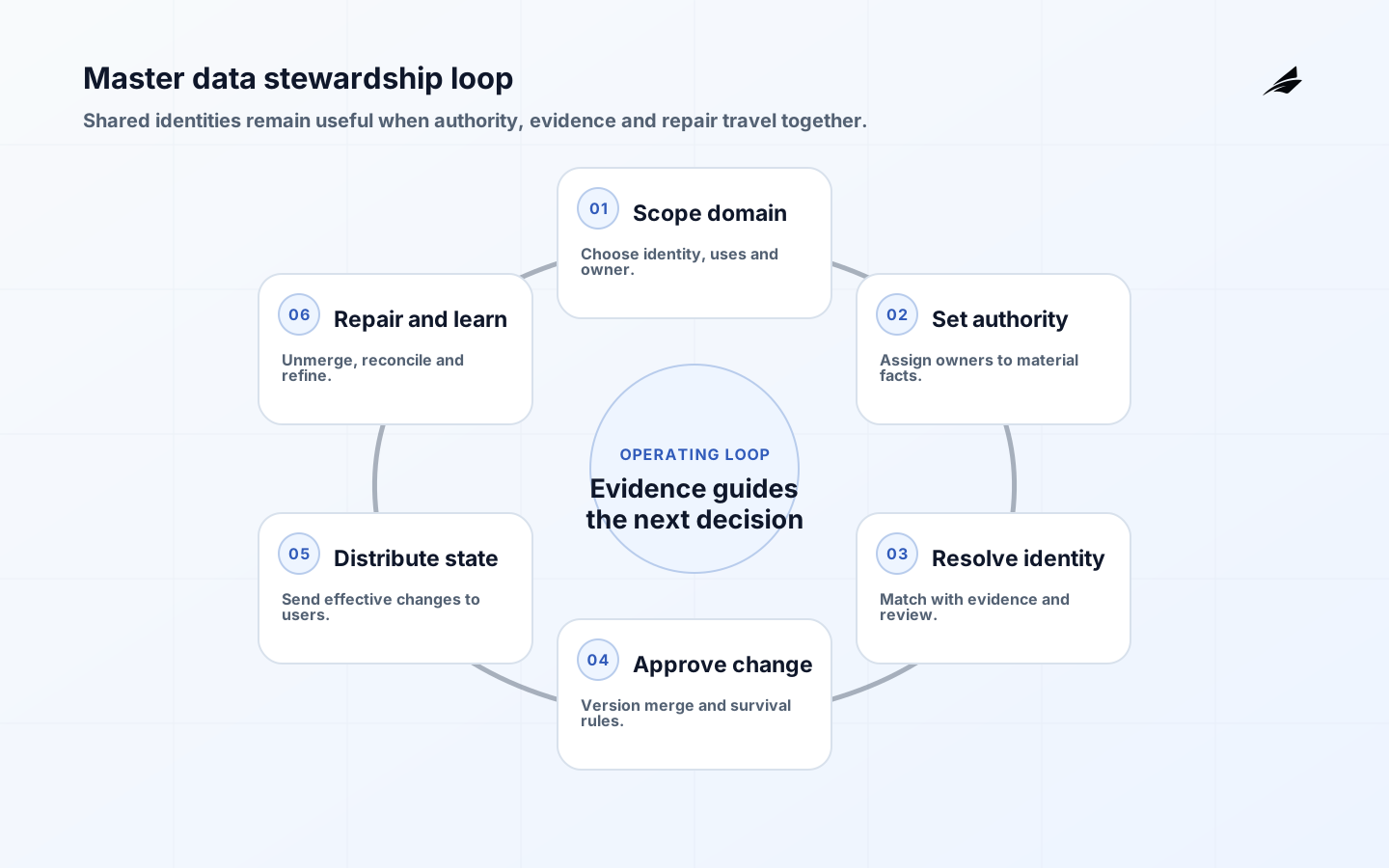
A master data management checklist is useful only when it clarifies who can create, match, merge, correct and retire a shared business identity. The hard problem is not collecting every customer, supplier, product or location attribute in one place. It is deciding which facts are authoritative, preserving evidence behind identity decisions, and repairing every affected consumer when a mistake crosses system boundaries.
Pair this checklist with master data engineering notes, system-of-record design, and the enterprise MDM guide. They help distinguish a governed master from another synchronized copy.
NIST provides useful primary anchors: its data governance glossary defines authority; the Data Governance and Management Profile connects data use with privacy and cybersecurity risk; the Privacy Framework addresses processing risk; and Cybersecurity Framework 2.0 connects governance, protection and recovery.
Frame the master data management decision
Before mapping fields or configuring rules, write one sentence that states the decision or action at stake: settle which system may create and change a shared business identity. Then identify the initiating event, the person who owns the decision, the systems that observe it, and the deadline at which a late answer causes harm. This narrows scope without hiding dependencies. NIST defines data governance as processes that formally manage enterprise data assets and establish authority for decisions; that is a helpful lens when teams disagree about who can change a consequential record. In master data management, a polished screen cannot compensate for authority that has not been decided. Document the system of record for the event, the consumer that relies on it, the failure mode, and the person allowed to accept a temporary workaround. master data engineering notes helps extend that framing into implementation detail.
Define records, states, and boundaries
The durable design unit is a record with a lifecycle, not a loose collection of fields. For customer, supplier, product, and location records, make the important states explicit: proposed, valid, changed, rejected, completed, and corrected where they apply. State transitions need a business meaning, an effective time, and an accountable actor. Also define what stays in the originating application and what is distributed as a reference or event. A customer account, a supplier, or a product can be valid in several applications while still needing one accountable definition. The point is not to centralize every field; it is to define which attributes are shared, who approves them, and how a consumer can identify the current record. The NIST Data Governance and Management Profile emphasizes that governance helps organizations manage privacy and cybersecurity risk alongside data use. In practice, this means that a new integration should not become the accidental owner of a record simply because it is easiest to query.
| Design question | Good operational answer | Evidence to retain |
|---|---|---|
| What starts work? | A named business event with a source and effective time | Source reference and correlation ID |
| Who may decide? | A current role or assigned owner, not an assumed inbox | Authority or assignment record |
| What can fail? | A defined rejection, retry, and escalation path | Error reason and handoff history |
| How is it corrected? | A controlled reversal or amendment, not a silent overwrite | Old value, new value, reason, and actor |
Design the exchange and exception path
A reliable path makes normal processing boring and abnormal processing legible. Define required inputs, validation rules, identity matching, timing, duplicate handling, target acknowledgement, and who investigates a failure. Use a stable internal identifier, retain source-system identifiers as references, and distinguish a proposed match from a confirmed merge. A survivorship rule should say which source wins for each shared attribute and when a person must decide. Do not use an error queue as a place to hide uncertainty. Each rejected record should show what failed, whether the source must change, whether a retry is safe, and who owns the next action. Where a workflow crosses several systems, preserve one correlation reference from the initiating event through the operational effect. That is the difference between proving a result and guessing from timestamps. This work also benefits from system-of-record design guidance, especially when the team must decide which application owns a fact rather than merely carrying a copy.
Control access and change
Controls should protect the decision that matters without turning ordinary work into an approval ritual. A change record should preserve the old value, new value, actor, reason, effective time, and the systems notified. Access should separate routine enrichment from a merge or retirement that changes many downstream records. The NIST Cybersecurity Framework is a useful reference for treating governance, protection, detection, response, and recovery as connected activities. Security is also operational: a mistaken role assignment, unreviewed mapping, or undocumented manual correction can be as damaging as a technical outage. Establish a short change record for rule and interface changes, including purpose, impacted records, test evidence, rollback approach, approver, and completion result. Keep production credentials and test data separate. When sensitive data is involved, minimize the fields in logs, exports, notifications, and support tickets before adding more monitoring.
| Signal | Likely interpretation | First accountable response |
|---|---|---|
| Records wait past their target | An owner, validation, or downstream dependency is blocked | Inspect the oldest items and assign a named resolver |
| Manual corrections rise | A rule, master record, or upstream process is drifting | Sample corrections and fix the shared cause |
| Duplicates or repeats appear | Retries lack a stable business key or matching rule | Pause unsafe replay and reconcile the affected population |
| Users work around the system | The path is slow, unclear, or missing an exception state | Observe the real task before adding another form |
Govern Master Data Changes
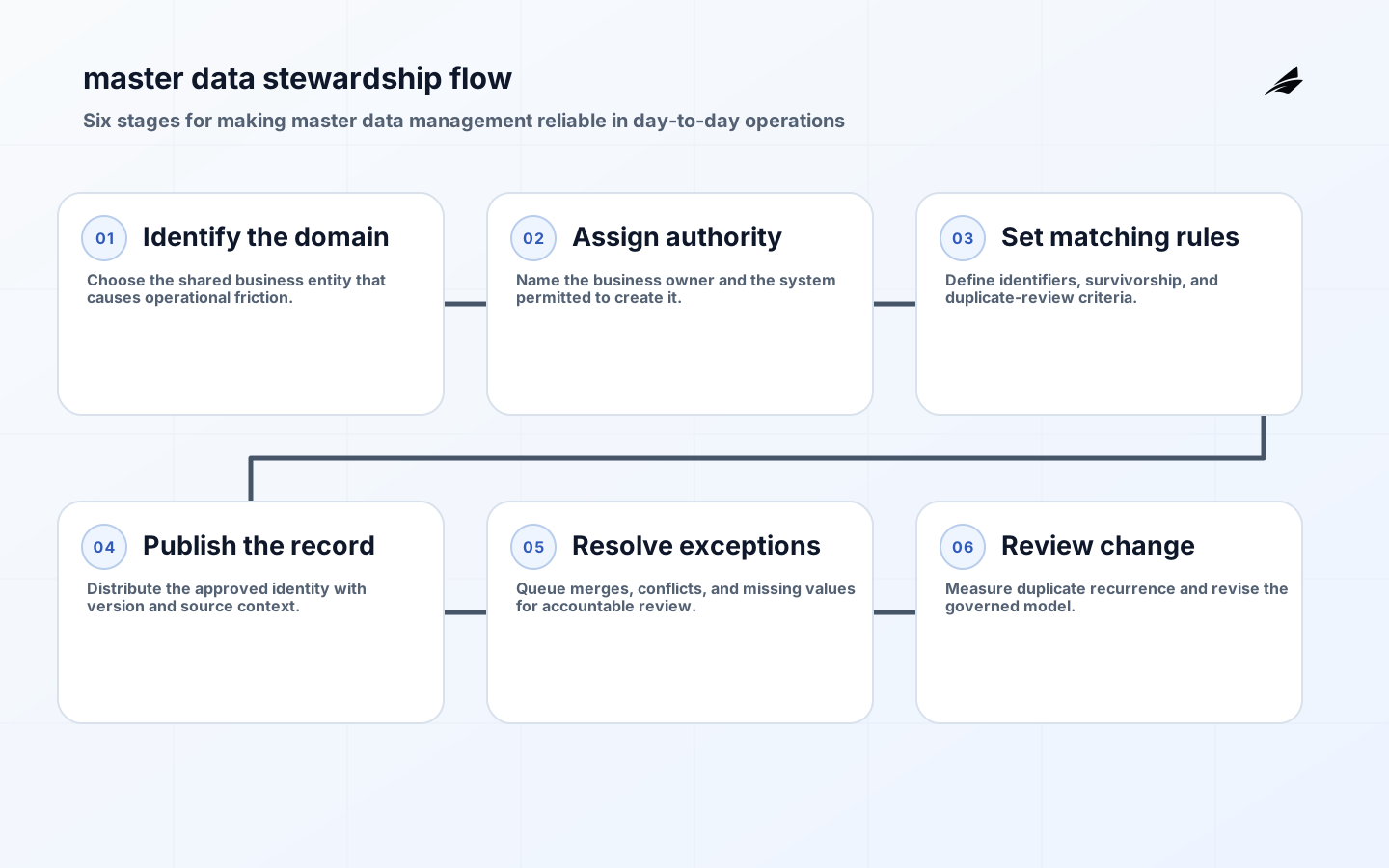
Operating discipline keeps master data management useful after the first release. Start with one domain that crosses at least two operational systems, such as customer accounts shared by CRM, billing, and support. Reconcile a small population by hand, then automate only the decisions the team can explain. Bring the data owner, a frontline user, a technical maintainer, and a control or finance partner into the review. They should agree on which result is authoritative, which failures stop work, which failures can be retried, and how a customer or colleague is informed. CISA's incident response planning guidance is written for security incidents, but its emphasis on documented roles, communications, and preparation transfers well to important business-system failure paths. The goal is not to label every defect an incident; it is to ensure that a consequential failure has a practiced route to a decision.

Release in small, observable slices
Choose a bounded population, a reversible change, and a time-boxed observation period. Baseline the current process first, including hidden spreadsheet steps and side-channel conversations, so the team can tell whether master data management reduced work or simply moved it. Duplicate creation during imports, unrecorded merges, locally invented codes, and synchronizations that overwrite a correction made by an accountable team. A release plan should include reconciliation before and after cutover, a clear support contact, and criteria for expanding, pausing, or rolling back. Avoid a big-bang migration when old and new records cannot yet be compared. A small parallel run is often worth the effort because it reveals semantics that diagrams miss: a late edit, a user with two roles, a correction from a trusted source, or a downstream system that acknowledges work before it is actually complete.
Measure useful operation
Measure the health of the decision path, not only system uptime. For this master data, useful signals include duplicate rate, unresolved-match age, synchronization failures, percentage of records with a named steward, and the time required to correct a bad identity across consumers. Review them with examples from real work rather than a single aggregate score. Google SRE's monitoring guidance distinguishes the fast signals used to detect a condition from the detailed evidence used to diagnose it; the same distinction helps business systems. An alert should name a service or process owner and indicate the next investigation step. A monthly review can retire noisy checks, address repeated exceptions, and make planned changes visible to the teams that will discover their effects first. production operations guide offers additional context for treating those reviews as an operating routine.
Prove identity decisions with a golden-record exercise
Select twenty difficult records: duplicates, shared addresses, renamed suppliers, regional product codes and previous corrections. Ask a steward to resolve them with the proposed matching and survivorship rules while an engineer records source references, confidence signals, judgments and downstream effects. The exercise tests whether a golden record can be explained, not merely produced.
For a supplier in procurement, finance and risk systems, assign ownership by attribute. A legal-name change must not erase prior invoices or create a new identity. Use an effective-dated amendment, redistribute approved fields and reconcile acknowledgements. An incorrect merge needs a tested unmerge route that restores links in every consumer.
- Name the domain owner and steward community.
- Define durable identifiers, source references and lifecycle states.
- Version match, merge, survivorship and unmerge rules.
- Separate proposed matches from approved changes.
- Retain actor, reason, evidence and effective time.
- Reconcile distribution and maintain a repair route.
Key takeaways
- Begin master data management with one consequential decision and a named data owner.
- Define lifecycle states, authority, effective time, and correction before automating handoffs.
- Use stable references and an explicit exception path across every consequential exchange.
- Protect sensitive data and high-impact changes with proportionate access, review, and audit records.
- Release with reconciliation and real failure cases, then use operating evidence to improve the path.
Frequently asked questions
Is a golden record a system of record?
Not necessarily. A golden record may assemble attributes from several authoritative systems. State the owner of each material fact.
When should matching remain manual?
Keep a person involved when evidence is weak, a merge affects consequential history, or reversal across consumers have not been proven.
What is the first practical step for master data management?
Choose one recurring master data event that currently causes rework or uncertainty, name its accountable owner, and map its source, states, consumers, deadline, and correction route. That produces a testable boundary for master data management without requiring an enterprise-wide redesign.
When is automation ready?
Automation in master data management is ready when the team can explain the normal result, duplicate behavior, rejection route, correction method, and who is allowed to change the rule. Test those cases with representative master data records before relying on volume or a dashboard as evidence of readiness.
Conclusion
Good master data management makes a consequential business event easier to understand, complete, correct, and audit. Keep the scope tied to a real decision, make ownership and state visible, and design failures as carefully as the happy path. That gives a growing team something more valuable than another connected tool: an operational system that can keep its promises while change is still happening.