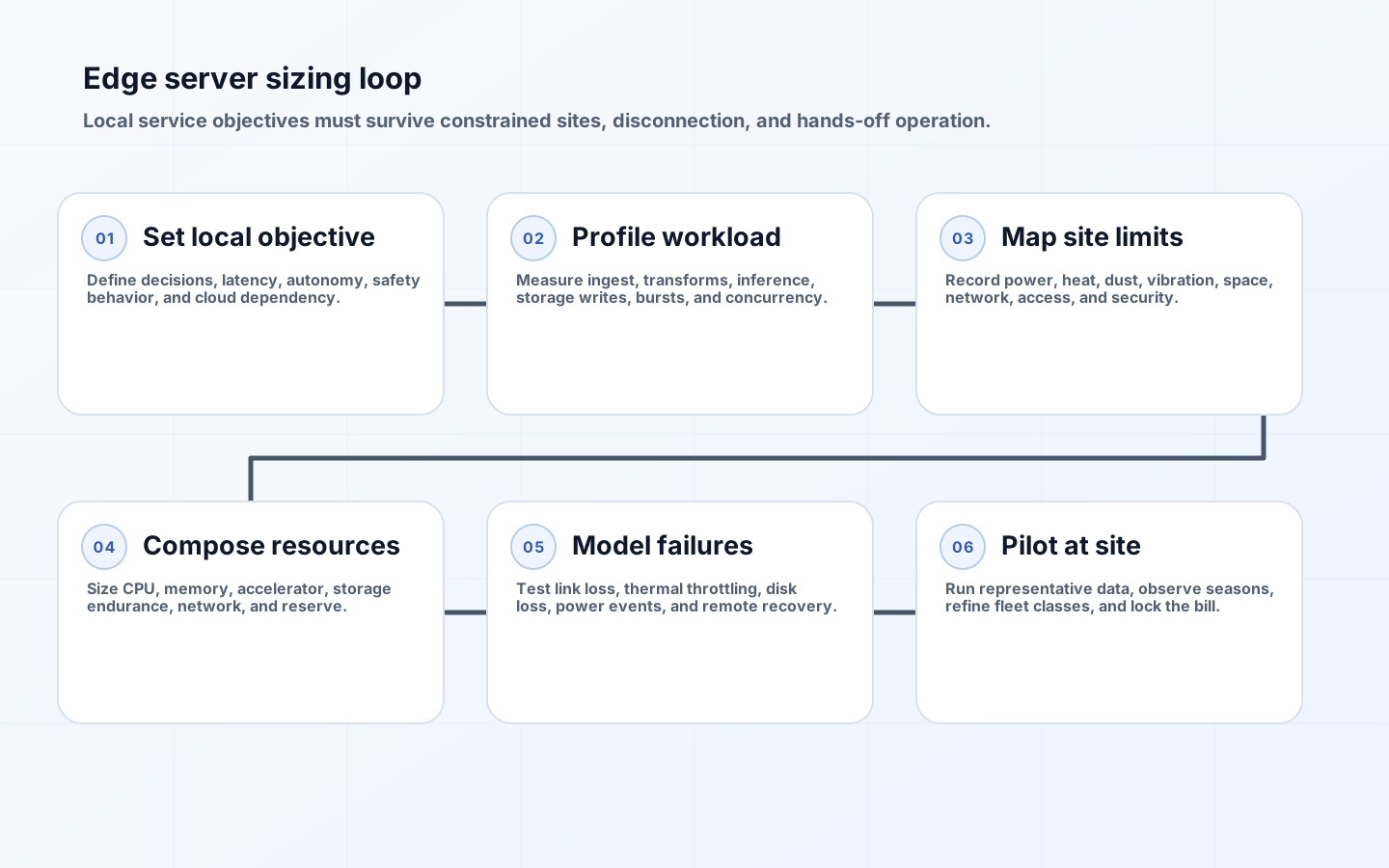
Edge server sizing starts with the service that must continue locally when bandwidth is expensive, latency is binding, or the cloud connection disappears. It does not start by shrinking a data-center configuration. An edge node may ingest cameras and sensors, translate industrial protocols, run inference, cache content, retain evidence, coordinate equipment, and synchronize upstream while sharing a small power and thermal envelope at a site with limited technical staff.
The sizing decision must connect latency and autonomy objectives to CPU, memory, accelerator, storage, network, environmental, security, and serviceability requirements. It also needs a fleet view. A configuration that performs well in a lab but requires frequent manual repair can be unaffordable across hundreds of locations. The goal is a small set of qualified hardware classes whose operating envelope, spare model, remote management, data lifecycle, and failure behavior are explicit.
Start with the local service objective and disconnection contract
List decisions and actions that must occur at the site, their deadlines, and the consequence of delay. Separate hard local needs from conveniences. A safety interlock should normally remain in a dedicated deterministic control system; an edge server may provide analytics or recommendations without becoming an uncertified control dependency. Define which functions continue during WAN loss, for how long, with what data, and how they degrade. State whether the site can operate independently, queue writes, use a cached model, or must enter a safe limited mode.
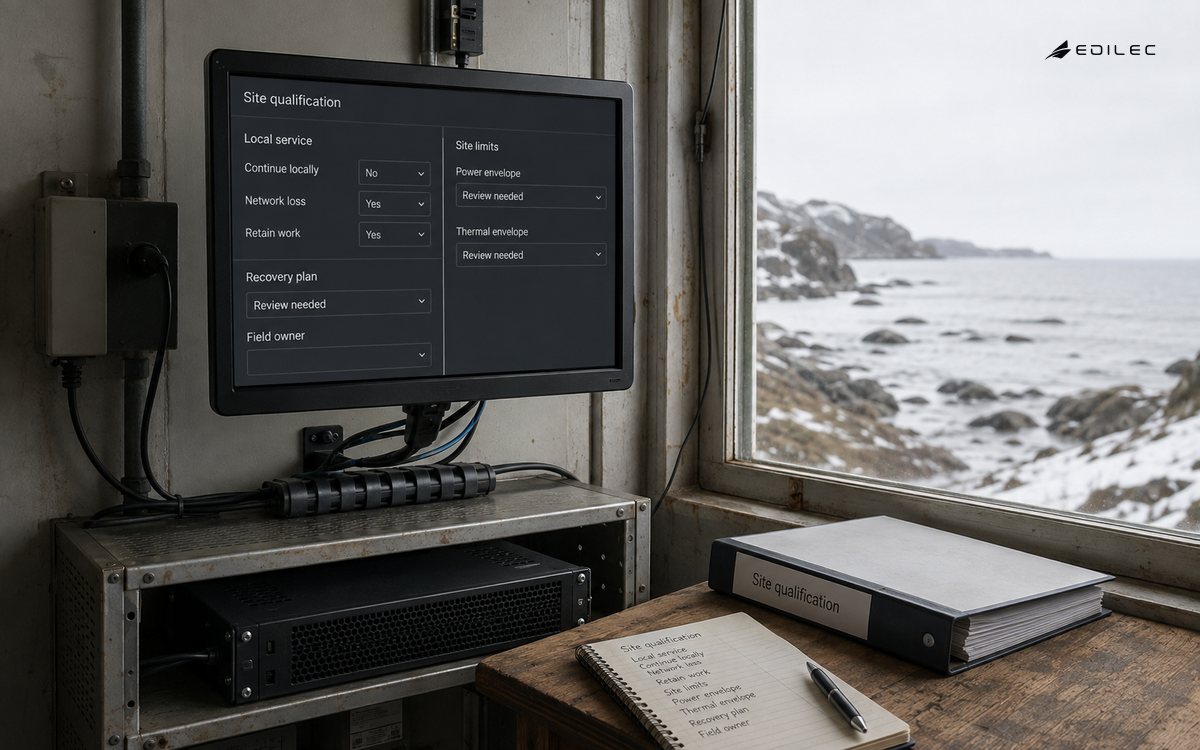
Build an availability budget across hardware, local network, power, environment, application, and remote operations. Define recovery time, recovery point, acceptable local data loss, and whether a second node is required. A redundant server pair is only useful if switches, storage, power, and application state can fail over. At small sites, a rapidly replaceable single node plus a documented manual procedure may outperform complex clustering that nobody can repair. Choose from business consequence and travel time, not from a default high-availability label.
| Requirement | Sizing signal | Likely resource impact | Validation |
|---|---|---|---|
| Local decision latency | End-to-end deadline and concurrency | CPU/accelerator, memory, network path | Representative percentile latency at site |
| Disconnected autonomy | Hours or days offline and queued event rate | Storage capacity, application state, local identity | WAN-loss and resynchronization exercise |
| Evidence retention | Streams, sampling, compression, and retention policy | Usable storage, endurance, encryption, export bandwidth | Full-retention replay and disk-life model |
| Environmental exposure | Temperature, dust, vibration, humidity, altitude | Ruggedization, filters, fan design, derating | Qualified environmental range and site telemetry |
| Recovery objective | Travel time, spare location, state restore duration | Redundancy, remote management, image size, spares | Bare-metal or replacement-node recovery test |
Profile ingest, processing, inference, and synchronization
Capture representative input traces rather than benchmarking a synthetic model alone. For video, record stream count, resolution, frame rate, codec, scene complexity, pre-processing, model, batch size, and concurrent outputs. For industrial or IoT workloads, record protocol message rates, bursts, transformations, rules, historian writes, and local user queries. Include encryption, compression, observability, container or VM overhead, and background synchronization. Profile startup, model swap, database compaction, and backlog replay because they may contend with the real-time path.
Measure CPU utilization by core, memory working set and bandwidth, accelerator utilization and memory, storage IOPS and latency, network throughput, queue depth, temperatures, throttling, and energy. Test percentile latency and deadline misses rather than average throughput. Determine whether the bottleneck moves as input changes. A faster accelerator may wait on decoding or storage; additional CPU cores may not help a single-threaded protocol handler. Preserve raw benchmark configuration so later software and model revisions can be compared.
Size local storage for capacity, endurance, and recovery
Calculate usable capacity from ingest rate, compression, retention, indexes, databases, logs, models, update images, queued outbound data, working space, filesystem reserve, and redundancy overhead. Apply high- and low-rate scenarios rather than one average. A disconnected period may accumulate both raw evidence and retry state. Define what is deleted first, what must never be evicted automatically, and how legal hold or incident preservation changes capacity. Storage pressure must produce an observable controlled mode, not silent loss.
Model write endurance from bytes written, amplification, retention churn, database compaction, and expected life. Consumer SSD capacity may appear sufficient while endurance and power-loss behavior are not. Evaluate drive class, temperature rating, power-loss protection, RAID or replication behavior, encryption, secure erase, and field replacement. Recovery time includes obtaining a spare, loading the image, restoring keys and configuration, rebuilding indexes, and resynchronizing data; a large disk can lengthen recovery even when capacity is welcome.
| Resource | Choose from | Tradeoff | Fleet control |
|---|---|---|---|
| CPU | Protocol, preprocessing, control, and general concurrency | More cores increase power and licensing without fixing all bottlenecks | Approved firmware and power profile |
| Accelerator | Qualified model latency, precision, throughput, and software support | High performance can increase heat, supplier lock-in, and update complexity | Model/runtime compatibility matrix |
| Memory | Working set, caches, VM/container overhead, and failure reserve | Too little causes unpredictable latency; too much raises cost and power | Telemetry with leak and pressure alarms |
| Storage | Retention, backlog, IOPS, endurance, and recovery | Capacity, write life, redundancy, and restore time conflict | Health, wear, encryption, and replacement policy |
| Network | Sensor ingress, local clients, upstream sync, and management | Extra ports and bandwidth add switch, cable, and security needs | Port profile and traffic segmentation |
| Reserve | Measured growth and worst qualified state | Excess headroom raises fleet capital and idle energy | Release rule tied to software roadmap |
Qualify the environmental and physical site envelope
Survey each site class for ambient and inlet temperature, humidity, dew point, dust and chemicals, vibration, shock, altitude, airflow obstruction, noise, physical space, orientation, sunlight or enclosure heating, floor or wall loading, water exposure, electromagnetic environment, and access. Use equipment manufacturer ratings and applicable industrial or safety requirements. A broad ambient rating does not guarantee full accelerator performance at the upper limit; obtain derating and throttling behavior. Verify that filters can be inspected and replaced at the real interval.
Measure available power, voltage quality, grounding, branch capacity, UPS or DC supply, outage duration, and restart behavior. Cooling may be passive, room air, enclosure air conditioning, or a specialized heat exchanger. Include heat from switches and power supplies in the enclosure. Define behavior on high temperature: alert, power-cap, shed nonessential processing, checkpoint, or stop. A server that protects itself by throttling can still violate the application deadline, so thermal state belongs in service monitoring.
Design remote operations, security, and lifecycle before buying
Require remote inventory, health, console, power control, firmware management, event logs, and secure boot capabilities appropriate to the threat model. DMTF Redfish provides a standard management interface for many server platforms, but verify the actual resources, authentication, certificates, update behavior, and vendor extensions. Isolate the management plane, use unique credentials or workload identity, log administrative actions, and define a controlled break-glass path. Remote power control must not bypass local safety or change authority.
Standardize images, configuration, firmware baselines, observability, update rings, spare units, replacement instructions, and return handling. Account for hardware root of trust, disk encryption, key recovery, tamper evidence, secure decommissioning, and ownership transfer. ETSI MEC describes a heterogeneous edge ecosystem and lifecycle management concerns; practical fleet design likewise needs version compatibility across hardware classes. Limit variants unless a distinct environment or workload justifies the support burden.
Pilot at representative sites and verify seasonal behavior
Run candidate hardware with captured or live representative data at a lab that reproduces site constraints, then at selected field locations. Test normal peak, backlog replay, WAN loss, slow WAN, disk pressure, model update, software rollback, power interruption, thermal stress, sensor flood, and remote recovery. Measure service deadlines, energy, temperatures, throttling, wear, failed messages, resynchronization time, and technician effort. Include business users because a technically graceful degraded mode must still support workable local operations.
Do not freeze the bill of materials after a short pilot if the estate experiences major seasonal temperature, dust, or workload changes. Define an observation window and expansion gates. When software becomes more efficient, decide whether to release reserve for new functions or reduce future hardware class. When models grow, re-run qualification rather than assuming spare accelerator memory is enough. Edge sizing is a managed loop because input rates, retention, models, security tooling, and site conditions evolve.
Key takeaways
- Derive the node from local decisions, latency, autonomy, and safe degraded behavior.
- Profile representative inputs and include synchronization, observability, updates, and backlog replay.
- Size storage for usable capacity, endurance, eviction policy, encryption, and full recovery time.
- Qualify performance across the real temperature, power, dust, vibration, network, and access envelope.
- Standardize a small number of fleet classes with remote management, spares, lifecycle control, and periodic requalification.
FAQ
How much headroom should an edge server have?
Use measured uncertainty, the approved feature roadmap, failure mode, thermal derating, and replacement lead time. Keep separate reserves for workload growth and degraded operation. A universal percentage either wastes fleet capital or hides a specific risk.
When does an edge server need a GPU or other accelerator?
When a qualified workload misses its latency, throughput, energy, or CPU-capacity objective without one. Test the exact model, precision, runtime, preprocessing, concurrency, temperature, and update path. Accelerator software support and lifecycle may matter more than peak benchmark speed.
Should every edge site have two servers?
No. Base redundancy on business consequence, repair time, shared failure domains, and application state. Some sites need active redundancy; others are better served by a hardened node, rapid spare replacement, and a clear manual operating mode.
Conclusion
A correctly sized edge server meets a local service contract inside the constraints of a real place. Workload traces expose compute and storage demand, site surveys expose environmental and recovery limits, and field pilots reveal interactions a data-center benchmark misses. With a controlled fleet design and a repeatable requalification loop, edge capacity can grow with software and business needs without turning every remote location into a unique infrastructure project.