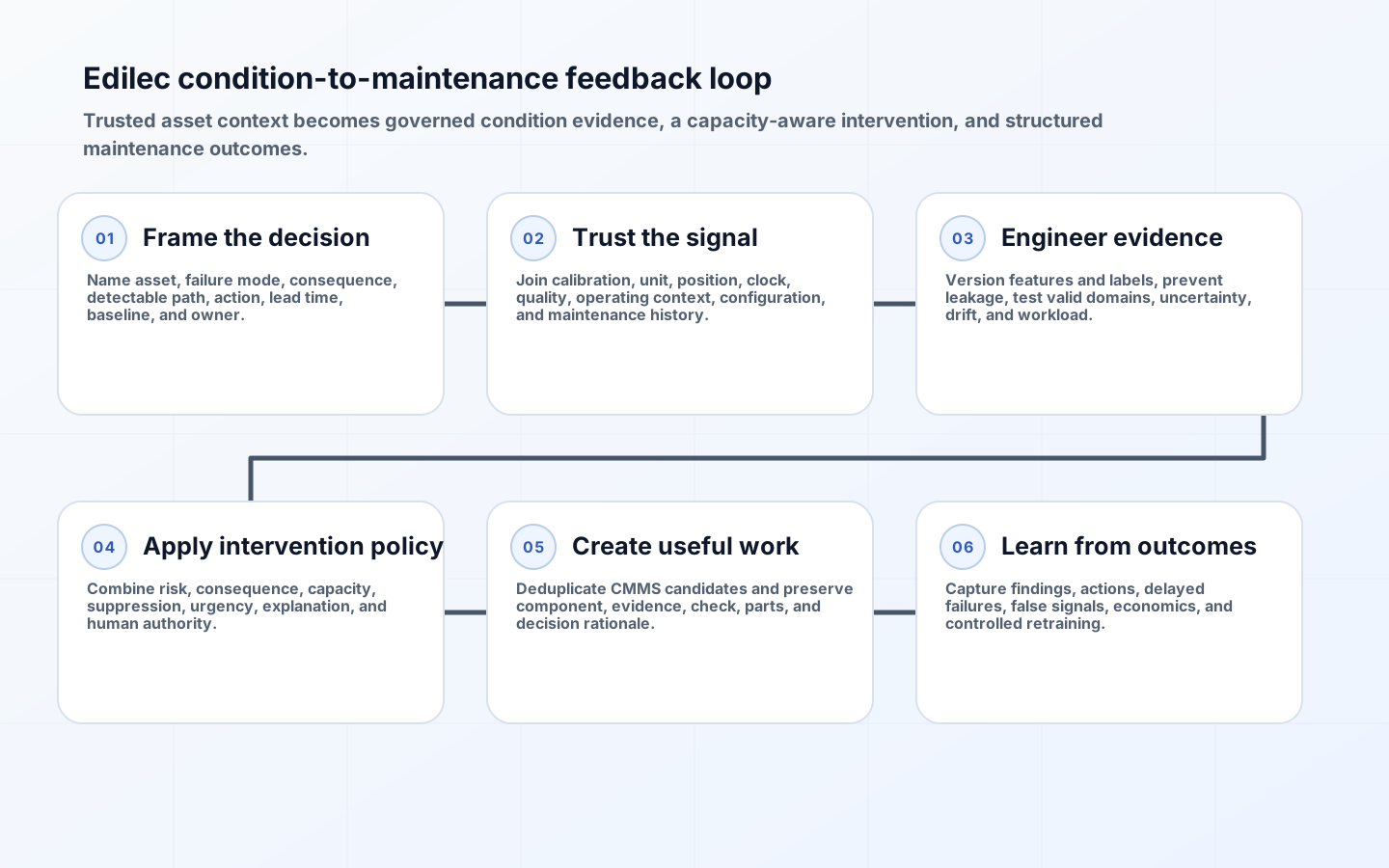
Predictive maintenance data architecture creates value only when a trustworthy condition signal becomes an appropriate intervention and the outcome returns as learning evidence. A model score that never reaches a planner, lacks an asset identity, or cannot explain urgency is an analytics artifact. A flood of low-confidence work orders can be worse than no model because it consumes scarce technicians and teaches operations to ignore alerts.
Design from the maintenance decision backward. Name the failure mode, lead time, consequence, feasible action, parts and labor constraints, existing inspection route, false-positive cost, and feedback available after work. Then build the sensor, context, feature, model, decision, and CMMS contracts needed to support that intervention. The architecture should preserve human review for uncertain or high-consequence decisions.
Frame the failure mode and maintenance decision
Select a bounded asset class and failure mode with a detectable degradation path. Define the prediction target precisely: failure within an operating-hour horizon, abnormal condition requiring inspection, or remaining useful life under stated assumptions. Baseline current preventive work, unplanned downtime, detection method, lead time, and maintenance outcome. Do not combine unrelated failures into one label merely to create more training rows.
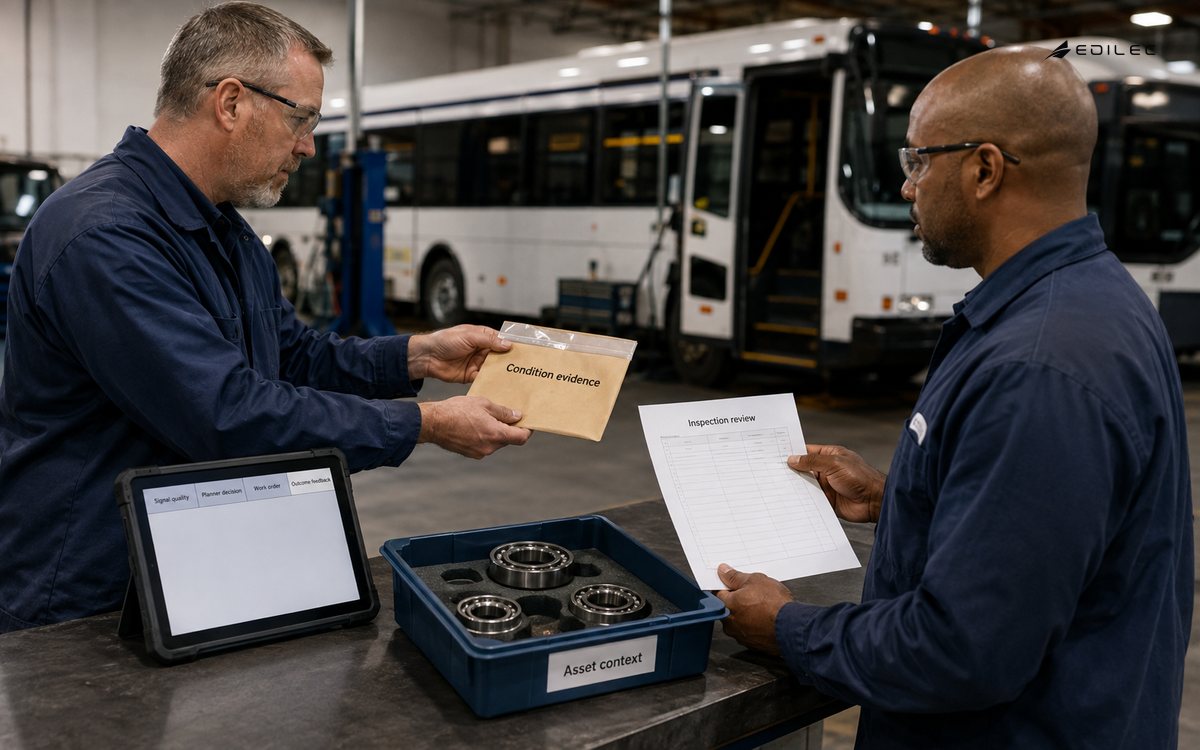
ISO 17359:2018 provides current general guidance for establishing a condition monitoring program. Use it to reinforce that sensors and analytics sit inside a program of equipment audit, measurement selection, criteria, diagnosis, and review. Define who can change thresholds, who approves work, and when safety rules override model recommendations. A predicted risk is evidence for a decision, not automatic authority to stop machinery.
| Layer | Required content | Quality gate | Owner |
|---|---|---|---|
| Asset/failure | Stable asset ID, class, component, failure mode, consequence | Taxonomy matches CMMS and engineering | Reliability engineering |
| Signal | Sensor, unit, location, rate, calibration, quality, clock | Coverage and plausibility meet use-case threshold | Instrumentation |
| Context | Load, speed, product, environment, operating state | Context present for valid inference region | Operations data |
| Inference | Model/version, score, horizon, uncertainty, reason features | Validated on representative assets and periods | Data science |
| Decision | Threshold, policy, urgency, recommended check, suppression | Capacity and risk constraints satisfied | Maintenance planning |
| Outcome | Inspection, finding, action, parts, downtime, confirmed cause | Structured closure and delayed-failure follow-up | CMMS owner |
Build an asset, sensor, and operating-context foundation
Join every sample to stable asset, component, sensor position, calibration, engineering unit, acquisition chain, source timestamp, quality, and configuration version. Capture operating state because vibration at idle and full load are not comparable. Preserve maintenance and replacement intervals so a component change does not look like sudden healing. ISO 13374-1 establishes guidance for software related to condition-monitoring data processing, communication, and presentation.
Validate range, stuck values, clipping, dropouts, clock drift, duplicate sequence, resampling, and cross-sensor consistency at ingestion. Keep raw diagnostic windows for selected events and version every transformation. Missingness may itself indicate a cable or gateway fault, but it should not become a healthy zero. Sensor calibration and installation quality require work processes and records; an algorithm cannot recover information the acquisition chain never captured.
Engineer features and model evidence for deployment
Create leakage-resistant training splits by asset and time so near-identical windows from one event do not appear in training and test sets. Align labels to confirmed failure or inspection evidence, account for censored assets that have not failed, and represent maintenance interventions. Compare against simple rules and condition thresholds. Evaluate precision and recall at operationally relevant horizons, calibration of risk, warning lead time, and workload produced per week, not one aggregate accuracy number.
The inference record should include asset, observation window, model and feature versions, valid-domain checks, score, calibrated risk where available, uncertainty, contributing evidence, generated time, expiry, and trace ID. Monitor data quality, feature drift, score distribution, delayed outcomes, and performance by equipment subtype and operating regime. Shadow a model before it creates work, and retain a control population when measuring avoided failures.
| Evidence state | System action | Human action | Feedback |
|---|---|---|---|
| Low risk, valid data | Continue monitoring | None | Observe future outcome |
| Moderate sustained deviation | Create review candidate, not work order | Reliability analyst checks trend and context | Disposition and reason |
| High risk with sufficient lead time | Propose prioritized inspection with evidence | Planner checks capacity, parts, and production window | Accepted, deferred, or rejected |
| High consequence or uncertain diagnosis | Escalate under safety and engineering procedure | Authorized engineer decides action | Decision rationale and inspection result |
| Invalid or missing data | Open instrumentation issue if persistent | Technician verifies sensor chain | Sensor finding and repair |
Integrate with CMMS without creating alert-driven chaos
Map the model output to a governed recommendation containing asset and component, suspected failure mode, urgency window, confidence, observations, recommended inspection, safety notes, parts implication, and evidence link. Deduplicate against open work, suppress during known shutdown or recent repair, and enforce per-asset cooldown. Let the CMMS remain authoritative for work status, scheduling, labor, parts, and closure. Use idempotency keys so retries do not create duplicate orders.
A planner may accept, defer, merge, or reject a candidate. Capture structured reason without forcing a false label. Priority should combine condition evidence with consequence, production plan, maintenance capacity, and safety policy. Integrate equipment hierarchy and work information through documented contracts; the OPC Foundation's ISA-95 reference can help align enterprise and control-system models, but site CMMS semantics still require explicit mapping.
Close the outcome and learning loop
Work-order closure should record inspected component, condition found, failure mode and mechanism, action, replaced part identity, labor, downtime, measurements, and whether the recommendation helped. ISO 14224 defines standardized categories for equipment, failure, and maintenance data in its reliability and maintenance data standard, although its industry scope must be considered. Normalize local codes while preserving originals and effective dates.
Not every accepted recommendation yields immediate truth. Track assets after inspection and record later failure or continued healthy operation. Review false positives, false negatives, duplicate work, lead time, planner acceptance, finding yield, avoided downtime evidence, sensor defects found, and maintenance backlog. Retraining requires a versioned dataset, approval, shadow comparison, cohort rollout, and rollback. Never train directly on free-text closure notes without quality and privacy controls.
Key takeaways
- Start with one failure mode, feasible intervention, lead-time need, and accountable decision owner.
- Join signals to asset, component, calibration, operating state, source time, quality, and maintenance history.
- Evaluate workload, warning lead time, calibration, and findings alongside statistical performance.
- Create governed recommendations and let CMMS own planning and work execution.
- Capture structured findings and delayed outcomes so the system learns from actual maintenance.
FAQ
Should a model automatically create work orders?
Only for well-bounded, validated, low-risk policies with deduplication and capacity controls. Most early systems should create review candidates. High-consequence actions need human authorization and established safety procedures.
What if there are too few confirmed failures?
Begin with condition monitoring, anomaly review, engineering thresholds, and better outcome capture. Use domain knowledge and inspection evidence. Synthetic or cross-site data can support testing but should not be presented as proof on the target population.
How should predictive maintenance value be measured?
Compare intervention outcomes and total process cost with a credible baseline or control: findings, warning lead time, avoided disruption, maintenance labor, parts, backlog, model operations, and shifted work. Avoid claiming every non-failure after a warning as an avoided failure.
Operate the predictive service safely and economically
Define service objectives for data arrival, inference freshness, recommendation delivery, and work-order integration, but keep machine protection independent. When sensors or the model service fail, revert to approved preventive and condition-monitoring procedures rather than treating absence of a prediction as healthy status. Maintain a kill switch that stops new recommendations without deleting evidence. Version thresholds separately from model artifacts and require authorization for urgent policy changes.
Cost the complete intervention loop: instrumentation, calibration, gateways, storage, labeling, model development, validation, integration, analyst review, planner time, technician work, false interventions, retraining, and support. Compare that with avoided consequence under conservative attribution. A promising model can still be uneconomic on inexpensive redundant assets or where no maintenance window exists. Prioritize assets by consequence, detectability, data readiness, and actionable lead time, not simply by the volume of available sensor data.
Review fairness across plants and equipment variants in an operational sense: one site should not receive excessive work because its sensors are noisier, and a rare model should not remain invisible in aggregate metrics. Publish model cards and runbooks describing intended assets, excluded conditions, training period, known limitations, thresholds, fallback, and owners. During incidents, retain the exact input window and decision record needed to reconstruct why a recommendation appeared.
Use deployment cohorts by asset subtype, plant, sensor chain, and operating regime. A model proven on one pump family under steady load should not silently score a different family under variable service. New regions begin in shadow mode, and promotion requires data-quality coverage, stable score behavior, planner review, and sufficient diagnostic follow-up. Rollback restores the prior model and threshold policy without losing pending recommendation evidence, reviewer dispositions, or later finding attribution.
Conclusion
Predictive maintenance becomes operational when trustworthy condition evidence enters a capacity-aware maintenance decision and returns as structured outcome data. Designing that full loop produces fewer impressive dashboards, but far more useful work orders, safer interventions, stronger learning evidence, and defensible reliability improvement.