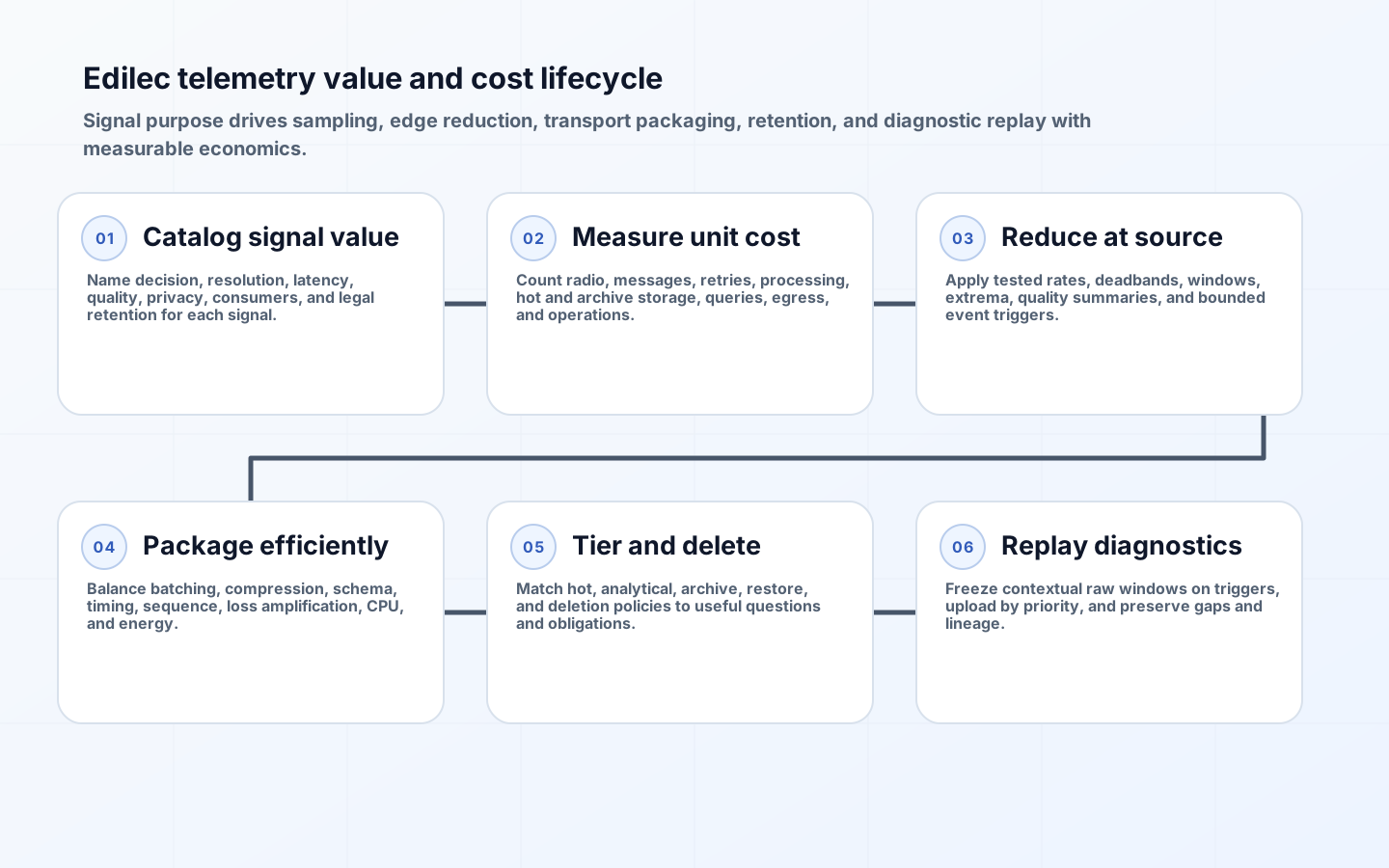
IoT telemetry cost optimization begins with a decision inventory, not a lower cloud bill target. Every sensor sample can create radio use, message operations, gateway work, ingestion, stream processing, hot indexes, replicas, queries, backups, and governance obligations. Collecting everything at maximum frequency often increases cost while making useful signals harder to find. Cutting data without understanding its purpose can erase fault evidence or weaken safety and compliance.
The durable approach assigns each signal an operational value, required resolution, latency, quality rule, and retention path. It then measures the full unit economics from device to deletion. Sampling, aggregation, compression, and tiering become explicit transformations with owners and tests. Raw high-frequency capture remains available when a justified diagnostic trigger needs it, rather than becoming the permanent default for the whole fleet.
Build a signal-value catalog and cost baseline
For every signal, name the producing asset, physical quantity, unit, normal and maximum source rate, payload size, decision served, maximum useful delay, precision, consumers, privacy class, and legal retention. Distinguish control data, alarms, operational trends, billing evidence, model features, and temporary diagnostics. A vibration waveform for bearing analysis has different economics from a once-per-minute cabinet temperature, even when both originate on the same gateway.
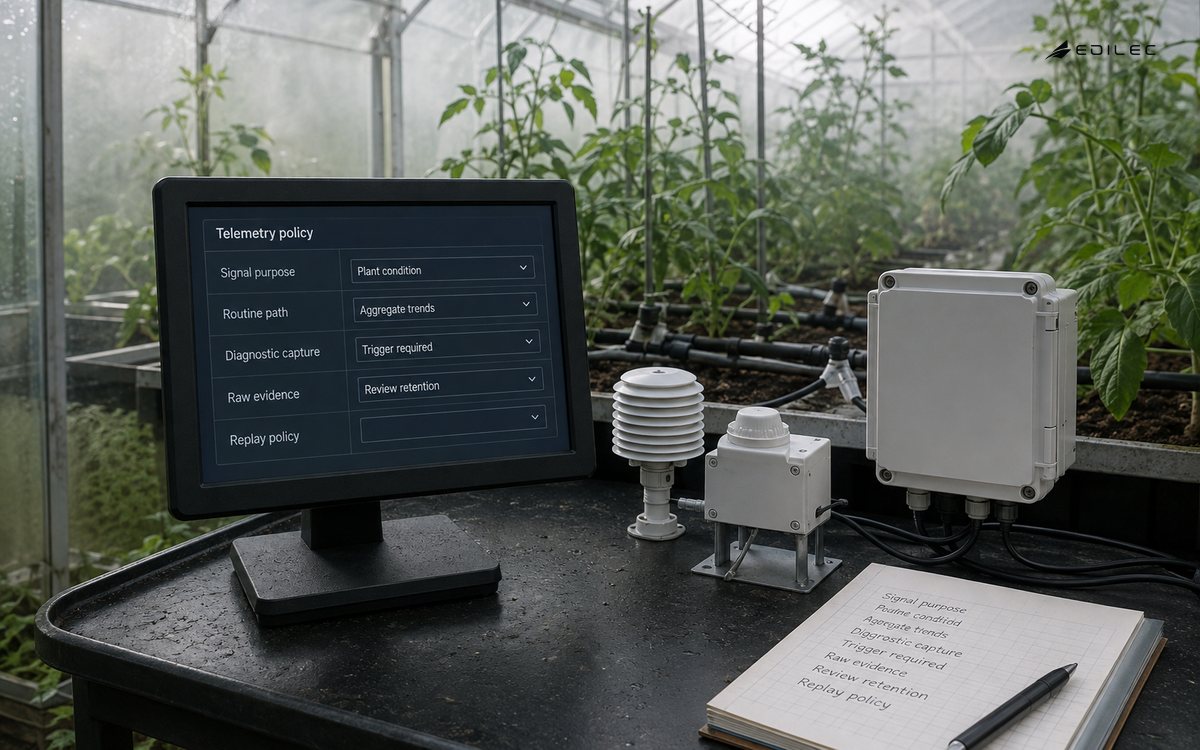
Model monthly cost by multiplying active devices, events per device, bytes per event, protocol overhead, retries, and days, then apply each service's metering units. Add network plans, broker operations, rules, compute, hot storage, object storage, catalog, queries, egress, replicas, backups, and observability. Use measured compression and retry rates from representative devices. AWS's IoT Lens cost guidance explicitly recommends edge aggregation while warning that it changes data fidelity.
| Signal class | Default capture | Cloud representation | Retention basis |
|---|---|---|---|
| Safety or protection event | Immediate event plus bounded context window | Immutable event with source time, quality, and configuration | Regulatory and incident requirements |
| Operational state | On change plus periodic heartbeat | Current state and state-change history | Troubleshooting and service window |
| Slow process trend | Fixed interval or deadband | Aggregates with count, min, max, mean, and quality | Trend and planning horizon |
| High-frequency waveform | Short local ring buffer; upload on trigger | Compressed object plus extracted features | Diagnostic value and labeled outcomes |
| Debug telemetry | Explicit temporary campaign | Isolated dataset with expiry | Campaign end plus short review period |
Select sampling and edge aggregation by signal behavior
Fixed-rate sampling is predictable but can oversample steady conditions and miss short events between intervals. Change-of-value with a deadband reduces repetitive traffic but must define hysteresis, maximum silence, and treatment near thresholds. Window aggregation should preserve count, minimum, maximum, mean, first, last, standard deviation where useful, quality counts, and window boundaries. Averages alone can hide excursions. Event-triggered capture should include pre-trigger samples from a local ring buffer and post-trigger duration, with rate limits to contain a noisy fault.
Run transformations close to the source only when the edge can maintain time, configuration, and recoverability. Store the policy version with each output so analysts know which reduction created it. Keep control loops independent of cloud sampling. OpenTelemetry's metrics data model explains temporal and spatial reaggregation and the semantic conditions required; the same principle applies to device metrics. Aggregation must preserve enough context to distinguish reset, gap, bad quality, and a genuine zero.
Engineer message and payload economics without adding fragility
Batch observations until the marginal savings from fewer envelopes balance latency and loss amplification. One large batch pays less header overhead, but a failed transfer delays more data and requires more memory. Align payload sizes with actual provider billing increments rather than folklore. Use compact field identifiers or binary serialization only when schema governance and debugging tools can support them. Compression helps repetitive payloads but costs CPU, energy, memory, and sometimes latency; measure on the constrained hardware.
Include sequence range, source timestamps, schema version, quality summary, and checksum in each batch. Do not omit identity or provenance merely to save bytes. MQTT topic aliases and payload grouping can reduce repeated overhead, but provider behavior and pricing must be verified for the chosen service and region. Track cost per active device and per useful business outcome, segmented by product model, firmware, geography, signal class, and customer tier. A single fleet average conceals one firmware version that retries excessively.
| Lever | Cost benefit | Primary risk | Required guardrail |
|---|---|---|---|
| Lower source rate | Reduces radio, messages, compute, and storage | Missed transient behavior | Signal-specific aliasing and event tests |
| Deadband/on-change | Removes repeated stable values | False silence and threshold chatter | Heartbeat, hysteresis, and quality events |
| Edge window aggregation | Reduces message count and hot-series volume | Loss of distribution or excursions | Preserve count, extrema, quality, and policy version |
| Batch/compress | Reduces envelope and transfer bytes | Higher delay and larger retry unit | Bounded batch age, memory, and corruption recovery |
| Retention tiering | Moves old data out of costly query paths | Slow investigations and restore expense | Document restore SLA and test retrieval |
| Diagnostic trigger | Limits raw high-rate capture to useful windows | Trigger misses or storms | Pre-trigger ring, trigger audit, and upload quota |
Design retention tiers around questions and restore time
Keep recent operational data in a hot time-series store only for the period when dashboards, alerts, and frequent troubleshooting need it. Move older aggregates to a lower-cost analytical tier and raw diagnostic objects to durable object storage with lifecycle rules. Delete data whose value and obligation have expired. Retention should be expressed by data class and purpose, not one fleet-wide number. Preserve schema, unit, calibration, device and firmware context, and transformation lineage alongside archived values.
Benchmark the queries that justify hot retention: recent state, percentile trend, incident window, fleet comparison, and customer export. Cardinality often dominates time-series cost; avoid unbounded identifiers such as request IDs in metric dimensions and place them in event records instead. Exercise archive restore and measure elapsed time, bytes scanned, and analyst steps. Cheap storage that cannot be found, interpreted, or restored within the incident objective is deferred waste, not economical evidence.
Preserve diagnostic replay and trustworthy gaps
When an anomaly occurs, a gateway may freeze its pre-trigger ring, collect a bounded high-rate tail, calculate features, and upload the raw segment when connectivity and quota permit. Give the segment a stable capture ID and record trigger, policy, clock quality, calibration, firmware, and dropped-sample count. Upload through a priority-aware store-and-forward path. Cloud analysis can then replay the exact window without forcing every device to stream waveforms continuously.
Never fabricate continuity. Represent missing intervals, late replay, device restart, and bad quality explicitly. Deduplicate by capture or event identity while retaining original source time. Monitor source samples, transmitted observations, accepted batches, rejected records, late age, compression ratio, hot bytes, archive bytes, query scans, restore tests, and cost per signal class. Review transformations when firmware, pricing, fleet scale, or the decision served changes.
Govern telemetry changes as measured experiments
Roll out a new sampling policy to a representative cohort with a control group. Compare network use, device energy, processing cost, alert performance, diagnostic success, model quality, and operator outcomes. Set rollback criteria before exposure. A cost reduction that delays fault detection or raises truck rolls simply moves expense. Keep policy configuration signed, versioned, and locally cached so an outage cannot leave devices with a partial rule.
Assign owners to signal definition, device implementation, pipeline, storage, finance allocation, and deletion. Review top cost movers monthly and conduct a deeper value review at product or contract milestones. The AWS IoT Lens design principles recommend lean data at the edge and enrichment in the cloud; implementation should preserve this boundary without stripping the source context needed to enrich correctly.
Key takeaways
- Catalog each signal by decision value, resolution, quality, privacy, and retention before optimizing volume.
- Model cost across radio, messages, processing, storage, queries, egress, and operations using measured fleet behavior.
- Preserve count, extrema, quality, timing, and policy version when aggregating at the edge.
- Tier storage by question and restore objective, and delete data after value and obligation expire.
- Use bounded triggered raw capture to retain diagnostic evidence without permanent high-rate streaming.
FAQ
What is the right IoT telemetry sampling rate?
There is no fleet-wide answer. Start from the fastest phenomenon and decision latency, then test aliasing, event detection, energy, and bandwidth on representative hardware. A control loop may sample locally at high rate while transmitting only features and exceptions.
Should raw telemetry ever be deleted?
Yes, when its diagnostic, contractual, research, and legal value has expired. Keep documented exceptions for regulated evidence and labeled failure datasets. Deletion should include derived copies where policy requires and should produce auditable completion.
How can teams detect information lost by aggregation?
Run a control cohort that retains raw windows, compare decisions and distributions, inject known transients, and record transformation versions. Periodically sample raw data under a strict budget to detect drift in assumptions.
Make savings claims reproducible: store the baseline period, fleet population, price sheet version, currency, discounts, transformation configuration, and observed service units. Report both gross infrastructure reduction and net savings after engineering, extra edge compute, restore, and support costs. This prevents a provider price change or one-time archive migration from being mistaken for a durable architectural improvement.
Conclusion
Telemetry economics improve when every byte has a purpose and every reduction has a known loss. A signal catalog, measured unit model, edge-aware transformations, tiered retention, and triggered replay allow a fleet to spend on decisions and evidence rather than on undifferentiated volume.