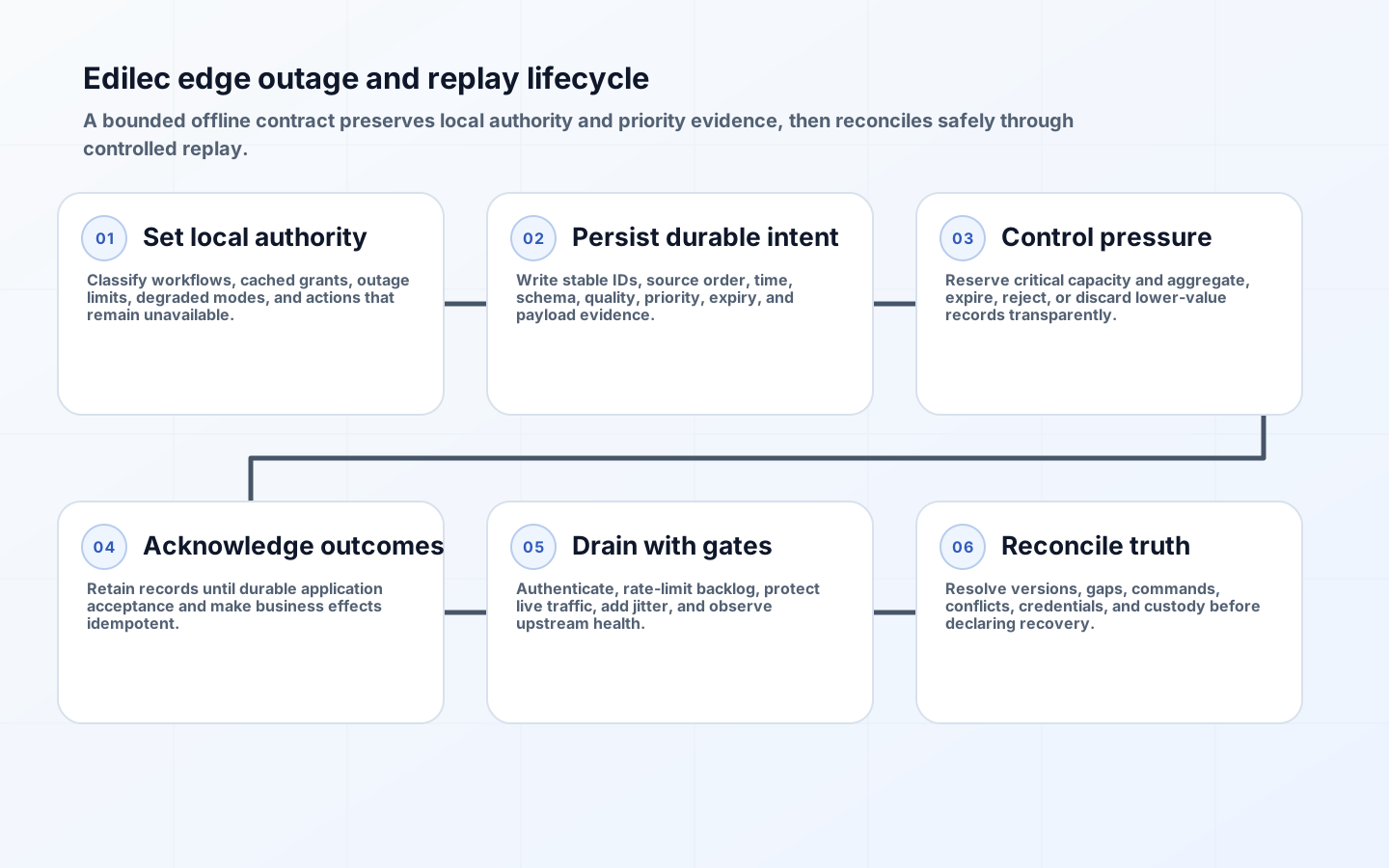
An edge store and forward architecture preserves useful operations while the WAN, DNS, identity service, broker, or cloud region is unavailable. It is more than a disk-backed MQTT queue. The design must define which decisions remain local, which messages deserve scarce storage, when data expires, how commands are constrained, and how a recovered link drains backlog without duplicating actions or overwhelming upstream systems.
Start by treating disconnection as an expected operating mode with a bounded service contract. A factory may need control and safety interlocks to remain entirely local, a store may continue sales under an offline limit, and a remote site may collect regulated measurements for later delivery. Cloud dashboards can become stale, but local truth must remain coherent. Document the maximum outage each function can tolerate and the point at which the site must degrade or stop.
Define local operational authority before sizing a queue
Classify every workflow as local-only, local-first with cloud synchronization, cloud-authorized with cached grant, or unavailable offline. Safety logic and fast machine control should not depend on a distant round trip. A cached grant needs subject, scope, resource, issue time, expiry, revocation limitations, and an offline risk ceiling. Never let an expired cloud policy silently become permanent local authority. Record the site's operating mode so users can distinguish current central approval from a bounded offline continuation.
Azure IoT Edge's offline capabilities illustrate several useful responsibilities: the edge hub stores upstream messages, authenticates modules and downstream devices from synchronized local state, and reconnects later. The same documentation warns that retention depends on time-to-live and available disk. Translate that into a product contract: startup after disconnection, local identity cache age, queue budget, data loss policy, and recovery order all need deliberate values.
| Workflow | Offline behavior | Required local evidence | Reconnect reconciliation |
|---|---|---|---|
| Safety interlock | Remain locally authoritative and independent of cloud | Validated local logic, configuration version, fail-safe state | Report events; never replay physical actuation |
| Telemetry | Buffer, summarize, or discard by signal class | Source time, sequence, quality, schema, retention class | Replay idempotently within expiry |
| Operator change | Allow only bounded low-risk actions | Authenticated local role and durable intent record | Resolve against newer policy and acknowledge outcome |
| Cloud command | Reject, defer, or execute only under unexpired grant | Command ID, deadline, precondition, authorization scope | Do not execute stale commands after recovery |
| Reference data | Use last-known-good version with visible age limit | Signed version, activation time, expiry | Fetch and validate newer version before switching |
Design a durable, bounded, priority-aware edge log
Persist an envelope containing stable event ID, source device, source sequence, event time, ingestion time, schema version, quality, priority, expiry, payload digest, and destination. Write data before acknowledging it to a producer when loss is unacceptable. Use append-oriented storage with checksums and atomic metadata, reserve free space for critical records, and test sudden power removal. Separate queues by priority or enforce quotas so high-rate diagnostic telemetry cannot evict alarms, transactions, or audit evidence.
Capacity planning should model bytes per event after framing, sustained and burst rate, outage duration, replication or filesystem overhead, compaction, wear, and a safety margin. A nominal 48-hour buffer is meaningless if a fault increases messages tenfold. Define high-water responses in advance: aggregate low-value samples, drop expired diagnostics, reduce sampling, reject new noncritical work, alert locally, and preserve the reason for every intentional discard. Encrypt sensitive records at rest and bind queue access to narrowly scoped processes.
Specify delivery, acknowledgement, and replay semantics
Most practical designs provide at-least-once delivery and make consumers idempotent. The edge retains a record until it receives a durable application acknowledgement, not merely a TCP write or broker acceptance if downstream persistence matters. The cloud stores the stable event ID with the resulting state change in one transaction or equivalent atomic boundary. Duplicate messages then return the prior result. Ordering should be scoped to the smallest entity that needs it, such as one meter or transaction stream, because a global order blocks unrelated work.
MQTT 5 offers session and message expiry, reason codes, and QoS behavior in the OASIS specification, but protocol QoS does not by itself create end-to-end exactly-once business processing. A broker can acknowledge before the business database commits, and reconnect can redeliver. Keep command messages distinct from telemetry: commands require an expiry, target state or precondition, authorization context, and idempotency key. A command to 'set valve to closed if run 42 is active' is safer to reconcile than 'toggle valve.'
| Record class | Priority | Expiry | Replay policy |
|---|---|---|---|
| Safety event | Highest | Long enough for investigation and obligations | Send first; preserve source ordering and acknowledgement evidence |
| Financial or production transaction | High | Business-defined | Idempotent apply with conflict queue and operator visibility |
| Operational state change | High | Until superseded or acknowledged | Coalesce only when intermediate states have no audit value |
| Periodic telemetry | Medium | Based on analytic value | Rate-limit replay and retain source timestamps |
| Debug sample | Low | Short | Discard first under pressure and never delay live alarms |
Control reconnect, backlog drain, and live traffic
When connectivity returns, verify identity, time, policy, schema compatibility, and destination health before opening the drain. Reserve capacity for live critical traffic and release backlog through a token bucket or adaptive rate controller. Increase only while cloud ingestion latency, rejection rate, database load, and queue age remain within gates. Apply jitter across sites so thousands of gateways do not reconnect at once. Traffic smoothing and exponential backoff are explicit benefits of the Azure IoT Edge gateway pattern.
Reconcile desired and reported state using versions rather than arrival time. Compare the cloud's last acknowledged source sequence with the edge log, identify gaps, and request ranges where supported. For configuration, preserve the last known-good local version until a newer signed configuration is fully validated; do not partially merge a stale offline edit with a changed central policy. Route unresolved business conflicts to an owned queue with context and a deadline. A silently discarded conflict is data loss with better manners.
Test the outage and recovery matrix
Inject loss at DNS, certificate validation, broker, application acknowledgement, and storage layers. Test hours-long disconnection, repeated flapping, clock drift, full disk, corrupt segment, process crash after local commit, process crash after cloud commit but before acknowledgement, schema upgrade during outage, identity rotation, and a regional failover. Exercise multiple outage boundaries because a gateway can reach the broker while the business consumer is unavailable. Measure queue depth by class, oldest age, discarded count and reason, retry rate, duplicate suppression, conflict count, flash health, and drain ETA.
Operations need local and central views. The local interface should show mode, last cloud contact, active policy version, queue pressure, data loss state, and permitted actions without requiring the cloud. Central monitoring should distinguish disconnected from silent, stale from missing, and replayed from live. Maintain a field procedure for replacing a failed gateway without duplicating transactions or abandoning its encrypted queue. Recovery is complete only after backlog, desired state, credentials, and operator understanding are reconciled.
Key takeaways
- Define offline authority and risk limits for each workflow before implementing persistence.
- Use a bounded durable log with priority quotas, expiry, stable IDs, source sequence, and explicit pressure behavior.
- Aim for at-least-once transport plus idempotent business processing and durable application acknowledgements.
- Treat commands as expiring conditional intents, not replayable telemetry.
- Rate-limit backlog drain, reserve capacity for live critical traffic, and reconcile versions and gaps explicitly.
FAQ
How much telemetry should an edge gateway buffer?
Derive it from each signal's value, worst credible event rate, outage objective, usable disk, endurance, and discard policy. Use separate budgets for critical and diagnostic classes. Test the fault-rate case, not only normal production averages.
Can store-and-forward guarantee exactly-once processing?
A transport label cannot guarantee one business effect across independent edge, broker, and database commits. Stable event IDs, idempotent consumers, atomic result recording, and durable acknowledgements provide a tractable effective-once outcome under retries.
Should cloud commands wait until a device reconnects?
Only when the command has an explicit deadline, authorization scope, precondition, and safe late-execution meaning. Many physical commands should expire quickly or be replaced by desired-state reconciliation. Never replay an unbounded toggle or emergency action.
Capacity and recovery policy also need a change process. A new signal, firmware version, or site workflow can invalidate queue sizing and priority assumptions. Require each producer to declare maximum rate, payload, retention class, and behavior under rejection. Load-test the combined declared maxima plus fault bursts, and block deployment when reserved critical capacity would be consumed. Review local time synchronization because long outages can make certificate checks, source ordering, and command expiry unreliable; use monotonic counters where wall-clock trust is unavailable.
Document data custody when hardware is replaced. An encrypted disk containing undelivered transactions may need controlled extraction, transfer to a replacement gateway, or destruction with an accepted loss record. The procedure should verify device identity, prevent two gateways from replaying the same queue, preserve event IDs, and produce an auditable chain of custody. Practicing this scenario closes a gap that normal reconnect tests never exercise.
Conclusion
Store-and-forward works when local authority, durable evidence, and recovery semantics are designed together. A gateway that can preserve critical intent, shed low-value data transparently, replay idempotently, and drain without destabilizing the cloud turns disconnection from an improvised incident into a tested operating mode.