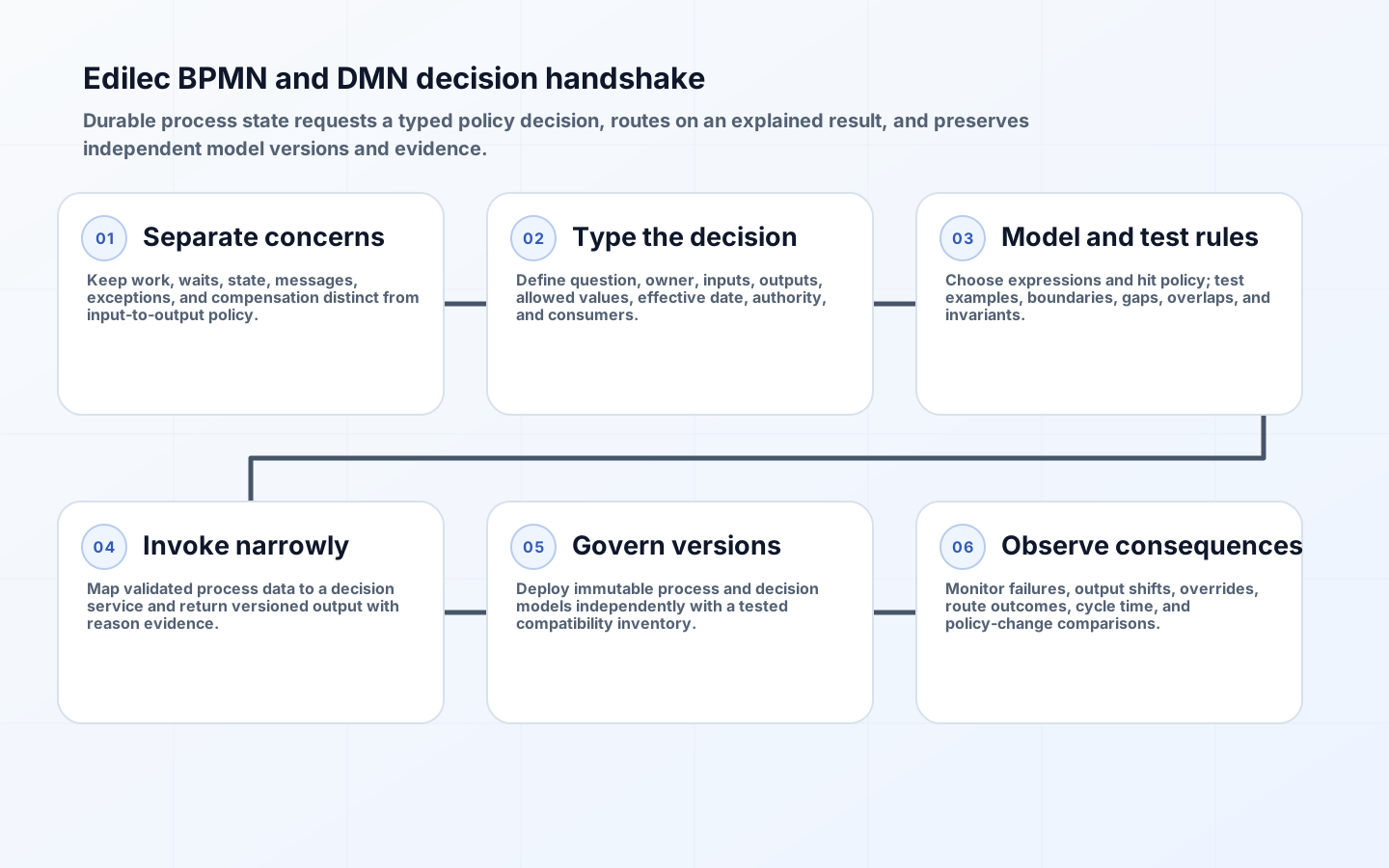
BPMN and DMN solve related but different automation problems. Business Process Model and Notation describes work unfolding over time: events, activities, sequence, participants, messages, waits, exceptions, and completion. Decision Model and Notation describes how inputs and knowledge determine an output at a decision point. Combining them well keeps workflow state visible while making policy reusable and testable.
The common failure is to embed a large policy inside gateway labels or to turn a simple route choice into a second process hidden in a rule table. The first makes rules difficult to analyze and reuse; the second hides temporal behavior from operators. Establish a contract: BPMN owns when and why a decision is needed and what happens afterward; DMN owns the repeatable evaluation from defined inputs to defined outputs.
Separate temporal process concerns from decision logic
Put a concern in BPMN when it involves an actor performing work, a message arriving, time passing, a retry, cancellation, escalation, compensation, or durable progress. Put it in DMN when the same complete input set should yield the same governed result without waiting for external work. A credit policy may decide required review level; obtaining missing evidence, assigning an analyst, waiting for a response, and escalating overdue work remain process concerns.

| Concern | BPMN owns | DMN owns | Boundary example |
|---|---|---|---|
| Time | Timers, deadlines, waits, duration | Date calculations only as decision inputs or logic | Process triggers reevaluation when policy date arrives |
| Work | Human, service, send, receive, and subprocess activities | No external task execution | Business rule task invokes decision service |
| State | Process instance and token progression | Stateless result for supplied inputs | Process stores decision output and continues |
| Exceptions | Boundary events, escalation, compensation, incident path | Valid result, validation error, or no rule result | Technical failure follows BPMN error path |
| Policy | Chooses where result is used | Requirements graph, expressions, tables, hit policy | Eligibility output feeds an exclusive gateway |
Model a decision contract before drawing rules
Define the business question, decision owner, input data, output type, allowed values, effective dates, authority sources, and consumers. Keep inputs factual and available at the invocation point. A decision named Determine review requirement with output {level, reasonCodes, policyVersion} is clearer than Is approved? when the process must distinguish automatic, analyst, and executive review. Do not let a decision service query arbitrary workflow state behind the model.
Use a Decision Requirements Diagram to show input data, decisions, and reusable business knowledge. Implement simple logic with literal expressions and tabular rules where appropriate. DMN's Friendly Enough Expression Language provides common expression semantics, but teams still need a type and null policy. Distinguish missing, inapplicable, unknown, and invalid inputs; collapsing all four into an empty string creates unexplainable routes.
Choose decision-table hit policies deliberately
A hit policy states what multiple matching rules mean. Use unique when exactly one rule may match, any when overlapping matches must produce the same output, first only when rule order is a deliberate business priority, priority when output ordering is defined, collect for aggregations, and rule order or output order only when returning multiple results is intended. Validate gaps and overlaps against the chosen policy rather than relying on row order accidentally.
Keep rule rows business-readable and traceable to an authority. Separate effective-date selection from historical evidence: the process should invoke the policy version effective for the case and store that version with the result. When a rule changes, existing long-running process instances need an explicit policy: retain prior result, reevaluate at a named milestone, or migrate through controlled exception handling. Silent reevaluation can alter obligations midway through work.
| Test type | Purpose | Example assertion | Owner |
|---|---|---|---|
| Rule example | Confirms a named business scenario | Low amount and verified customer requires no manual review | Policy analyst |
| Boundary | Checks limits, dates, and inclusivity | Amount exactly at threshold gets documented outcome | Analyst and QA |
| Gap and overlap | Verifies hit-policy assumptions | Every valid segment matches one unique row | Decision engineer |
| Metamorphic | Checks relationships across input changes | Increasing risk cannot lower required review without reason | Risk owner |
| Process contract | Verifies BPMN mapping and error behavior | executive result enters executive-review activity | Workflow team |
Invoke the decision service through a narrow process contract
In BPMN, use a business rule task or clearly named service task at the point all required inputs are available. Map process variables into a versioned request and validate them before evaluation. Return a typed result with decision ID, model version, output, reason codes, evaluation time, and correlation to the process instance. A gateway may route on the result, but its labels should describe process meaning such as manual review required, not duplicate the policy expression.
Define technical and business failure separately. A model deployment unavailable or timed out is a technical incident and should retry or enter a controlled service-failure path. Incomplete input, no applicable rule, or policy conflict is a modeled business result that usually enters data correction or manual review. Decide whether evaluation must be synchronous. If the process can wait for an asynchronous decision, model the wait and correlation explicitly rather than hiding it in a worker.
Govern model versions, deployment, and evidence
The BPMN 2.0.2 specification and DMN 1.5 specification define notation and interchange semantics, but organizational governance determines whether models remain trustworthy. Version process and decision artifacts independently, keep machine-readable models in source control, require owner review, execute tests in CI, and deploy immutable versions. Record which process deployments are compatible with which decision contracts.
Use a semantic business vocabulary so terms in tasks, inputs, and rules do not drift. OMG's SBVR specification provides a standards-based foundation for vocabulary and business rules, though teams can implement a lighter governed glossary. Every production decision should be explainable from input snapshot, model version, matched rules or evaluation trace, output, authority, and subsequent process route, subject to privacy and retention limits.
Operate policy change and process observability together
Before activating a decision version, replay representative historical cases, compare old and new outputs, quantify changed routes, and have the policy owner approve intended differences. Canary by new process instance or stable cohort; avoid splitting repeated evaluations for one case across models unless designed. Maintain an emergency rollback to the previous immutable model and know whether rollback affects only future evaluations or also rework.
Measure decision latency, technical failure, no-result and invalid-input rates, output distribution, rule coverage, changed-outcome rate, manual override, downstream completion, and process cycle time. An output distribution shift can indicate data drift, model defect, or real business change; investigate with source owners. Never optimize straight-through processing by suppressing justified review. The goal is an explainable outcome and controlled flow, not the smallest human queue.
Preserve interchange and human review
Use the standards' machine-readable interchange, but verify behavior in the target engine. Vendors can implement different DMN conformance levels, FEEL extensions, BPMN execution subsets, and deployment metadata. Build portability tests around the constructs the organization actually uses, export models from source control, and avoid proprietary expressions in core policy unless the lock-in is consciously accepted. A diagram that imports successfully may still evaluate differently.
Keep business review separate from technical validation. Policy owners should inspect vocabulary, authorities, examples, gaps, overlaps, reason codes, and changed outcomes; engineers should inspect types, deployment, failure semantics, performance, and process mappings. Generate a readable change report from old and new models plus scenario results. Approval of XML or a colored diff alone is not meaningful evidence that the business consequence was understood.
When several processes consume one decision service, maintain a consumer inventory with supported contract and model ranges. A new optional reason code may be harmless to one process but break another that treats unknown values as an error. Run consumer contract tests before activation, publish deprecation dates, and keep model rollback available until every affected process has passed production verification.
Key takeaways
- Keep waits, work, exceptions, compensation, and durable progress in BPMN.
- Keep repeatable input-to-output policy in a typed, versioned DMN decision contract.
- Select hit policy explicitly and test rule examples, boundaries, gaps, overlaps, and process mapping.
- Return model identity and reason evidence; distinguish technical failure from a modeled no-result.
- Deploy process and decision versions independently but maintain a tested compatibility matrix.
FAQ
Can gateway conditions contain business rules?
Small routing checks can remain gateway conditions. Extract logic when it has an independent policy owner, many rules, repeated use, frequent change, explanation needs, or meaningful gap and overlap analysis. Keep the gateway label focused on route meaning.
Should a DMN decision update workflow state?
No. Treat evaluation as a function of supplied inputs. The process receives and persists the result, then performs effects. This separation improves replay, testing, version comparison, and incident diagnosis.
What happens to running cases after a rule change?
Choose explicitly by case type: retain the recorded decision, reevaluate at a defined milestone, or migrate through reviewed exception handling. Store the original model version and input evidence so either behavior is auditable.
Conclusion
BPMN and DMN work best as a visible handshake between durable workflow and governed judgment. A typed decision contract, deliberate hit policy, narrow invocation, independent versioning, and joined operational evidence let policy teams change rules without turning process state into a mystery, while workflow teams can evolve orchestration without copying policy across gateways.