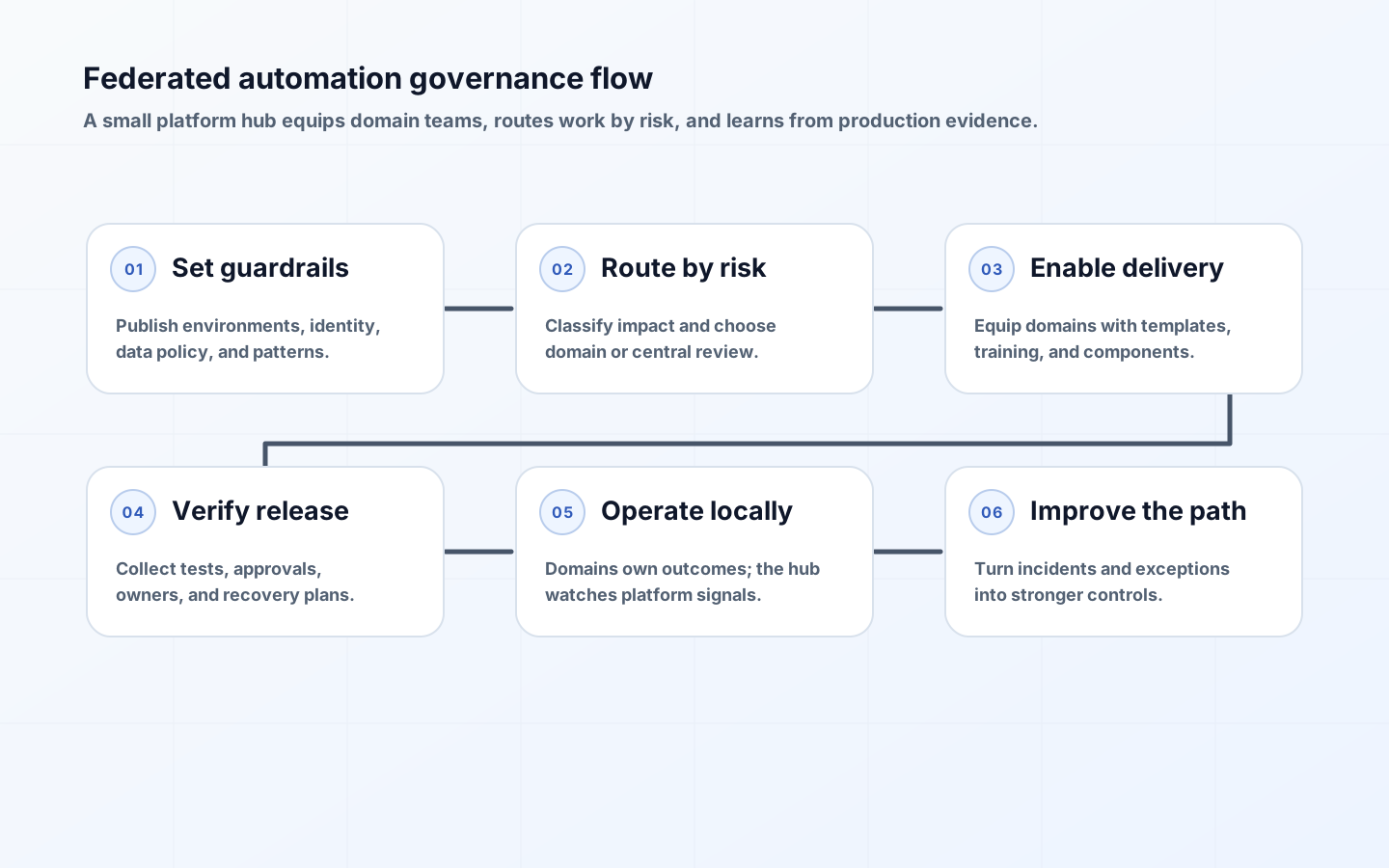
An automation center of excellence should make reliable automation easier to deliver across the enterprise. It should not force every workflow, robot, low-code app, and AI-assisted process through one central delivery queue. The scalable design is a federated operating model: a small platform team owns common controls and reusable capabilities, while accountable domain teams build and operate solutions within explicit risk boundaries.
This guide turns that principle into an operating design. It covers mandate, service catalog, risk tiers, intake, citizen development, assurance, funding, and metrics. The aim is a CoE that reduces the cost of doing the right thing, concentrates scarce experts on consequential work, and gives executives evidence about value and exposure without confusing activity counts with business outcomes.
Define the mandate before choosing the organization chart
Start with a written mandate that names the decisions the CoE owns. Typical central responsibilities include platform configuration, identity integration, environment policy, connector and data controls, common observability, approved patterns, inventory, and incident coordination. Business domains should retain process ownership, benefit accountability, acceptance criteria, operating procedures, and first-line support for their automations. Security, privacy, records, and internal audit functions remain independent control owners rather than being absorbed into the CoE.
Describe the CoE as a capability, not merely a team. Microsoft explicitly notes that its CoE Starter Kit is a set of templates rather than the whole center of excellence; people, communication, requirements, and processes still have to be designed. That distinction prevents an inventory dashboard from being mistaken for governance. Publish a decision-rights matrix and an escalation route so makers know which choices are self-service, which need consultation, and which require approval.
| Decision area | Central CoE | Domain automation team | Independent control owner |
|---|---|---|---|
| Platform and environments | Defines tenancy, environment classes, identity, and baseline policy | Uses the approved environment and names an owner | Reviews control design where required |
| Process and benefits | Provides discovery and measurement methods | Owns process design, baseline, target, and adoption | Challenges material claims during assurance |
| Solution delivery | Publishes patterns, components, and delivery gates | Builds, tests, releases, and supports within its tier | Approves exceptions in its authority |
| Production events | Coordinates platform incidents and cross-domain learning | Triages business impact and restores its service | Receives reportable events and validates remediation |
Use a hub-and-spoke operating model
The hub should be intentionally small. Staff it with a platform product owner, administrator, solution architect, reliability or support lead, governance lead, and enablement capability appropriate to scale. Each business unit appoints a process owner and one or more trained automation leads. Those spokes translate enterprise policy into domain decisions, review low-risk work, maintain local backlogs, and bring uncommon or high-impact cases to the hub. A community of practice connects the spokes without changing accountability.
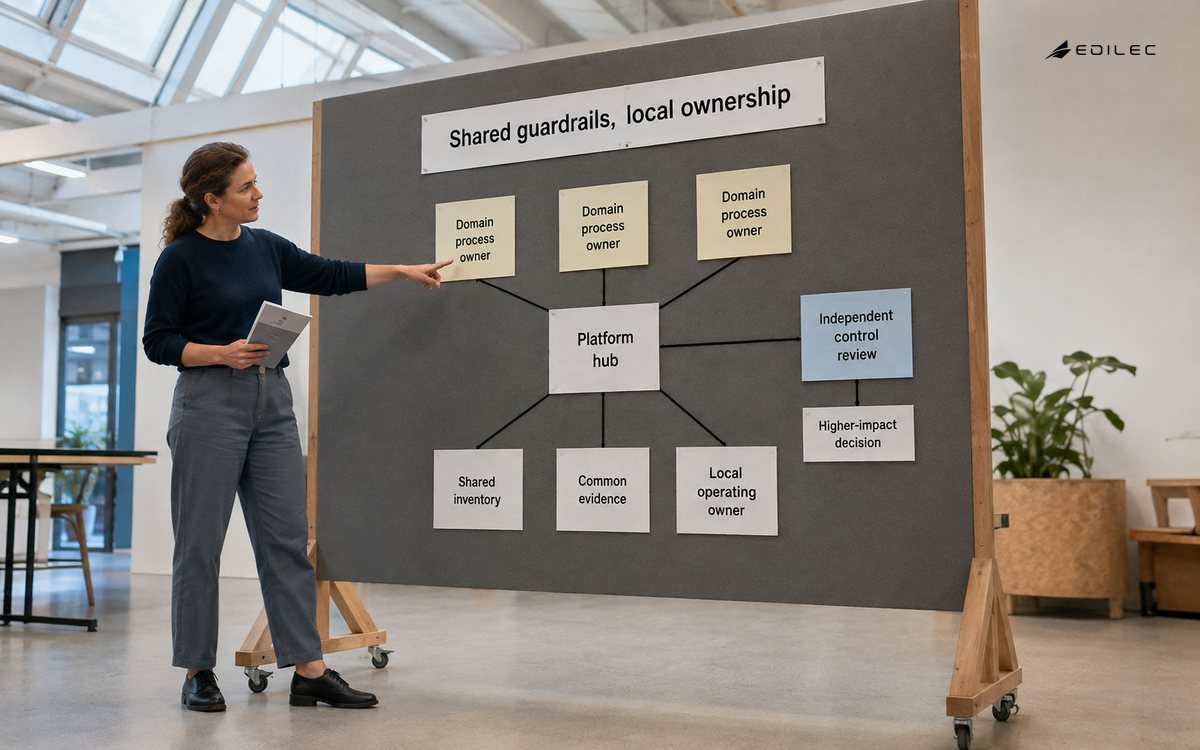
Federation is not permission to create different control systems in every department. The hub supplies one inventory model, risk vocabulary, release evidence format, incident taxonomy, and reusable technical baseline. Spokes can add domain-specific checks for regulated data, financial authority, safety, or customer commitments. This creates local speed while preserving comparable evidence. Review the split quarterly: a repeated central consultation is a candidate for documentation or automation, while repeated local exceptions may reveal a missing enterprise control.
Publish a service catalog with response commitments
A service catalog makes the CoE's contribution visible and limits unplanned work. Separate platform services such as environment provisioning, credentials, connectors, logging, deployment pipelines, reusable components, architecture consultation, maker training, production onboarding, and incident assistance. For each service, state eligibility, required inputs, expected lead time, decision owner, and an escalation route. Productize frequent requests through forms, policy checks, templates, office hours, and documented examples.
Do not make central development the default service. Reserve it for shared components, cross-enterprise processes, recoveries, or work whose risk exceeds domain capability. A domain asking for an ordinary environment should receive a policy-backed automated path, not wait for a committee. Track demand by service and outcome. If architecture consultations repeatedly discover the same connector, logging, or retry problem, improve the paved path rather than adding reviewers.
Route work through risk tiers, not one universal gate
Classify a proposed automation using observable attributes: data sensitivity, external exposure, financial or legal effect, privilege, autonomy, transaction volume, process criticality, recoverability, and use of probabilistic AI. The resulting tier determines the delivery path. A personal reminder with no sensitive data may require inventory and ownership only. A payroll change, customer eligibility decision, privileged account action, or safety-related command needs independent evidence and stronger release authority.
Make tiering reproducible. Store the answers, calculated tier, assessor, date, and policy version. Permit reclassification when scope changes, and require it when a solution gains a new connector, dataset, audience, or autonomous action. NIST's AI RMF organizes AI risk work around Govern, Map, Measure, and Manage; a CoE can use that lifecycle for AI-enabled automation without applying it indiscriminately to deterministic low-risk flows. The purpose is proportional assurance, not a larger questionnaire.
| Tier | Representative use | Delivery path | Minimum evidence |
|---|---|---|---|
| Tier 1: personal | Individual productivity with reversible local effect | Self-service in a constrained environment | Owner, purpose, connectors, expiry or review date |
| Tier 2: team | Shared workflow using approved business data | Domain review and standard pipeline | Process test, support owner, monitoring, rollback |
| Tier 3: material | Customer, financial, regulated, or privileged action | Architecture and control-owner review | Threat and failure analysis, segregation, acceptance evidence, recovery exercise |
| Tier 4: critical | Enterprise-critical or safety-sensitive automation | Central design authority and independent release decision | Resilience test, manual continuity, incident runbook, executive risk acceptance |
Make automation intake a routing function
An effective automation intake captures enough information to route the idea, not a complete business case before discovery. Ask for the process owner, users, trigger, current work, desired outcome, systems touched, data classes, decision authority, frequency, known exceptions, and consequence of failure. Return one of four outcomes quickly: self-service guidance, domain delivery, CoE consultation, or stop and redesign. Provide the reason and next action with every route.
Separate qualification from prioritization. Qualification asks whether automation is appropriate and what controls apply. Prioritization compares qualified opportunities using measurable benefit, strategic relevance, readiness, delivery cost, operational risk, and capacity. Avoid ranking solely by hours claimed as saved: volume can be uncertain, work may shift rather than disappear, and quality or control benefits may be more important. Revisit assumptions after a pilot and close proposals that lack an accountable process owner.
Enable citizen developers with progressive permissions
Training should unlock defined capabilities. A new maker might build personal flows with approved connectors after basic training. A domain maker earns access to shared development environments after demonstrating solution packaging, error handling, testing, privacy, and support practices. Advanced makers can own material workflows only with named professional engineering and control partners. Tie privileges to current competency and solution risk, not job title or attendance at a single course.
Give makers maintained starter solutions, naming conventions, connection patterns, logging, idempotency examples, accessibility checks, and deployment automation. Include clear limits and an assisted path. The most useful standard is executable or embedded in the platform; a long PDF that competes with the authoring experience will be bypassed. Use office hours for ambiguous design problems, and convert each recurring answer into a tested pattern or concise decision record.
Move assurance into the delivery and operating lifecycle
Controls should operate from creation through retirement. Inventory discovers new assets and orphaned ownership. Policy checks detect disallowed connectors, sharing, credentials, and unmanaged production changes. Deployment gates verify an immutable artifact, test results, configuration, and approval. Runtime controls monitor failures, latency, queue age, business exceptions, and unexpected privilege use. Periodic attestation confirms that the process, owner, data, and business need remain current.
Design an exception process that is faster than covert workarounds. An exception records the exact control, scope, rationale, compensating measure, owner, approver, expiry, and review evidence. It should not silently expand to related solutions. The CoE reports exception age and recurrence, while the relevant risk owner accepts exposure. When the same justified exception recurs, decide whether the baseline is wrong, the platform lacks a capability, or the domain needs a dedicated environment.
Fund the platform and measure flow, control, and outcomes
Use a durable funding model for common platform work and transparent chargeback or showback for domain consumption where appropriate. Shared funding covers administration, security baselines, observability, reusable components, enablement, and incident capability. Domains fund process discovery, delivery, adoption, and operation. This prevents the CoE from chasing project revenue while unglamorous controls decay, and it keeps benefit ownership with the business area able to realize it.
Balance three views. Flow metrics include intake-to-route time, environment lead time, deployment frequency, and review wait. Control metrics include inventory coverage, orphaned assets, policy violations, expired exceptions, failed recoveries, and incident trends. Outcome metrics belong to each process: cycle time, error or rework, customer delay, control effectiveness, capacity released, and verified financial effect. Count makers and automations only as context; growth without quality is not success.
Key takeaways
- Keep platform policy, shared capabilities, inventory, and cross-domain learning in the hub; keep process outcomes and daily operation in accountable domains.
- Use reproducible risk tiers to determine evidence and approval instead of sending every automation through the same gate.
- Treat intake as rapid routing, and turn frequent consultations into self-service platform capabilities.
- Measure review wait, control health, and process outcomes so the CoE is rewarded for enablement rather than central workload.
Frequently asked questions
Should an automation CoE build automations? It can build enterprise components and selected high-risk or cross-domain solutions, but it should not become the default factory. Its highest-leverage work is making domain delivery observable, repeatable, secure, and supportable.
How large should the central team be? Size follows platform diversity, regulatory exposure, support hours, and adoption, not employee count alone. Start with named ownership for product, administration, architecture, governance, reliability, and enablement; combine roles at small scale and add capacity when measured demand or risk warrants it.
Does federation weaken governance? It weakens governance only when standards and decision rights are ambiguous. A shared inventory, risk model, evidence format, technical baseline, and exception process let local teams act quickly while producing centrally comparable assurance.
Conclusion
A scalable automation center of excellence behaves like an internal platform and governance product. It creates reliable defaults, routes by risk, equips domain owners, and learns from operating evidence. Central expertise remains available where consequences are material, but ordinary delivery does not wait in its queue. That is how the CoE increases both automation velocity and control rather than trading one for the other.