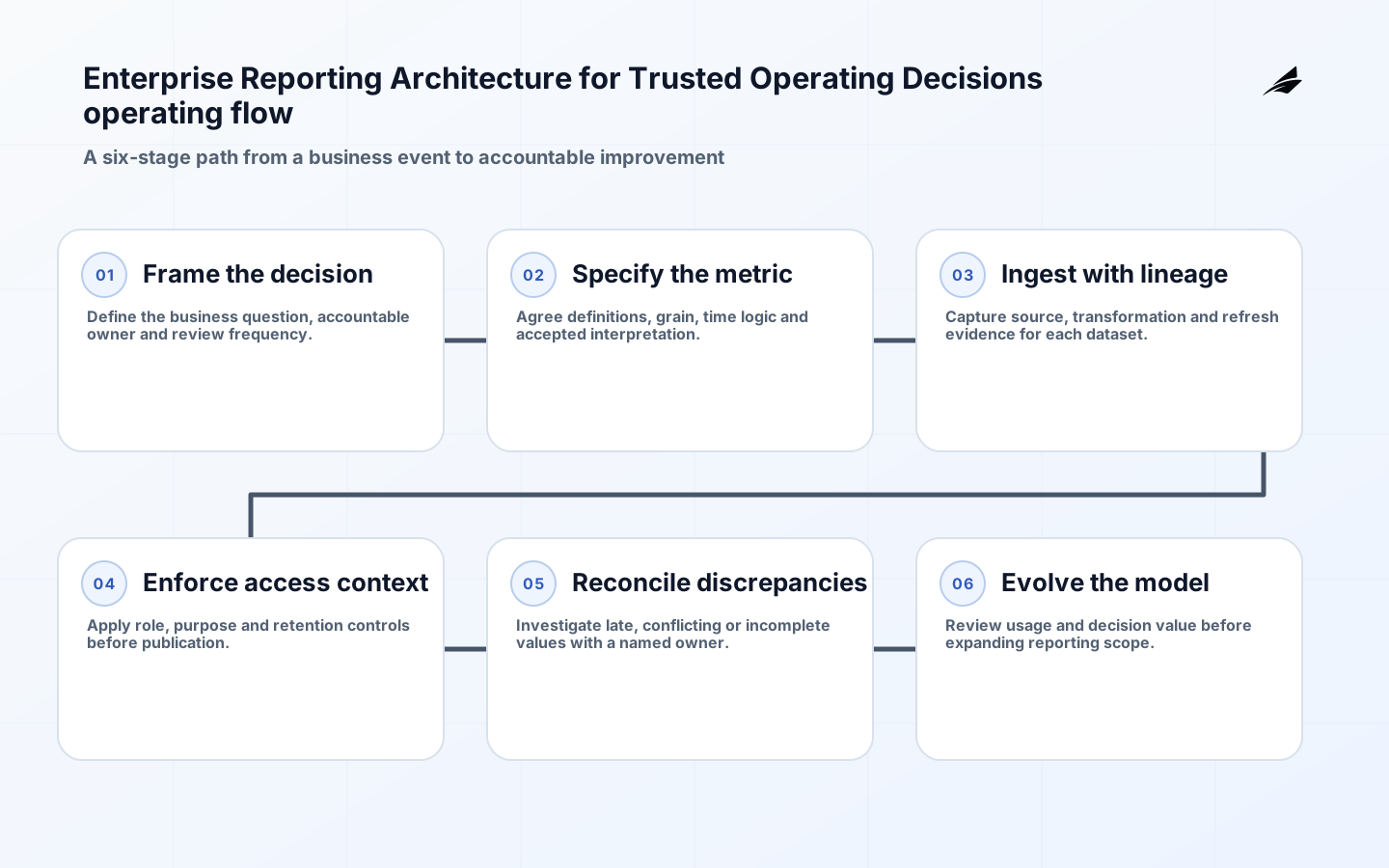
Enterprise reporting architecture is best treated as an operating-design decision, not a screen or routing exercise. Product leaders, enterprise architects and reporting owners should begin with one observed journey: a reporting refresh, a management review or a material discrepancy in a published measure. Follow that journey from initiation to a confirmed outcome, including the moment an operator must make a judgement. The useful question is not whether every task can be automated or displayed. It is whether the organization can show who owns the work, what evidence supports the next action and how the work is recovered when something goes wrong. This guide uses that discipline to turn an ambitious systems idea into a release that people can operate under ordinary pressure. In enterprise reporting, the architecture is an operating agreement about evidence and decisions, not a diagram of tools.
Start with recent examples rather than an idealized process map. Ask participants which information they trusted, where they had to leave operational sources, integration layer, governed data store, semantic model and reporting interface, and what delayed the case. Include an example involving late-arriving data, changed business definitions, unauthorized access request and a source-to-report discrepancy. The resulting evidence often exposes hidden approvals, parallel spreadsheets and unclear responsibilities that a requirements workshop misses. It also makes scope practical: the first release should support the normal path, a meaningful exception, administration and support, while deferring adjacent work that cannot yet be owned safely. For this design choice, name the accountable owner, supporting evidence, exception route, and next measurable check.
Define the operating outcome
Write the release outcome as an observable statement: when a reporting refresh, a management review or a material discrepancy in a published measure occurs, reporting owner, data engineer, business steward, security owner and decision-maker can reach an authorized, evidenced and traceable result. Then name the boundary around the metric definition, source dataset, transformation, access rule and decision evidence. A boundary is not a technical limitation; it is an agreement about which facts the system owns, which it only reads, and which decision remains outside the release. Make the next step visible in every state. When a user cannot tell why work stopped, the process has simply moved its uncertainty into a queue. Within this decision boundary, name the accountable owner, supporting evidence, exception route, and next measurable check.
| Design layer | Decision to make | Evidence before release |
|---|---|---|
| Business event | What starts a reporting refresh, a management review or a material discrepancy in a published measure and who may initiate it? | Examples drawn from current operations |
| Record boundary | Which system owns the metric definition, source dataset, transformation, access rule and decision evidence? | Named identifiers, permitted editors and consumers |
| Decision right | Who may decide which data is fit for a stated decision, who can view it and how a disputed result is corrected? | Authority matrix and delegation rule |
| Exception path | How are late-arriving data, changed business definitions, unauthorized access request and a source-to-report discrepancy handled? | Queue, service target and accountable owner |
| Operating review | How will report freshness, lineage coverage, reconciliation time and adoption of governed measures change decisions? | Metric definitions and review cadence |
Design the record and decision
Model the business record before modelling fields or integrations. For enterprise reporting architecture, the record is the metric definition, source dataset, transformation, access rule and decision evidence; it needs a stable identifier, effective time, current state, source, owner and history of material changes. Distinguish a system that displays a fact from the system authorized to correct it. That distinction prevents every interface from becoming a competing source of truth. The W3C PROV model is a useful reference when the team needs to preserve the relationship among a record, the activity that changed it and the person or system responsible. When implementing this data handoff, name the accountable owner, supporting evidence, exception route, and next measurable check.

Use states that answer a real operational question: what has happened, what may happen next, who has the authority to act and what evidence is still missing? Avoid using a generic “pending” status to conceal building a warehouse of copied numbers before agreeing what the number means or who can change its definition. A state should carry an explicit owner and a service expectation. Where policy is ambiguous, route the work to a named reviewer. Automating an unresolved policy does not remove judgement; it only makes an eventual correction harder to understand and audit. Before releasing this data handoff, name the accountable owner, supporting evidence, exception route, and next measurable check.
| Failure condition | Required behavior | Operational evidence |
|---|---|---|
| Required information is absent | Keep work recoverable and identify the person who supplies it. | Validation message and incomplete-work queue |
| A downstream system fails | Avoid duplicate action; retry under a documented policy. | Correlation identifier, delivery state and alert |
| Two records disagree | Protect the authoritative record and open reconciliation work. | Before-and-after values, source and decision owner |
| A decision is overdue | Escalate according to policy without silently changing authority. | Ageing measure and escalation history |
| An override is used | Record reason, actor and any required retrospective review. | Auditable override event and follow-up task |
Connect systems with recovery in mind
Integrations should be designed around the event a receiving system needs, rather than around a promise to keep every screen identical. In this case, operational sources, integration layer, governed data store, semantic model and reporting interface need a clear contract for identifiers, authoritative timestamps, allowed updates and expected failure behavior. Send the smallest useful event; retain the source context needed for investigation. Version mappings, expose delivery status and give operators a visible reconciliation queue. A retry without a named owner is delayed failure, especially when a repeated message could create another financial, access or service action. While operating this operating step, name the accountable owner, supporting evidence, exception route, and next measurable check.
For delivery teams working on enterprise reporting architecture, this recovery path should connect workflow authority, system-of-record ownership, approvals, exceptions, reconciliation, and reporting to evidence an accountable owner can inspect. Choose a synchronous call only when the initiating user truly needs an immediate response. For work that can complete safely later, asynchronous delivery can protect the user experience while giving operations a controlled recovery path. Both patterns require idempotency, duplicate handling and an answer to “what proves completion?” Review access and audit controls alongside the handoff. NIST SP 800-53 provides a useful control catalogue, but the release still needs test cases that reflect the organization’s actual privileges and exception decisions. In this operating review, move beyond the recovery path only after the owner can show the accepted result, the exception path, and the signal for another review.
Set controls that people can use
In enterprise reporting architecture, delivery teams should make the relationship between workflow authority, system-of-record ownership, approvals, exceptions, reconciliation, and reporting explicit and reviewable. Controls work when they are proportional to the consequence of the action. Apply least privilege to material changes, separate incompatible duties where the risk warrants it and preserve a decision trail for exceptions. The NIST Cybersecurity Framework helps teams organize governance, protection, detection, response and recovery; it does not substitute for naming a business owner. Privacy and accessibility belong in this workflow too. Collect only information needed for the decision and test representative journeys with keyboard and assistive technology before calling the service ready. This operating review should close the operating decision only when the result, unresolved exception, and next review condition are recorded.
- Define a reporting refresh, a management review or a material discrepancy in a published measure with a stable identifier, state model and evidence rule.
- Name the owner for the metric definition, source dataset, transformation, access rule and decision evidence, each decision right and every recovery queue.
- Test late-arriving data, changed business definitions, unauthorized access request and a source-to-report discrepancy as release scenarios, not just as notes in a process document.
- Log material state changes, delivery attempts, overrides and reconciliations in a form operators can use.
- Review permissions when people change roles, leave teams or receive delegated authority.
- Give service and support teams a short runbook for triage, escalation and correction.
Measure and improve the service
Measure whether enterprise reporting architecture makes work more dependable, not whether a dashboard has more activity. Establish a baseline for report freshness, lineage coverage, reconciliation time and adoption of governed measures, document exactly how each signal is calculated and review it with people who can change the process. Separate normal-path performance from exception performance so a fast average does not hide difficult work displaced to private channels. Review manual bypasses closely: they frequently reveal a missing state, permission, integration rule or policy decision that should be made visible. To validate this evaluation, name the accountable owner, supporting evidence, exception route, and next measurable check.
A dependable enterprise reporting architecture design makes workflow authority, system-of-record ownership, approvals, exceptions, reconciliation, and reporting visible to the owner responsible for this operating signal. Run a limited release with users who handle real volume and can identify uncomfortable cases early. During the review, inspect both completed and abandoned work. Ask whether the result, evidence and next owner were clear without oral context. Expand only when the workflow can be supported, reconciled and improved by the people responsible for it. That pacing produces durable evidence for the next investment decision and keeps the system grounded in how the organization actually works. The next step in this operating review is justified when the team can trace the accepted outcome, the fallback route, and the owner of follow-up.
Implementation checklist
- Collect five real examples of a reporting refresh, a management review or a material discrepancy in a published measure, including a consequential exception.
- Write the first-release outcome, record boundary and explicitly deferred work.
- Validate authority and evidence rules with reporting owner, data engineer, business steward, security owner and decision-maker.
- Document interfaces, retries, reconciliation and an escalation path before build begins.
- Instrument report freshness, lineage coverage, reconciliation time and adoption of governed measures with an owner, baseline and review cadence.
- Release narrowly, test recovery in production-like conditions and revise from observed work.
Key takeaways
- Enterprise reporting architecture succeeds when ownership and evidence are as clear as routing or interface design.
- A focused path with a real recovery model is more valuable than a broad system with hidden manual work.
- Integration reliability includes observable delivery, duplicate safety and reconciliation, not just a successful demonstration.
- The best measures connect an operating outcome to a decision a named owner can change.
Frequently asked questions
This operating decision for enterprise reporting architecture is strongest when workflow authority, system-of-record ownership, approvals, exceptions, reconciliation, and reporting can be reviewed as one operating record. Should every adjacent process be replaced in the first release? Usually not. Start with the business event and record boundary that cause the most costly uncertainty, then integrate or retire surrounding tools once the new path has evidence. How much automation is appropriate? Automate repeatable, explainable decisions with a safe exception route; keep ambiguous or consequential decisions reviewable. Who owns the system? Business leaders own policy and outcome, while technology owners make the service secure, observable and maintainable. Both must agree on the recovery duty. Acceptance in this operating review requires a visible outcome, a bounded exception path, and a measurable reason to revisit the decision.
Conclusion
A dependable enterprise reporting architecture initiative makes work more accountable, not simply more digital. Define the operating outcome, establish the record and decision model, make connections recoverable, apply usable controls and review real evidence. That sequence gives product leaders, enterprise architects and reporting owners a service that can move ordinary work efficiently and still explain itself when an exception matters. For this part of the system, test one expected case, one ambiguous case, and one failure with a documented recovery action.