A Field Guide to System of Record Design for Growing Teams
System of record explains how a team can make system of record dependable before the work becomes difficult to reverse. System of record uses a decision with a named owner, bounded action, visible state, and inspectable evidence.
Define the system of record decision
System of record is ready for a controlled release when the team can state what is authoritative, which context permits action, what must be retained, and how an exception reaches a responsible person. System of record uses a provisional state when evidence is incomplete; System of record never turns an unanswered question into a silent default.
A Field Guide to System of Record Design for Growing Teams
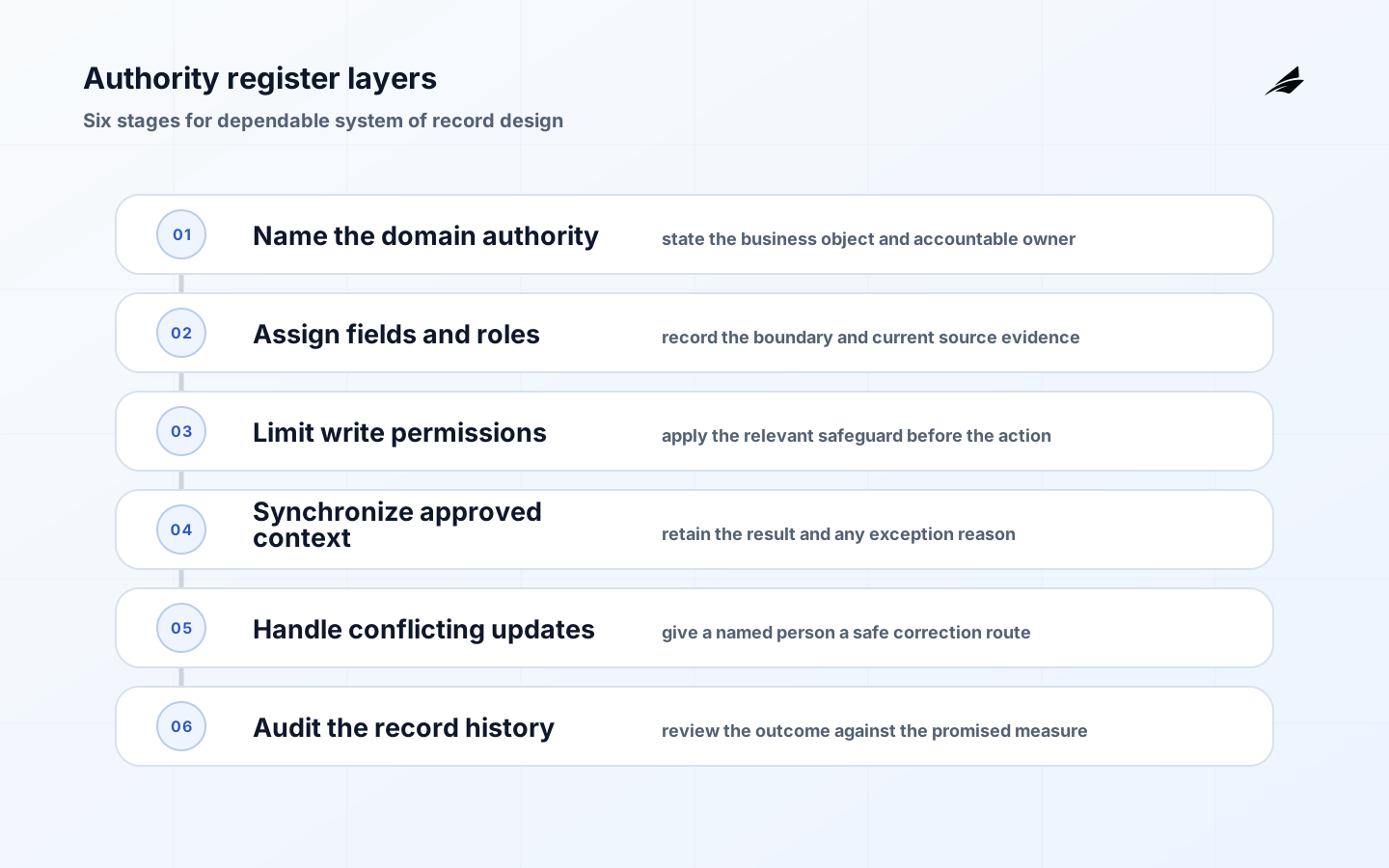
- For system of record, frame one consequential business object and one accountable owner.
- For system of record, capture field authority at the boundary where a request becomes an approved operational action.
- For system of record, test the conflict resolution route with missing, late, duplicate, denied, and corrected inputs.
- For system of record, review downstream impact before a change reaches a reader, customer, employee, supplier, or device.
- For system of record, approve a bounded correction with a named resolver, deadline, and retained reason.
- For system of record, verify the released result against the promised measure and record what remains uncertain.
Controls and evidence for System of record
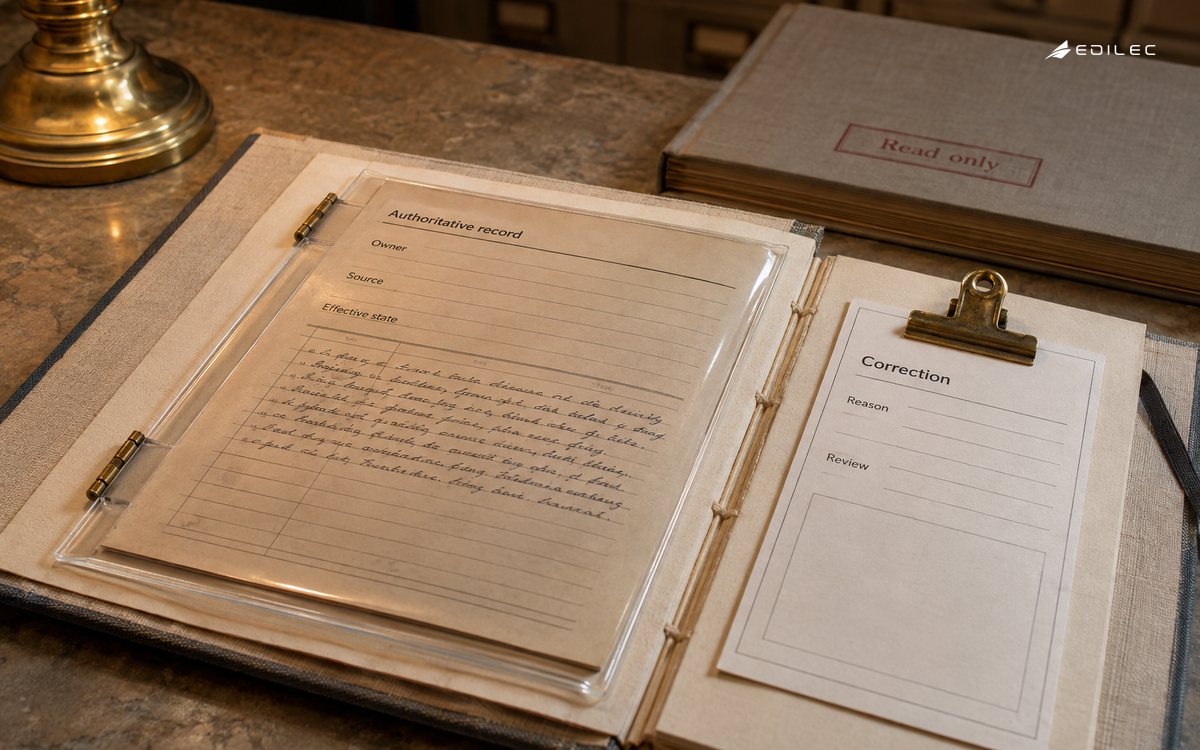
A system-of-record control should make authority and evidence inspectable at the point where data becomes an operational fact. Define which source is authoritative for each important field, who may approve a change, and when that authority takes effect. Record the input, rule or policy boundary, actor, timestamp, and resulting state so another operator can reconstruct the decision. Validation should distinguish a missing value from a conflicting or stale value; each condition needs a permitted action and an accountable resolver. Preserve the original event when a correction is approved, then link the correction to its reason, effective time, affected consumers, and verification result. The control is complete only when the audit record, approval context, recovery outcome, and remaining uncertainty are visible to the record steward and can be reviewed during the next handoff.
| Decision point | Evidence to retain | Owner response |
|---|---|---|
| Normal case | The input, rule, actor, timestamp, and outcome for an authoritative record. | Confirm the result and publish its status. |
| Exception | The failed check, affected scope, safe options, deadline, and disposition. | Route the case to the record steward without overwriting history. |
| Change | The previous behavior, new definition, approval, effective time, and rollback point. | Reconcile the affected records before expanding scope. |
Test System of record before rollout
- For system of record, trace one case from intake through the final decision and observable outcome.
- For system of record, replay a normal case and an exception case while preserving field authority and the responsible actor.
- For system of record, ask an operator outside the build team to explain the conflict resolution route without private context.
- For system of record, measure completion quality, exception age, recovery time, and evidence completeness by owner.
- For system of record, check that a correction reaches every affected consumer without rewriting the original event.
- For system of record, record the next review date, escalation route, and condition for safely expanding scope.
Before rollout, test the record path as an operator experiences it, including the evidence left behind at each state transition. Trace a normal case from intake through publication, then replay missing, late, duplicate, denied, and corrected inputs. Confirm that the system identifies the authoritative source, preserves the responsible actor, and prevents an ambiguous value from silently becoming final. Test the exception route with someone outside the build team: they should be able to find the failed check, affected scope, safe next action, resolver, deadline, and prior context without private knowledge. Verify that an approved correction reaches every affected consumer without rewriting the original event. Review completion quality, exception age, recovery time, and evidence completeness by owner, and record the next review date and condition for expanding scope.
Implementation notes for System of record
Implementation should express the authority model in the data structure and in the operator workflow. Give each governed field a clear source, owner, allowed state transitions, effective-time rule, and correction method. Use validation constraints, including SHACL shapes where the data model calls for them, to catch missing, incompatible, or disallowed values before release. Store provenance that identifies the source, activity, agent, and time needed to explain how a value entered the record; keep the prior event available rather than overwriting it. Separate routine edits from policy exceptions, require approval for changes with wider impact, and make the permitted action explicit when evidence is incomplete. A correction should create a traceable new result, notify affected consumers, and carry a verification outcome that the record steward can inspect.
Release a system-of-record change in a narrow scope that can be reconciled or reversed without losing the authoritative history. Start with observation or a parallel result when the new rule has not yet been exercised against representative cases. Define the migration boundary, affected consumers, approval owner, effective time, and rollback point before enabling writes. Make retries idempotent and make downstream reconciliation explicit so a delayed or duplicated message does not create a second business fact. Monitor exception queues, correction age, consumer lag, and evidence completeness during the first operating window. If the new behavior fails, disable the bounded path, preserve the failed inputs and decisions, restore the prior permitted behavior where appropriate, and reconcile every affected record. Expansion should require review of the release evidence, not merely a successful demonstration.
The operating model should keep authority decisions usable after the implementation team moves on. Assign a record steward, an exception resolver, and an owner for each downstream consumer; define which person may pause publication, approve a correction, or authorize recovery. Retain the decision evidence and provenance for the period required by the record's governance policy, while limiting access to what operators need. Review samples and measures on a defined cadence, including completion quality, unresolved exception age, recovery time, correction propagation, and evidence completeness. Treat source changes, policy changes, permission changes, and consumer changes as triggers for proportionate review. A material defect should have a route to contain the affected scope, preserve history, notify owners, and verify recovery. Expand use only when normal and exceptional cases show that the authority, evidence, and correction paths work in ordinary operations.
| Operational question | Evidence to retain | Owner response |
|---|---|---|
| What proves system of record is ready? | For system of record, a dated field authority decision record connects the input, rule, actor, result, and review. | Confirm the evidence before widening scope. |
| What happens when system of record is uncertain? | For system of record, the system marks the state, limits the action, names the resolver, and preserves prior context. | Route the exception without erasing history. |
| How is system of record corrected? | For system of record, the correction names the changed fact, affected readers, approval, effective time, and verification result. | Reconcile consumers and close the case. |
| Which measure protects system of record? | For system of record, track completion quality, exception age, recovery time, and evidence completeness by owner. | Review the trend with the accountable operator. |
| What should be rehearsed for system of record? | For system of record, test normal completion, missing data, duplicate input, denied access, delayed dependency, and reversal. | Record the scenario outcome and remaining risk. |
| When may system of record expand? | For system of record, expand only after representative normal and exceptional cases pass with a usable correction route. | Approve the next bounded use explicitly. |
Document how record conflicts are resolved
A system-of-record decision is incomplete until conflict behavior is written down. For each important field or state, name the authoritative service, permitted writers, validation rule, effective-time convention, and the evidence used to reject or reconcile a competing update. Include identity merges, corrections, imports, offline work, and delayed events; these are the cases that expose an ambiguous ownership model. Keep the resolution visible to support and audit teams through stable identifiers and a durable change record. When authority moves to a new system, define the transition window and the point after which the former source becomes read-only rather than allowing two writers to drift indefinitely.
Key takeaways for System of record
For system of record, keep the owner, authoritative state, permitted action, evidence boundary, and recovery route visible. For system of record, pause the normal path when proof is missing and show how a corrected result reaches each affected reader.
System of record design FAQ
For system of record, what should a team settle first? System of record teams should start with the accountable owner, authoritative state, permitted action, evidence boundary, and recovery route. For system of record, ask which operator can pause the normal path, what proof they need, and how correction reaches each affected reader.
A dependable system of record design operating rule
For system of record, keep the first release narrow, measurable, and owned. For system of record, a result earns its next use only when it can be explained, challenged, corrected, and reviewed by the right person.
For system of record, consult these official references for the operating choices in this guide: NIST Glossary: System of Record; NIST Research Data Framework; Shapes Constraint Language (SHACL); PROV-AQ: Provenance Access and Query. system of record related guide 1; system of record related guide 2; system of record related guide 3