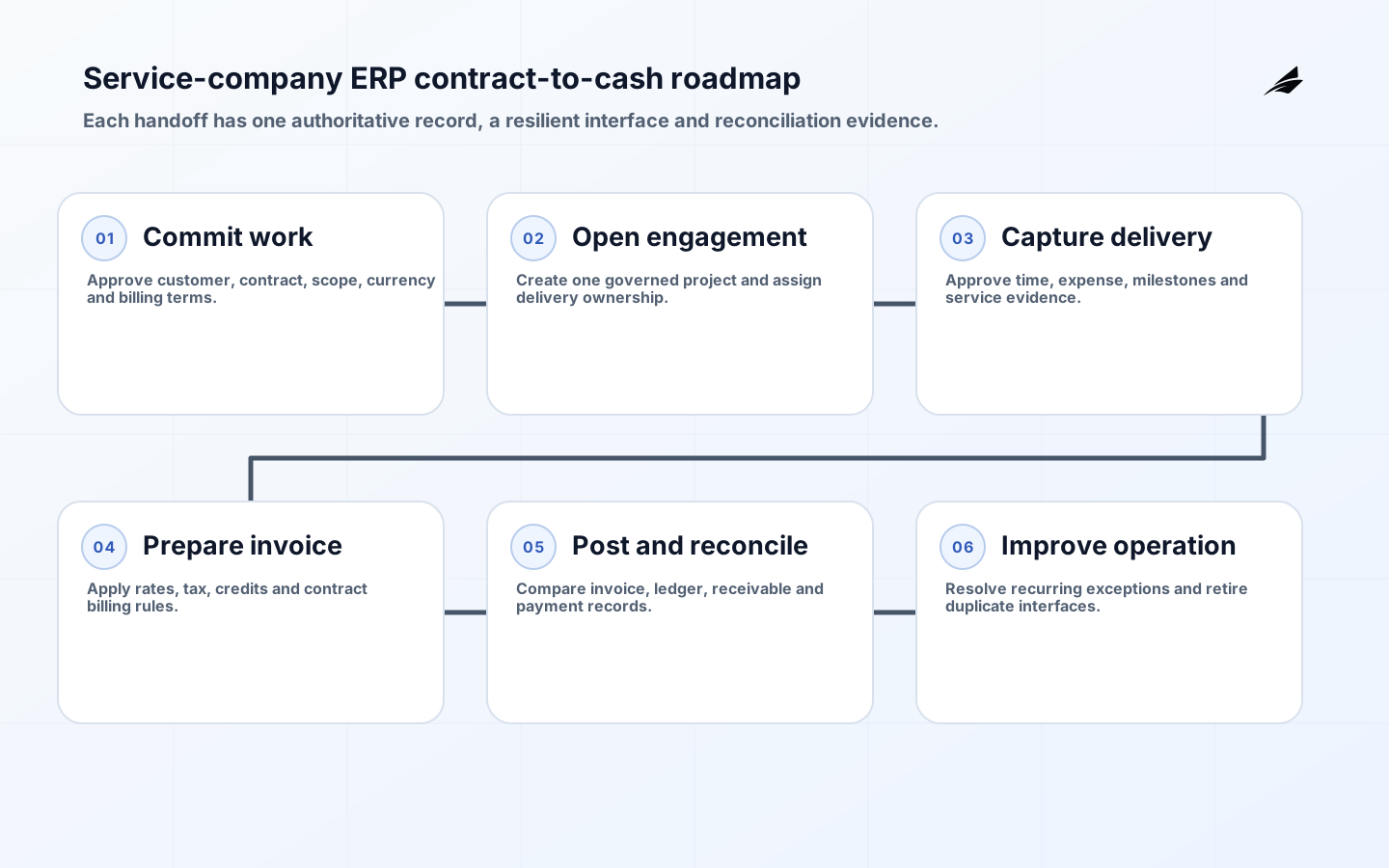
An ERP integration roadmap for service companies should connect the commercial promise to delivered work and recognized financial results. The core chain is usually lead or contract, customer and engagement, staffing, time and expense, project status, billing, payment and general ledger. Integration fails when each system carries a plausible but different version of the same customer, rate, project or invoice. A roadmap must therefore sequence business decisions, data ownership, interfaces, migration and operating controls rather than listing connectors.
This guide builds on ERP integration fundamentals, the practical enterprise integration guide and the reliable operations checklist. It is intended for professional services, field services, agencies and other project- or contract-based businesses. Product-specific choices vary, but the roadmap remains anchored in authoritative records, explicit states, recoverable data movement and finance-approved reconciliation.
Define the operating outcomes before choosing interfaces
Start with the decisions the integrated environment must improve. Examples include whether a project may start, which rate applies, how much capacity is available, what work is billable, why an invoice differs from forecast and which receivable needs action. Map each decision to its required evidence and current delay. This prevents a broad “single source of truth” ambition from concealing distinct records with different authorities. Finance may own posted invoices while delivery owns approved time and CRM owns the active opportunity.
Draw the end-to-end process with exceptions: contract amendments, credit holds, subcontractors, rejected time, write-offs, split billing, tax changes, refunds and project closure. State the business event that hands responsibility to the next system. The roadmap should prioritize a complete value stream, such as contract-to-cash for one service line, over migrating every data object at once. Baseline close effort, billing delay, duplicate entry, disputed invoices and reconciliation breaks before implementation.
| Business object | Typical authority | Integration concern |
|---|---|---|
| Customer and legal entity | ERP or governed master data service | Duplicate identities, tax and payment attributes |
| Opportunity and proposal | CRM | Version accepted as the commercial commitment |
| Engagement and work plan | Project or service management system | Scope, staffing, milestones and status |
| Approved time and expense | Time or project system | Approval evidence, rate date and correction path |
| Invoice and payment | ERP | Posting, tax, credit, settlement and audit trail |
Establish data ownership and contracts
Create an interface register that names producer, consumer, business object, key, schema, frequency, volume, security class, service objective and owner. For each field, define meaning, format, nullability and authority. A shared label such as “project status” is not enough if CRM means sold, delivery means active and finance means open for posting. Use canonical terminology only where teams agree on semantics; otherwise translate explicitly at the boundary and retain the source value for investigation.
Use stable business identifiers and a cross-reference table when systems cannot share keys. Do not match financial records by mutable names or email addresses. Version API and event contracts, publish compatibility rules and test representative examples. OpenAPI can describe request-response interfaces, while a common event envelope such as CloudEvents can standardize identity, source, type and time. Neither specification decides business ownership; that remains a documented operating agreement.
Choose an integration pattern for each business need
Use synchronous calls when the initiating workflow genuinely cannot proceed without an immediate answer, such as validating an active customer or obtaining a current credit decision. Keep the chain short, set timeouts and give users a recoverable response. Use asynchronous events when consumers can react independently and brief inconsistency is acceptable, such as notifying analytics or resource planning that an engagement changed. Use batch for high-volume reference or historical data where latency is not operationally important.
Avoid defaulting to bidirectional synchronization. It creates conflict rules that are difficult to explain and can amplify bad changes. Prefer one writer for each authoritative attribute and publish changes outward. Where a multi-system process cannot be atomic, model explicit steps and compensating actions. For example, if an engagement is created but downstream project provisioning fails, retain the failure state and retry safely; do not create a second engagement or silently delete evidence of the first attempt.
| Pattern | Use when | Required controls |
|---|---|---|
| Synchronous API | A user decision needs current confirmation | Timeout, authorization, rate limits and clear fallback |
| Asynchronous event | Several consumers react independently | Durable delivery, idempotency, ordering scope and replay |
| Scheduled batch | Volume is high and delay is acceptable | Watermarks, checksums, restartability and totals |
| Virtualized view | Users need source data without copying it | Identity delegation, latency handling and availability notice |
| Managed file exchange | A partner has constrained interfaces | Encryption, schema validation, acknowledgments and quarantine |
Sequence the roadmap in business-capability releases
Phase one should establish foundations: process ownership, data classification, identity, environments, integration runtime, secrets, monitoring and a governed customer or engagement key. Phase two delivers one end-to-end flow with limited scope, often won-work to project setup and approved time to a draft billing view. Phase three hardens invoice posting, reconciliation and correction. Later phases add resource forecasting, procurement, advanced revenue treatment and analytics once the transactional path is trustworthy.

Each release needs a business acceptance statement. “CRM connected to ERP” is not testable; “an accepted engagement creates exactly one project with the approved customer, contract currency and billing rule, or an operator-visible exception” is. Include peak period, closed accounting period, duplicate message, dependency outage and role-change tests. Keep a decision log for deliberate deferrals so temporary manual controls do not become invisible permanent architecture.
- Confirm business outcomes, scope, owners and baseline measures.
- Reconcile customer, service, project and financial definitions.
- Build the integration platform and observable exception handling.
- Pilot one service line through contract, delivery, billing and ledger.
- Reconcile results and rehearse rollback before wider cutover.
- Expand by capability while retiring duplicate entry and old interfaces.
Treat migration and cutover as a finance control
Profile source data before mapping it. Quantify missing keys, invalid references, duplicate customers, open projects without contracts, unapproved time and balances that do not reconcile. Decide which historical records must be transactional, which can be read-only archive and which should be retired under policy. Rehearse extraction, transformation and load with production-like volume. Every transformation rule needs an owner and a control total; screenshots of successful import jobs are not reconciliation evidence.
Plan the cutover around business state, not only a weekend. Freeze or queue specific changes, capture a final delta, load in dependency order and compare counts, amounts and selected records. Finance should approve opening balances, unbilled work, receivables and posted documents. Delivery should approve active engagements and staffing. Define rollback limits: after new invoices or payments are posted, restoration may require forward correction rather than restoring an old database snapshot.
Build exception operations and security into the service
Every interface needs a dashboard that expresses business state: oldest unprocessed event, failed records by reason, duplicate suppression, reconciliation difference and dependency health. Give operators safe actions to inspect, correct permitted data and replay an item with the original correlation identifier. Direct database edits and blind resubmission undermine evidence. Set alert thresholds based on billing or service impact, and assign owners across business hours, month-end and incident escalation.
Use workload identities, least privilege, encrypted transport and segregated administrative access. A connector that can read every customer and post journals deserves stronger controls than an employee dashboard. Review vendor and custom integrations against a verification standard such as OWASP ASVS, rotate secrets and test authorization at the destination. Audit consequential changes with actor, source, time, prior state and result while limiting sensitive data in logs and nonproduction environments.
Measure integration as an operating capability
Technical availability matters, but service leaders need outcome measures. Track time from accepted work to project readiness, approved time to invoice, invoice exceptions, days spent reconciling, manual re-entry, duplicate records and unresolved interface age. Pair speed with correctness: faster invoice creation is not progress if credits and disputes rise. Segment measures by service line, contract type and system path to find where local workarounds persist.
Review the roadmap monthly with finance, operations, sales and technology owners. Examine changed assumptions, recurring exceptions, upcoming vendor releases, access reviews, capacity and support burden. Retire interfaces and credentials when their consumers have moved; parallel systems left indefinitely increase both data conflict and security exposure. A roadmap is complete only when ownership and evidence have transferred to steady operations.
Key takeaways
- Organize the roadmap around contract-to-cash outcomes, not connector inventory.
- Assign one authority for each consequential record and attribute.
- Select synchronous, event, batch or virtual patterns from business latency and consistency needs.
- Reconcile migration and cutover with counts, amounts and finance-approved evidence.
- Operate exceptions through visible queues, safe replay and named ownership.
Frequently asked questions
Should CRM or ERP own the customer record?
The answer can vary by attribute. CRM may own prospect relationships while ERP owns the legal billing entity, tax status and payment terms. Document the transition and prevent both systems from independently editing the same authoritative field.
Does an integration platform eliminate point-to-point risk?
It can standardize transport, security and monitoring, but it does not resolve unclear semantics or ownership. A poorly governed hub can centralize confusion. Keep contracts, mappings and business exception responsibility explicit.
How much history should be migrated?
Migrate what current operations, reporting, regulation and audit genuinely require. Keep older data in a protected, searchable archive when full transactional migration adds cost without operational value. Test that authorized users can retrieve it.
Can service companies cut over module by module?
Yes, if temporary boundaries and reconciliations are designed. A phased cutover must state which system is authoritative at each stage, how deltas move, how duplicates are prevented and when the temporary interface will be retired.
Conclusion
ERP integration roadmaps for service companies work when each phase improves a complete business handoff and leaves the books explainable. Clear authority, fit-for-purpose integration patterns, reconciled migration and operable exceptions turn separate systems into a dependable contract-to-cash capability. The roadmap should end with retired duplication and accountable operations, not a permanent project team mediating inconsistent records.