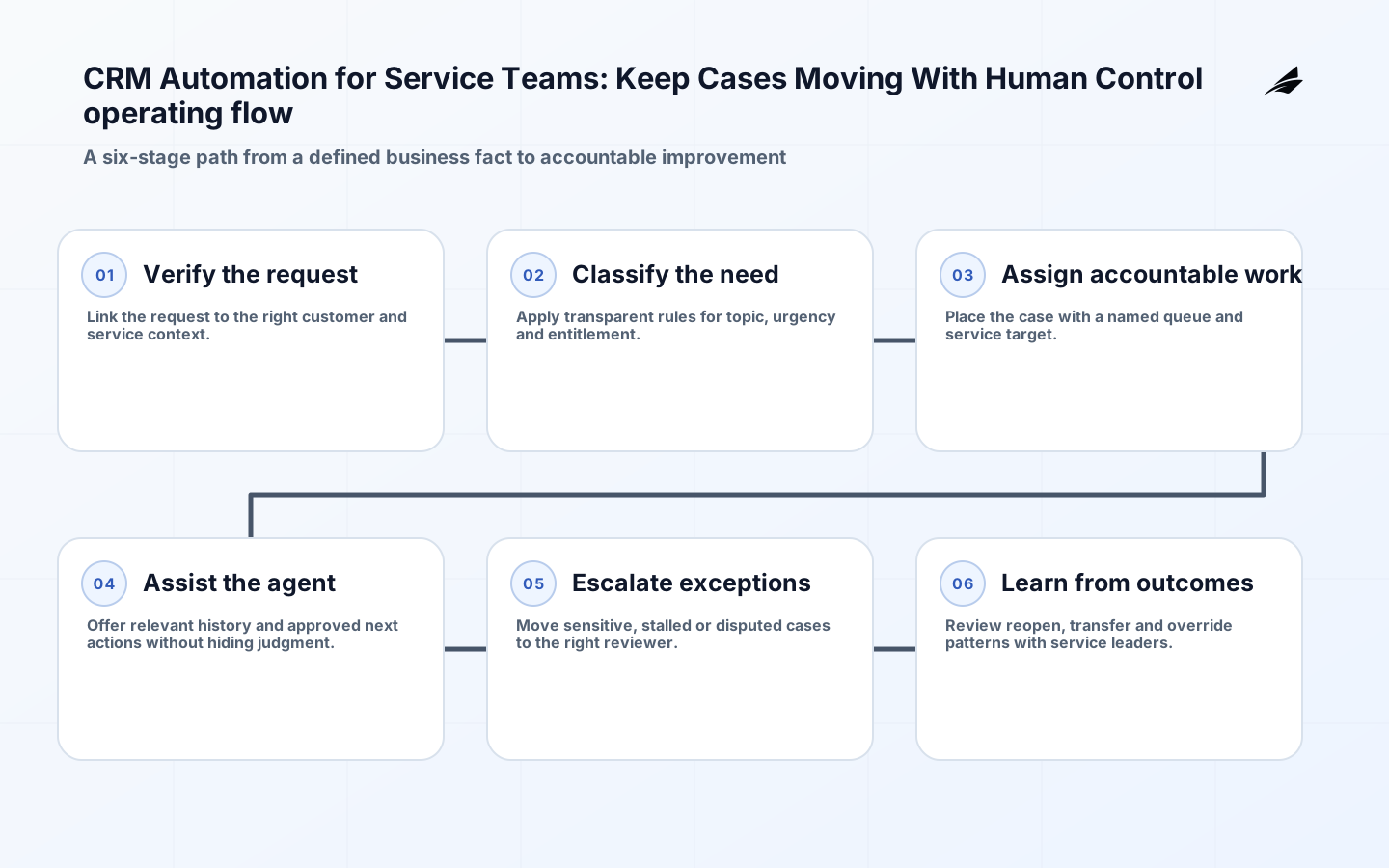
CRM automation for service teams succeeds when it makes a business commitment easier to see and safer to fulfill, not when it merely moves more fields between applications. Start with one high-volume service request from arrival to confirmed resolution. Follow it through the people, systems and decisions that turn a verified inbound request or material account update into a timely response with accountable human review. Ask where the record is created, which facts may change, what a receiving team is entitled to rely on and who notices when the handoff fails. That observed path exposes the actual work: workarounds, delays, policy judgments and partial data that a tidy future-state diagram commonly leaves out. This guide treats CRM automation for service teams as an operating design exercise. The technology matters, but the release is only credible when frontline agents, service managers, privacy leads and CRM administrators can explain the current state, correct a mistake and show the evidence behind a consequential action.
Start with the business commitment
Define the release around a customer service case, its contact history and its promised next action. Write a plain-language outcome: after a verified inbound request or material account update, the organization can produce a timely response with accountable human review within a stated time and under a named owner. This prevents a project from confusing a copied field or a completed API call with business completion. The owner is the service operations owner for the case lifecycle; that person may delegate work, but remains accountable for the rule that determines completion. Interview people using recent cases, including a routine case, a delayed case and automation routing a vulnerable or disputed case to the wrong queue. Compare what they did with what each system says occurred. The differences establish the first release scope and the evidence the design must preserve.
| Design question | Decision to document | Evidence to collect |
|---|---|---|
| Business event | What exactly counts as a verified inbound request or material account update? | Recent cases, timestamps and initiating roles |
| Authoritative fact | Who owns a customer service case, its contact history and its promised next action at each lifecycle point? | Named system, steward and permitted editors |
| Completion | What proves a timely response with accountable human review? | Record state, confirmation and time expectation |
| Decision right | Who may route or update a case or override the rule? | Delegation rule and approval evidence |
| Recovery | How is automation routing a vulnerable or disputed case to the wrong queue made visible and owned? | Exception queue, severity and response target |
Define the record, state and ownership
Give the working record a stable identifier and a compact state model before designing screens or integrations. For CRM automation for service teams, record the source, effective time, current state, accountable owner, material evidence and a history of significant changes. States should answer operational questions: what happened, what may happen next, who can act and what is blocking progress. Avoid a broad "pending" state that conceals whether work is awaiting data, an external dependency, an authorized decision or manual repair. A receiving team should be able to distinguish a fact that is final from one that is proposed, and a display copy from the record allowed to correct it.
Ownership is more precise than access. The service operations owner for the case lifecycle decides the definition of the business fact and the correction process; a technical team may operate the platform without becoming the owner of the policy. Document source-of-truth boundaries for every field that crosses a team boundary. Include effective dates where changes must take effect later, and retain the correlation identifier that connects the original request, downstream actions and any recovery work. This small discipline stops an incident investigation from becoming a search across unrelated dashboards and inboxes.
Design the handoff contract and recovery path
Treat the handoff around a verified inbound request or material account update as a contract rather than a promise that two applications will always look identical. Specify the event name, stable identifiers, fields, allowed values, effective time, delivery expectation and receiver behavior for duplicates or out-of-order delivery. Send the smallest useful data set, especially where personal or sensitive information is involved. A synchronous request is appropriate only when the initiating user needs an immediate decision. Otherwise, asynchronous delivery can keep the interaction responsive while allowing monitored processing. Either pattern needs an answer to a more important question: what evidence proves the receiver accepted a customer service case, its contact history and its promised next action and what happens if it did not?

| Condition | Required behavior | Visible operating evidence |
|---|---|---|
| Required value is missing | Stop or hold the work with a specific, actionable reason. | Validation result and accountable follow-up |
| Delivery times out | Use an idempotent retry policy and preserve the original attempt. | Correlation identifier, attempt count and status |
| Receiver rejects the change | Keep the source fact intact and open recovery work. | Rejected payload context and assigned owner |
| Two records disagree | Protect the authoritative record and reconcile deliberately. | Before-and-after values, source and resolution |
| Manual override is used | Require a reason, actor and any retrospective review. | Auditable override event and follow-up task |
Build controls into the work
Controls are useful when they fit the consequence of the action. Use least privilege for material changes, separate incompatible duties where the risk warrants it and preserve a decision trail for exceptions. Make temporary authority time-bounded and reviewable. Design the operator view so a person can understand why the next action is permitted or blocked; otherwise an apparently controlled process will accumulate side channels. Protect integration credentials, constrain API scopes and log enough context to investigate without collecting every available field. For CRM automation for service teams, privacy, security and usability are not separate acceptance exercises. They determine whether people can complete legitimate work without resorting to unsafe shared accounts, spreadsheet copies or undocumented approvals.
Release in thin, operable slices
Choose a first slice that includes the common path, one consequential exception, administration and support visibility. It should not be a polished demo that assumes clean data and permanent availability. Rehearse automation routing a vulnerable or disputed case to the wrong queue; test a duplicate event, an unavailable dependency, an unauthorized action and a correction after a downstream action has begun. Agree on who monitors the queue, who can pause automation and when the process owner is called. Launch with a short operating review cadence that compares what the workflow reports with real case outcomes. Expand only when the team can consistently explain the discrepancy and demonstrate a safe correction.
- Observe one high-volume service request from arrival to confirmed resolution with the people who actually complete it.
- Name the service operations owner for the case lifecycle and document the authority to route or update a case.
- Define identifiers, effective times, state transitions and completion evidence.
- Publish contracts that cover validation, duplicate delivery, rejection and reconciliation.
- Test the exception path with operational staff before expanding automation.
- Review quality, latency, overrides and unresolved work after release.
Measure what operators can change
A useful measure connects a workflow signal to an action an accountable team can take. Track completion time by state, aged work, handoff failure rate, rework, overrides and reconciliation backlog. Pair speed with a quality measure so that a shorter cycle does not mask an increase in corrections or customer harm. Define the numerator, denominator, time window and exclusions before reporting begins. Review a small sample of resolved and unresolved cases with frontline agents, service managers, privacy leads and CRM administrators; the narrative often reveals a policy or data issue that an aggregate chart cannot. Measurement is a feedback loop for the operating model, not a scoreboard for a launch announcement.
Key takeaways
- CRM automation for service teams needs a named business owner for the fact and outcome it changes.
- A stable record, explicit states and correlation identifiers make recovery practical.
- Handoff contracts must define failure behavior as carefully as normal delivery.
- Controls should preserve accountable judgment instead of forcing work into side channels.
- Release the normal path and a real exception together, then improve from operating evidence.
Frequently asked questions
How much should the first release include? Include enough to produce a trusted outcome for one high-volume service request from arrival to confirmed resolution: normal work, one meaningful exception, an administrator path and visible support evidence. Exclude adjacent processes whose owner, data definition or recovery policy is still unsettled. The aim is not to model the entire enterprise; it is to establish a reliable pattern for a customer service case, its contact history and its promised next action that can be repeated.
Should every exception be automated? No. Automate detection, classification and repeatable routing where the rule is clear. Keep a named reviewer in the loop when automation routing a vulnerable or disputed case to the wrong queue requires interpretation, delegated authority, sensitive data handling or a decision that changes a material commitment. Fast escalation with the relevant case context is usually safer than confident but opaque automation.
Conclusion
CRM automation for service teams becomes durable when teams can follow a real business event from initiation to a confirmed, recoverable outcome. Begin with one high-volume service request from arrival to confirmed resolution, establish ownership of a customer service case, its contact history and its promised next action, and make the normal and failure paths equally explicit. A strong first release gives people a clear state, a clear next action and evidence they can use when something changes. That is the foundation for broader integration and automation: not more connected screens, but work that remains trustworthy when ordinary operating conditions get complicated.