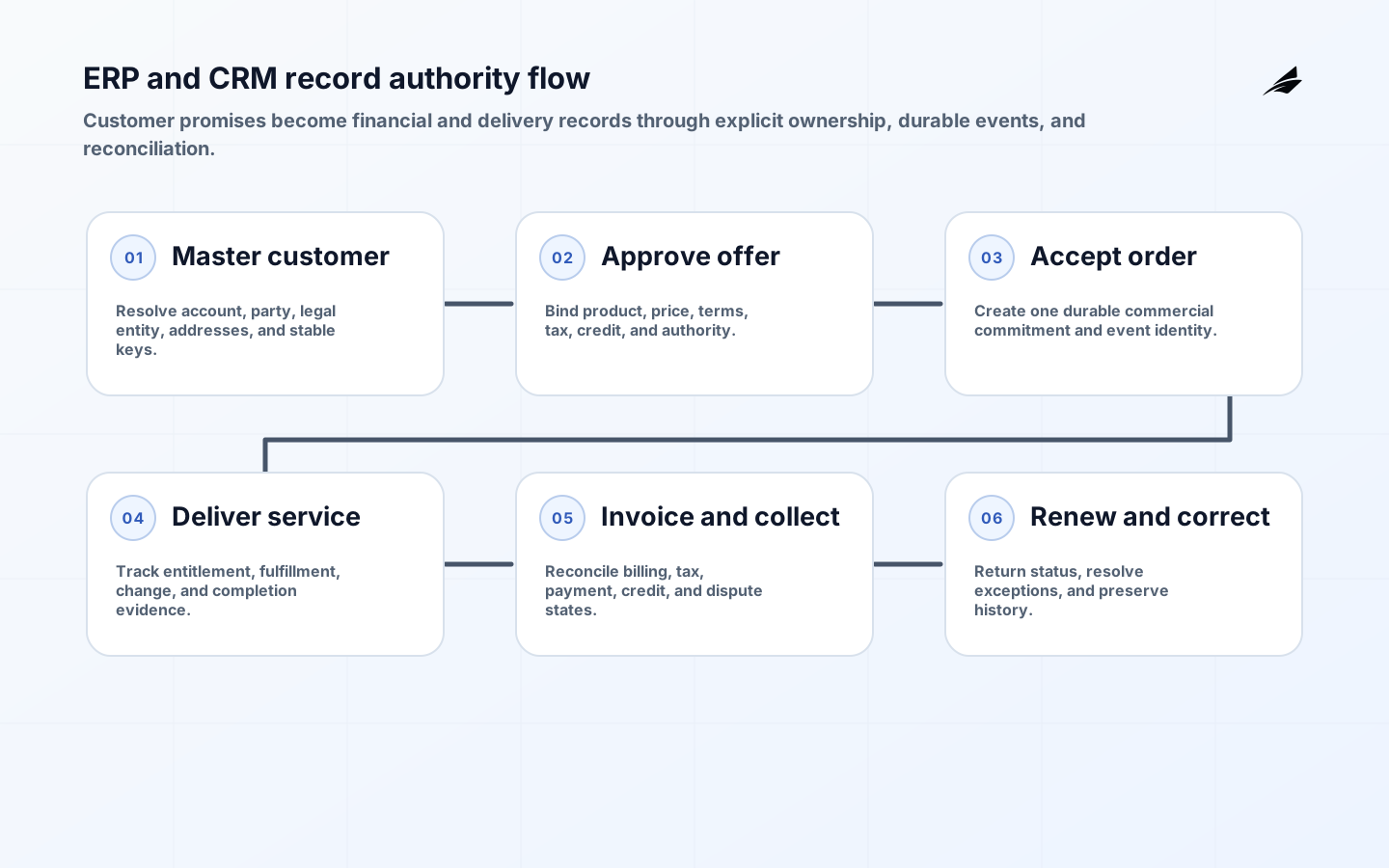
ERP and CRM integration is valuable only when it changes a founder-led company moving from individual tools to a repeatable commercial operation in a way people can explain and operate. Start with the outcome: a customer promise, approval, order, invoice, and renewal can be traced without asking staff to reconcile competing spreadsheets. That framing keeps the work anchored in a real commitment rather than a collection of screens or APIs. Map the people, decisions, and records involved, including lead, account, opportunity, quote, contract, order, invoice, payment status, entitlement, and renewal. Then ask what happens when a record is late, wrong, duplicated, or unavailable. The answer should name an owner and a visible recovery path. planning ERP and CRM integration provides a useful companion for teams that need to turn those decisions into an implementation plan.
Define the operating outcome for ERP and CRM integration
Treat the first design session as a working definition of completion. For a founder-led company moving from individual tools to a repeatable commercial operation, completion means that a customer promise, approval, order, invoice, and renewal can be traced without asking staff to reconcile competing spreadsheets. Write the normal case in plain language, then include a changed request, an incomplete request, a duplicate, a rejected handoff, and a correction after downstream work begins. This prevents a technically successful message from being mistaken for a successful business result. Name the person who can accept the outcome, the teams that act on it, the customer or colleague affected by delay, and the evidence that will show what happened.
| Decision area | Practical rule | Evidence to retain |
|---|---|---|
| Business outcome | State how a customer promise, approval, order, invoice, and renewal can be traced without asking staff to reconcile competing spreadsheets. | Named outcome owner and acceptance examples. |
| Authoritative facts | Identify the source and permitted changes for lead, account, opportunity, quote, contract, order, invoice, payment status, entitlement, and renewal. | Fact register, identifiers, and effective dates. |
| Failure handling | Route exceptions caused by a fast-moving sales change reaches a customer but not the team responsible for cash collection, delivery capacity, or service obligations. | Case identifier, queue owner, and disposition. |
| Access boundary | Apply the least access needed for the action. | Authorization decision and relevant audit event. |
Assign record authority before automating handoffs
The CRM owns pipeline and relationship history; the finance or ERP system owns posted transactions and receivables; product or service systems own delivery entitlement. Put that statement beside the field and state definitions, not only in an architecture diagram. Authority answers who can correct a fact, but it also answers whose validation applies when another system sends an update. Use stable identifiers and effective dates so receivers can distinguish a new fact from a late delivery or replay. Consumers may keep a local copy for performance or operational work, but they should record its source and freshness rather than quietly becoming a second authority.
Choose an integration pattern for each business event
Do not make every record bidirectional and real time. Use synchronous validation only when the user cannot proceed without an immediate answer; publish business events when downstream systems can react independently; use scheduled bulk exchange for high-volume or non-urgent movement; and use a virtual or query view when copying the record creates more risk than value. Microsoft’s Dynamics 365 integration guidance describes synchronous dual-write, events, virtual tables, and other patterns, each with different coupling and failure behavior.

Define an integration key that remains stable across systems and legal entities. Vendor-generated row IDs alone are rarely enough when duplicate accounts, merged contacts, or historic migration records exist. Microsoft’s dual-write integration-key guidance illustrates why all key fields and lookups must be mapped consistently for updates and deletions to find the right row. For API failures, adopt a machine-readable contract such as RFC 9457 Problem Details, include a correlation identifier, and distinguish retriable transport failure from rejected business rules.
| Business event | Preferred pattern | Failure handling |
|---|---|---|
| Quote requests credit or tax validation | Synchronous query with timeout and explicit unavailable state | Do not convert timeout into approval |
| Order accepted | Durable event with idempotent consumers | Replay safely and reconcile source and target IDs |
| Customer master correction | Governed command to the authoritative system | Reject unauthorized fields and preserve correction history |
| Invoice or payment status update | Event or scheduled exchange according to urgency | Monitor lag, duplicates, and unmatched records |
| Cross-system reporting | Curated analytical copy or virtualized read | Publish freshness and lineage instead of writing back |
Design the handoff contract and its boundaries
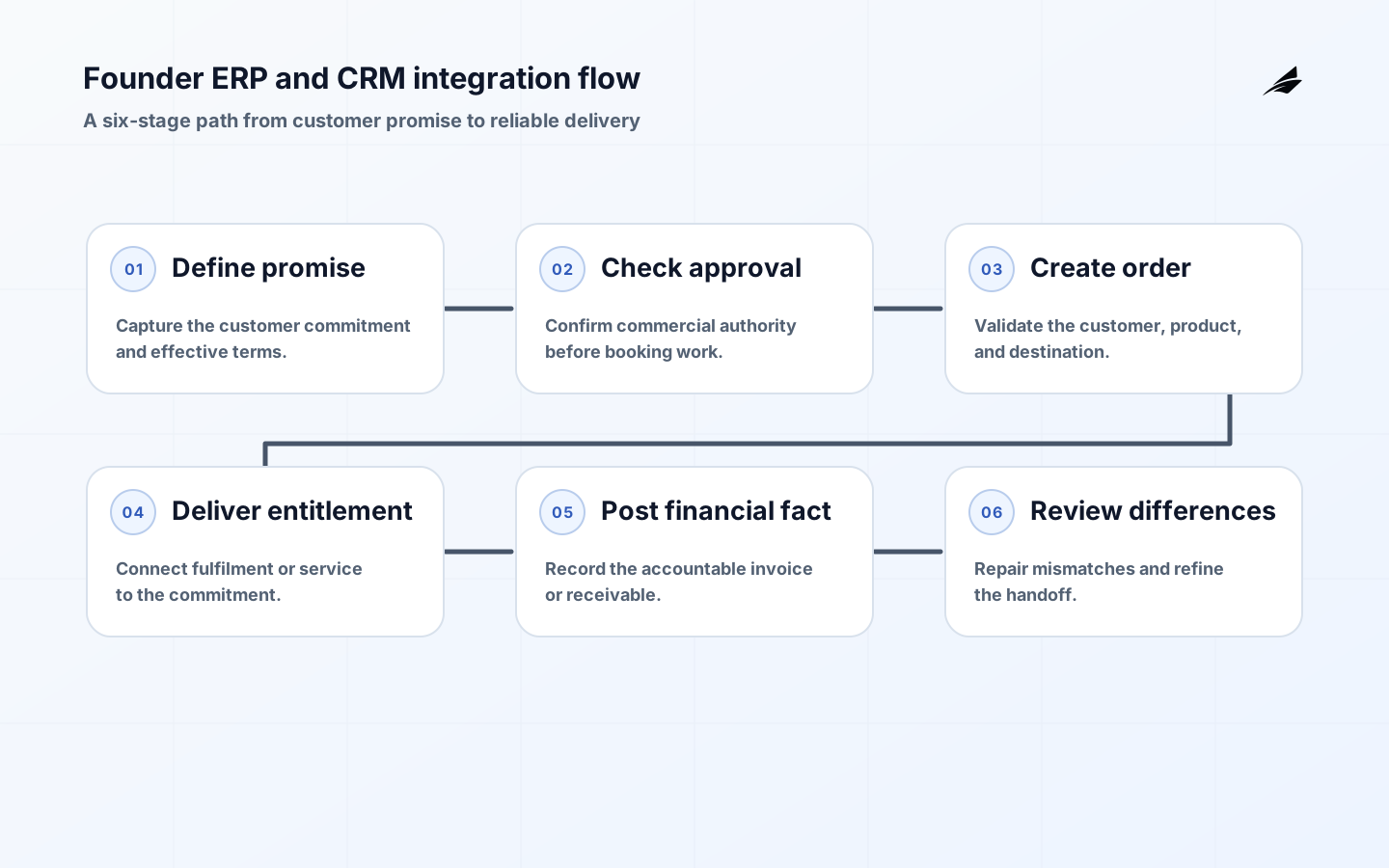
A commercial promise changes operational commitments only through an explicit approved handoff, with an effective date and source reference. The contract should identify the event or command, required values, allowed states, source reference, freshness expectation, duplicate behavior, and response for rejection. Avoid a vague “sync everything” promise. It masks the difference between publishing a fact, requesting an action, and reporting a derived value. Use a correlation identifier across the path so support staff can move from a customer or employee question to the exact delivery, validation, decision, and result.
| Condition | Required system behavior | Accountable owner |
|---|---|---|
| Duplicate delivery | Recognize the request or event and avoid creating a second business action. | Receiving service owner |
| Invalid or incomplete data | Reject with a reason that the sending team can act on; do not silently discard it. | Source process owner |
| Dependency unavailable | Use a durable, monitored recovery route only when the business can tolerate delay. | Integration operations |
| Approved correction | Preserve prior context and propagate the authorized change deliberately. | Authoritative record owner |
Build for exceptions, not only the happy path
Start with a small canonical identifier set and a quote-to-order contract, then add integrations after recovery ownership is working. A recovery queue is part of the product: it needs a business-readable reason, priority, owner, service target, and safe way to retry or correct. Do not give a background job unrestricted power to repair records. Recovery often changes a commitment, balance, entitlement, or access decision, so it should respect the same authority as the original workflow. Where automation makes a recommendation, make the rule version and inputs visible to the person who must decide.
Test the business result and the control evidence
Testing is complete when a representative user can get the right result and the organization can explain how it was reached. Test new, changed, cancelled, and duplicate commitments and compare approved commercial values with booked financial values. Include authorization failures, out-of-order messages, timeout recovery, manual intervention, and a rollback or cancellation where relevant. Check both directions of the handoff: a sender needs acknowledgement or an actionable rejection, while a receiver needs assurance that it processed the intended version exactly as its business rules allow. Keep test evidence with the release decision, not in an informal chat thread.
Operate with measures that lead to action
After release, review manual re-entry, order rejects, billing corrections, time from signed agreement to usable entitlement, and unlinked customer records. Define each measure's population, period, exclusions, source, and owner before relying on it. Pair the numbers with a small sample of real cases, especially those that crossed teams or required repair. That combination catches a common failure: a green technical monitor alongside customers, staff, or finance teams who are still waiting for a business outcome. Each review should produce one owned improvement, whether that is a rule change, a data correction, a training update, or a service capacity decision.
Make ERP and CRM integration tradeoffs explicit
Founders must balance a fast commercial motion against the discipline needed for cash and delivery. It is sensible to keep early sales steps lightweight, but an approved commitment needs a protected version before it creates operational work. Resist the urge to make every tool share every field. A few trusted identifiers, a clear order boundary, and a visible cancellation path make later scale less painful than a hurried all-to-all connection.
Key takeaways
- Define success as a business outcome for a founder-led company moving from individual tools to a repeatable commercial operation, not a successful screen load or API call.
- Name authority for lead, account, opportunity, quote, contract, order, invoice, payment status, entitlement, and renewal and make correction rights visible to every consuming team.
- Publish handoff rules for identity, state, validation, duplicates, delays, and rejection.
- Give exceptions a business owner, an evidence trail, and a safe route to resolution.
- Test changed, incomplete, duplicate, late, unauthorized, and corrected cases before release.
- Review manual re-entry, order rejects, billing corrections, time from signed agreement to usable entitlement, and unlinked customer records with real cases and assign improvements to the people able to make them.
Frequently asked questions
Do we need to replace every connected system first? A full ERP is not automatically the first answer. The first need is usually a disciplined boundary: which tool owns pricing, which records an approved order, and how a cancellation reaches finance and delivery. A smaller system with clear ownership can be safer than a rushed replacement.
What is the best starting point? Founders should stay involved in the first definitions of customer, product, contract, and revenue status. Those decisions shape reporting and customer communication. Delegating them entirely to a software implementation can encode assumptions that no longer fit the company.
Conclusion: make ERP and CRM integration accountable
ERP and CRM integration succeeds when the organization can connect an important outcome to authoritative records, protected decisions, dependable handoffs, and a recovery path that people actually use. Begin with one high-value journey, make ownership and evidence concrete, and prove the behavior under normal and difficult conditions. Expand only after the first journey has stable measures and a named operating rhythm. That approach builds trust in the work rather than merely connecting more software. Use the first integration as a management exercise as well as an engineering one. Review a handful of orders, changes, credits, and cancellations with sales, finance, and delivery together. Their shared explanation of those cases is a much stronger foundation than a diagram that nobody owns during an escalation.