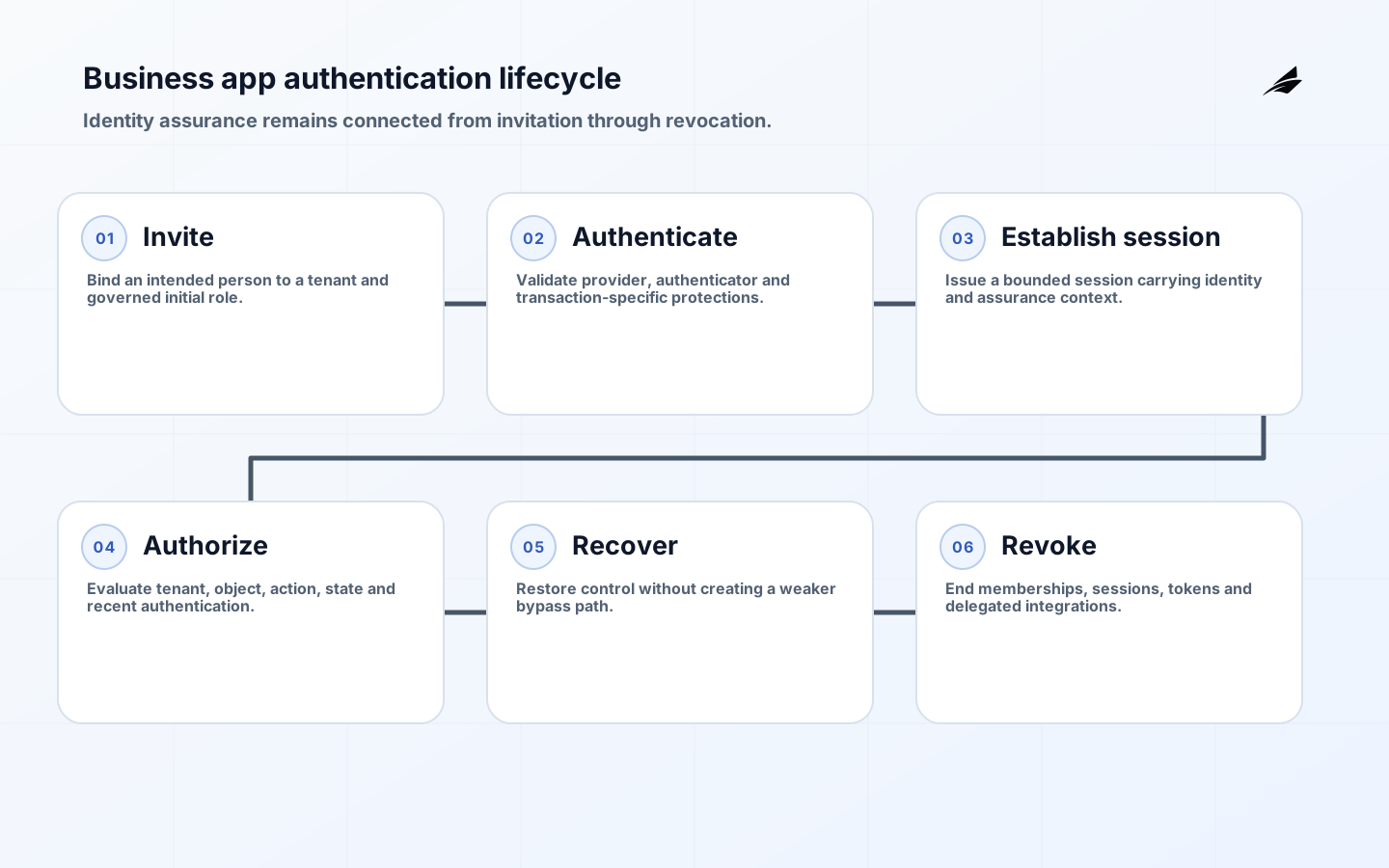
Authentication flow design for business apps is the design of an identity lifecycle, not merely a login screen. A dependable flow determines how a person is invited, which organization they belong to, how an identity provider is trusted, when stronger authentication is required, how a session is limited, how permissions change and how access ends. Those decisions must remain coherent across browser sessions, mobile clients, APIs, support tools and administrative actions. When each screen is built independently, teams often create duplicate accounts, unsafe recovery routes, stale privileges and sessions that survive longer than the business relationship.
The practical objective is simple: every successful authentication should establish who the subject is, which tenant or business context applies, what assurance was achieved and what the application is permitted to do next. Authentication does not decide every business permission. It supplies trustworthy identity and session facts to authorization. The related guides on OAuth and OpenID Connect and testing workflow-heavy software cover protocol and test detail; this article connects those mechanisms into an operating flow.
Model the complete authentication lifecycle
Begin with events rather than pages. Typical events include a company administrator inviting a worker, an employee arriving through enterprise SSO, a contractor using a local credential, an administrator elevating privileges, a person replacing an authenticator, a help-desk agent starting recovery, an organization changing identity providers and an account being suspended or removed. For every event, identify the actor, approving authority, evidence, notification, audit record, failure path and revocation action. This exposes dependencies that a login mock-up cannot show.
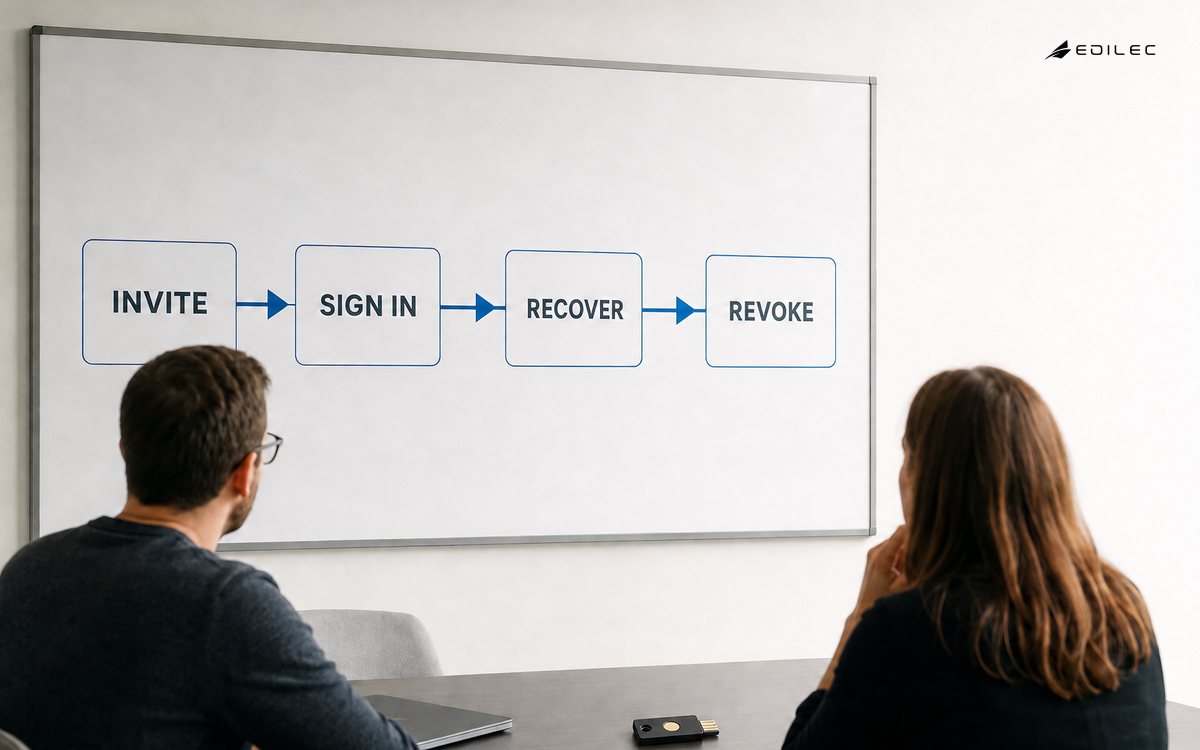
Separate identity proofing, authentication, federation and authorization. Proofing establishes that an applicant corresponds to a claimed real-world identity when the risk requires it. Authentication verifies control of authenticators. Federation conveys authentication results from an identity provider. Authorization decides whether the resulting subject may act on a resource. A business app may need only organizational invitation and domain control for ordinary users, but require stronger proof and phishing-resistant authentication for finance administrators. Write these assurance choices down instead of allowing the identity vendor's default settings to become policy.
| Lifecycle event | Required decision | Evidence to retain |
|---|---|---|
| Invitation | Who may invite, for which tenant and role? | Inviter, intended recipient, expiry and accepted identity |
| Sign-in | Which provider and authenticator strength are acceptable? | Provider, assurance context, device/session identifiers |
| Privilege change | Does the action need step-up or approval? | Old role, new role, approver and reason |
| Recovery | How is control re-established without bypassing MFA? | Recovery method, checks, notifications and revocations |
| Offboarding | Which sessions, tokens and integrations must end? | Trigger, completion time and residual-access checks |
Join SSO, invitations and tenant membership safely
An invitation should grant an opportunity to join a tenant, not silently bind privileges to whichever account opens a link. Make invitations single-purpose, time-limited and invalid after acceptance or cancellation. Display the organization and intended email, but do not treat email ownership alone as proof of employment or role. After authentication, verify that the authenticated identity satisfies the invitation policy, then create membership through a transaction that records the inviter and initial role. For high-impact roles, require a second approver or a separately authenticated administrator.
For enterprise SSO, bind each tenant to explicit issuer, client and claim rules. Use exact redirect URI matching and authorization code with PKCE as described by RFC 9700. Validate issuer, audience, signature, expiry and nonce; never choose a tenant solely from an untrusted email domain claim. Decide how account linking works before enabling multiple providers. Automatic linking by matching email can merge identities controlled under different policies. Prefer an authenticated linking ceremony or administrator-governed mapping, with a visible record and an unlink recovery path.
Treat sessions as security credentials
A session is continuing evidence that authentication occurred under known conditions. Protect session secrets with secure, HTTP-only cookies where appropriate, rotate identifiers after authentication or privilege change, enforce inactivity and overall limits, and terminate server-side state when access is revoked. Avoid placing sensitive tokens in URLs or browser storage that unrelated scripts can read. NIST distinguishes session continuity from the original authenticator; the application still needs reauthentication rules when risk changes or a high-impact action occurs.
Step-up authentication should be tied to meaningful transitions: exporting customer data, changing payment instructions, adding an administrator, viewing recovery codes or disabling a control. Preserve the intended action across the step-up flow without accepting attacker-controlled return URLs. Explain why the extra check is required and what will happen next. Record the assurance achieved and a short validity window, but do not make users repeat strong authentication for every low-risk click. Excessive prompts encourage unsafe workarounds and make genuine warnings less noticeable.
| Action | Baseline control | Additional control for higher risk |
|---|---|---|
| Routine work | Tenant-bound session and ordinary role checks | Risk-based reauthentication after unusual context |
| Sensitive export | Object-level authorization | Recent phishing-resistant authentication and audit reason |
| Add administrator | Administrative permission | Step-up, independent approval and notification |
| Change identity provider | Named tenant owner | Recovery verification, staged test and rollback window |
| Issue API credential | Scoped creator permission | Short display window, rotation owner and revocation test |
Make recovery no weaker than the account it restores
Recovery is frequently the real authentication boundary. Define separate procedures for lost password, lost second factor, inaccessible corporate identity provider and compromised account. Recovery codes should be generated securely, displayed once, stored safely and invalidated after use. Adding a new authenticator should require a current strong authenticator when available. If all authenticators are lost, apply risk-appropriate checks, delay or independent review for privileged accounts, notify established channels and revoke prior sessions and recovery material after success.
Help-desk recovery needs a constrained tool, not a universal bypass button. Agents should see only the evidence required for their task, follow a recorded procedure and be unable to assign themselves approval. The system should prevent agents from reading existing secrets, minting permanent sessions or suppressing account notifications. For administrators and service accounts, route recovery to a smaller, specifically authorized group. Test social-engineering scenarios and verify that urgent language cannot override mandatory controls.
Automate provisioning without losing accountability
SCIM can automate user and group lifecycle changes, but the application must still define source-of-truth and conflict rules. Decide whether groups map directly to roles, whether a local administrator may override them and what happens when the provider sends an unknown group. Make provisioning idempotent so repeated messages do not duplicate memberships. Reject ambiguous tenant mappings. Preserve last-known-good access during transient synchronization failures only under a documented policy; a failed feed must become visible rather than silently leaving everyone enabled forever.
Offboarding should revoke active sessions, refresh tokens, API credentials and delegated integrations, not only mark a user row inactive. Remove group-derived and local roles, transfer owned records where business continuity requires it, and prevent background jobs from continuing under the departed identity. Measure time from authoritative termination event to effective revocation. Reconcile the identity provider, application membership, privileged roles and active credentials regularly so drift becomes an operational signal rather than an audit surprise.
Test the paths attackers and support teams will use
Build a state-transition test matrix covering invited, active, suspended, recovered and terminated users across ordinary and privileged roles. Exercise expired invitations, reused links, wrong-tenant identity providers, replayed authorization responses, changed email claims, concurrent recovery, revoked sessions, partial SCIM outages and browser back-button behavior. Test race conditions around membership creation and role change. Security tests should confirm exact redirect validation, token claim checks, CSRF protection, PKCE, rate limits and sensitive-log redaction. Accessibility tests should confirm that authentication and error messages work with keyboard and assistive technology.
Operational acceptance needs observable outcomes. Track sign-in success by provider without logging secrets, challenge and recovery rates, invitation failures, stale privileged membership, revocation latency and support-assisted recovery. Alert on abrupt changes rather than using one global threshold. Keep audit events understandable: who acted, on which tenant and subject, what changed, which policy permitted it and whether it succeeded. A raw token dump is both dangerous and less useful than a structured decision record.
Key takeaways
- Design invitation, sign-in, session, recovery, role change and offboarding as one lifecycle.
- Keep authentication assurance separate from business authorization.
- Bind federation to explicit tenant configuration and modern OAuth protections.
- Make recovery and help-desk procedures proportionate to the access they restore.
- Measure revocation latency and reconcile identity state across systems.
Frequently asked questions
Should every business app use passwordless authentication?
Phishing-resistant options such as WebAuthn credentials can materially improve security, especially for privileged users. The right rollout still depends on supported devices, recovery design, identity-provider capability and user population. A passwordless front door with a weak email-based recovery path does not deliver the intended assurance.
Is SSO enough to remove local accounts?
Not automatically. Organizations need an emergency access and identity-provider outage plan, but emergency access should be narrowly scoped, strongly authenticated, monitored and regularly tested. Consumer or contractor populations may also need separate providers. Avoid an undocumented local-account backdoor that becomes the easiest route to privileged access.
How long should a business-app session last?
There is no universal duration. Set inactivity, overall and reauthentication limits from data sensitivity, action impact, device context and workforce conditions. Shortening every session may increase support and unsafe behavior. Protect high-impact actions with recent stronger authentication while allowing proportionate continuity for routine work.
Conclusion
Strong authentication flow design makes identity changes explicit and recoverable. A person should enter through a trusted route, receive only the right tenant membership, carry a bounded session, satisfy stronger checks for consequential actions and lose access promptly when the relationship changes. That outcome comes from lifecycle ownership and tested transitions, not from adding another login library.
Start by drawing the invitation-to-offboarding path for an ordinary user and an administrator. Mark every authority, token, session, notification and recovery branch. The gaps on that map will identify the engineering and operating work that matters most.