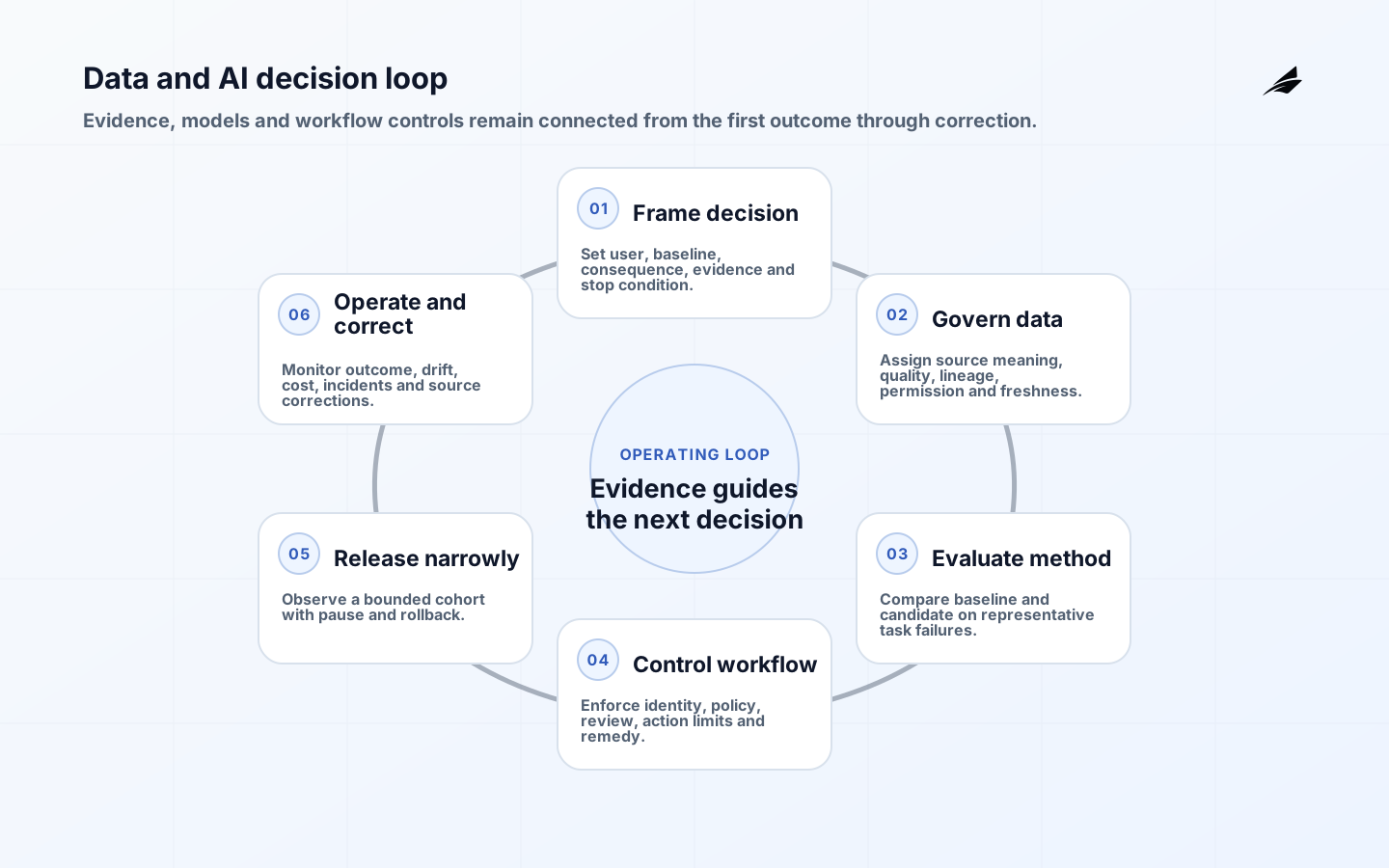
Data and AI solutions are production capabilities that turn governed records into analysis, recommendations or controlled actions. They are not simply a data lake plus a model license. A useful solution starts with a decision that needs to improve, establishes which evidence is fit for that decision, and gives named people responsibility for quality, model behavior, security, cost and correction. The result may be a forecast, search assistant, anomaly detector, decision-support screen or automated workflow, but the operating obligations remain.
This FAQ answers the questions business, data and technology leaders should settle before funding delivery. It complements the data and AI solutions scope guide, the implementation checklist, the data ingestion checklist and the data ingestion FAQ. Those guides go deeper on planning and pipelines; here the focus is the end-to-end questions that determine whether an integrated solution can be trusted and operated.
What counts as a data and AI solution?
A solution has a bounded user, task and consequence. A claims team may need a ranked queue with reasons, while a finance team may need a demand forecast with uncertainty bands. Both need source definitions, refresh expectations, access rules and a fallback when evidence is late or the model is unavailable. Calling a general chatbot a solution before those dependencies are defined hides the work that determines reliability.
Keep analytics and AI distinct where their assurance differs. Deterministic reporting should reproduce a metric from governed transformations. A predictive model estimates an outcome and must be evaluated against representative labels. A generative model produces variable content and needs task-specific tests, grounding and output controls. The NIST AI Risk Management Framework organizes AI work around Govern, Map, Measure and Manage; it does not treat model selection as a substitute for risk management.
| Solution pattern | Minimum evidence | Production control |
|---|---|---|
| Executive metric | Approved definition, lineage, freshness and reconciliation | Named metric owner and correction workflow |
| Prediction | Representative labels, baseline comparison and error analysis | Threshold, review path and drift monitoring |
| Generative assistant | Grounded task set, factuality and harmful-output tests | Permission-aware retrieval, citations and safe fallback |
| Automated action | End-to-end outcome and severe-failure evaluation | Authorization, transaction limits, audit and reversal |
How should the business case be framed?
Start with the current decision flow. Record who makes the decision, evidence consulted, volume, delay, rework, error cost and downstream impact. Then state the proposed change in operational terms: for example, reduce time to identify invoices requiring review while preserving the controller's authority. This creates a baseline and prevents a proxy such as model accuracy from becoming the only definition of value.
Estimate benefits by adoption and reachable volume, not by multiplying a laboratory time saving across every employee. Include data remediation, integration, evaluation, security review, change management, inference, observability and ongoing stewardship in cost. Use ranges for uncertain usage and price. The business case should also identify a stop condition, such as no improvement over the existing rules after a representative pilot, and a scale condition based on user outcome, control effectiveness and unit cost.
What architecture do data and AI solutions need?
A durable architecture separates sources, governed data products, analytical or model services, policy enforcement and user workflow. Source systems remain authoritative for transactions. Pipelines preserve event time, source identifiers and transformation versions. A semantic layer or metric contract gives important measures one owner and definition. Models and prompts are versioned artifacts rather than unrecorded settings. The application passes the user's identity and purpose through retrieval and action layers so permissions are not lost when data is copied into a vector index or feature store.

Provenance is practical, not academic. The W3C PROV-O recommendation supplies concepts for entities, activities and responsible agents. A team need not implement the entire ontology, but should be able to answer which source, transformation, model, prompt and policy produced a consequential output. That trace supports debugging, correction and audit without logging excessive personal or confidential content.
| Architecture layer | Owner question | Acceptance evidence |
|---|---|---|
| Source and ingestion | Who owns meaning and correction at source? | Contract tests, late-data behavior and reconciliation |
| Governed data product | Who approves schema, quality and access? | Catalog entry, quality rules, lineage and service objective |
| Model or analytic service | Who approves versions and thresholds? | Evaluation report, model record and rollback artifact |
| Workflow and action | Who handles exceptions and remedies? | Role tests, audit trail, reversal and support runbook |
How good must the data be?
There is no universal quality score. Data must be fit for the named use. The UK Government Data Quality Framework emphasizes knowing users, assessing quality throughout the lifecycle, communicating limitations and addressing causes at source. For a payment decision, accuracy and timeliness of bank details may dominate. For a trend report, consistent historical definitions and completeness may matter more.
Define rules at critical fields and joins, then show failures by owner and business effect. Measure freshness against event time, not only pipeline completion. Distinguish missing from zero, corrected from original and observed from inferred values. Training data also needs population coverage, label provenance and time boundaries. A clean table can still encode biased collection or exclude the cases where the model will be used, so domain review and slice analysis remain necessary.
Which AI risks require explicit controls?
Risk depends on context and consequence. Inventory uses, classify affected people and decisions, and identify foreseeable misuse. Test validity, reliability, security, privacy, transparency and harmful performance differences at the task level. The GAO artificial intelligence resources organize accountability practices around governance, data, performance and monitoring, a useful reminder that a launch review is not enough.
Generative systems add confabulation, prompt injection, sensitive-data disclosure, unsafe code and excessive agency. The NIST Generative AI Profile recommends lifecycle risk actions rather than a single universal score. Constrain tools to minimum functions and permissions, validate structured outputs, require meaningful review for high-impact actions, and preserve a deterministic route for authentication, authorization and final transaction rules. Human review must include time, evidence and authority to disagree.
What does production ownership include?
Production ownership covers data incidents, model incidents and ordinary service failures. Set service objectives for freshness, availability and task quality. Monitor input shifts, missing cohorts, retrieval failures, override patterns, latency and cost per completed outcome. Route alerts to an owner who can pause a feature, fall back to rules or restore a previous version. A model dashboard without a correction process only describes failure.
Create one change record that connects schema, feature, model, prompt, policy and application releases. Test compatibility before promotion and release to a bounded cohort. Keep evaluation sets protected from casual tuning. Review providers for data use, retention, region, subcontractors, security, portability and exit. ISO/IEC 42001 specifies an AI management system for organizations that provide or use AI, reinforcing the need for maintained governance and continual improvement rather than one-time approval.
A practical first 90-day sequence
In the first month, choose one decision, reproduce its baseline and create the use-case, data and responsibility records. Interview the people who perform and receive the work, sample normal and costly exceptions, and confirm that the proposed evidence is available at decision time. Build a thin path from authoritative source to a read-only workflow. The deliverable is not a polished demonstration; it is agreement on outcome, population, permissions, failure severity, evaluation method and stop condition.
In the second month, implement quality and lineage checks, compare at least one simple baseline with the candidate method, and test representative and adversarial cases. Estimate full production cost from observed volume. In the third month, run shadow or assist mode with a bounded cohort, measure downstream outcome and review burden, exercise pause and correction, and present a scale, redesign or stop decision. Keep the decision pack concise: outcome trend, severe failures, cohort limits, unresolved controls, unit cost, owner readiness and the evidence required for the next gate.
Key takeaways
- Begin with a measurable decision or workflow and its consequence, not a preferred model.
- Treat source meaning, quality, lineage and access as part of the product contract.
- Evaluate the complete task against a baseline and representative failure cases.
- Keep authorization, transaction rules, rollback and remedy outside probabilistic judgment.
- Fund ongoing stewardship, monitoring, correction and provider exit as production work.
Frequently asked questions
Should we buy a platform or build the solution?
Buy commodity capability where the provider's controls, interfaces and economics fit. Build the workflow-specific integration, evidence model and policy that differentiate the decision. Compare both options using total cost, data rights, evaluation access, portability, operational skills and exit effort. A fast demonstration with proprietary data structures can become expensive if those terms are ignored.
How long should a pilot run?
Long enough to cover representative volume, user groups, exceptions and a meaningful operating cycle. Define the sample and decision thresholds before the pilot. A two-week test may suit a high-volume support queue; a seasonal forecast may require backtesting across multiple periods. Calendar duration alone is not evidence.
Do we need one platform for data and AI?
Not necessarily. A coherent control plane matters more than a single vendor. Teams need consistent identity, metadata, lineage, policy, evaluation and observability across components. Consolidation can reduce integration work, while modularity may improve fit and exit. Make the tradeoff explicit and test data and artifact portability.
What is the best return-on-investment metric?
Use the unit of the workflow: cost per accurately resolved case, forecast error at a decision horizon, avoided review time with rework included, or margin per recommendation accepted. Pair value with quality and risk guardrails so a system cannot appear successful by processing more low-quality work or shifting effort to another team.
Conclusion
Effective data and AI solutions connect evidence, models and workflows under named ownership. The practical test is whether the organization can explain the output, measure the task, limit an unsafe action, correct the record and operate the service at a justified cost. When those capabilities are designed together, AI becomes a controlled part of decision-making rather than a detached experiment.