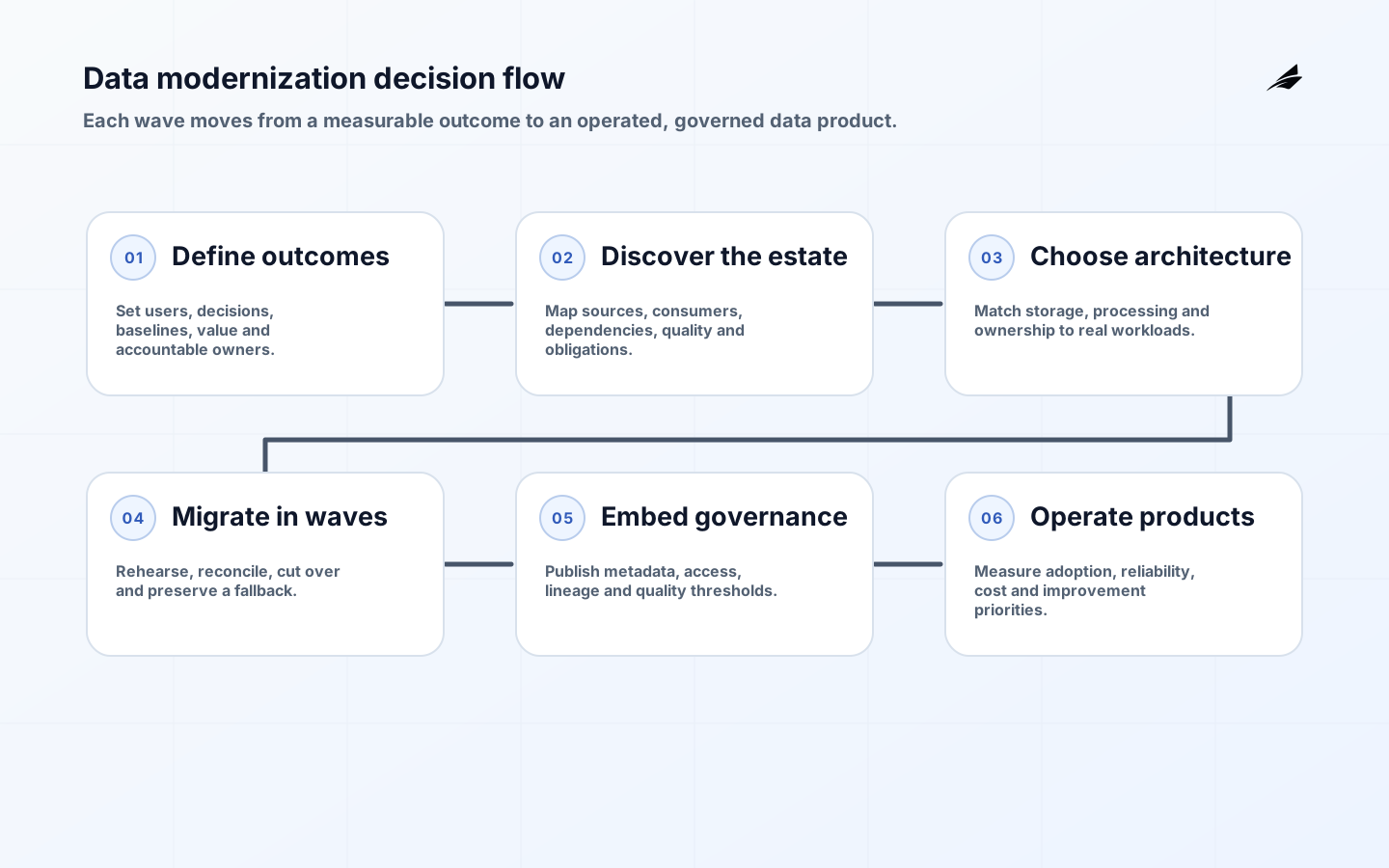
Data modernization services replace fragile data movement, unclear ownership and slow access with an operated platform that can support reporting, applications and AI. The work is broader than moving a warehouse to cloud storage. It connects business definitions, source-system behavior, migration engineering, security, quality, lineage, cost control and ongoing product ownership. This FAQ gives buyers a practical way to scope that work and judge whether a proposed modern data platform will remain trustworthy after cutover.
Use it alongside the data modernization implementation checklist, the data modernization delivery guide and the broader data and AI services FAQ. Those guides cover execution in depth; here the focus is on the questions sponsors, data owners, architects and procurement teams should settle before approving a service.
What do data modernization services include?
A complete engagement usually begins with discovery: business outcomes, consumers, source systems, critical reports, interfaces, data classifications, retention obligations and operational pain. It then defines a target operating model and architecture, builds reusable ingestion and transformation capabilities, migrates selected workloads in waves, validates results with users, and establishes support. Depending on the estate, modernization may include relational databases, files, streaming events, metadata catalogs, semantic models, data quality controls, master or reference data, APIs and analytical products.
Modernization does not require one universal architecture. Microsoft’s cloud-scale analytics guidance treats data management and governance as a lifecycle and emphasizes data products, shared infrastructure and business outcomes. Google’s data mesh architecture similarly combines domain-owned products with organization-wide standards. A centralized warehouse, lakehouse, mesh or hybrid can all be valid. Choose from workload evidence, ownership maturity and consumption patterns rather than fashion.
| Modernization area | Useful deliverable | Acceptance evidence |
|---|---|---|
| Portfolio and value | Prioritized use cases, dependencies and retirement candidates | Named outcome, owner, baseline and decision date for every wave |
| Architecture | Target data flows, interfaces, trust boundaries and nonfunctional requirements | Reviewed decisions plus performance, resilience and security tests |
| Migration | Reconciled mappings, cutover plan and rollback path | Record counts, control totals, exception disposition and user sign-off |
| Governance | Ownership, catalog, quality rules, access policy and lineage | Searchable metadata, approved access tests and quality trend |
| Operations | Runbooks, service objectives, monitoring and cost allocation | Alert exercise, restore test, support handoff and cost dashboard |
How should the business case be framed?
Tie each investment to a decision or service that data enables. Examples include reducing a finance close from eight days to five, making inventory positions available every fifteen minutes, shortening analyst onboarding, retiring unsupported databases, or supplying governed features to a fraud model. Record the present cycle time, error rate, infrastructure cost and manual effort. A target such as “move 40 terabytes” describes activity, not value; it can be achieved while users still distrust the result.
Include risk reduction and avoided cost, but make assumptions visible. Separate one-time migration cost from recurring platform consumption, licenses, support and domain staffing. Account for running old and new systems in parallel, outbound data transfer, test environments, retention, observability and decommissioning. Benefits should have owners and measurement dates. A credible business case also states what will not be modernized, because retaining a stable workload can be better than funding change with no useful outcome.
How do teams choose a target data architecture?
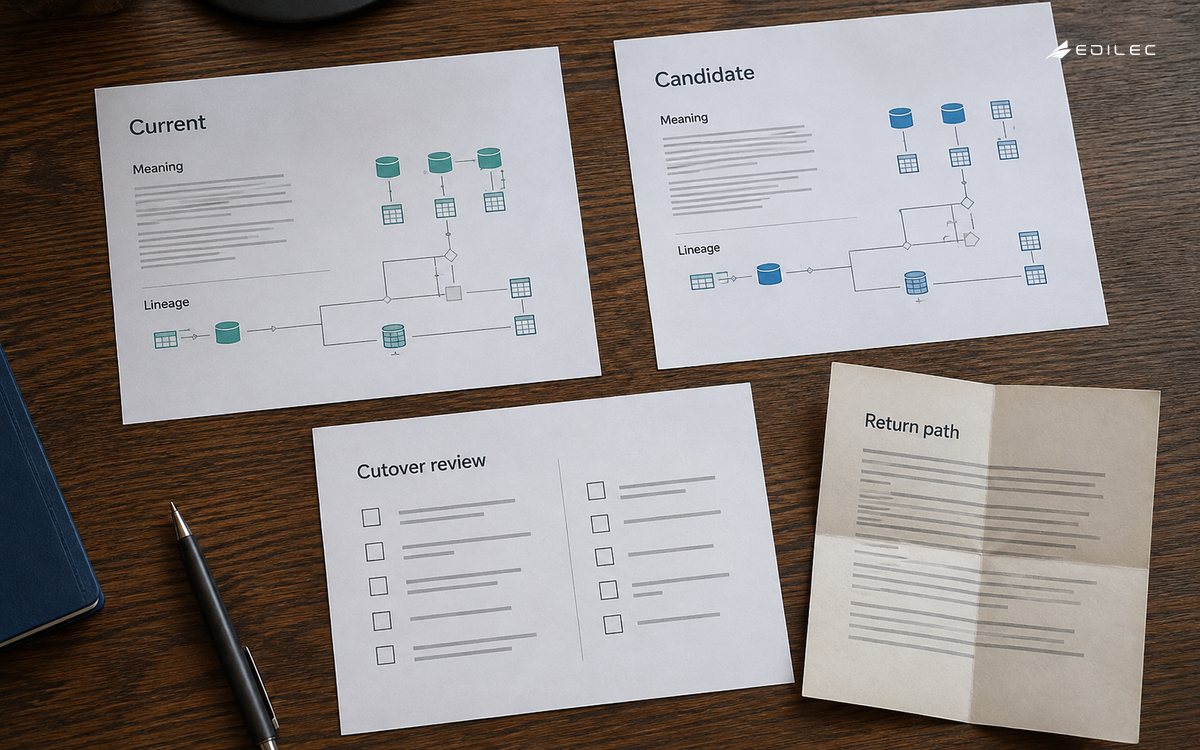
Start from data characteristics: transaction consistency, query patterns, latency, volume, change rate, residency, retention, recovery objectives and consumer skills. Then evaluate candidate services against portability, interoperability, operational burden and total cost. Do not force operational transactions, exploratory analytics and low-latency event processing into one engine simply to simplify a slide. Purpose-built components can be sensible when interfaces, metadata and ownership remain coherent.
Choose the organizational model at the same time. Google describes a self-service data platform as shared capabilities and templates that lower the barrier for domain teams while embedding governance in delivery; its self-service platform guidance also makes clear that the platform itself needs a roadmap and service ownership. A mesh without capable domain owners becomes distributed neglect. A central platform without product thinking becomes a ticket queue. Many enterprises need central guardrails with accountable domain data products.
What is a safe migration sequence?
Build a wave plan around dependencies and reversibility. Begin with a bounded use case that exercises ingestion, governance, transformation, consumption and support without carrying the highest business consequence. Establish automated reconciliation before scaling. For each wave, freeze or control source changes, capture a baseline, rehearse migration with production-shaped volume, validate downstream interfaces, agree a cutover decision, and preserve a tested rollback or fallback window. Decommission only after consumers and retention owners accept the result.
Database strategy must consider applications as well as data. AWS’s Database Migration Service best-practices guide puts migration planning, schema conversion review, documentation review and a proof of concept ahead of production migration. Rehosting can meet a time-bound exit; replatforming can reduce operations; refactoring can unlock new capabilities but expands test scope. Apply the choice per workload and prove the selected path with representative data, dependencies and workload behavior. A portfolio-wide mandate to refactor everything usually creates a long dependency chain and delayed value.
- Inventory producers, consumers, schedules, interfaces, owners, classifications and known quality defects.
- Define source-to-target mappings as versioned artifacts and review business transformations with accountable data owners.
- Reconcile counts, sums, uniqueness, referential integrity and selected record samples at each migration rehearsal.
- Test late-arriving data, duplicate delivery, schema change, partial failure, replay, access revocation and restore.
- Run old and new outputs side by side for an agreed period, documenting tolerances and exception owners.
- Retire pipelines, credentials, storage and licenses through a controlled decommission checklist rather than abandoning them.
How should governance and data quality work?
Governance should make reliable use easier. For every priority data product, name a business owner who can approve meaning, access and quality trade-offs, and a technical owner who operates the interface. Publish purpose, schema, freshness, quality expectations, classification, lineage, support route and change policy in a catalog consumers actually use. Microsoft’s organizational readiness guidance recommends defining who owns data and why it matters before choosing technology. That order prevents governance from becoming a post-build documentation exercise.
Quality rules need operational semantics. “Customer data must be accurate” is not testable. “At least 99.5 percent of active customer records have a valid country code by 06:00 UTC, with failures quarantined and assigned to Customer Operations” is. Track freshness, completeness, validity, uniqueness, consistency and reconciliation where they matter to a consumer. Set warning and breach thresholds, route exceptions, and record accepted limitations. Do not silently repair source defects in every downstream pipeline; feed accountable corrections back to the producing process.
| Measure | Practical definition | Decision supported |
|---|---|---|
| Time to usable data | Elapsed time from approved source request to governed consumer access | Whether platform self-service is improving |
| Freshness attainment | Products meeting their stated availability window divided by products measured | Whether scheduled and streaming delivery is dependable |
| Quality rule pass rate | Applicable checks passing, with waivers reported separately | Whether consumers can trust defined fields |
| Migration reconciliation | Required control totals within accepted tolerance | Whether a wave is ready for cutover |
| Unit cost | Allocated platform cost per agreed workload unit | Whether architecture and retention remain economical |
| Product adoption | Active, attributable consumers using the governed interface | Whether a data product creates actual value |
What security and resilience controls belong in scope?
Classify data before migration and carry policy through copies, backups, logs and nonproduction environments. Use federated identity, least privilege, group-based access, separation of administration duties, encryption, managed secrets and attributable service identities. Test access at row, column, object and export boundaries where applicable. Record lawful purpose, residency and retention requirements with the data product. Masking production data in development is useful only if re-identification paths and copied files are also controlled.
Design recovery around business use, not storage durability alone. Define recovery time and recovery point objectives for platform services and critical products. Test restoring metadata, code, orchestration state, keys and access policy as well as datasets. Exercise a failed cutover and a corrupted transformation. Microsoft’s modernization planning guidance distinguishes in-place and parallel deployment and recommends parallel approaches for complex, high-risk workloads. The additional temporary cost can buy a much clearer fallback path.
How should buyers evaluate a provider and price?
Ask for a deliverable-level scope: systems, domains, environments, migration waves, interfaces, quality rules, catalog coverage, support hours and exclusions. Confirm who supplies source expertise, resolves data meaning, approves access, owns cloud accounts and accepts migration results. Review named roles, relevant platform experience, sample reconciliation evidence, security practices and the proposed handover. A polished reference architecture is less important than evidence that the team can discover hidden dependencies and run a controlled production change.
Normalize commercial proposals using the same assumptions. Common drivers are number and complexity of sources, data volume and change rate, transformation count, environments, regulatory controls, latency, availability, retention, migration downtime and support. Milestone pricing should attach to accepted outputs, not elapsed weeks. Reserve explicit capacity for source defects and new dependencies, with a change process. Require infrastructure, code, mappings, metadata, tests, runbooks and unresolved risks to remain exportable so the customer can operate or transition the platform.
Key takeaways
- Define modernization through business decisions and operated data products, not a cloud destination.
- Select architecture per workload and pair it with an ownership model that the organization can sustain.
- Migrate in reversible waves with automated reconciliation and production-shaped rehearsals.
- Make governance executable through ownership, metadata, quality thresholds, access controls and support paths.
- Measure adoption, trust, delivery performance and unit cost after launch; migration completion is only an intermediate result.
Frequently asked questions
Does data modernization require a lakehouse or data mesh?
No. Those patterns solve particular storage, processing or ownership problems. A well-run warehouse may be the simplest fit for stable reporting. Use a lakehouse when its combined analytical capabilities fit the workload, and use domain-oriented ownership when domains can genuinely own products. The required outcome is governed, reliable and economical data access, not adoption of a label.
How long does a data modernization program take?
A first bounded product may reach production in weeks or a few months; an enterprise estate can require multiple years of waves. Duration depends on source knowledge, dependencies, quality, regulatory evidence, downtime tolerance and internal decision speed. Demand a roadmap that releases usable outcomes and retires cost throughout the program rather than one distant final cutover.
Should AI readiness be the main goal?
AI can be a valuable consumer, but “AI-ready” is too vague for acceptance. Identify the model or workflow, needed fields, provenance, freshness, consent, quality and evaluation requirements. The same ownership and observability that support trustworthy analytics also help AI systems. Do not replicate sensitive data broadly on the assumption that an unspecified future model may need it.
Conclusion
Effective data modernization services leave an enterprise with more than new infrastructure. They create defined products, accountable owners, traceable transformations, tested migration evidence and an operating model that can improve safely. Start with a measurable use case, build the shared controls once, and expand in waves. That approach gives users value early while preserving the discipline needed to retire legacy risk and keep the modern data platform credible.