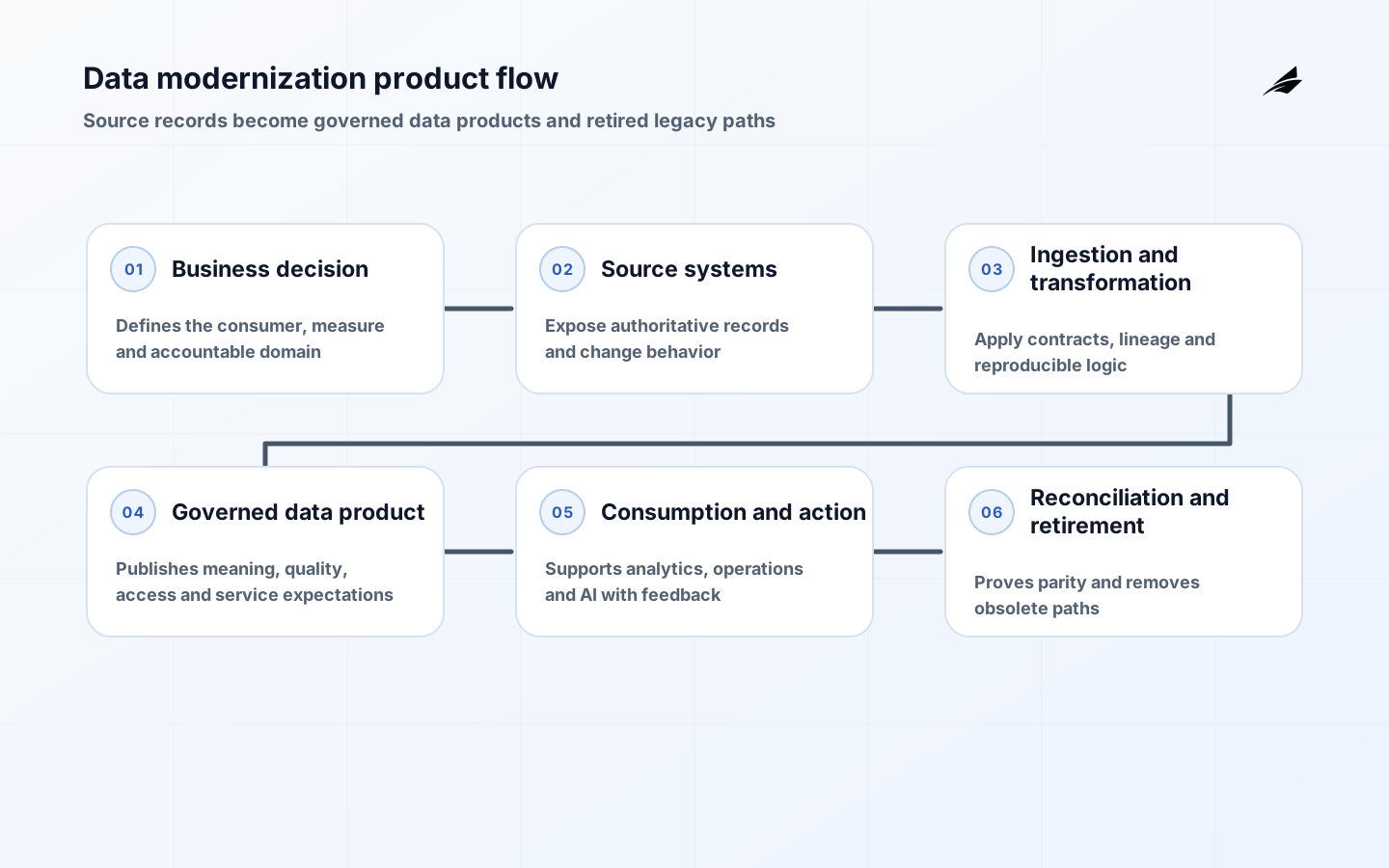
Data modernization services should make important decisions faster, more trustworthy and easier to govern. They should not merely replace one storage stack with another. Modernization becomes necessary when legacy data paths create recurring reconciliation effort, stale reporting, unowned extracts, brittle batch jobs or compliance risk around access and retention. In those situations, the service buyer is really purchasing a new operating model for data: authoritative sources, governed transformations, discoverable products, observable quality and a deliberate retirement path for the old estate.
The challenge is that legacy data systems often still perform essential business work while they are being modernized. That means the service must preserve meaning and continuity, not just move bytes. Governance, lineage and quality therefore belong in scope from the beginning. Standards and public-sector playbooks are useful because they describe data as a managed asset with provenance, cataloging and stewardship needs. This guide turns those ideas into practical scoping, architecture, cost and acceptance decisions for data modernization services.
Define the target state as governed data products, not a generic platform
Start with the decisions, reports or operational actions that need better data. Name the decision owner, required freshness, acceptable error, current workaround and business consequence when the data is wrong or late. Then define the target data product that will support that use: a dataset, semantic layer, report, serving table, feature set or API with an owner and service expectations. This keeps modernization anchored to useful outcomes rather than to a technology refresh plan that can grow without delivering trust.
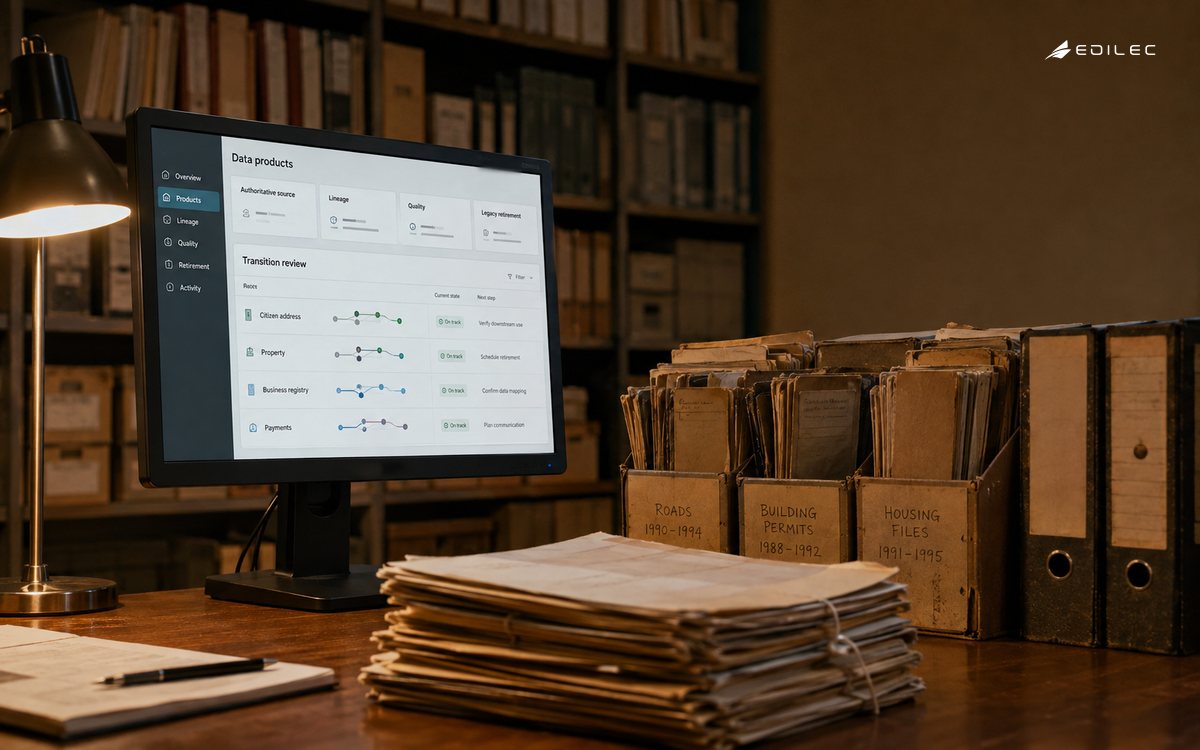
The target state should also say what legacy paths will remain during transition and what conditions allow them to be retired. Many modernization programs fail because they stand up a new platform while the old spreadsheets, extracts and side databases continue to carry the real business logic. A durable target state includes authoritative source rules, metadata expectations, access patterns, lineage obligations, retention and reconciliation responsibilities. In other words, it describes how the new system earns trust before it asks the business to abandon the old one.
| Target-state layer | Decision to record | Acceptance signal |
|---|---|---|
| Decision use | Which business or operational decision should improve | Named owner, baseline and target behavior |
| Data product | What governed output will serve that decision | Owner, consumers and service expectations |
| Authority | Which system is authoritative for each fact | Reviewed source map and conflict rules |
| Lineage | How outputs trace back to inputs and transformations | Versioned provenance and run history |
| Quality | Which dimensions matter most for this use | Thresholds, tests and escalation rules |
| Retirement | What legacy path can be switched off and when | Reconciliation evidence and exit checklist |
Design architecture that preserves meaning during transition
A modernization architecture usually includes source acquisition, durable raw history, transformation layers, metadata or catalog services, governed serving models and controlled consumer access. The important design question is not only where the data lands. It is how meaning, timing and ownership survive movement between stages. Batch, event-driven and change-data-capture patterns all have roles, but they should be chosen according to decision latency, source behavior, recovery needs and consumer expectation. If the architecture cannot explain how a number was produced or corrected, it is modernizing infrastructure without modernizing trust.
Lineage should connect source records, transformation runs, semantic definitions, release versions and downstream products. DCAT and PROV concepts are especially useful here because they separate datasets, distributions, activities and agents in ways that map well to modern data estates. The practical requirement is simpler: when a metric is disputed, responders must be able to see which source changed, which pipeline ran, which logic version applied and who owns the next action. Without that chain, modernization creates a new platform but preserves the old ambiguity.
Build quality, cataloging and stewardship into the product contract
Quality should be defined relative to use. Completeness, timeliness, consistency, validity and accuracy answer different questions, and not every data product needs the same emphasis. A leadership dashboard may tolerate slight latency but not semantic disagreement. A fulfillment workflow may tolerate missing optional attributes but not duplicate or out-of-order events. Good modernization services express these distinctions in product contracts and tests. The team should know which checks block publication, which produce warnings and who can accept an exception temporarily.
Governance is how those contracts remain real after the project team leaves. Stewardship roles, catalog metadata, change review, access approval, retention and decommissioning rules must all have named owners. The goal is not to create a committee around every field. It is to make important decisions reviewable and reversible. A catalog entry without stewardship or lineage is documentation theater. A stewardship model without technical enforcement becomes policy drift. Modernization services should connect the two.
| Governance concern | What to define | Why it matters |
|---|---|---|
| Stewardship | Who owns meaning, approval and exception handling | Prevents data disputes from becoming endless cross-team debates |
| Cataloging | How datasets, products and consumers are described | Makes governed reuse possible instead of relying on tribal memory |
| Quality rules | Which tests block, warn or trigger review | Turns trust expectations into executable controls |
| Access | Who can view, export or change each product | Reduces hidden copies and unmanaged sharing |
| Retention | How long raw and served data persists | Controls cost, privacy exposure and legal obligations |
| Change control | How semantic or pipeline changes are reviewed | Prevents silent metric drift |
Estimate cost across coexistence, migration and retirement
There is no credible flat price for data modernization services without inspecting legacy reality. Cost depends on source count and condition, history volume, event ordering, semantic disagreement, privacy constraints, integration complexity, downtime tolerance and how long dual running must last. Coexistence is often the hidden driver. For a period, the organization may need to operate the old and new paths simultaneously while reconciling numbers and retraining users. That work is essential and should be priced explicitly instead of being treated as incidental overhead.
Separate one-time platform and migration work from recurring storage, compute, orchestration, observability, cataloging and stewardship cost. Model the labor for data profiling, backfill, reconciliation, source remediation, user adoption and report retirement. A cheap platform migration can still be a poor modernization outcome if it leaves manual reconciliation, duplicate pipelines or governance gaps intact. Reforecast after the first vertical slice because the true difficulty of definitions, source behavior and legacy retirement only becomes visible once a real product path is built and challenged.
| Cost layer | What usually drives it | Evidence to inspect |
|---|---|---|
| Discovery | Profiling, source interviews and semantic analysis | Samples, schema history and owner availability |
| Build | Ingestion, transformation, metadata and serving layers | Backlog, contracts and environment plan |
| Coexistence | Dual running, reconciliation and user comparison work | Wave plan, tolerance for discrepancy and old-path dependencies |
| Assurance | Quality tests, privacy controls and lineage verification | Thresholds, review requirements and remediation allowance |
| Run | Compute, storage, orchestration, observability and stewardship | Traffic patterns, retention and support expectations |
| Retirement | Report shutdown, export cleanup and residual access removal | Legacy inventory and exit criteria |
Control the risks that keep legacy logic alive
The biggest modernization risks are usually semantic and organizational. Teams move data without agreeing on meaning. Legacy extracts remain the trusted source because the new product cannot explain discrepancies. Lineage exists in diagrams but not in operational evidence. Access is modernized slowly, so users keep exporting unmanaged copies. Put each risk beside an early indicator and a treatment. The service should make those decisions easier by turning vague distrust into specific reconciliation and governance work.
| Risk | Early evidence | Practical treatment |
|---|---|---|
| Semantic disagreement survives the migration | Teams still calculate key metrics differently | Create reviewed definitions and reconcile against worked examples |
| Legacy path remains the real source of truth | Users continue to rely on old extracts after cutover | Treat retirement as a scoped deliverable with explicit gates |
| Lineage is incomplete | Responders cannot explain a disputed number end to end | Capture provenance automatically and review missing steps |
| Quality checks stay superficial | Pipelines pass but business users distrust the output | Add decision-specific checks and sampled record reviews |
| Access sprawl grows | Users keep broad exports or duplicate stores | Tighten product access rules and monitor unmanaged copies |
| Dual running never ends | No one can define what evidence is enough to retire old systems | Set reconciliation thresholds and authority before the pilot |
Review the supplier on reconciliation and retirement capability
Ask prospective providers to walk through one representative data product from source record to consumer decision, including how discrepancies would be investigated. Strong teams talk about definitions, ownership, quality thresholds, lineage capture, privacy and retirement gates before they talk about tooling. Review examples of source profiles, data contracts, catalog entries, reconciliation plans and adoption dashboards. The provider's credibility comes from whether it can make ambiguity shrink over time, not from how many technologies it can name.
Contracts should cover artifact ownership, metadata export, code and pipeline access, source-system remediation responsibilities, user training, legacy shutdown support and deletion evidence. If the buyer cannot regain direct control of the product definitions, metadata and orchestration logic, the modernization program may simply be moving dependency from an internal legacy estate to an external supplier.
Modernize one vertical slice before scaling the estate
- Frame: agree the decision, data product owner, baseline and retirement target.
- Discover: profile sources, map authority, inspect history and resolve critical definitions.
- Build: create the end-to-end slice with lineage, quality tests, cataloging and access controls.
- Reconcile: compare against the existing method and capture unexplained differences explicitly.
- Pilot: serve a bounded consumer group while monitoring trust, freshness and support demand.
- Scale: add products or source domains only when stewardship and operating evidence remain healthy.
- Retire: remove duplicate reports, exports, credentials and jobs after agreed gates are met.
A vertical-slice approach is powerful because it exposes semantic, technical and organizational blockers early. It proves whether the new platform can produce a governed product that people actually trust. That is far more informative than building broad ingestion first and postponing consumer use, reconciliation and legacy shutdown until the end.
Key takeaways
- Define data modernization from decision use and governed products, not only from platform replacement.
- Preserve meaning through lineage, reviewed definitions and explicit source authority.
- Build quality and stewardship into product contracts from the start.
- Price coexistence, reconciliation and retirement work explicitly.
- Evaluate suppliers on how they handle disagreement and legacy shutdown.
- Scale only after one vertical slice has earned trust with real users.
Frequently asked questions
Is data modernization just moving to a cloud warehouse or lakehouse?
No. The platform move may be part of the program, but modernization also includes source authority, lineage, quality, stewardship, access and retirement of legacy paths. Without those elements, the organization may gain a new platform while keeping the same trust and governance problems.
How long should legacy and modern paths run together?
Long enough to reconcile representative outputs and prove that users can complete the target decision or workflow confidently on the new path. The period should be bounded by explicit thresholds and authority. Dual running without defined exit evidence often becomes a permanent tax.
What should the first modernized data product be?
Choose a product tied to a meaningful decision, with identifiable owners and enough complexity to exercise the full governance and lineage path. If the first slice is too trivial, it will not reduce uncertainty about the broader modernization program.
What proves that modernization is complete for a product?
The product should show reconciled outputs, explainable lineage, owned access, quality evidence, reliable operation and an executed or ready retirement plan for the replaced path. A dashboard alone is not proof of modernization.
Conclusion
Data modernization services succeed when they replace legacy ambiguity with governed data products that people can trust, operate and eventually evolve without the old shortcuts. That requires clearer target states, lineage that answers real disputes, quality tied to use and deliberate retirement gates. Modernization earns its value when the new path becomes the easier and more dependable path for real decisions.