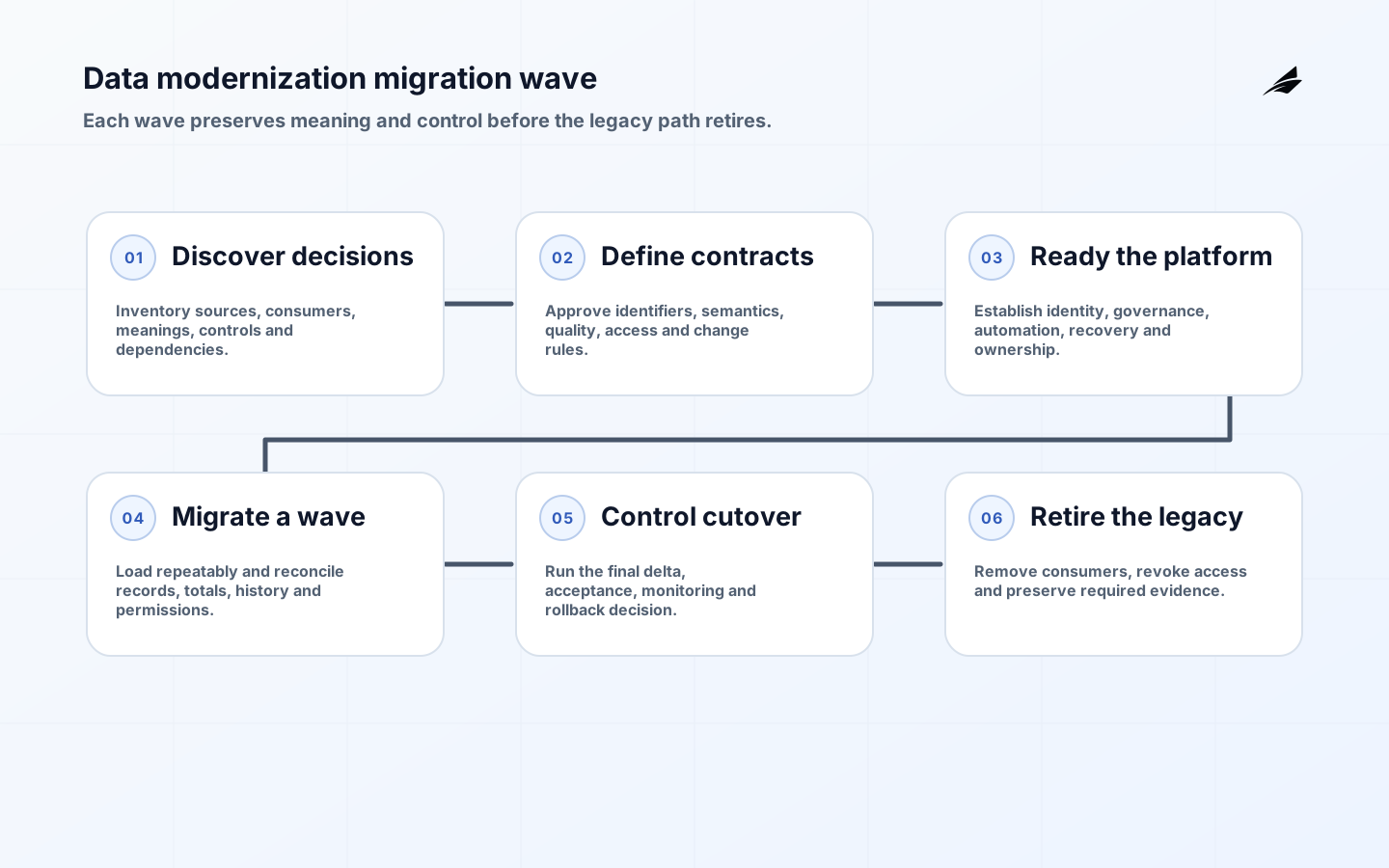
Data modernization services should improve how an organization understands, changes and operates data, not merely relocate databases. A successful program preserves business meaning and control while replacing brittle storage, integration and delivery paths. This data modernization services implementation checklist covers the work from portfolio discovery through reconciled migration, consumer cutover and legacy retirement.
Start with the data modernization services delivery plan to establish outcomes and use the data modernization FAQ to compare approaches. The data model documentation checklist is useful for preserving definitions during a cloud move. Modernization should be sequenced by business capability and dependency, not by the age of a technology alone.
Discover the data estate and its decisions
Inventory databases, files, queues, reports, extracts, APIs, spreadsheets, models and retention archives. For each, name the owner, authoritative records, consumers, refresh pattern, volume, sensitivity, service level, technology state and known quality issues. Observe real month-end, customer-service, regulatory and operational workflows. A rarely queried table may still be critical because it supports an annual filing, legal hold or recovery procedure.
Assess readiness at the application and organization levels. Microsoft's current cloud modernization planning guidance recommends matching replatform, refactor or rearchitect choices to business value and delivering complex modernization in controlled phases. Add data-specific questions: Can records be extracted consistently? Are keys stable? Can totals be reconciled? Who approves a definition? Which consumers cannot tolerate changed latency or history?
| Discovery area | Evidence | Decision enabled |
|---|---|---|
| Business use | Decisions, reports, APIs and operational workflows | Which outcomes justify modernization? |
| Data authority | Systems of record, identifiers and stewardship | Which source wins during conflict? |
| Technical dependency | Jobs, schemas, schedules, libraries and network paths | What must move together? |
| Control obligation | Privacy, retention, residency, audit and recovery | Which target controls are mandatory? |
| Economics | Run cost, change effort, licenses and incident burden | Which wave creates credible value? |
Design a target operating model, not a tool diagram

Choose architecture from workload needs: transactional consistency, analytical scale, streaming latency, document search, retention, regional processing and data science all differ. Define platform and product responsibilities. A central team may operate identity, networking, encryption, observability, catalogs and standard pipelines, while domain owners remain responsible for definitions, quality and access decisions. Avoid a central data team becoming the only group capable of explaining every dataset.
The Microsoft Cloud Adoption Framework separates strategy, planning, readiness, migration, modernization, governance, security and management. That separation is useful even outside Azure: a target service is incomplete without landing-zone controls and an operating model. Microsoft's Azure landing zone guidance also emphasizes repeatable foundations for identity, connectivity, management, security, governance and automation. Apply equivalent foundations before onboarding sensitive data.
Define contracts and preserve semantics
For each data product or interface, specify owner, purpose, schema, identifiers, units, time semantics, quality rules, update expectations, sensitivity, permitted consumers and change policy. Capture meaning that code does not reveal: whether revenue is booked or billed, whether a timestamp is event time or ingestion time, how cancellations appear, and how slowly changing attributes are represented. Version contracts and provide representative fixtures so producers and consumers can test changes independently.
Profile history before transforming it. Record null patterns, duplicate rates, invalid codes, referential gaps and distribution shifts by meaningful segments. Decide whether each defect will be corrected at source, transformed with an explicit rule, quarantined or carried forward as a known limitation. Never silently clean data in a way that makes migrated totals impossible to trace. Store source record references and transformation versions so a user can explain a target value.
- Approve canonical definitions and identifiers with business owners.
- Create consumer contracts for schema, quality, timeliness and change.
- Classify sensitive fields and enforce least-privilege access in every environment.
- Version pipeline code, infrastructure, mapping rules and reference data.
- Capture lineage from target records and metrics back to authoritative sources.
- Define deletion, retention and legal-hold behavior before copying history.
Migrate in reversible waves
Select a thin vertical wave with an owned source, representative transformations and a real consumer. Build repeatable extraction and load processes rather than a one-off bulk copy. Use change data capture or controlled deltas where the source remains live, and define how inserts, updates, deletes and late events are ordered. Run old and new paths in parallel long enough to compare business behavior, but set an exit criterion so dual operation does not become permanent.
Reconciliation must cover more than row counts. Compare control totals, key uniqueness, balances, state distributions, history, permissions and consumer outputs. Sample individual records from source to target and back. For financial or regulated data, obtain formal owner approval for tolerances and unresolved differences. Keep rejected records in an attributable queue with reasons and owners. A green pipeline run does not prove that the resulting records are semantically correct.
| Migration control | Method | Pass condition |
|---|---|---|
| Completeness | Counts by period, source and business state | All expected records are loaded or explained |
| Accuracy | Field comparison and business control totals | Differences remain within approved, documented tolerance |
| History | Effective dates, versions and delete behavior | Time-based reports match expected historical state |
| Security | Role, row, column and export tests | Only approved identities can access each class |
| Resilience | Restart, replay, restore and corruption exercise | Recovery meets objectives without double processing |
| Consumer behavior | Parallel reports and API contract tests | Named consumers accept output and performance |
Control cutover and legacy retirement
A cutover plan should name the change window, freeze rules, final delta, validation steps, decision authority, communications, rollback trigger and support coverage. Rehearse it with production-scale data. Monitor freshness, failed jobs, reconciliation, query performance, access denials and consumer errors immediately after release. Keep the old environment recoverable for the agreed period, but restrict write access to prevent two authorities from emerging.
Retirement is part of modernization value. Confirm that all consumers have moved, records satisfy retention and legal-hold requirements, licenses and integrations are terminated, secrets are revoked and assets are removed from monitoring and backup schedules. Preserve required audit evidence and mapping documentation. For destructive events, the NIST data integrity recovery guide stresses recovering quickly while trusting the accuracy and precision of recovered data; test that property in the target before discarding the source.
Measure the modernized service
Track consumer-facing outcomes: time to onboard a dataset, freshness attainment, failed data contracts, incident duration, reconciliation exceptions, change lead time, query performance, cost per workload and percentage of decisions using governed products. Pair cost with usage and service level; a lower storage bill can hide higher engineering effort or poor latency. Review ownership and quality exceptions with domain teams, and publish deprecation dates and support commitments for platform capabilities.
Privacy risk can increase when modernization makes data easier to combine. Apply the NIST Privacy Framework to identify problematic data actions, not just security threats. Review new joins, derived attributes, broad analytics access and exported copies. Preserve purpose restrictions and data-subject workflows across the old and new estates. A technically successful consolidation should not create an uncontrolled profile of people.
Implementation example: customer revenue data product
A company wants to replace overnight extracts that feed customer revenue reporting. Discovery shows that customer identifiers differ between billing, contracts and support, refunds arrive after period close, and finance uses a spreadsheet mapping for acquisitions. The first wave creates governed identity and invoice contracts, versions the acquisition mapping and publishes a daily revenue product for one business unit. Finance approves definitions for booked, billed, collected and refunded amounts and sets reconciliation tolerances by currency and period.
The team backfills history through a repeatable pipeline, then runs legacy and target reports in parallel across month-end. Automated checks compare invoice counts, amounts, refunds, customer assignment and effective dates; sampled records trace to source. Rejected records enter an owned queue. Cutover occurs only after finance, sales operations and the dashboard owner accept results and recovery is rehearsed. The support runbook identifies freshness, contract and reconciliation alerts with separate owners. The legacy extract becomes read-only, its consumers are monitored, and retirement waits until no scheduled job or annual report depends on it.
After cutover, observability follows data through the decision path. The dashboard distinguishes source lateness, pipeline failure, contract rejection, reconciliation difference and consumer query failure because each has a different owner. Service objectives apply to named products and business windows, not only infrastructure uptime. Cost reporting separates storage, processing, data movement and support effort by product. Quarterly review removes unused copies, challenges broad access and confirms that source and consumer contracts still match actual behavior.
Key takeaways
- Prioritize data modernization by business capability, dependency and evidence of value.
- Design platform controls and ownership before onboarding sensitive workloads.
- Preserve business definitions, time semantics, lineage and consumer contracts.
- Use reversible migration waves with business-level reconciliation and named acceptance.
- Treat cutover, recovery and legacy retirement as designed deliverables.
- Measure consumer outcomes, quality, resilience and total operating cost after migration.
Is lift-and-shift a valid data modernization strategy?
It can be a deliberate first step when exit speed or infrastructure risk dominates, but relocation alone does not modernize contracts, ownership or delivery. State what the move will and will not improve, preserve reconciliation, and create a dated follow-on plan for architecture or operating changes. Otherwise the organization can reproduce legacy coupling on a new bill.
How long should old and new data platforms run in parallel?
Long enough to cover representative business cycles and prove reconciliation, performance and recovery, but no longer than justified by explicit acceptance criteria. Month-end, seasonal or annual processes may require different windows. Define the window per consumer and risk tier. Extended parallel operation raises cost and can create conflicting records, so set a final authority and retirement decision before the wave begins.
Conclusion
Data modernization is complete when users can rely on clearer contracts, controlled change and recoverable services, and when the organization can retire the old path with confidence. Preserve meaning through every wave, prove target records against business controls, and make ownership as modern as the technology.