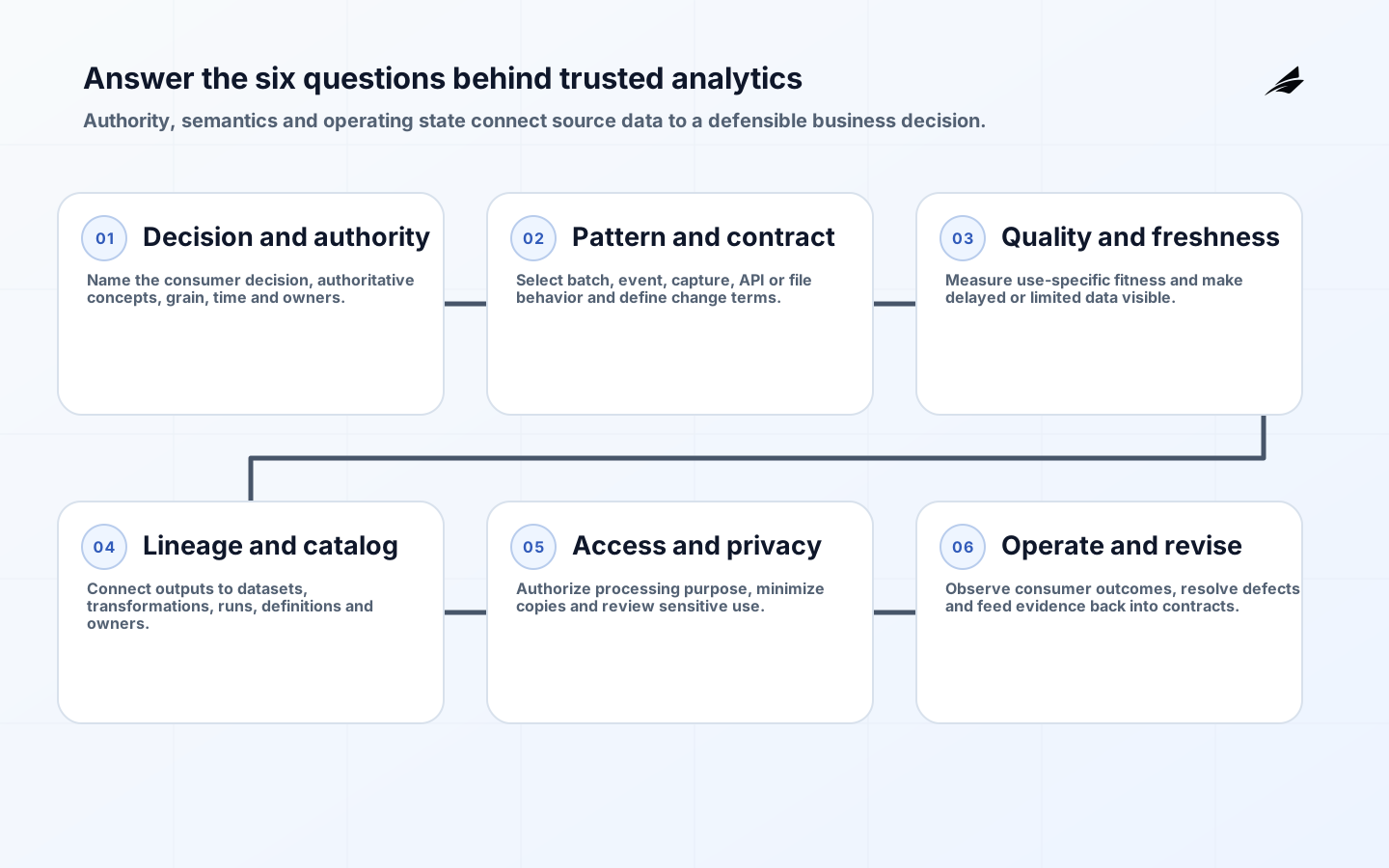
Analytics enterprise integration connects source systems, transformation pipelines, governed data products, semantic definitions and decision tools. The objective is not to move every record into one platform. It is to give authorized people reliable, explainable information at the point of a business decision while preserving ownership, security and operational control. This FAQ addresses the questions enterprise sponsors, data leaders, architects, security teams and delivery teams should settle before and during implementation. The companion analytics enterprise integration implementation checklist turns these answers into gates.
What does analytics enterprise integration include?
It includes the path from an authoritative source to a consumed metric or analytical output: extraction or event capture, transport, transformation, quality checks, storage, metadata, semantic modeling, access, visualization, observability and support. It also includes source ownership, metric approval, change notice, privacy review and incident response. A useful boundary follows a decision domain. Integrating order, shipment and inventory information for fulfillment review is more coherent than importing every table from three systems. Name the decision, users, history and acceptable latency.
Does integration require a single source of truth?
No. A source system can remain authoritative for operational state while an analytical model becomes authoritative for a defined metric. Name authority by concept, grain and time. Customer identity, booked revenue and daily active users may have different owners and rules. Calling a warehouse the source of truth does not resolve definitions. Record event versus processing time, late-arrival policy, correction workflow and who approves semantic change.
| Question | Decision to record | Evidence |
|---|---|---|
| Authority | System and owner by entity, field or metric | Approved source and semantic register |
| Grain | Event, transaction, account, day or other unit | Examples and aggregation tests |
| Timing | Event time, processing time and close policy | Freshness and late-arrival rules |
| Change | Business and technical approval path | Versioned contract and decision history |
| Challenge | Reconciliation and correction process | Owned issue queue and resolution record |
Which integration pattern should we choose?
Choose by semantics and failure behavior. Batch fits stable extracts and tolerable delay. Change-data capture can reduce source impact but introduces ordering, schema and replay concerns. Events represent business facts well when producers own durable contracts. APIs suit bounded queries but create runtime coupling. Managed files remain valid when manifests, encryption, quarantine and reconciliation are disciplined. Hybrid designs are normal; standardize metadata, identity, observability and governance without forcing every source through one mechanism.
| Pattern | Good fit | Main control |
|---|---|---|
| Scheduled batch | Periodic analysis and stable source windows | Completeness, watermark and rerun |
| Change-data capture | Low-latency replication from supported logs | Ordering, schema evolution and replay |
| Domain event | Business facts with a capable producer | Idempotency, versioning and ownership |
| API retrieval | Bounded on-demand data | Limits, authentication, timeout and fallback |
| Managed file | Partner or legacy exchange | Manifest, encryption, quarantine and reconciliation |
What belongs in a data contract?
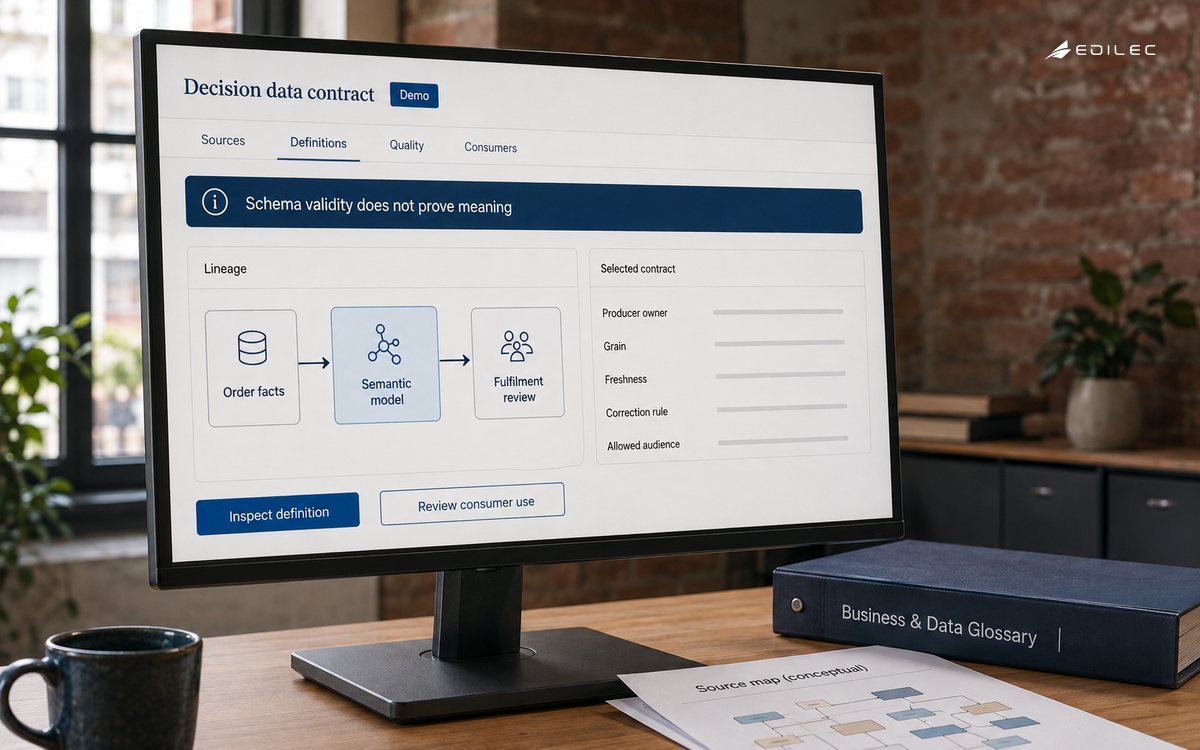
Identify producer, consumers, purpose, schema, semantic meaning, keys, grain, allowed values, classification, freshness, completeness, change policy, compatibility, support and deprecation. Describe absence, deletion and correction, not only valid rows. Machine-readable schemas enable enforcement; plain-language definitions prevent technically valid but semantically wrong use. Put producer checks near creation, consumer checks at use and platform checks at boundaries. A passing schema test cannot prove that a status code means what a dashboard label claims.
How should data quality be measured?
Measure quality in relation to use. Completeness may matter for a financial total, timeliness for an operational queue and consistency when two outputs must reconcile. W3C’s Data Quality Vocabulary can express measurements and annotations, but the enterprise defines dimensions, methods, thresholds and owners. State dataset, field, grain and window for each rule. Separate source defects, transport failures, transformation defects and semantic disputes. Preserve rejected records and explain whether data is blocked, corrected, excluded or shown with a warning.
How much lineage is enough?
Capture what is needed for impact analysis, incident diagnosis and assurance. At minimum, connect consumed data to transformations and upstream datasets, with owners and deployed versions. OpenLineage distinguishes datasets, jobs, runs and events, providing a useful runtime model. Automated lineage misses manual uploads, rules in documents and calculations inside visualization tools; supplement it with declared relationships. Test whether a team can identify affected dashboards before a source change and trace a disputed metric to inputs and code.
Do we need a catalog?
A catalog is useful when it helps people discover data, understand ownership and judge fitness. W3C DCAT 3 defines interoperable concepts for catalogs, datasets, distributions and data services. A deployment still requires curation, access integration and lifecycle rules. Harvesting thousands of technical objects without meaning or owners creates inventory rather than trust. Start with the products and sources used by material decisions, then expand through ownership.
How should access and privacy work across platforms?
Classify data and processing purpose before access. Propagate identity where practical, apply least privilege, separate service identities from people, protect secrets, encrypt transport and storage, and log material use and administration. Decide where row, column, tenant and purpose restrictions are enforced because duplicated policies drift. NIST’s Privacy Framework supports decisions about processing risk, minimization, retention and governance. Test deletion, legal hold and subject-right workflows across derived data instead of assuming source deletion propagates.
What should integration observability cover?
Observe business data movement and the platform carrying it. Pipeline completion is insufficient. Track source arrival, control totals, watermark, freshness, rejected records, transformation version, publication and consumer availability. Correlate them with metrics, logs and traces; OpenTelemetry defines signal types, but teams add dataset and business context. Consumer-visible freshness prevents a technically successful job from presenting old information as current.
| Signal | Question answered | Response |
|---|---|---|
| Freshness | Is the product current enough for its decision? | Warn, pause or restore flow |
| Completeness | Did expected scope arrive and publish? | Reconcile and rerun safely |
| Compatibility | Can consumers interpret the change? | Block or version |
| Quality | Is data fit for named use? | Quarantine, annotate or escalate |
| Lineage | Which run and inputs produced output? | Trace and compare versions |
| Access | Who or what used sensitive data? | Review, investigate or revoke |
How should legacy reports be migrated?
Inventory reports, extracts, scheduled emails, spreadsheet dependencies and manual adjustments. Record owner, audience, decision, source, metric definitions and usage. Classify each as retain, rebuild, consolidate or retire. Reconcile representative periods and edge cases, not just row counts. Categorize differences as corrected defects, changed rules, timing, missing source, grain or implementation error. Obtain business acceptance for intentional change. Parallel running must have an owner and exit date, followed by removal of jobs, permissions and distribution paths.
What does a safe rollout look like?
- Frame one decision domain, owners and measurable acceptance.
- Profile sources and prove the least-known contract or access path.
- Build one end-to-end data product with quality, lineage, access and observability.
- Reconcile current decisions and run failure, replay and recovery scenarios.
- Release to an approved cohort with visible freshness and support.
- Expand by source, domain or consumer only when ownership and controls hold.
- Retire duplicate pipelines and reports after retention and audit needs are met.
What are the main risks?
| Risk | Early signal | Control |
|---|---|---|
| Semantic conflict | Same label produces different totals | Metric owner, grain and versioned definition |
| Silent staleness | Successful job publishes old inputs | End-to-end freshness objective |
| Breaking source change | Rejects or nulls rise | Contract tests and notice |
| Sensitive copies | Unknown extracts or broad test access | Catalog, minimization and review |
| Lineage gaps | Impact depends on personal memory | Runtime plus declared lineage |
| Dual reporting | Teams select the preferred number | Bounded reconciliation and retirement |
Key takeaways
- Integrate around a decision domain, not a mandate to centralize every record.
- Name authority, semantics, grain and timing before choosing tools.
- Back data contracts with tests, change governance and accountable owners.
- Operate freshness, quality, lineage, privacy and access as product capabilities.
- Roll out one observable data product, reconcile it and retire duplicate paths.
Additional frequently asked questions
Does analytics need to be real time?
Only when a decision loses value with delay and the operating model can support the latency. Streaming increases ordering, replay, capacity and support demands. Define a freshness objective and test the consequence before selecting it.
Should integration use one platform?
A shared platform can standardize controls, but acquisitions, residency, latency and specialist workloads often create a federated estate. Standardize contracts, metadata, identity and operating evidence across platforms; centralize only where benefits exceed migration and concentration risk.
When is integration complete?
When the approved consumer can use the output, understand its semantics and current state, trace material results, obtain support and recover from failure. Data movement alone is not completion.
Conclusion
Before closing an integration program, verify that governance survives organizational change. Source ownership should transfer when applications move teams; contracts and lineage should remain discoverable when pipelines are rebuilt; and access reviews should follow the current purpose rather than the original project. Schedule periodic product reviews covering consumer value, unresolved quality exceptions, unused datasets, policy drift, support load and retirement candidates. This lifecycle discipline prevents a successful first release from becoming another opaque dependency. It also creates a controlled way to change freshness objectives, semantic definitions and platform placement as business needs evolve.
Analytics integration earns trust when consumers can understand a metric, see whether it is current, trace how it was produced and know who resolves a defect. Architecture matters, but durable ownership, semantic contracts and controlled rollout turn connected systems into dependable decisions. Procurement and architecture reviews should therefore compare operating evidence, contract portability, export paths and ownership transfer, not feature lists alone.