Warehouse Grain Contracts for Reliable Analytics
Warehouse grain explains how a team can make warehouse grain dependable before the work becomes difficult to reverse. Warehouse grain uses a decision with a named owner, bounded action, visible state, and inspectable evidence.
Define the warehouse grain decision
Warehouse grain is ready for a controlled release when the team can state what is authoritative, which context permits action, what must be retained, and how an exception reaches a responsible person. Warehouse grain uses a provisional state when evidence is incomplete; Warehouse grain never turns an unanswered question into a silent default.
Warehouse grain contract
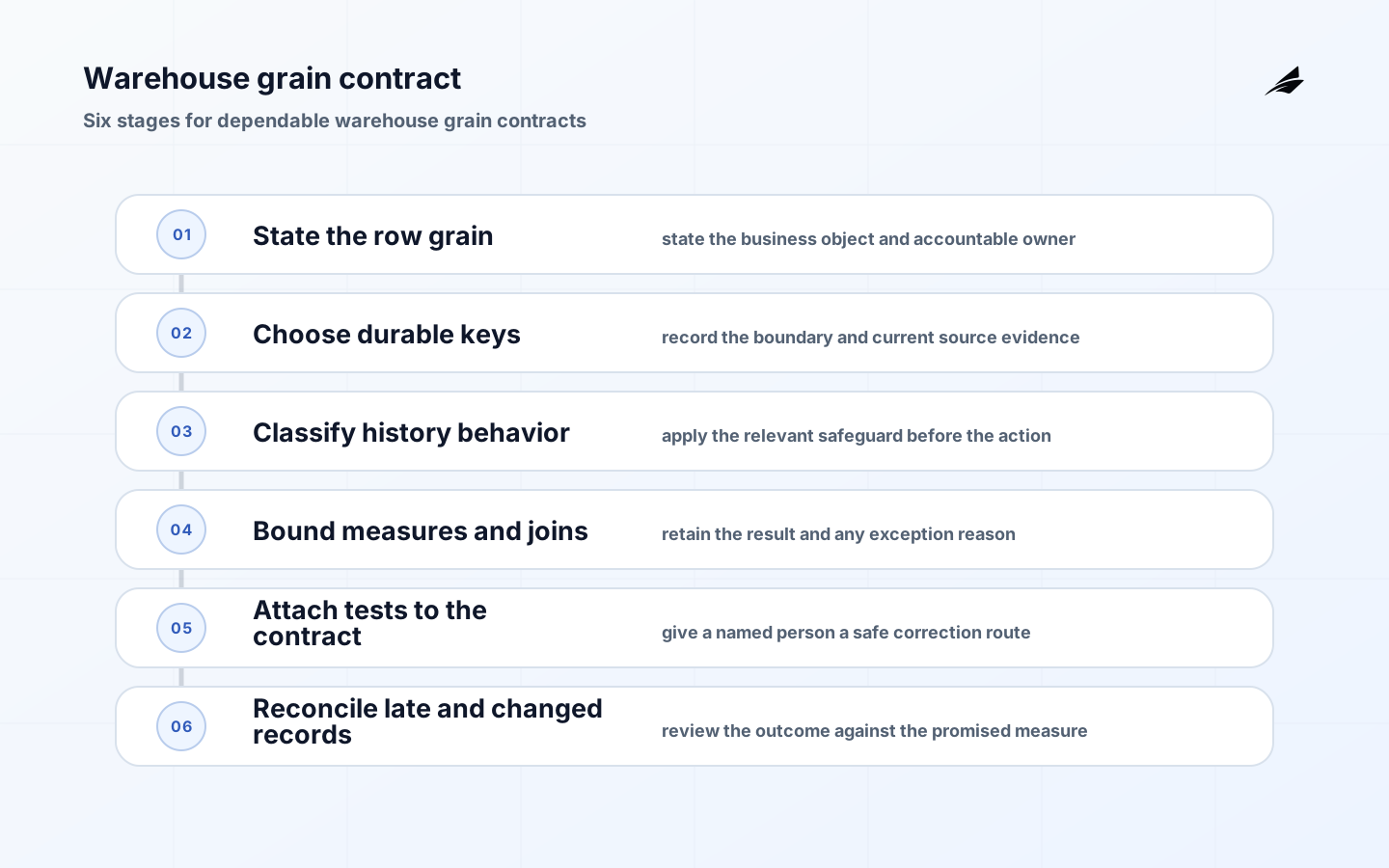
- For warehouse grain, frame one consequential business object and one accountable owner.
- For warehouse grain, capture row-level contracts at the boundary where a request becomes an approved operational action.
- For warehouse grain, test the reconciliation route with missing, late, duplicate, denied, and corrected inputs.
- For warehouse grain, review downstream impact before a change reaches a reader, customer, employee, supplier, or device.
- For warehouse grain, approve a bounded correction with a named resolver, deadline, and retained reason.
- For warehouse grain, verify the released result against the promised measure and record what remains uncertain.
Controls and evidence for Warehouse grain
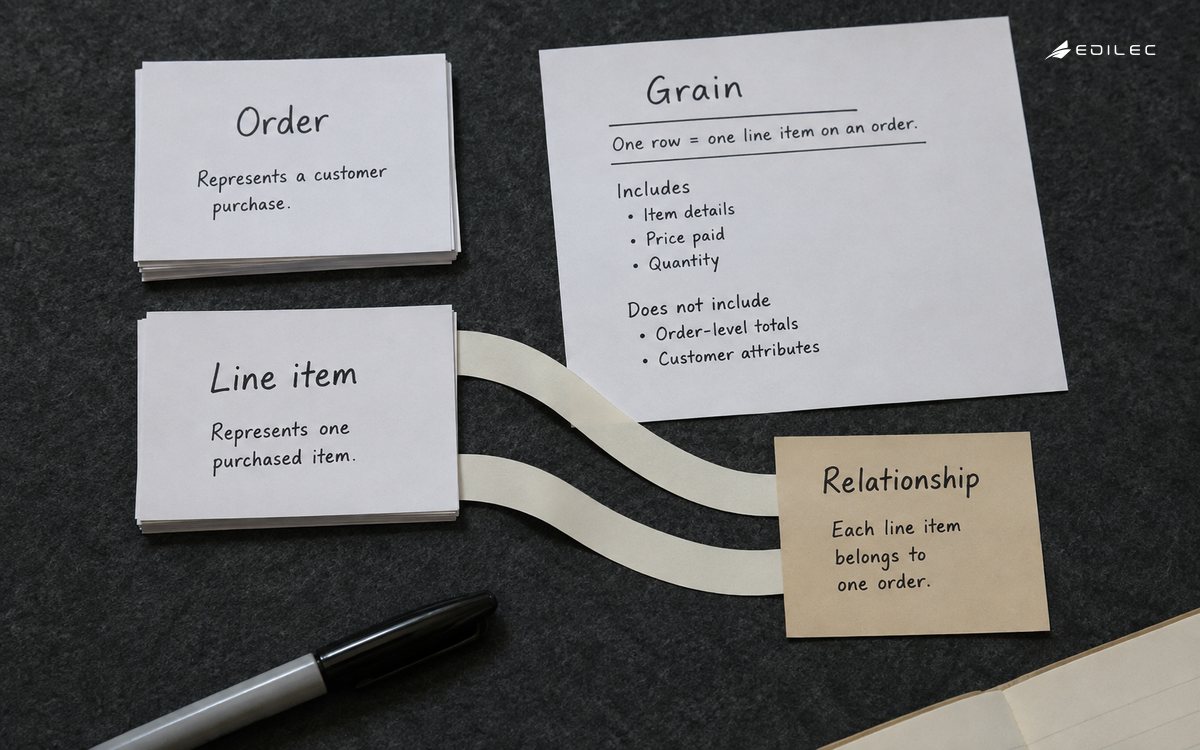
Start with an explicit grain contract: state what one row represents, which business event or observation it records, and which key makes that row identifiable. Document the required dimensions, measures, units, time semantics, nullability, uniqueness expectation, and permitted relationships before choosing a fact or dimension layout. The contract should name the source owner, model owner, downstream consumers, and the evidence used to reconcile the model with its input. W3C RDF Data Cube terminology is useful when a dataset is organized around dimensions, measures, and observations; the contract still needs local rules for corrections, late data, and access. Preserve the source reference, load or event time, model version, and test results with each release. If the team cannot explain whether a join changes the row count or grain, the model is not ready for production use, regardless of how plausible its aggregate results appear.
| Decision point | Evidence to retain | Owner response |
|---|---|---|
| Normal case | The input, rule, actor, timestamp, and outcome for a warehouse result. | Confirm the result and publish its status. |
| Exception | The failed check, affected scope, safe options, deadline, and disposition. | Route the case to the warehouse model owner without overwriting history. |
| Change | The previous behavior, new definition, approval, effective time, and rollback point. | Reconcile the affected records before expanding scope. |
Test Warehouse grain before rollout
- For warehouse grain, trace one case from intake through the final decision and observable outcome.
- For warehouse grain, replay a normal case and an exception case while preserving row-level contracts and the responsible actor.
- For warehouse grain, ask an operator outside the build team to explain the reconciliation route without private context.
- For warehouse grain, measure completion quality, exception age, recovery time, and evidence completeness by owner.
- For warehouse grain, check that a correction reaches every affected consumer without rewriting the original event.
- For warehouse grain, record the next review date, escalation route, and condition for safely expanding scope.
Test the model at the grain boundary and at every transformation that can alter it. Check required fields, key uniqueness, null behavior, relationship integrity, duplicate inputs, late arrivals, corrections, and records that fail authorization or validation. Exercise joins with one-to-one, one-to-many, and unmatched cases so the team can see whether a measure is duplicated, dropped, or moved to a different grain. Reconcile representative source slices to the resulting facts or observations, recording the query or extract, model version, run time, owner, and disposition of any difference. Run the same scenarios through incremental and replay paths, including a delayed event and a correction to an earlier period. Have a consumer outside the build team verify that column names, definitions, units, and time boundaries support the intended decision. A rollout should remain bounded until failures have an explicit owner and recovery path.
Implementation notes for Warehouse grain
Choose the physical model only after the row contract is stable. A warehouse may separate facts, dimensions, and bridge tables, but every table should state its grain and the keys that connect it to other tables. Use stable business identifiers where the source provides them, and introduce surrogate keys or snapshots only with a documented reason and history rule. For incremental pipelines, define how event time, processing time, watermarks, retries, and late data affect inclusion without silently changing an earlier row. Apache Beam's pipeline vocabulary is relevant when event-time processing and windowing shape the output. Publish model definitions and ownership in the catalog, and describe dimensions, measures, and observation context in terms that consumers can interpret. Physical partitioning, clustering, and materialization choices may improve operation, but they do not repair an ambiguous grain or an uncontrolled many-to-many join.
A change to grain is a contract change, even when the SQL diff looks small. Version the model definition and state whether the new release preserves, splits, merges, or reinterprets rows. Before deployment, identify affected dashboards, extracts, metrics, and consumers; compare old and new outputs on representative periods; and obtain approval from the model owner and the decision owner. For a backfill, retain the source snapshot or extraction reference, processing run, effective time, and correction reason. For slowly changing dimensions or snapshots, document which attributes are valid at event time and which describe the current state. Keep the prior model available for a bounded rollback or reconciliation window, and do not overwrite its evidence. When a dependency is late, expose the affected period and provisional status so consumers can distinguish an incomplete load from a genuine zero or absence of activity.
After deployment, observe the contract rather than relying on aggregate totals alone. Review freshness and load status, required-field failures, duplicate or missing keys, relationship violations, unexpected grain changes, and reconciliation results by source and model owner. Keep the input reference, model version, test output, exception reason, affected consumers, and recovery result together so an operator can explain a discrepancy without rebuilding the investigation. The catalog should show who owns the dataset and who approves a contract change; the pipeline should expose whether a row is current, corrected, provisional, or rejected. Review sampled records and downstream queries alongside operational measures such as exception age, recovery time, and evidence completeness. Expand use only when normal and exceptional cases have a tested correction route. A dependable warehouse model is one whose rows, definitions, and limitations remain understandable during the next handoff.
| Operational question | Evidence to retain | Owner response |
|---|---|---|
| What proves warehouse grain is ready? | For warehouse grain, a dated row-level contracts decision record connects the input, rule, actor, result, and review. | Confirm the evidence before widening scope. |
| What happens when warehouse grain is uncertain? | For warehouse grain, the system marks the state, limits the action, names the resolver, and preserves prior context. | Route the exception without erasing history. |
| How is warehouse grain corrected? | For warehouse grain, the correction names the changed fact, affected readers, approval, effective time, and verification result. | Reconcile consumers and close the case. |
| Which measure protects warehouse grain? | For warehouse grain, track completion quality, exception age, recovery time, and evidence completeness by owner. | Review the trend with the accountable operator. |
| What should be rehearsed for warehouse grain? | For warehouse grain, test normal completion, missing data, duplicate input, denied access, delayed dependency, and reversal. | Record the scenario outcome and remaining risk. |
| When may warehouse grain expand? | For warehouse grain, expand only after representative normal and exceptional cases pass with a usable correction route. | Approve the next bounded use explicitly. |
Treat grain changes as contract changes
A warehouse grain decision should travel with the model as a versioned contract. Record the business event represented by one row, the natural and surrogate keys, late-arriving behavior, deduplication rule, update policy, and the measures that may be safely aggregated. Before changing that contract, identify every downstream model, dashboard, export, and reconciliation that assumes the current grain. Compare row counts and business totals across a representative period, then publish the effective date and migration method. This discipline prevents a technically valid schema change from silently double-counting revenue, splitting customer histories, or changing the meaning of an established metric.
Key takeaways for Warehouse grain
For warehouse grain, keep the owner, authoritative state, permitted action, evidence boundary, and recovery route visible. For warehouse grain, pause the normal path when proof is missing and show how a corrected result reaches each affected reader.
Warehouse grain contracts FAQ
For warehouse grain, what should a team settle first? Warehouse grain teams should start with the accountable owner, authoritative state, permitted action, evidence boundary, and recovery route. For warehouse grain, ask which operator can pause the normal path, what proof they need, and how correction reaches each affected reader.
A dependable warehouse grain contracts operating rule
For warehouse grain, keep the first release narrow, measurable, and owned. For warehouse grain, a result earns its next use only when it can be explained, challenged, corrected, and reviewed by the right person.
For warehouse grain, consult these official references for the operating choices in this guide: W3C PROV overview; W3C Data Catalog Vocabulary version 3; RDF Data Cube Vocabulary; Apache Beam Programming Guide. warehouse grain related guide 1; warehouse grain related guide 2; warehouse grain related guide 3