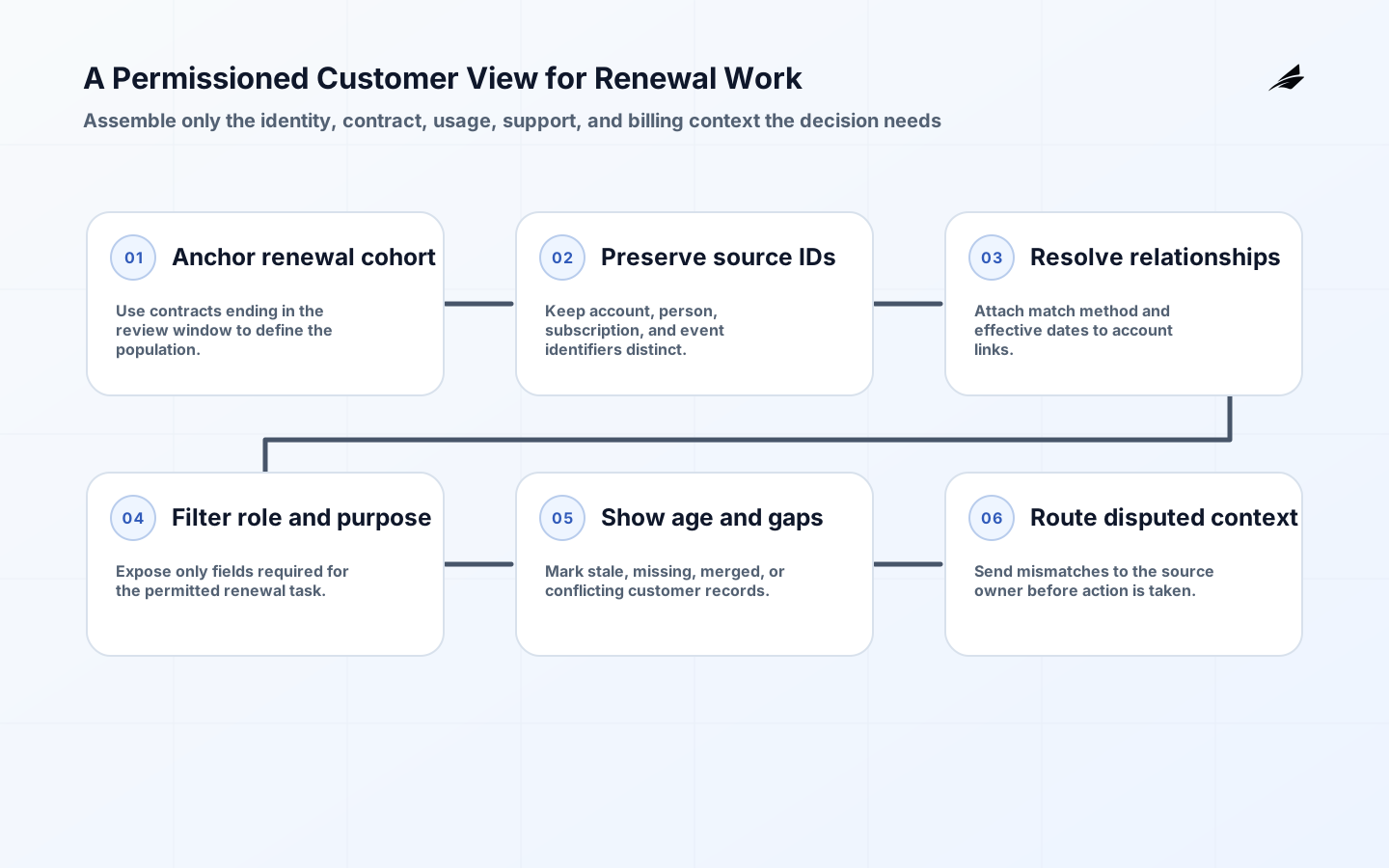
Customer data visibility is the ability to answer a customer-facing question with the right records, at the right level of detail, for a permitted purpose. It is not a mandate to combine every attribute into one screen. An account manager preparing for a renewal may need current product use, open support cases, contracted entitlements, and the last billing status; a service leader may only need an aggregated risk queue. The useful design starts by separating those decisions and their audiences. That makes customer data visibility a managed service: it has a defined question, source authority, freshness expectation, access rule, and way to investigate a surprising result.
Define the decision before connecting customer records
Begin with a short decision inventory. For each decision, name the user, the action they can take, the customer population, and the point at which an older record becomes unsafe to use. A retention conversation and a fraud investigation may both reference the same customer, but their permitted fields, time horizon, and escalation routes differ. This inventory exposes where a single customer identifier is insufficient: subsidiaries, household accounts, merged profiles, and contacts can all make a roll-up misleading. The goal is a clear answer to “what does this view enable?” rather than a catalog of fields that happens to be available.
- Write one decision statement for every view, queue, or exported dataset.
- Record the accountable system for identity, contract, billing, support, and product events.
- Specify whether the reader needs an individual record, account roll-up, or cohort aggregate.
- Set a freshness threshold that matches the decision rather than a generic daily refresh.
- Name a business owner who can resolve a disputed definition.
Model identity and context without inventing certainty
Customer data visibility depends on careful identity resolution. Keep the original identifiers from each system, then make the relationship between a person, account, subscription, and event explicit. A matched record should carry the matching method and, where relevant, its effective dates. Do not silently treat a probable match as a confirmed fact. For example, a billing account can legitimately cover several product workspaces, while a support ticket may be opened by a contractor who is not the commercial contact. The data model should let users inspect that context instead of encouraging a false one-row customer story. Data model documentation for a cloud migration offers a useful companion discipline for documenting grain and relationships.
| Design element | Question to answer | Evidence to keep |
|---|---|---|
| Customer key | Which identifiers are retained and which one is used for each purpose? | Source-system IDs and a documented crosswalk. |
| Relationship | Is this person, account, household, workspace, or contract relationship current? | Relationship type, effective dates, and match method. |
| Context | Which product, region, or commercial terms qualify the result? | Scoped attributes and the system that owns them. |
| Freshness | When was the assembled view last fit for use? | Visible source and publication timestamps. |
Govern access and quality at the use case level
A durable customer view has two parallel controls: access decisions and data-quality decisions. Access should be based on a role and a demonstrable business purpose, with sensitive fields minimized or masked where a decision does not require them. Quality controls should test the promises made by the view: required identifiers exist, records arrive within the stated window, key relationships do not multiply a balance, and controlled values remain valid. The NIST data governance profile is a useful reminder that governance connects organizational roles, policies, and data-management practices; it is not merely a catalog tool.
- Test duplicate, late, and conflicting identifiers before publishing a new relationship rule.
- Display a limitation when a source is delayed instead of presenting the combined view as complete.
- Use row- and column-level controls where a broad export would expose unnecessary detail.
- Keep correction requests linked to the contributing system, not only to a spreadsheet extract.
- Review access when a role, customer relationship, or purpose changes.
Build a customer data visibility operating model
Release a narrow, observable use case first, such as the renewal preparation queue for one market. Reconcile a representative sample with the teams who run the work and deliberately include difficult cases: an account transfer, a merged profile, a late invoice, and an inactive user with recent support activity. Put automated assertions close to the transformations they protect; dbt data tests describes a practical pattern for codifying checks on models. Publish what changed in meaning, which history is affected, and whom readers should contact. This is also where an analytics team can connect the view to customer analytics implementation rather than creating a separate ungoverned reporting path.

| Operating moment | Control | Response |
|---|---|---|
| Source is late | Compare source arrival with the published freshness threshold. | Warn users, hold the affected result, or use an approved fallback. |
| Identity rule changes | Reconcile old and new matches on sampled accounts. | Version the rule and explain material historical effects. |
| Sensitive access request | Check role, purpose, scope, and approval record. | Grant the smallest useful access for the needed duration. |
| Customer disputes a record | Trace the result through the view to the accountable system. | Correct at source where appropriate and record the disposition. |
A practical customer visibility example
Consider a renewal manager preparing for accounts whose contracts end in the next 90 days. The view should not indiscriminately combine all customer activity. It can start with a contract record that establishes the renewal population, use the current account hierarchy to route responsibility, add recent qualified product activity to establish engagement context, and show unresolved support cases only where they are relevant to the conversation. Each item retains its own time meaning: a contract has a term, an event has an occurrence time, and a support case has a current state. The manager can see whether evidence is recent enough for a decision and drill into the accountable system when it is not.
Now consider an account that was acquired and merged under a new parent company. A simplistic customer roll-up might either double-count activity or attach historical behavior to the wrong commercial relationship. A stronger implementation retains the original account identifiers, records the relationship change with effective dates, and offers an explicit rule for how results are presented before and after the merger. When a reader needs a historical trend, the view can state whether it follows the original account or the current parent. That clarity is more valuable than a seamless-looking total whose meaning shifts when organizational relationships change.
The operational test is straightforward: give a sample queue to the people who will use it and ask them to prepare for actual conversations. Note every time they leave the view, ask whether a record is current, or question why an account is included. Some of those questions identify training needs, but many identify missing source authority, an over-broad match, or a timing rule that must become part of the product. Convert the repeatable discoveries into definitions, quality checks, or a better drill path. This makes the view increasingly useful without broadening access simply to silence a question.
- Confirm the decision owner can state the action expected from each queue or account view.
- Verify that entity relationships include a documented treatment for mergers, transfers, and closures.
- Check that time-sensitive sources display both source freshness and final publication time.
- Review sample records with account, support, finance, and data stewards before a major release.
- Document which customer attributes are unavailable by design and why they are not needed.
- Test access using the roles that will actually prepare customer conversations and resolve exceptions.
- Record how a reader reports an identity mismatch, stale source, or inappropriate field exposure.
- Measure how often users need an external spreadsheet to understand or act on the view.
- Review correction trends to decide whether the issue belongs in matching, source data, or training.
- Retire fields and queues that no longer support a current customer decision.
Key takeaways for customer data visibility
- Design around decisions, not an abstract 360-degree profile.
- Keep identity relationships, source authority, and effective dates inspectable.
- Pair least-privilege access with explicit completeness and freshness controls.
- Pilot a real operational queue before expanding across the enterprise.
Frequently asked questions about customer data visibility
Is customer data visibility the same as a customer data platform? No. A platform can support collection and activation, but visibility is the operating outcome: a permitted reader can understand the right customer context for a defined task. How fresh should the data be? Fresh enough for the decision. A weekly account plan may tolerate overnight data; an entitlement check before service delivery may not. Who owns the view? Assign a business owner for meaning and a technical steward for delivery, lineage, and incident response. Should every team see the same fields? No. Shared definitions are valuable, while universal field access is usually neither necessary nor appropriate.
Conclusion: make visibility useful and bounded
Enterprise customer data visibility earns trust when it makes the right context available without hiding uncertainty or oversharing sensitive records. A disciplined design preserves source evidence, tells readers whether the view is current, and gives teams a route to resolve a mismatch. As the use cases grow, keep the decision inventory and relationship model current. That is more valuable than a grand promise of a universal profile, because it lets each new view remain explainable, permissioned, and connected to the work it is meant to improve.