Warehouse Readiness: What to Settle Before Your Data Platform Build begins with a working decision, not a tool selection. The data platform lead, domain owner, and security partner need to know whether a domain is ready for a dependable warehouse release and what must be resolved first. That is the standard for every field, calculation, and screen in this guide. Start by writing the operating moment in plain language: who looks, what they can change, how quickly they need evidence, and what could go wrong if the evidence is late or incomplete. Warehouse readiness is dependable when readers can see its scope, source, freshness, and owner without having to reconstruct the logic from a report.
Define the decision warehouse readiness must support
Interview the intended readers in the place where the decision is actually made. Ask for the last difficult case, the evidence they trusted, and the action they took. For this work, the decisive question is whether a domain is ready for a dependable warehouse release and what must be resolved first. A requirement such as “show performance” is too broad to test; a decision statement establishes a boundary for the first release. It also prevents one view from trying to serve executives, operators, and analysts with incompatible levels of detail. Keep an investigation path available, but make the opening view answer the immediate question.
- Name the accountable reader and the meeting, queue, or handoff where warehouse readiness will be used.
- Write the action that follows a material change and the person authorized to take it.
- State the decision horizon: what must be known now, this week, or at period close.
- Record the consequence of stale or disputed evidence before setting a refresh expectation.
- Separate the reader’s first action from exploratory questions that need a deeper workspace.
Set a compact operating contract
Before development, turn the decision into a short service contract. For warehouse readiness, the evidence is source contracts, data classifications, keys, delivery expectations, and consumer use cases. The expected grain is one explicitly named business fact or entity, with event time and load time kept distinct. The intended cadence is before the first domain build and at each new source onboarding. Record the scope, permitted users, owner, refresh expectation, and escalation route in one place the delivery and business teams can both inspect. The contract should be explicit about exclusions too. A clear exclusion is safer than an implied promise that every source, historical correction, or local exception will appear in the first release.
| Contract element | Question to settle | Evidence to retain |
|---|---|---|
| Decision boundary | What decision does warehouse readiness influence? | Named reader, operating moment, and expected action. |
| Authority | Which records are authoritative for this use? | source contracts, data classifications, keys, delivery expectations, and consumer use cases, with a domain owner and source contact. |
| Timing | When is the result safe to use? | before the first domain build and at each new source onboarding, plus a visible last-successful publication time. |
| Recovery | What happens when evidence fails? | an undocumented source owner, incompatible identifiers, an unclassified sensitive field, or a pipeline whose late-arriving records silently rewrite history; defer the dependent model, assign the missing decision, and publish the readiness gap in the delivery plan. |
Map evidence and choose a defensible grain
Many reporting failures begin when events, snapshots, and summaries are joined before anyone states what a row means. Write the grain as a sentence: one explicitly named business fact or entity, with event time and load time kept distinct. Then list the identifiers, time fields, expected arrival, correction behavior, and permitted use for each source. Preserve enough lineage to trace a published result back to the source record and transformation. Where systems use different identifiers, maintain a controlled crosswalk with an owner and review date. This work is less glamorous than dashboard design, but it is what makes a later disagreement answerable.
- Keep source identifiers and observation times when records can be corrected after arrival.
- Distinguish event time, effective time, load time, and publication time; each answers a different question.
- Document join cardinality and the expected result when a matching record is missing.
- Classify sensitive fields before making a model easy to discover.
- Treat a manual mapping as a governed dataset with change history, not as a private spreadsheet.
Define measures and controls for warehouse readiness
Warehouse readiness is not a procurement checklist. It is evidence that a team can explain what a row represents, who is allowed to use it, where it came from, and how a correction reaches downstream readers. A warehouse can begin small, but uncertainty about authority or grain compounds quickly once multiple teams reuse the same model. For each material measure, document its business meaning, population, calculation, inclusion and exclusion rules, time window, grain, owner, and known limitation. The core signals here are source completeness, load latency, reconciliation status, access coverage, and transformation test results. A threshold deserves a response path, not a color alone. Use worked examples to test whether two reasonable readers reach the same result. If a measure cannot be explained without a long technical aside, keep refining the definition before it becomes a default in an important meeting.
| Measure component | Planning question | Control that prevents misunderstanding |
|---|---|---|
| Business meaning | What condition does this describe? | A plain-language definition reviewed by the accountable reader. |
| Calculation | Which records count and which do not? | Versioned logic and a small set of worked examples. |
| Comparison | What is the reference point? | An explicit target, baseline, forecast, plan, or prior period. |
| Response | What happens outside tolerance? | defer the dependent model, assign the missing decision, and publish the readiness gap in the delivery plan |
Design the controlled path
Build the delivery path so an investigation can travel from reader output to source evidence without guesswork. Separate intake, transformation, reusable definitions, and the reader experience. Run checks at the point where they are cheapest to diagnose: source arrival, schema conformance, record-level validity, transformation outputs, and published totals. Treat an undocumented source owner, incompatible identifiers, an unclassified sensitive field, or a pipeline whose late-arriving records silently rewrite history as a designed operating condition rather than a rare technical exception. Decide in advance whether the system warns, suppresses a measure, holds the last approved result, or blocks release. Make the result and its freshness visible to readers.
Run a usable release and review rhythm
For warehouse readiness, use a pilot that exposes the actual handoff before widening scope. Put one complete decision loop into the relevant operating moment, then watch what readers do when the evidence is late, surprising, or incomplete. Warehouse Readiness: What to Settle Before Your Data Platform Build should be judged by whether a real owner can interpret the signal and carry out the agreed response, not by whether every desired field appeared in the initial release. Keep a short log of questions, overrides, and unresolved exceptions; those are the best inputs to the next iteration.
- Confirm access with real reader roles, including the person who must resolve an exception.
- Reconcile a small, agreed sample to the authoritative records before broad release.
- Publish freshness and quality status beside the result, not in a hidden runbook.
- Capture reader questions and classify them as documentation, model, access, or workflow work.
- Schedule an owner review for thresholds, source changes, and unresolved exceptions.
A six-stage path for warehouse readiness
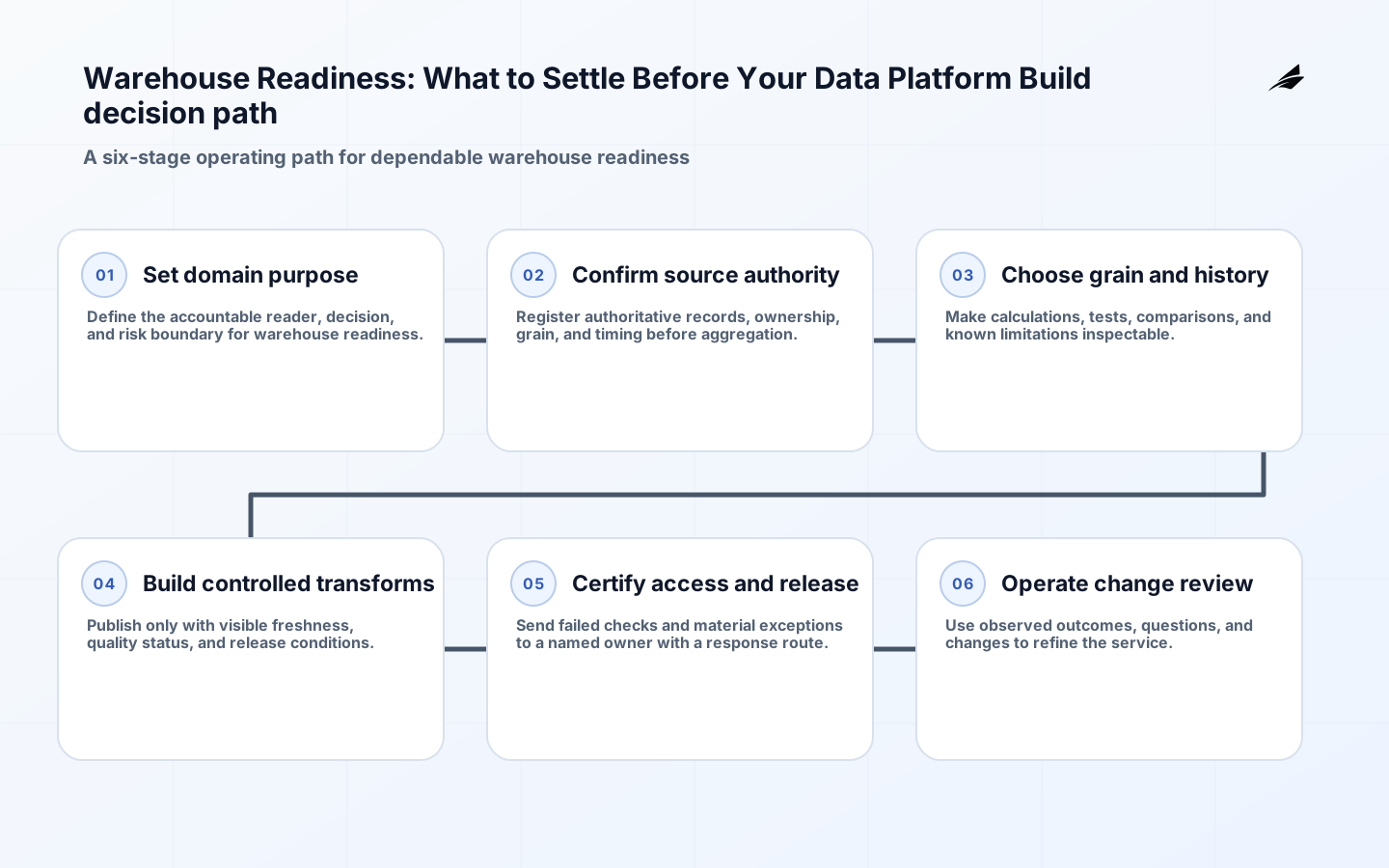
This six-stage warehouse readiness diagram makes the operating sequence visible. It connects the first decision to the evidence that supports it, the definitions that make it repeatable, the release conditions that keep it honest, and the exception route that turns a failed check into work for a named owner. The final stage matters: decisions, source changes, and reader behavior reveal where the service needs revision.
Key takeaways
- Warehouse readiness should begin with a decision statement that names the reader, action, and acceptable evidence.
- A stated grain, source register, and versioned measure definition make later investigation possible.
- Freshness, quality status, and a named exception route are reader-facing requirements.
- Adoption is proven in the operating routine, not by a successful deployment alone.
- Retire or revise measures that no longer change a useful decision.
Frequently asked questions
How much should the first warehouse readiness release cover?
Start the first warehouse readiness release with the narrowest complete scope that can support a genuine decision. Include enough authoritative evidence to show the result, enough definition to interpret it, and one real response path for an exception. Resist adding adjacent data merely because it is available. A focused release makes errors visible quickly and lets the team learn which context readers truly need before expanding the service.
Who owns definitions in warehouse readiness?
Ownership for warehouse readiness is shared deliberately. The domain owner decides what a measure or model means and when it is fit for use; the data delivery owner implements, documents, and monitors that agreement. The reader who acts on the output should be able to challenge both. When interpretation changes, publish the effective date, rationale, and affected output so old and new results are never silently blended.
What should happen when a check fails?
A failed warehouse readiness control needs a response that is proportional to its decision risk. A missing optional attribute may remain visible with a warning, while a failure that alters a committed total or operating priority should block or clearly label publication. Readers deserve a concise status and next review time; the accountable owner needs the failing rule, affected population, and source context to correct the problem without reconstructing the incident from scratch.
Conclusion
Warehouse Readiness: What to Settle Before Your Data Platform Build is most useful when it behaves like a dependable operating service. Define the decision, make evidence and grain explicit, document measures, test the release path, and keep exception ownership visible. That discipline gives teams a smaller but more credible starting point, and it creates a practical foundation for later automation, new sources, and broader reporting.