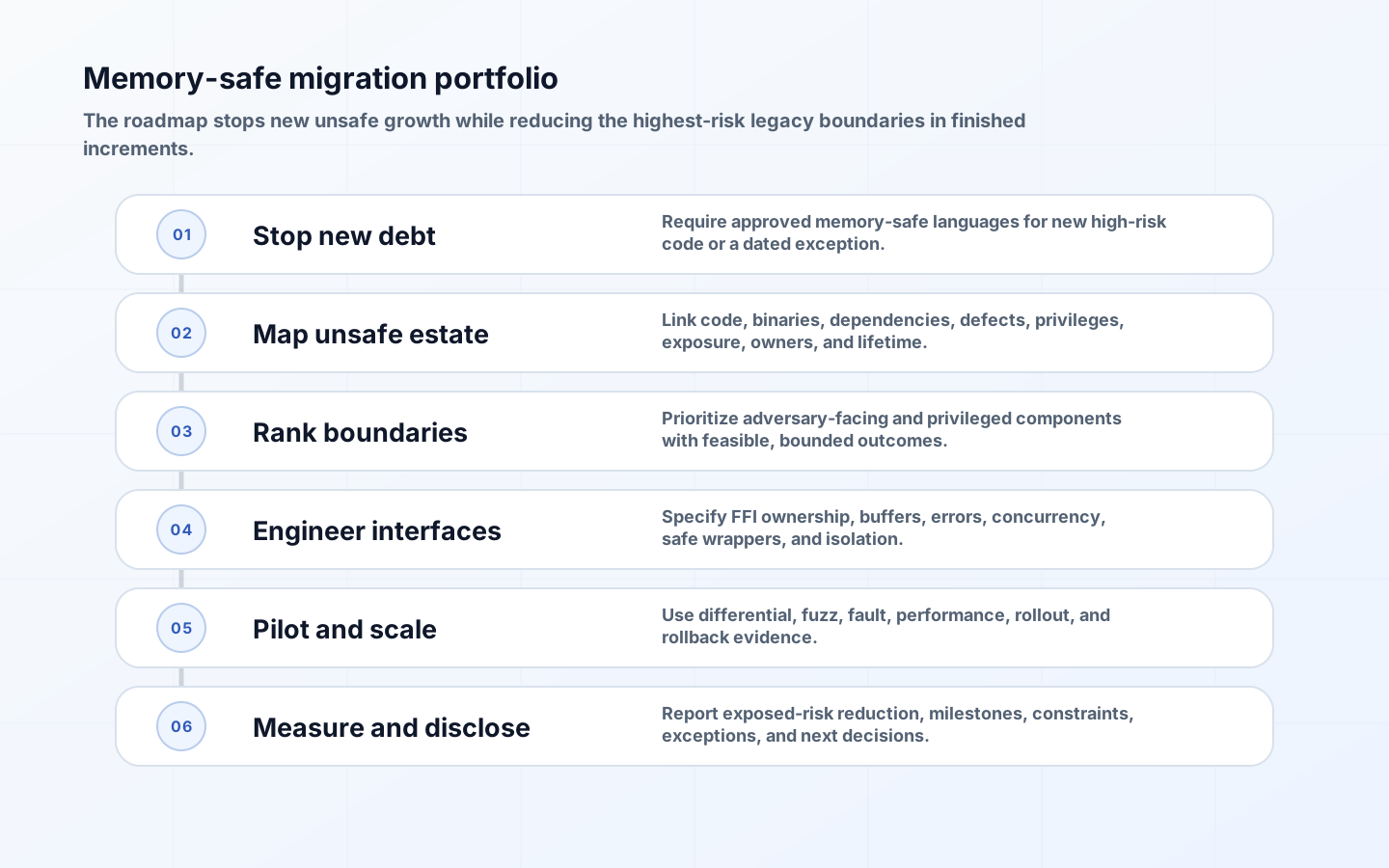
A memory safe language roadmap is not a promise to rewrite an entire product in Rust. It is a portfolio decision about where language-enforced safety will remove the most consequential classes of defects, where interoperability can contain remaining unsafe code, and how progress will be measured without destabilizing customers. Existing products combine legacy C or C++, generated code, device interfaces, third-party libraries, build scripts, and operating-system constraints. The roadmap must respect that reality while refusing to make it an excuse for permanent inaction.
Begin with customer outcomes: fewer exploitable memory errors, narrower unsafe boundaries, faster diagnosis, and reduced dependence on defensive testing alone. Memory-safe code can prevent many out-of-bounds, use-after-free, uninitialized-memory, and data-race defects by construction or runtime enforcement. It does not prevent authorization mistakes, injection, flawed cryptography, unsafe business logic, or every denial of service. A credible plan states both the security benefit and the remaining secure-development work.
Set roadmap principles that survive implementation tradeoffs
Adopt a forward rule first: new internet-facing, privileged, parser, protocol, and security-sensitive components should use an approved memory-safe language unless an accountable exception demonstrates why constraints outweigh the reduction in risk. This prevents the unsafe estate from growing while migrations proceed. Define approved languages by use case, not fashion. Managed languages, Go, Rust, Swift, and others provide different runtime, interoperability, latency, platform, and ecosystem properties.

The joint NSA and CISA memory-safe languages guidance emphasizes that adoption need not mean a complete rewrite and discusses interoperability and ways to strengthen code where migration is impractical. Turn that into two tracks: eliminate unsafe implementation where feasible, and harden, isolate, minimize, and monitor the remainder. Give both tracks owners and dates so mitigation does not quietly become the permanent destination.
Inventory the unsafe estate and defect history
Map source repositories, languages, generated code, foreign-function interfaces, native extensions, build tools, firmware, kernels, libraries, drivers, parsers, and shipped binaries. Connect each component to reachable interfaces, privileges, data, supported platforms, owners, release cadence, and expected lifetime. Include third-party and open-source dependencies; rewriting an application shell while retaining a vulnerable native codec may barely change exposure. Binary composition and runtime loading can reveal dependencies that source manifests miss.
Analyze defects by root cause and component. Use CVEs, internal incidents, sanitizer findings, crash telemetry, fuzzing results, and code-review records, while recognizing reporting bias. A component with no recorded memory bug may simply be under-tested. Record use of compiler hardening, control-flow protections, sandboxing, privilege separation, fuzzing, and sanitizers as current controls, not evidence that an unsafe language has become memory safe. NSA's Software Memory Safety guidance distinguishes language adoption from defensive mitigations that raise exploitation difficulty.
| Inventory field | Why it matters | Evidence | Roadmap use |
|---|---|---|---|
| Attack surface | Exposed parsers and protocols receive adversary-controlled input | Routes, formats and threat model | Raise migration priority |
| Privilege | Memory corruption inherits process authority | Runtime identity and capabilities | Split or sandbox before rewrite |
| Change rate | Active code creates recurring opportunity and migration touchpoints | Commit and release history | Apply forward language rule |
| Lifetime | Long support windows extend cumulative exposure | Product and device support commitments | Fund durable replacement |
| Dependency depth | Unsafe transitive code can preserve risk | Source, binary and runtime inventory | Replace, isolate or influence upstream |
| Platform constraint | Toolchain or runtime may limit options | Target matrix and certification needs | Choose language or documented mitigation |
Prioritize components by risk and feasibility
Score no single factor as destiny. Combine adversary-controlled input, privileges, isolation, customer reach, historical memory defects, component lifetime, rewrite complexity, test quality, interoperability, and available expertise. The best first migration is often a bounded parser, network service, or utility with a stable contract: important enough to matter, small enough to finish, observable enough to compare, and representative enough to teach build and release practices.
Avoid selecting only easy but irrelevant modules. A demonstration command-line tool can prove the compiler works while leaving the product's risk unchanged. Also avoid making the highest-risk monolith the first experiment if its behavior is poorly specified. Decompose it, freeze interfaces, strengthen regression tests, and extract one boundary. Roadmap sequencing should create capability and reduce exposure together.
| Migration pattern | Best fit | Main tradeoff | Acceptance evidence |
|---|---|---|---|
| New code only | Growing products with clear component boundaries | Legacy risk declines slowly | No unjustified unsafe-language additions |
| Leaf replacement | Parser, codec, agent or library behind stable API | FFI and packaging complexity | Behavioral parity and boundary fuzzing |
| Service extraction | Privileged monolith can be split | Operational and latency overhead | Least-privilege isolation and failure tests |
| Incremental in-process rewrite | Strong language interoperability and tests | Two memory models coexist | Unsafe boundary inventory shrinks |
| Full replacement | Small component with severe design debt | Schedule and semantic-regression risk | Parallel validation and rollback |
| Harden and contain | Platform-constrained or end-of-life code | Defect class remains possible | Documented controls, expiry and retirement path |
Choose languages and design unsafe boundaries
Evaluate language and ecosystem against target operating systems, architectures, real-time or latency needs, memory footprint, toolchains, debugging, package governance, cryptographic libraries, certification, developer experience, hiring, long-term maintenance, and supplier support. Run small technical spikes using representative workloads rather than synthetic syntax exercises. A language that is safe in principle but depends on immature platform bindings or extensive unsafe glue may not improve the chosen component yet.
Every foreign-function boundary becomes a security interface. Specify ownership, lifetimes, buffer lengths, encoding, concurrency, errors, and panic or exception behavior. Generate bindings where mature tooling exists, keep conversion at the edge, and make safe wrappers the only interface available to most code. In Rust, unsafe is a scoped assertion that extra invariants hold, not a defect by definition; the Rustonomicon explains the obligations. Inventory every unsafe block and dependency policy rather than claiming a Rust component contains no unsafe implementation.
Build migration engineering into the delivery system
Create approved toolchains, reproducible builds, dependency review, artifact signing, static analysis, formatting, linting, test harnesses, fuzzing, sanitizers where applicable, debugging, release packaging, and incident support. Train reviewers to evaluate language-specific hazards and FFI invariants. Update threat models and coding standards. NIST SSDF remains relevant because language safety sits inside broader practices for protected development, secure production, vulnerability response, and continuous improvement.
Preserve behavior intentionally. Build golden tests from protocols and file formats, differential tests between old and new implementations, property tests for parsers, fault-injection for resource exhaustion, performance budgets, and compatibility suites across supported platforms. Run old and new paths in shadow or controlled cohorts when possible. A memory-safe replacement that changes authorization, corrupts output, violates timing guarantees, or breaks updates is not a successful security migration.
Address dependencies and supplier constraints
Classify unsafe dependencies as replace, wrap, sandbox, contribute upstream, contract for change, or accept temporarily. Prefer maintained components with transparent security response and a migration direction. Do not fork casually: owning a private memory-safe fork can create update and assurance burdens larger than the original risk. For indispensable native libraries, expose the smallest typed interface, isolate parsing where practical, and maintain fuzz targets and rapid update procedures.
Put roadmap questions into procurement: language composition, native dependencies, unsafe-code policy, memory-safety defect history, compiler hardening, sandboxing, support lifecycle, and planned transitions. Ask for evidence that maps to the purchased product, not corporate-wide percentages. Suppliers may be unable to disclose detailed source composition, but can still explain boundaries, practices, milestones, and customer-impact measures under appropriate confidentiality.
Measure risk reduction and publish bounded commitments
Track exposed unsafe components, privileged unsafe processes, new unsafe-language code under exception, unsafe FFI surface, critical native dependencies, memory-safety findings by root cause, time to remediate, fuzz coverage where meaningful, and migrated release adoption. Lines-of-code percentages can support inventory but do not express risk: one small privileged decoder may matter more than a million lines of isolated tooling. Report denominators, scope, and method.
A public roadmap should state product scope, principles, completed work, near-term milestones, dependencies, customer effects, and known constraints without promising exploit-free software. Include how new components are governed, how high-risk legacy areas are sequenced, and when progress will be updated. Internally, retain more detailed component plans, funding, decision records, and exceptions. Transparency is useful when it creates accountable milestones, not when it exposes sensitive architecture or substitutes publicity for delivery.
Key takeaways
- Stop growth of the unsafe estate with a forward rule and accountable exceptions.
- Prioritize adversary-facing, privileged, long-lived components while selecting bounded pilots that can finish.
- Treat FFI, native dependencies and unsafe blocks as explicit security boundaries.
- Preserve compatibility and operational behavior through differential, fuzz, fault and rollout testing.
- Measure exposed risk reduction and publish scoped milestones instead of simplistic language percentages.
Frequently asked questions
Must an existing C or C++ product be completely rewritten?
No. New-code rules, leaf replacements, service extraction, safe wrappers, dependency changes, isolation, and eventual retirement can reduce risk incrementally. The right pattern depends on architecture, product lifetime, testability, and platform constraints.
Does using Rust guarantee memory safety?
Safe Rust enforces strong properties, but applications can contain unsafe blocks, vulnerable native dependencies, FFI mistakes, logic flaws, or toolchain issues. Review unsafe invariants and the complete dependency and build boundary.
How should teams handle code that cannot migrate yet?
Minimize exposure and privilege, apply compiler and platform hardening, fuzz and sanitize, isolate risky parsing, monitor crashes, maintain rapid patching, and record a time-bound exception. These controls reduce risk but do not erase the underlying defect class.
Conclusion
A realistic memory-safe language roadmap changes the product portfolio one risk boundary at a time. It inventories unsafe code and dependencies, prevents new debt, sequences meaningful components, engineers interoperability, and measures customer-relevant exposure. It also preserves the wider discipline of secure design, testing, release protection, and vulnerability response. The strongest roadmap is neither an indefinite study nor a rewrite slogan; it is a funded series of bounded changes whose security and operational outcomes can be demonstrated.