A secure by design roadmap is a public or customer-shareable commitment to reduce product security risk through concrete changes across releases. It should show what becomes safer by default, which customer burdens disappear, how the manufacturer will measure outcomes and what evidence customers can inspect. It is not a list of confidential vulnerabilities, a compliance badge collection or a promise that no defect will occur. Credibility comes from scoped commitments and visible follow-through.
The roadmap translates product-security strategy into work that product, engineering, support, legal and go-to-market teams can own together. It complements Edilec's threat-modeling field guide and release controls by making selected outcomes externally legible. Begin with material customer harm and friction, then choose commitments the manufacturer can deliver and verify without revealing information that would increase attackability.
Turn Secure by Design principles into outcomes
CISA's Secure by Design initiative emphasizes manufacturer responsibility for customer security outcomes, transparency and accountability, and organizational leadership. Convert those principles into product statements. Customers can require phishing-resistant authentication for every administrator is an outcome. Improve IAM is not. New tenants deny public sharing by default identifies changed behavior. Harden sharing leaves customers unable to test the promise.
Choose outcomes from observed incidents, support work, threat models, penetration tests, vulnerability reports, configuration telemetry and buyer concerns. Prioritize changes that remove a dangerous default or eliminate repeated customer labor. Do not rank solely by feature demand: customers may request a security setting because the product transferred a preventable burden to them. Record who experiences the harm, affected editions and deployment modes, baseline state and target state.
| Weak roadmap item | Verifiable commitment | Customer evidence | Completion boundary |
|---|---|---|---|
| Improve authentication | Support and enforce phishing-resistant admin authentication | Tenant policy and sign-in event | All admin paths covered |
| Enhance logging | Emit named high-risk admin and data events | Documented schema and sample export | API, UI and support actions included |
| Strengthen defaults | Disable anonymous sharing for new tenants | Default-state test and release note | No alternate creation path bypasses it |
| Fix vulnerabilities faster | Publish severity-based remediation objectives | Advisory dates and support record | Clock and exception rules defined |
| Secure dependencies | Maintain release component inventory and response process | Versioned SBOM or equivalent evidence | Shipped artifacts in scope |
Publish a baseline, target and scope for every item
A useful item includes product and version scope, customer population, current behavior, target behavior, metric, evidence, owner and expected release window. State exclusions. If on-premises editions cannot support centralized revocation yet, say so and provide their separate plan. Avoid exact dates when discovery uncertainty makes them fiction, but use bounded quarters or release trains and update changes promptly. A roadmap without time intent cannot guide a buyer's risk decision.
Metrics should describe security outcome and adoption, not activity alone. Code-scanning coverage may support delivery, while the customer outcome could be fewer exploitable classes or shorter exposure. CISA's broader Secure by Design guidance can be used as a review reference when translating manufacturer responsibility into measurable work. Track denominator and eligibility: 92% of active enterprise tenants with eligible identity providers enforce MFA is interpretable only if eligibility and active tenant are defined. Avoid invented precision and never imply that telemetry captures deployments where the product cannot observe configuration.
Plan secure defaults and existing-customer migration
A secure default applies without requiring each customer to discover and enable it. New-tenant defaults are the simplest start, but existing customers often carry the greatest exposure. Define compatibility analysis, notification, migration window, opt-out authority and eventual enforcement. High-risk defaults may warrant a shorter transition; breaking changes may need staged enforcement and safe diagnostics. Do not make an insecure exception permanent merely because its owner is unknown.
Test every creation and recovery path: API, import, template, clone, mobile, command line, support tooling and older clients. A secure UI default is not a product default if an API still creates an open resource. Explain what customers must do and what the product will do automatically. Provide configuration inventory and bulk remediation where possible so organizations can migrate without manually inspecting thousands of objects.
Connect roadmap promises to the SSDF delivery system
NIST SP 800-218 organizes secure development practices into preparing the organization, protecting software, producing well-secured software and responding to vulnerabilities. Map each roadmap outcome to internal practices, release gates and evidence. A public commitment to signed releases, for example, depends on protected build identities, keys, artifact integrity, verification instructions and incident response, not only a documentation update.
Keep sensitive implementation evidence in controlled systems while publishing customer-usable proof. Suitable artifacts can include release notes, configuration documentation, security advisories, supported-version policy, vulnerability disclosure policy, conformance results, event schema, SBOM access process and dated status updates. External statements must match shipped behavior. Have product security validate completion and a customer-facing owner verify that evidence is understandable without privileged internal context.
| Roadmap gate | Owner question | Evidence | Do not publish as complete when |
|---|---|---|---|
| Design approved | Does target reduce a named customer harm? | Threat model and decision record | Only implementation activity is defined |
| Implementation ready | Are all product paths covered? | Tests and configuration inventory | One API or edition bypasses control |
| Release staged | Can customers migrate and recover? | Pilot results and support runbook | Rollback restores insecure state silently |
| Outcome verified | Does shipped behavior meet target? | Production-safe measurement | Feature exists but default or adoption does not |
| Commitment closed | Can customers inspect proof? | Release note, docs and status update | Evidence remains internal only |
Report progress, delays and exceptions without spin
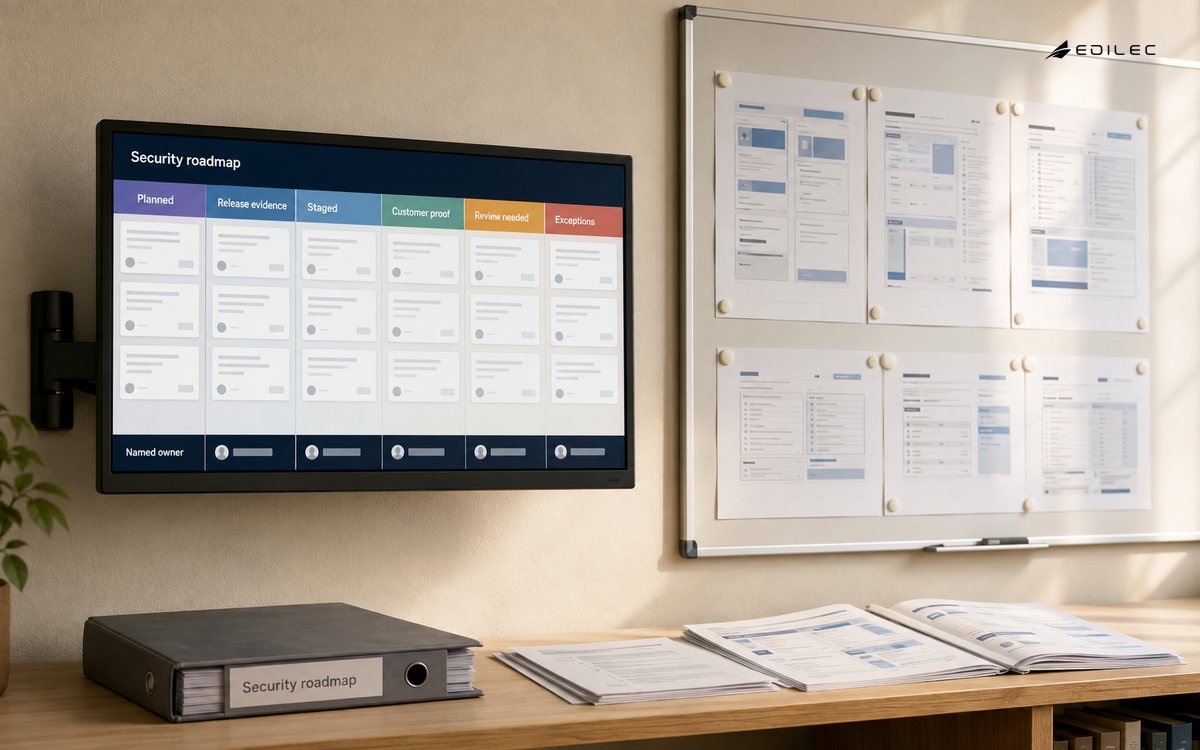
Publish status using consistent terms such as planned, in design, piloting, released, enforcing and verified. Distinguish feature availability from default enforcement. When timing changes, state the affected scope, reason at a safe level, interim mitigation and revised decision point. Do not erase delayed items or rewrite the original target. A changelog lets buyers understand execution reliability and prevents a roadmap from becoming a rotating marketing page.
CISA and FBI's updated Product Security Bad Practices guidance highlights practices manufacturers are encouraged to avoid. Use applicable bad-practice categories as a challenge set for roadmap prioritization, especially where products support critical infrastructure. If an exception remains, assign an executive risk owner, affected versions, compensating control, customer communication and dated exit review.
Use the six-stage Edilec Secure by Design roadmap
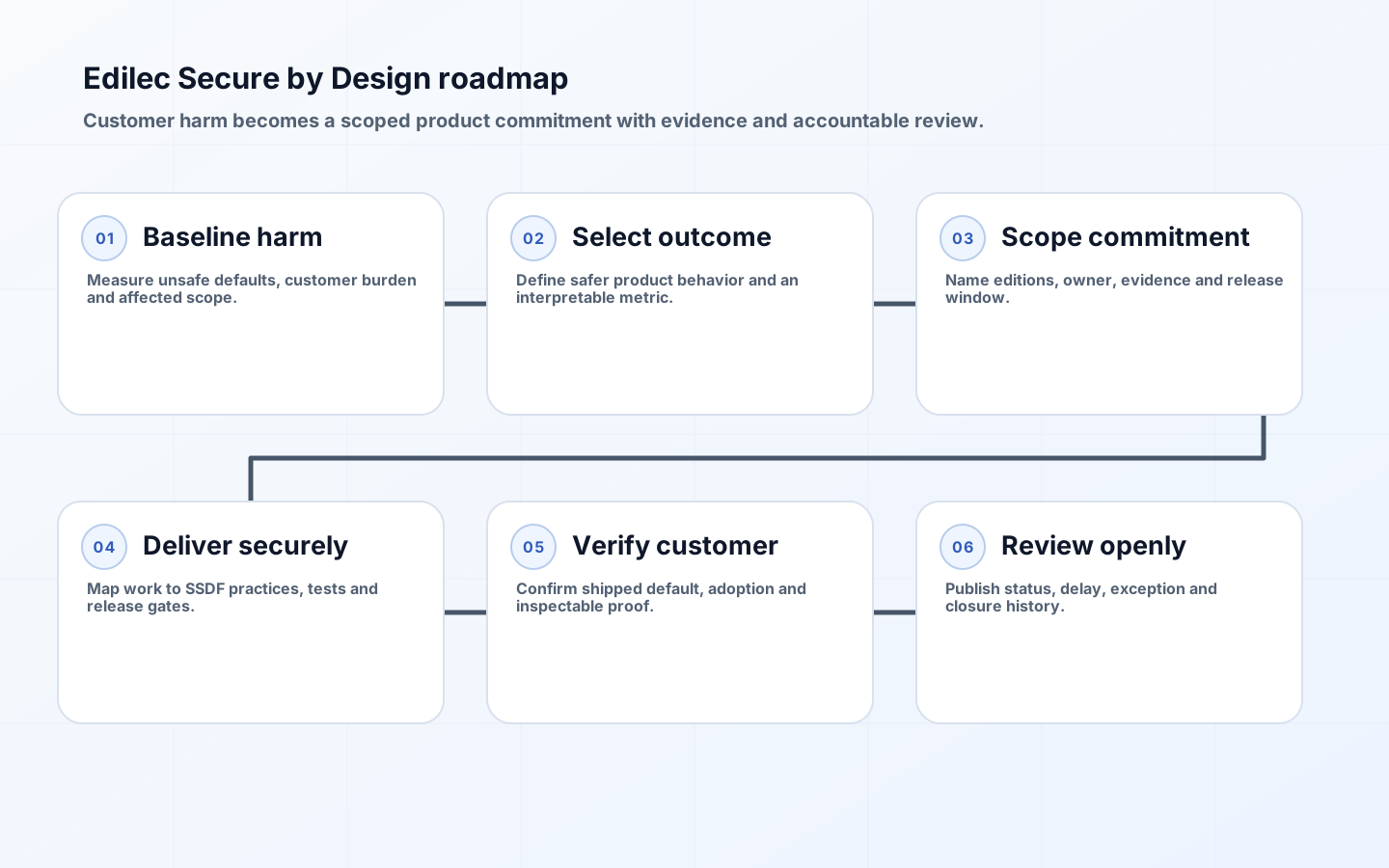
The Edilec roadmap moves from customer harm baseline to outcome selection, scoped commitment, secure delivery, customer verification and transparent review. The six-stage diagram belongs at this heading because publication is not the first stage or the last. A commitment should enter the public plan only after ownership and measurement exist, then remain open until shipped behavior and customer evidence agree.
Pilot with three commitments of different types: a secure default, a vulnerability-response improvement and a customer-visible control or event. Review them with a design partner under nondisclosure before public release, checking whether each can be tested and whether wording creates an unintended warranty or ambiguity. Publish the approved scope, then update on a fixed cadence even when no status changes. Consistency builds more trust than an ambitious launch followed by silence.
Create a roadmap governance and publication cadence
Establish a monthly internal review and a predictable external update cadence. Product security verifies risk and evidence, engineering reports delivery state, product owns customer behavior, support contributes migration impact, legal reviews wording and an executive resolves scope or priority conflicts. One editor should maintain consistent terms and history without becoming the sole source of truth. Status must derive from release and measurement records, not presentation deadlines.
Define entry and exit criteria. A candidate enters only with an approved outcome, owner, metric, scope and forecast. It exits as verified only when shipped behavior meets the target and customer evidence is available. Items canceled because the underlying risk changed should retain a short rationale rather than disappear. Archive superseded roadmaps while keeping stable links so procurement teams and existing customers can understand which commitments applied to their versions.
Invite structured customer feedback through account teams, advisory groups and the vulnerability disclosure channel, but do not let the loudest individual request reset security priority. Aggregate requests against product harm and adoption data. Report recurring blockers to leadership, especially where pricing, compatibility or ownership prevents secure defaults. Connect customer-facing evidence to Edilec's audit log design guide and use the least-privilege field guide when commitments change administrative power. The governance body should be empowered to fund cross-team platform work; otherwise the roadmap will favor visible settings over difficult systemic improvements.
Key takeaways
- Frame every roadmap item as a measurable reduction in customer harm or security burden.
- State baseline, product scope, target behavior, evidence and release window without invented precision.
- Treat secure defaults as migrations across every UI, API, import and recovery path.
- Connect external commitments to SSDF practices, release gates and controlled internal evidence.
- Keep a transparent history of progress, delays, exceptions and final customer verification.
Frequently asked questions
Must the entire security roadmap be public?
No. Publish commitments and evidence useful for customer decisions while keeping exploit details, sensitive architecture and unannounced incident data controlled. A customer portal under appropriate terms can hold deeper evidence for qualified buyers.
Should every commitment have an exact date?
Use the most honest bounded window the delivery system supports. Exact dates can help contractual dependencies but should not be fabricated before discovery. Always publish scope, status, next decision point and prompt updates when the forecast changes.
Can certifications substitute for roadmap evidence?
No. Certifications may support assurance about a defined system and period, while roadmap items concern specific future product behavior and customer outcomes. Link relevant reports, but provide direct evidence for the shipped commitment.
Conclusion
A secure by design roadmap makes manufacturer responsibility concrete. It names the customer harm, changes product behavior, connects delivery practices to evidence and preserves a record of progress. The roadmap is credible when a buyer can distinguish planned work, released capability and verified secure outcome.
Start with a small set of consequential promises and build the publication discipline around them. Use Edilec's application security review guide to connect risk discovery and remediation evidence. A focused roadmap that closes commitments reliably is more useful than a long feature list that customers cannot test.