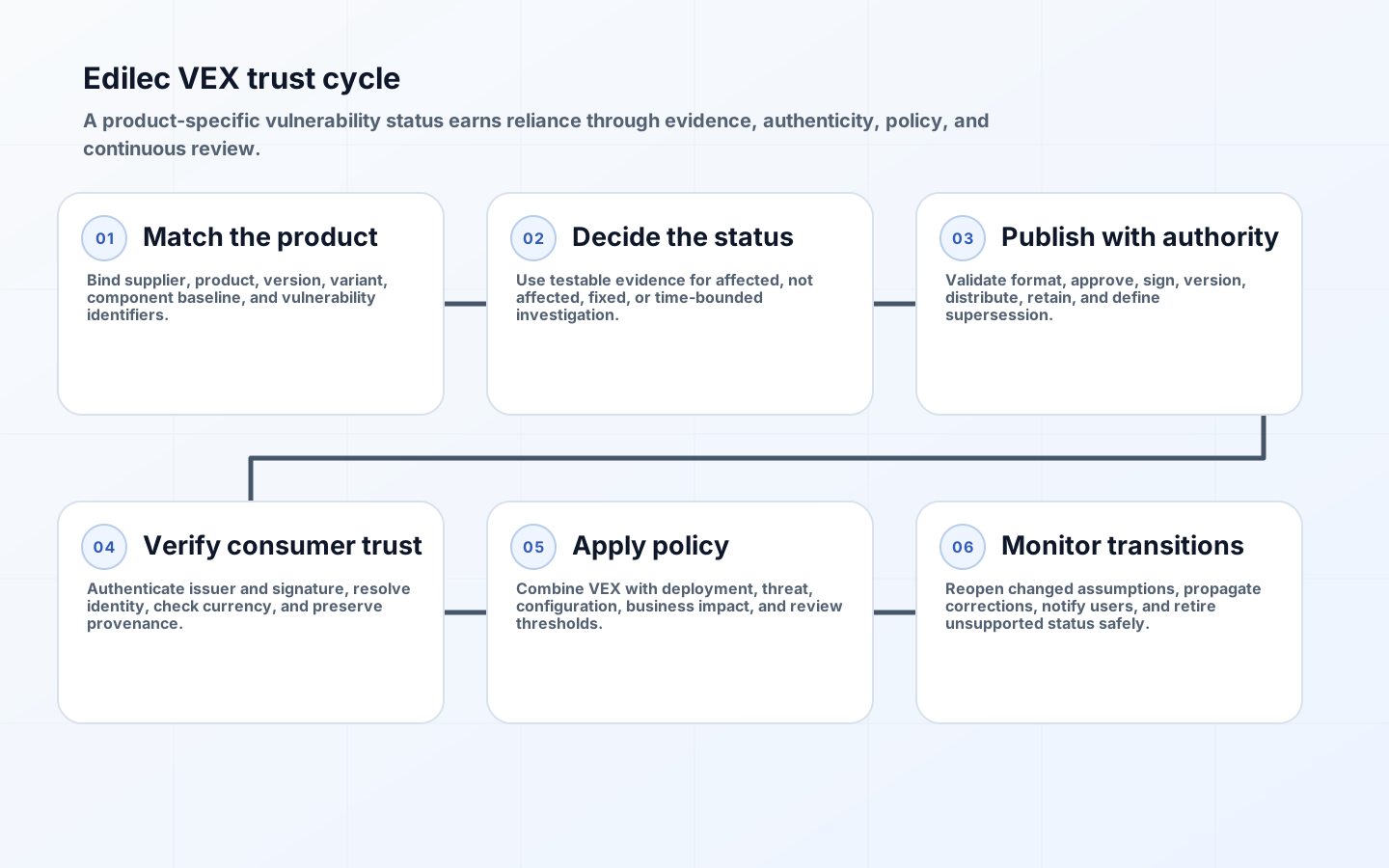
VEX vulnerability management uses machine-readable statements to communicate whether a vulnerability affects a product in context. It addresses a central limitation of SBOM-to-advisory matching: a component can be present without the vulnerable code being executable, exposed, configured, or included in the supplier's build. VEX does not prove safety automatically. A statement is useful only when the issuer is trusted, the product and vulnerability are identified precisely, the status is supported, the document is current, and the consumer's policy decides how much reliance is justified.
CycloneDX describes VEX as conveying exploitability of vulnerable components in the product where they are used; CSAF provides a security-advisory framework with product status and justification structures. CISA's guidance addresses when information should be issued. Build format handling after the operating policy: who may issue, which evidence supports each status, how statements are signed and distributed, how consumers authenticate and match them, when a status expires, and what occurs when threat or product facts change. Otherwise VEX becomes a suppression feed that can hide unresolved exposure.
Define the VEX vulnerability management policy model
Separate producer and consumer roles. Producers investigate their products and publish bounded statements. Consumers receive statements and combine them with inventory, deployment, threat, and risk evidence. Assign product-security authority, technical analyst, document signer, release owner, customer-communication owner, feed operator, consumer risk owner, and exception approver. Define which product classes and vulnerability severities require VEX, expected issue time, update cadence, retention, revocation, and service levels. Not every irrelevant CVE needs a public statement; high-impact ambiguity and customer demand may justify one.
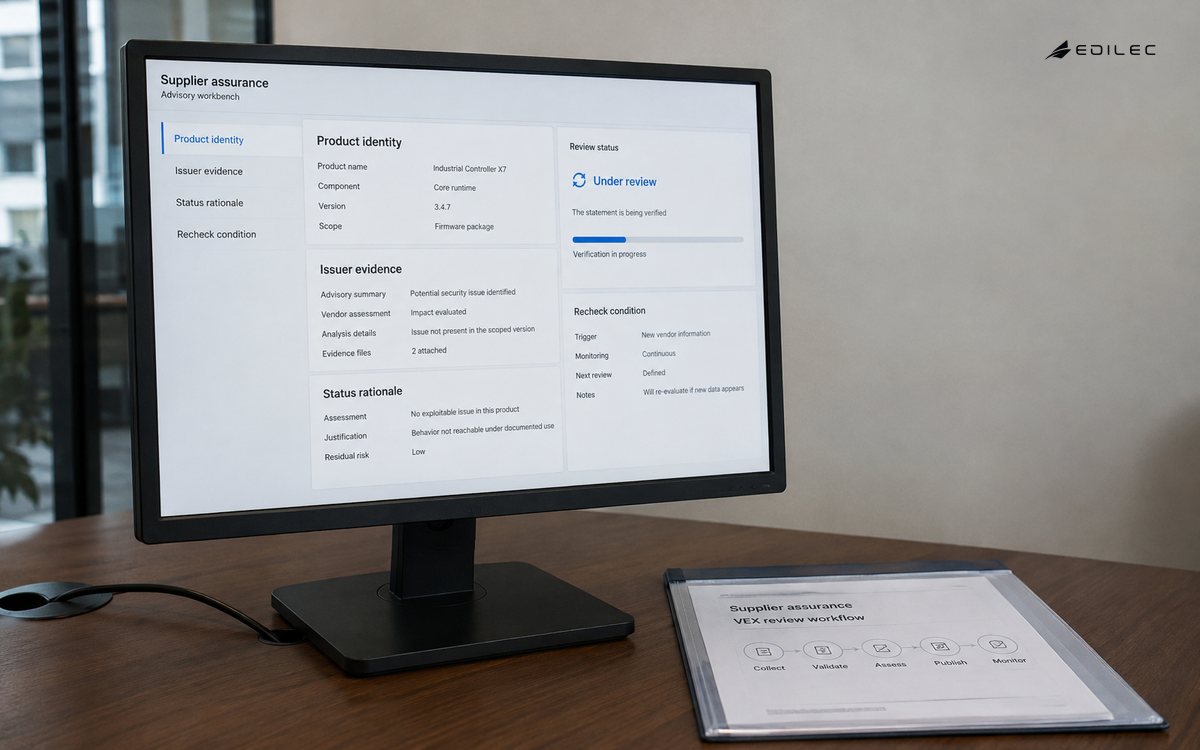
Specify allowed states according to the selected format and map them to internal workflow. Common concepts include affected, not affected, fixed, and under investigation. Define transition rules, evidence thresholds, and maximum age. Under investigation should have an owner and deadline; not affected should include an approved technical justification; fixed should identify the corrective product version; affected should connect to mitigation or remediation. The vulnerability-management guide provides prioritization mechanics; VEX adds product-specific status communication and trust.
Identify the exact product and vulnerability
A VEX statement must bind to the correct product, version range, edition, platform, module, and vulnerability identifier. Preserve supplier namespaces, package URLs, CPEs, hashes, serial identifiers, and product-tree relationships as supported. Avoid broad product-family statements when variants differ. A not-affected conclusion for a cloud edition should not suppress the same component in an on-premises edition. Link the statement to the SBOM or release baseline used in analysis and record identity confidence.
Consumers should reject or quarantine ambiguous matches rather than applying the most convenient interpretation. Validate vulnerability aliases and ecosystem, because one advisory can carry multiple identifiers and version semantics. Maintain mappings with provenance and review. The supply-chain security guide helps identify critical suppliers; require higher identity precision and faster correction for products supporting material services. Preserve the original document and normalized interpretation so parser or mapping changes can be audited.
| Status | Producer evidence | Consumer treatment | Refresh trigger |
|---|---|---|---|
| Under investigation | Confirmed product match and open analysis | Maintain active queue and interim risk controls | Deadline, new exploit evidence or analysis result |
| Affected | Vulnerable conditions apply to product | Prioritize by deployment and business impact | Mitigation, fix or changed threat |
| Not affected | Specific justification tied to product implementation | Verify trust and assumptions before suppression | Product, component, configuration or threat change |
| Fixed | Corrective release and validation | Map fixed version to deployed population | Regression, incomplete rollout or revised advisory |
| Withdrawn or superseded | Replacement reference and reason | Stop relying on old status | Immediate re-evaluation |
Justify not-affected decisions with testable facts
A not-affected statement should explain why the vulnerability cannot affect the named product: vulnerable code is absent, code is present but not executed, vulnerable code cannot be controlled by an attacker, an inline mitigation prevents impact, or another format-supported justification applies. Add a human-readable impact statement where useful. The justification should identify assumptions such as compiler flags, disabled modules, input validation, sandboxing, privilege boundaries, or unreachable interfaces. Attach tests, call-path analysis, build evidence, or configuration proof internally.
Do not use not affected to mean not yet observed, low likelihood, low business impact, patch inconvenient, or supplier says so without product analysis. Those may influence prioritization or risk acceptance, but they are not equivalent to exploitability absence. Consumers should sample high-impact not-affected claims and verify assumptions against deployed configuration. If a compensating control can be disabled, monitor its state. Time-bound the reliance when evidence is indirect or the threat is evolving.
Produce authentic, versioned, and distributable VEX
Generate documents from an approved case, validate them against the selected CycloneDX or CSAF schema and profile, assign unique document identity and version, include issue and update times, and sign or distribute through an authenticated channel. Separate document authoring from approval for consequential statements. Publish a stable discovery location and notify affected customers or consumers when status changes. Retain every version and the evidence snapshot supporting it. A corrected statement should supersede rather than silently replace history.
Protect signing keys, publishing accounts, and build integrations as product-security assets. Restrict issue authority, require strong authentication, log draft, approval, signing, publication, withdrawal, and correction events, and test recovery. The audit-log guide supports attributable workflow evidence. Monitor feeds for missing updates, duplicate identities, invalid signatures, schema drift, and publication delays. A forged not-affected statement could suppress urgent remediation across many customers.
Consume VEX through a trust and policy engine
Authenticate transport and signature, validate schema, identify issuer, verify document version and time, resolve product and vulnerability identity, and check supersession before applying status. Maintain issuer trust profiles based on contractual relationship, disclosure history, statement quality, correction behavior, and product authority. The product manufacturer may have strong implementation knowledge, but a statement still can be stale or scoped incorrectly. Trust should influence review depth, not bypass validation.
Combine VEX with SBOM, asset, deployment, configuration, exploit intelligence, and business context. An affected statement does not set remediation priority by itself; a not-affected statement does not justify deleting the vulnerability record. Store it as evidence in the case, record policy outcome, and monitor assumptions. The vendor-access guide demonstrates supplier lifecycle control; use parallel onboarding, escalation, and offboarding for trusted advisory feeds and security contacts.
| Condition | Automated action | Human review | Safeguard |
|---|---|---|---|
| Trusted signed affected statement matches deployed product | Create or enrich case | Prioritize service impact and response | Do not wait for generic database match |
| Trusted not-affected statement has precise match and accepted justification | Lower queue urgency | Sample high-impact claims | Retain record and monitor assumptions |
| Statement is under investigation | Keep active with due time | Set interim mitigation | Never treat as not affected |
| Identity match is ambiguous | Quarantine status application | Resolve product and version | Do not suppress candidate finding |
| Signature invalid or document superseded | Reject reliance and alert | Contact issuer if material | Preserve failed artifact for audit |
Manage status transitions and customer communication
Watch for revised advisories, exploit publication, product updates, configuration changes, component replacement, mitigation failure, and new research. Reopen affectedness when an assumption changes. Define transition approvals and notification thresholds. A product can move from under investigation to not affected, then back to affected after a bypass is discovered. Systems must preserve history and propagate the newest status to vulnerability queues, customer portals, and downstream consumers without erasing prior decisions.
Customer communication should state the named product and versions, vulnerability, current status, justification or impact, mitigation, fixed version, update time, and support contact. Use plain language beside machine-readable documents. Avoid implying that component presence is harmless across all configurations when the conclusion is narrow. When correcting an erroneous statement, explain the changed fact and urgent action. Track delivery and customer questions, because repeated confusion can reveal product-identity or justification weaknesses.
Assure the VEX program and measure outcomes
Exercise producer and consumer paths with affected, not-affected, ambiguous, invalid-signature, and superseded statements. Measure investigation time, statement issue time, identity-match success, stale status, correction latency, affected deployment closure, and suppression reversals. Sample statements back to technical evidence and forward to customer or remediation action. Monitor whether analysts override automation and why. High override rates can indicate weak identity, trust, or policy rules rather than analyst inconsistency.
Report noise reduced only alongside missed or reopened risk. A declining queue is not success if broad not-affected statements hide exposure. Useful outcomes include faster affected-product decisions, fewer unsupported suppressions, shorter time to mitigation, current statements for supported releases, and verified customer action. Review suppliers whose statements are late, vague, unsigned, or frequently corrected. Use that performance in procurement and resilience decisions, while preserving independent investigation for critical services.
Account for withdrawn support and end-of-life products. A producer may stop issuing new VEX statements after a declared support date, but consumers can still operate older releases and receive new vulnerability intelligence. State support boundaries in the feed and product documentation, retain the last valid statements, and avoid presenting silence as not affected. Consumers should apply an aging rule that increases uncertainty after support ends and routes critical deployments to upgrade, isolation, replacement, or explicit risk acceptance. When a supplier is acquired or a product is transferred, verify issuer authority and continuity of signing keys, identifiers, archives, and correction channels before trusting statements under the new organization.
Key takeaways
- Define producer and consumer authority, status transitions, evidence thresholds, expiry, and correction.
- Bind every statement precisely to product, version, variant, and vulnerability identity.
- Reserve not affected for testable exploitability facts, not low priority or absent observations.
- Authenticate, validate, version, sign, distribute, and retain statements through a controlled publication path.
- Combine VEX with SBOM, deployment, threat, configuration, and business evidence.
- Measure decision speed and unsupported suppression risk together.
VEX vulnerability management FAQ
Does VEX replace an SBOM?
No. An SBOM describes components; VEX communicates product-specific vulnerability status. Consumers often use both with deployment and threat context.
Should not-affected VEX statements automatically suppress findings?
Only under a defined policy after issuer, signature, product match, status currency, and justification checks. High-impact cases should be sampled, and the original record should remain traceable.
Can CycloneDX and CSAF both carry VEX?
Yes, through different data models. Choose supported specifications, validate their profiles, and normalize carefully without losing original semantics or provenance.
Conclusion
VEX creates value when it communicates a bounded, current, and evidence-backed product decision. Strong identity, authentic publication, explicit justification, cautious consumption, lifecycle monitoring, and correction keep that signal trustworthy. Used this way, VEX reduces noise while preserving accountability for real and changing exposure.