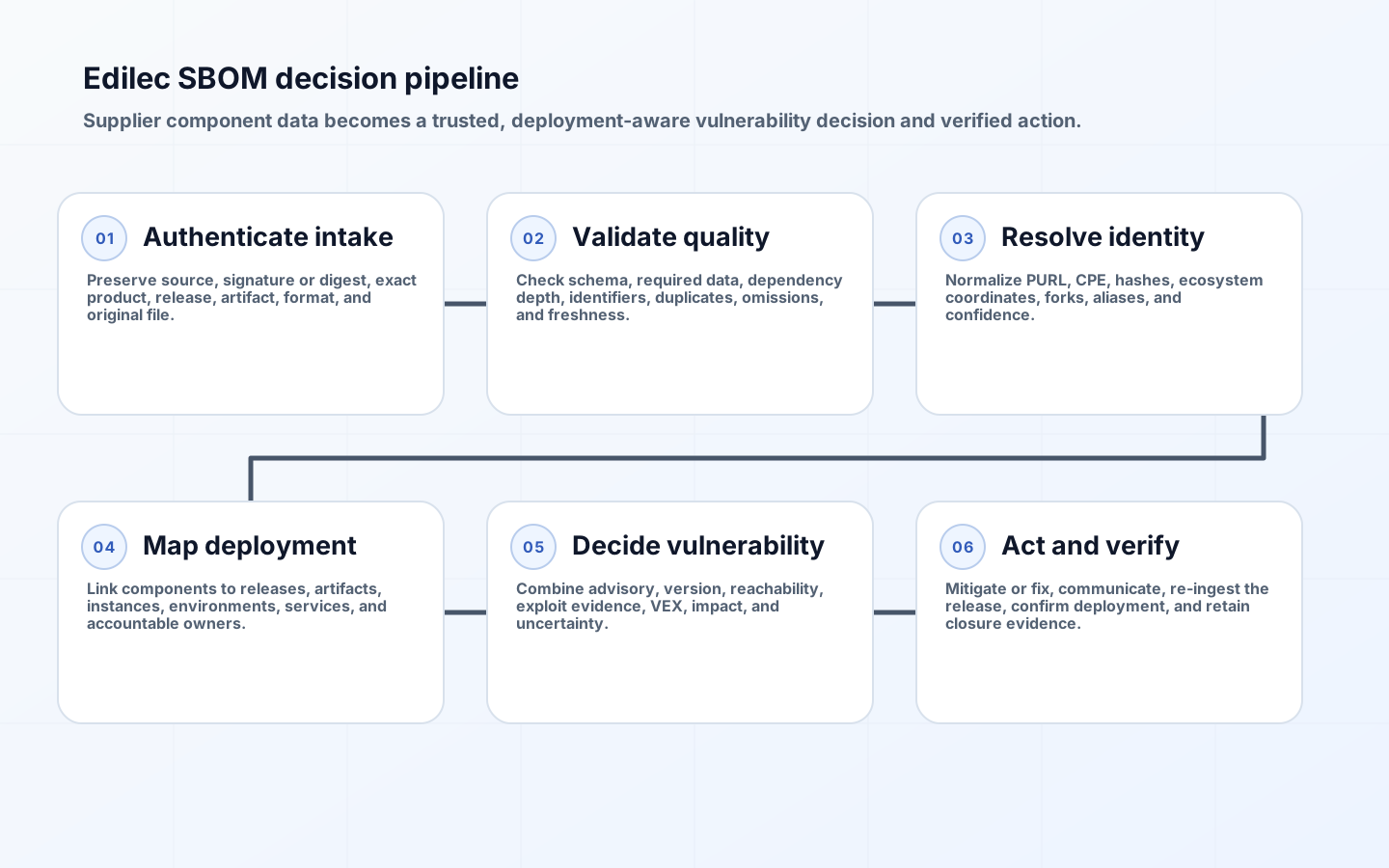
SBOM consumption is the operating process that turns a supplier's component record into decisions about products and deployed systems. Receiving a CycloneDX or SPDX file does not answer whether it is authentic, complete, current, correctly identified, relevant to a purchased release, present in a deployment, affected by a vulnerability, exploitable in context, or owned for action. Without those links, a vulnerability match creates noise while responders still ask the hardest question: where is this component running, in which business service, under whose authority, and what can be done now?
CISA's SBOM program resources organize baseline component transparency around machine-readable data and operational practices, while its consumption guidance moves from receipt toward use. Design the consumer capability around explicit use cases: acquisition due diligence, new vulnerability response, end-of-life monitoring, license or policy review, supplier assurance, and incident scoping. Each use case needs different freshness, component depth, identity confidence, deployment context, and response time. Do not promise precision that the source data cannot support.
Define SBOM consumption outcomes and ownership
Choose the decisions before selecting a repository. For vulnerability response, the target may be identifying affected products and owners within hours of a credible advisory. For procurement, it may be comparing component transparency, unsupported dependencies, and supplier update commitments before approval. Name the SBOM service owner, supplier relationship owner, product or asset owner, vulnerability analyst, procurement decision-maker, and exception authority. Define service levels by product criticality. A low-impact utility and an internet-facing identity service should not receive identical manual effort.
Write entry and exit criteria. An SBOM enters trusted analysis only after source, artifact association, schema, and identity checks. A vulnerability case exits only after affected status, deployment exposure, action, verification, and residual risk are recorded. The supply-chain security guide helps tier suppliers and dependencies. Add measurable SBOM outcomes: coverage of critical products, release association, validation pass rate, unknown component rate, deployment linkage, time to owner, and stale supplier response.
Build the SBOM consumption operating model
Create a controlled intake route for supplier portals, APIs, contract delivery, product downloads, and internal generation. Capture supplier identity, retrieval channel, timestamp, signature or digest where provided, product name, release, edition, platform, distribution artifact, SBOM format and version, author, creation time, serial identifier, and lifecycle state. Preserve the original file immutably. Parse into a normalized model without discarding format-specific fields. Store parser version and validation output so a later interpretation can be reproduced.

| Gate | Decision | Evidence | Disposition |
|---|---|---|---|
| Provenance | Did an authorized supplier channel provide it? | Signature, digest, portal or authenticated transfer | Quarantine unknown origin |
| Artifact association | Which exact product and release does it describe? | Supplier identifiers, version and artifact hash | Request correction if ambiguous |
| Schema validity | Can the document be processed reliably? | Format and semantic validation | Reject or ingest with explicit defects |
| Minimum data | Are supplier, component, version and relationship fields usable? | Completeness checks | Score and route quality exception |
| Freshness | Does it represent the acquired or deployed release? | Creation and release timestamps | Retain history; seek current file |
| Identity confidence | Can components be matched without guessing? | PURL, CPE, hashes and supplier context | Hold uncertain matches for review |
Validate SBOM quality beyond schema
Schema validity only proves structure. Assess field completeness, component depth, dependency relationships, unique identifiers, version precision, duplicate nodes, generated and vendored code, containers, firmware, build tools, optional modules, and known omissions. Compare the SBOM with binary or package analysis where legally and technically appropriate. Sample a release against supplier documentation and runtime artifacts. Score dimensions separately so a document with excellent identifiers but shallow dependency depth is not summarized as simply good.
Quality decisions should drive action. A critical supplier with ambiguous versions may need contractual correction, enhanced binary analysis, or restricted deployment. Missing dependency relationships may limit reachability analysis but still permit basic component matching. Record limitations beside every downstream result. Procurement can require creation frequency, distribution method, correction time, historical access, version support, and VEX availability. The vendor-access guide illustrates lifecycle ownership; apply similar discipline to supplier security artifacts and contacts.
Normalize component identity without false certainty
Component identity is a data-resolution problem. Preserve the supplier's original name and identifiers, then map package URL, CPE, SWID, hashes, ecosystem coordinates, namespace, version, qualifiers, and supplier. Avoid fuzzy name matching as an automatic vulnerability decision. A package called core, a fork with vendor patches, and an embedded library lacking package metadata can produce false positives or negatives. Assign confidence and rationale to aliases. Keep identity mappings versioned because improved intelligence can alter earlier matches.
Build relationships between component, supplier, SBOM document, product release, distribution artifact, deployed instance, business service, owner, and environment. One component version can appear in many releases; one release can have platform-specific SBOMs; one deployed service can combine commercial and internal software. Reconcile deployment data from asset, container, endpoint, cloud, and application inventories. Without runtime context, the consumer can identify potentially affected products but not prioritize actual exposure or measure remediation completion.
Match vulnerabilities to products and deployment context
Ingest advisories from authoritative suppliers and vulnerability sources, preserving publication and modification times, affected ranges, ecosystem, configuration, and references. Match exact identifiers where possible, apply version-range logic appropriate to the ecosystem, and route ambiguous cases to analysts. Do not treat CVSS as product impact. Add exploit status, exposure, privileges, reachable functionality, data and service consequence, compensating controls, supplier fix, and VEX statements. Record both the machine result and analyst decision.
The vulnerability-management guide provides a risk-based queue. SBOM consumption enriches it with product and dependency evidence. A vulnerable library in an unreachable build utility differs from the same code parsing hostile input in production, but both conclusions need support. Unknown should remain an active state with a deadline. Suppressing a match because exploitability is unconfirmed can hide risk; escalating every uncertain match as critical can exhaust teams and erode trust.
| State | Meaning | Required evidence | Next action |
|---|---|---|---|
| Affected | Vulnerable code and conditions apply | Identity, version, path and product context | Mitigate, remediate and communicate |
| Not affected | Product-specific conditions prevent impact | Technical justification and tested assumption | Monitor assumption and new information |
| Under investigation | Match exists but context is incomplete | Known facts, owner and due time | Gather deployment, reachability or supplier evidence |
| Fixed | Corrective release is available and validated | Version, test and advisory | Deploy and verify population |
| Resolved | Affected deployment population is corrected or accepted | Deployment proof and residual decision | Close with retained trace |
Drive remediation, communication, and verification
Create an owned case for affected and time-bounded investigation states. Link business service, deployed population, product owner, supplier, mitigation, fix version, testing, rollout, deadline, exception, and customer duty. Verify that the updated artifact no longer contains the vulnerable component or that a product-specific mitigation blocks the path. Re-ingest the new SBOM and compare expected component changes. A supplier advisory or patch download does not prove all deployed instances are corrected.
Communicate according to audience and decision. Operations needs affected instances and action; leadership needs business consequence and residual exposure; customers need product versions, mitigation, fix authenticity, and support; procurement needs supplier performance. Preserve notices and acknowledgements. The audit-log guide helps design attributable transitions. Measure time from advisory to match, match to owner, owner to decision, fix to deployment, and deployment to verified closure.
Govern retention, refresh, access, and improvement
Retain SBOMs for supported and relevant historical releases because incidents may concern older deployments. Refresh on every acquired release and supplier correction, not an arbitrary annual date. Restrict sensitive product composition while enabling analysts and owners to act. Monitor parser failures, stale feeds, unmapped products, uncertain identities, unsupported components, and supplier response. Exercise a high-impact advisory across ingestion, matching, ownership, remediation, and customer communication. Use the result to improve contracts, data, tooling, and roles.
Treat SBOM coverage as a confidence statement, not a vanity percentage. Report critical-product coverage, artifact association, data quality by dimension, deployment linkage, decision latency, and closure. Sample false positives and false negatives. Review whether teams bypass the platform because results are noisy or stale. The consumer capability earns trust when it exposes uncertainty, preserves provenance, and consistently shortens a real vulnerability decision without replacing accountable technical judgment.
Design for supplier disagreement and correction. A consumer may detect an omitted component, invalid version, stale document, or product association that conflicts with binary evidence. Open a structured quality case that contains the original SBOM, observed artifact, reproduction method, business consequence, requested correction, supplier response, and resolution. Do not silently edit the supplier's document; preserve a consumer overlay with provenance until an authoritative replacement arrives. Track correction time and recurrence by supplier. For high-impact products, unresolved composition uncertainty may justify deployment restrictions, enhanced monitoring, contractual escalation, or independent analysis. This feedback loop improves both the immediate decision and future SBOM quality instead of leaving analysts to compensate repeatedly.
Key takeaways
- Define acquisition, vulnerability, lifecycle, and incident decisions before choosing SBOM tooling.
- Authenticate intake and associate every document with an exact product release and artifact.
- Measure semantic quality, component depth, identifiers, relationships, and known limitations.
- Preserve original identity while normalizing aliases with explicit confidence.
- Connect component matches to deployments, business services, exploit context, owners, and verified action.
- Retain historical data and test the complete consumer workflow with realistic advisories.
SBOM consumption FAQ
Is an SBOM the same as a vulnerability scan?
No. An SBOM describes components and relationships. Vulnerability analysis matches that data to advisories and product context; testing may still be needed to confirm exposure and remediation.
Which SBOM format should consumers require?
Choose machine-readable formats supported by the ecosystem and consumer tooling, commonly CycloneDX or SPDX. Data quality, artifact association, identifiers, and update practice matter as much as the format name.
Does an SBOM show where software is running?
Usually not by itself. Link product releases and artifacts to asset, deployment, container, cloud, or application inventories to understand runtime population and remediation completion.
Conclusion
SBOM value appears after receipt. Trusted provenance, release association, quality checks, identity resolution, deployment context, vulnerability reasoning, and owned remediation turn component transparency into action. A consumer program that retains uncertainty and verifies outcomes can reduce response time without flooding teams with unqualified matches.