AI agent trace redaction must reconcile two legitimate needs. Engineers need enough context to explain model choices, retrieval failures, handoffs, policy decisions, tool calls and external effects. Security and privacy teams need to prevent prompts, documents, credentials, health or financial records, customer secrets and approval evidence from accumulating in a broadly searchable telemetry store. The right objective is not to log everything and clean it later. It is to design each event around a purpose, a minimum field set, and a controlled path to deeper evidence.
Agent traces are unusually sensitive because one workflow can join data from many systems. A single run may contain a user's free text, retrieved passages, hidden instructions, memory, model output, API arguments, tool results, employee identities and durable record IDs. Edilec's LLM observability checklist explains useful signals. This guide focuses on capture policy, redaction, retention, access and break-glass debugging for those signals.
Start with trace purposes and misuse cases
List the decisions telemetry must support: detect failures, measure latency and cost, evaluate quality, investigate incidents, reconcile tool effects, satisfy audit requirements, or improve a product. For each purpose, name the users, retention need and minimum granularity. Then threat-model the trace system itself: insider browsing, compromised dashboards, overbroad vendor access, data residency violations, accidental model training, support exports, insecure links, copied screenshots and joins that re-identify people.
The NIST Privacy Framework provides a risk-based structure for identifying and managing privacy risk. Apply it to telemetry as a data-processing system, not merely a security log. Inventory data actions, communicate purpose, govern retention, control processing and protect data. A field can be encrypted and still create privacy risk through excessive collection, unexpected secondary use or long retention.
Inventory events and classify every field
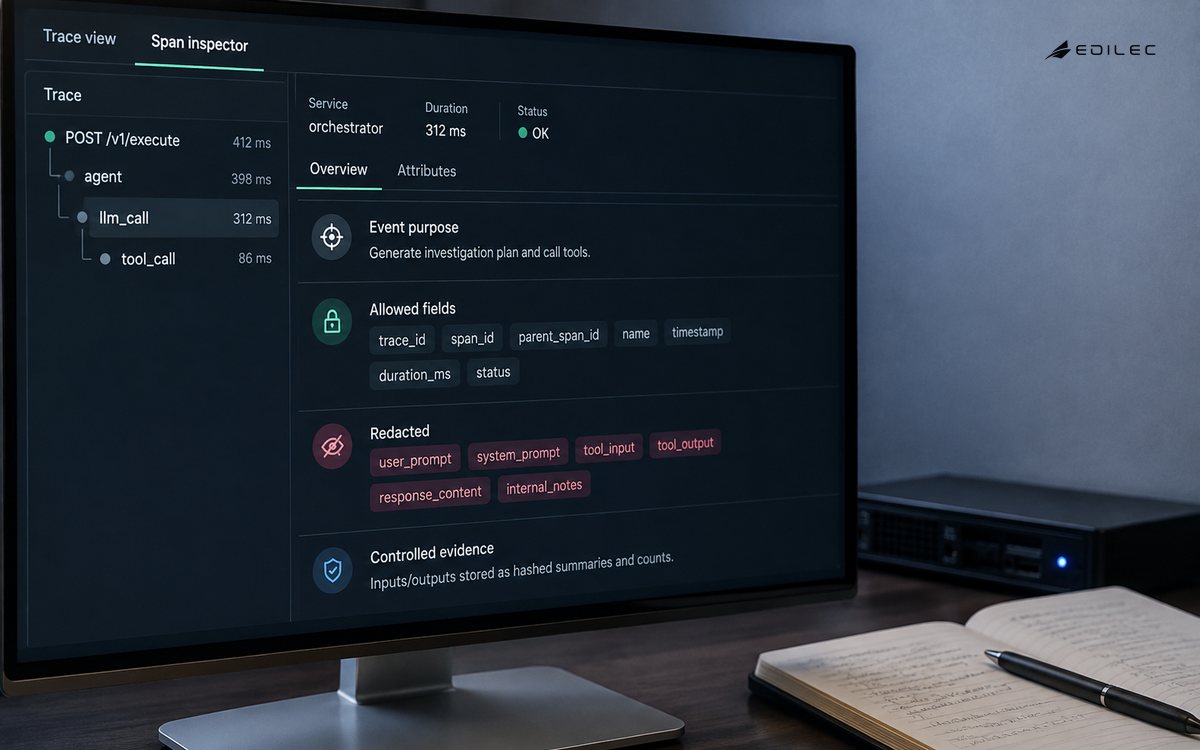
Create a trace schema for run, model call, retrieval, handoff, guardrail, approval and tool spans. Classify each attribute as operational metadata, identifier, customer content, secret, personal data, regulated data, security evidence or derived value. Mark the source, purpose, default capture mode, redaction rule, retention class and access role. Do not rely on a single 'sensitive' boolean; an email address, access token and medical note require different handling and response.
| Trace element | Useful default | High-risk payload | Safer representation |
|---|---|---|---|
| Model request | Model ID, token counts, duration, policy version | Full user and system text | Content omitted, classified, sampled or stored under separate restricted reference |
| Retrieval | Collection, source IDs, ranks, chunk digests | Full retrieved records | Versioned source references and short approved excerpts |
| Tool call | Tool, schema version, decision, outcome, duration | Credentials and complete arguments | Allowlisted argument fields, typed hashes and external record IDs |
| Tool result | Status, affected-record reference, error class | Response body or exported file | Validated summary, size, digest and controlled artifact pointer |
| Identity | Pseudonymous subject, tenant, role class | Name, email, session token | Scoped stable identifier with separate resolution service |
| Approval | Policy, approver role, decision and time | Comments containing case details | Reason code and restricted evidence reference |
Minimize and transform before telemetry export
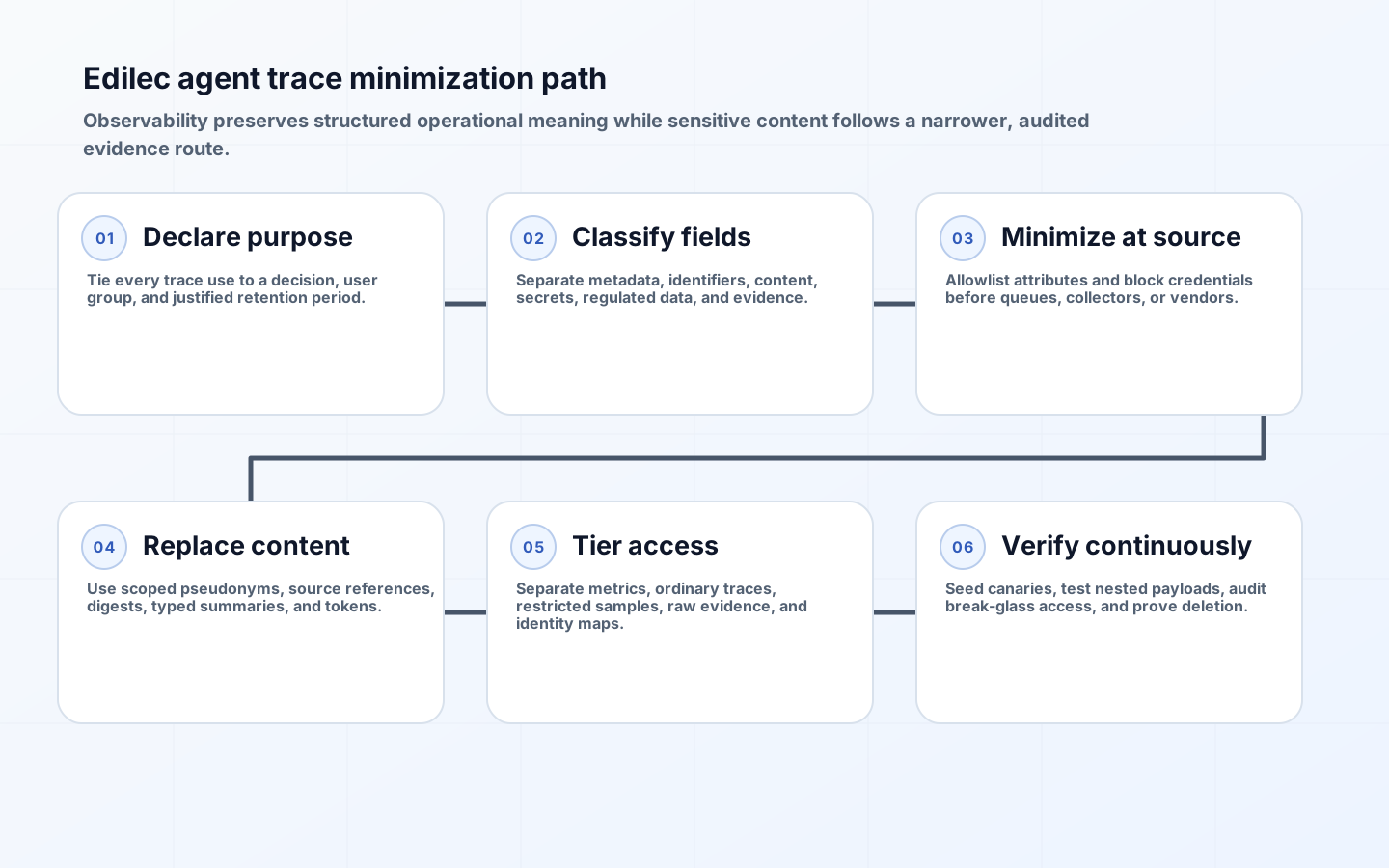
Redact as close to the source as possible, before queues, collectors, processors and vendors multiply copies. Use typed application objects so fields such as authorization headers, access tokens, passwords, cookies, private keys and payment data are never serialized into spans. Allowlist useful tool arguments rather than maintaining an endless denylist. Keep raw model content off by default in high-risk workflows and enable controlled sampling only where an approved purpose requires it.
Pattern matching helps with well-formed secrets and identifiers but misses free-form sensitive meaning and can remove harmless text. Combine deterministic detectors, data-loss-prevention rules, application context and explicit field typing. If a model-based redactor is used, treat it as an untrusted processor: constrain its data path, evaluate recall and over-redaction on representative classes, prevent retention by the provider, and retain deterministic blocks for credentials. Never send a secret to another external model merely to decide that it was secret.
Separate trace semantics from content payloads
The OpenTelemetry generative AI semantic conventions define common attributes and events for generative AI operations. Use stable semantic metadata to answer most operational questions without capturing bodies: provider, operation, request model, response model, token usage, finish reason, error and duration. Adopt only conventions at a stability level the team can support, version local extensions, and avoid placing raw prompts in generic attributes that every exporter receives.
OpenAI's Agents SDK tracing documentation describes traces and spans for generations, function calls, guardrails, handoffs and custom events, and provides controls around sensitive data and custom processors. Framework defaults are a starting point, not an enterprise policy. Review what each library version emits, including errors and third-party processors, before enabling it for production. Test with synthetic secrets and personal data to confirm they do not cross the exporter boundary.
Use pseudonyms, tokens, and controlled references
Replace direct user and tenant identifiers with scoped pseudonyms that remain useful for joins within an approved purpose. Scope keys by environment or data domain so a leaked trace identifier cannot be correlated everywhere. Store re-identification mappings in a separate, tightly controlled service with audited access. Hashing low-entropy values such as email addresses without a secret key is vulnerable to guessing; use keyed transformation or tokenization designed for the identifier.
For large or sensitive inputs and outputs, record an immutable reference, digest, size, classification, source and retention class rather than the content. Investigators can request the source record through its native authorization. If a snapshot is needed because the source is mutable, place it in a restricted evidence store, not the general trace backend. Edilec's agent memory guide addresses similar separation of useful context from uncontrolled retention.
Control access, retention, and observability vendors
Separate operational metrics, ordinary traces and restricted content evidence into different stores or access tiers. Engineers may need aggregate failure and latency views without customer content. Security investigators may need a time-bound case view. Use tenant-aware authorization, short sessions, export controls, immutable access logs and alerts for bulk queries. Dashboard links should not become bearer tokens to sensitive traces. Production content should not appear in lower environments.
Set retention by data class and purpose. Metrics may outlive detailed traces; restricted evidence may follow incident or legal hold; debugging samples should expire quickly. Delete indexes, replicas, exports and vendor copies consistently. Review vendor subprocessors, regions, training-use terms, encryption, support access, breach notice, deletion and evidence export. The ICO guidance on privacy-enhancing technologies emphasizes selecting PETs in context rather than treating technology as automatic compliance.
| Access tier | Typical content | Who should use it | Control and retention |
|---|---|---|---|
| Metrics | Counts, latency, cost, status and model version | Operations, product and engineering | Aggregated, no direct content, longest operational retention |
| Standard traces | Pseudonymous IDs, source references, policy and tool outcomes | On-call engineering and security | Role and tenant scoped, moderate retention |
| Restricted samples | Approved redacted excerpts or classified payloads | Named quality or incident reviewers | Case-bound access, short retention and no bulk export |
| Raw evidence | Preserved prompt, record or tool payload when necessary | Authorized incident, legal or privacy personnel | Separate store, dual approval, hold and explicit deletion |
| Re-identification map | Token-to-subject resolution | Small privacy or security function | Separate keys, purpose checks and full audit |
| Developer test | Synthetic fixtures and canary secrets | Engineering teams | No copied production content; routine reset |
Design a break-glass debugging path
When ordinary telemetry cannot explain a critical failure, allow temporary enhanced capture for a narrowly identified workflow, tenant, test account or trace correlation. Require a ticket, purpose, approver, fields, duration and deletion time. Notify relevant data owners, avoid uninvolved users, mark captured events, and send them to the restricted store. Automatically disable the override. Emergency access should be fast enough to use and visible enough to review.
Prefer replay with synthetic or customer-approved fixtures before enabling raw production capture. Reconstruct from source references under native authorization. If a live reproduction is needed, exclude external side effects and use least-privilege identities. The authorization posture in Edilec's zero-trust application guide applies to observability: every request for sensitive evidence should be evaluated against subject, resource, purpose and current risk.
Test redaction as a production control
Build fixtures containing API keys, tokens, passwords, personal identifiers, multilingual names and addresses, financial and health examples, secrets in nested JSON, base64, files, errors and tool responses. Assert what leaves the application, collector and final backend. Test truncation, malformed payloads, retries and exception handlers. Use canary secrets that trigger alerts if they appear in telemetry. Measure missed sensitive content and harmful over-redaction by data class, not one blended accuracy score.
Review schema changes and tracing-library upgrades like data-processing changes. Inspect sample events, exporter configuration and vendor destination before rollout. Monitor redaction failures, restricted-store growth, break-glass use, access anomalies, deletion completion and content-bearing custom attributes. A quarterly policy review cannot compensate for an application release that starts serializing full tool payloads tomorrow.
Key takeaways
- Assign a purpose, data class, capture mode, access role and retention rule to every trace field.
- Allowlist structured metadata and redact before export; do not depend on downstream cleanup.
- Keep content evidence behind controlled references and native authorization whenever possible.
- Separate metrics, standard traces, restricted samples, raw evidence and re-identification mappings.
- Continuously test secrets, nested payloads, errors, upgrades, break-glass access and deletion.
Frequently asked questions
Should full prompts ever be logged?
Only for a documented purpose when less sensitive evidence is insufficient. Limit scope, users, retention and destination; redact predictable secrets; and use restricted sampling or case-bound capture rather than a universal production default.
Is hashing personal data enough?
Usually not. Unsalted or unkeyed hashes of predictable identifiers can be guessed and remain linkable. Use scoped keyed pseudonyms or tokenization, protect the mapping, and still apply purpose, access and retention limits.
Can redaction be delegated entirely to the observability vendor?
No. Once raw content reaches the vendor, collection and transfer have already occurred. Use vendor controls as defense-in-depth after application and collector minimization, and verify behavior contractually and technically.
Conclusion
Good agent observability does not require a searchable copy of every conversation and tool payload. Structured versions, decisions, references, outcomes and timings answer most operational questions. Restricted evidence can remain available through a deliberate, auditable path for the cases that truly need content.
Inventory one production trace end to end and mark every content-bearing field. Remove fields without a purpose, type the secrets that must never serialize, and separate the few payloads that need controlled investigation. That exercise usually improves both debugging clarity and privacy posture.