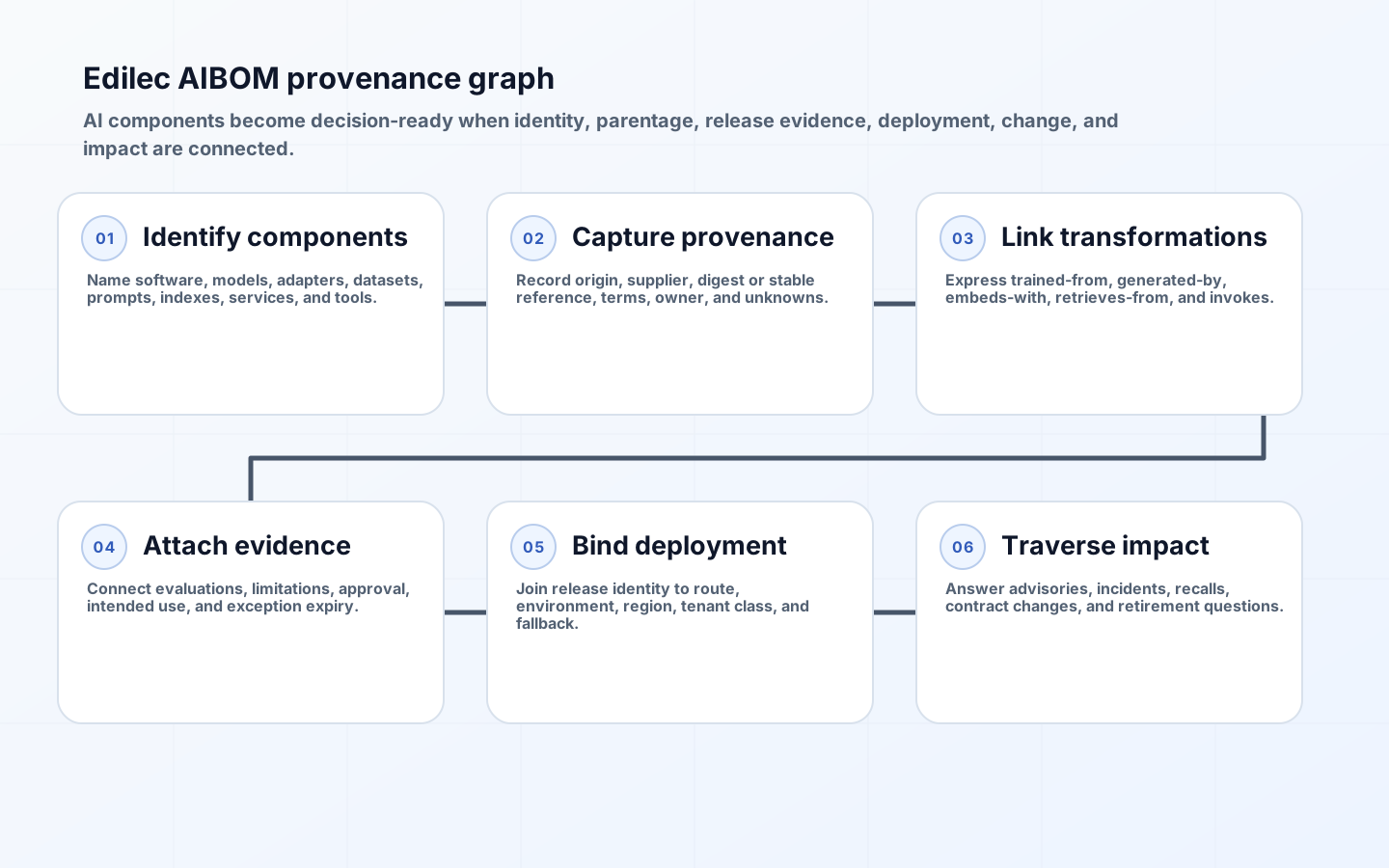
An AI bill of materials is a governed inventory of the components and relationships that make an AI system behave as deployed. A conventional software bill of materials can identify libraries and packages while missing the base model, adapter, datasets, prompts, retrieval sources, embedding model, vector index, safety models, external APIs, agent tools and evaluation evidence. An AIBOM extends the view so security, engineering, procurement and incident teams can ask what changed, what is affected, and what evidence supports trust.
The useful artifact is not a spreadsheet of model names. It is a versioned graph connecting component identity, supplier, origin, digest or stable reference, license, data and deployment context, dependency relationships, approvals, known limitations, and evidence. Scope one deployed use case first. Edilec's AI agent architecture guide helps identify runtime components; the AIBOM makes their identity and lineage answerable.
Define the decisions the AIBOM must support
Start with operational questions: Which products use a model under recall? Which deployments inherited a poisoned dataset? Where is a vulnerable parser used before retrieval? Which systems rely on a provider changing its retention terms? Which adapter lacks training provenance? Can an incident responder reproduce the serving configuration? Each question implies entities, relationships and freshness requirements. Building every possible field before choosing decisions creates expensive metadata with no accountable consumer.
| Consumer | Decision | Required AIBOM context | Freshness trigger |
|---|---|---|---|
| Product security | Is a disclosed component relevant and reachable? | Version, deployment, dependency and exposed interface | Advisory, artifact or route change |
| AI engineering | Can this behavior be reproduced? | Model, adapter, prompt, retrieval, parameters and environment | Every promoted release |
| Privacy | What data influenced or enters the system? | Dataset purpose, origin, class, retention and provider handling | Source, purpose or provider-term change |
| Procurement | What supplier dependencies and restrictions exist? | Provider, license, region, subprocessor and exit evidence | Contract, model or service update |
| Incident response | Which descendants may be affected? | Provenance graph, deployment inventory and immutable digests | Incident scope expansion |
| Model risk | What evidence justified release? | Evaluation set, results, limitations, approver and monitoring | Material behavior or control change |
Define an AI bill of materials component model
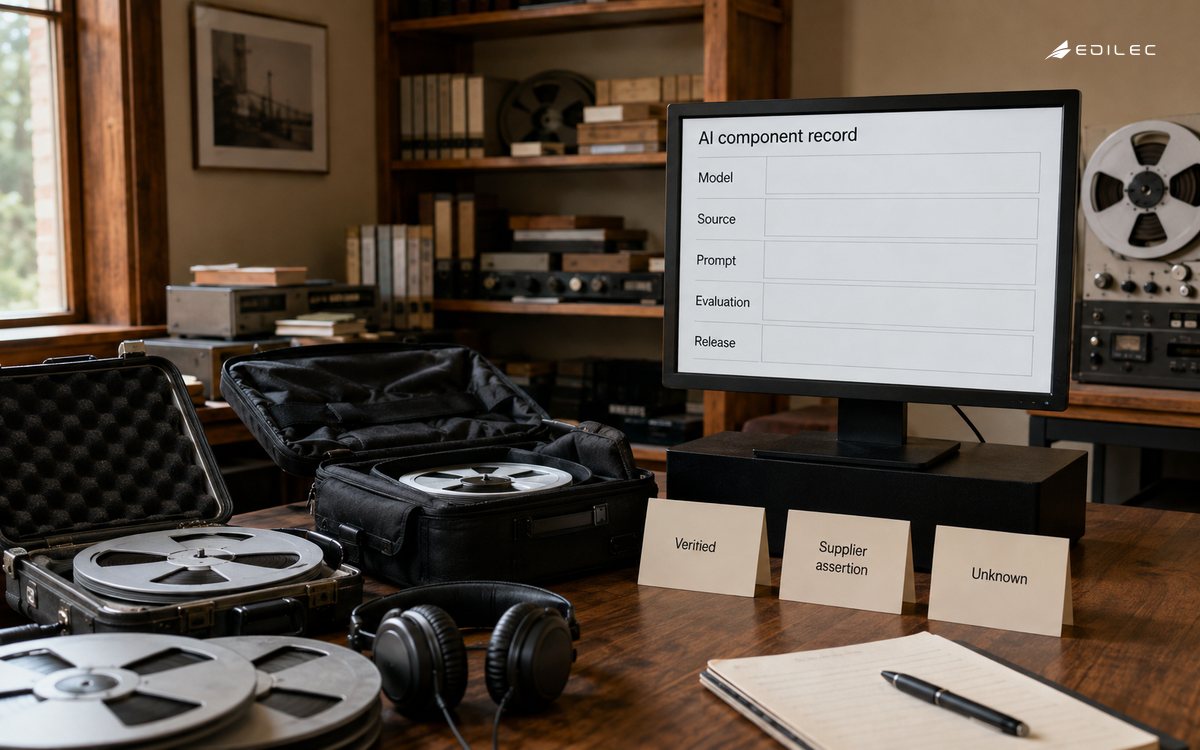
Represent at least software, model, adapter, dataset, prompt or policy bundle, retrieval collection, embedding model, index, guardrail, service provider, tool, evaluation set and deployment. Give each component a stable internal identifier, type, name, version, supplier or owner, creation and approval time, integrity reference, lifecycle status, license or terms, and sensitivity. Not every type has a file digest: a hosted model may require a provider model ID and contractual change record, while a mutable knowledge source requires a versioning and snapshot strategy.
CISA's Software Bill of Materials resource describes an SBOM as a nested inventory of software components and a building block for software security and supply-chain risk management. Preserve that machine-readable, operational spirit rather than inventing a narrative dossier. Extend, do not discard, the software inventory. Package identifiers and dependency relationships remain vital because AI runtimes still depend on conventional libraries, containers, operating systems and services.
Capture model and dataset provenance separately
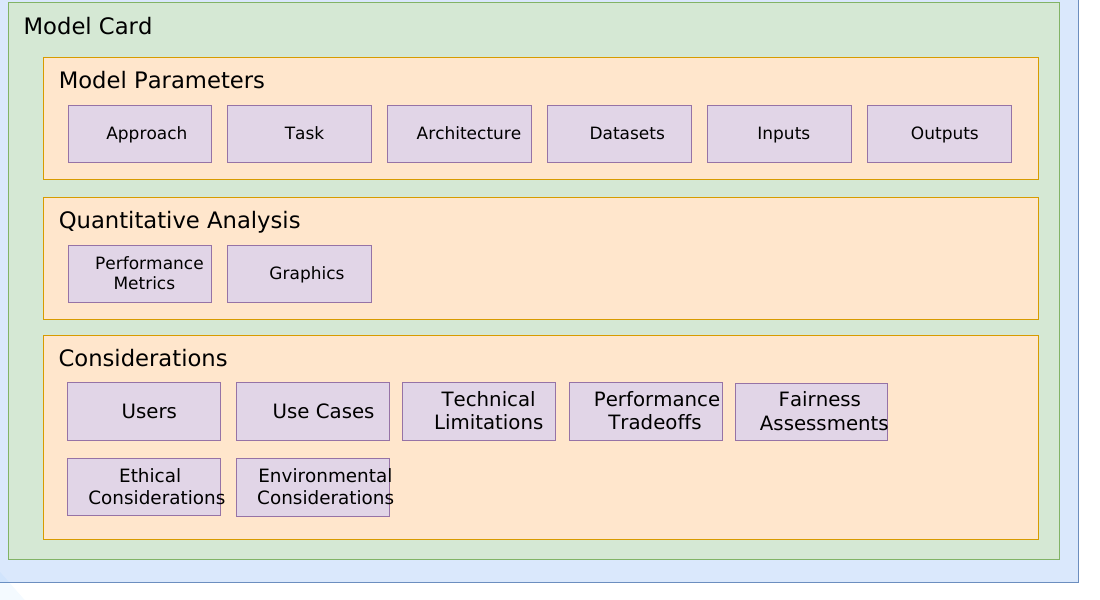
Model provenance should identify the producer, original artifact or service, model family and version, acquisition channel, digest where available, license or use restrictions, declared training information, modifications, adapters, quantization or conversion, evaluations, approval and deployment. Distinguish facts verified internally from supplier assertions and unknowns. A model card may be linked evidence, but it is not a substitute for the organization's exact acquired version and use context.
Dataset provenance needs source classes, collection purpose, dates, rights or consent basis, owner, contributors, data classification, transformation chain, exclusions, snapshot manifest, review and models trained from it. Do not force individual sensitive records into the AIBOM; reference a controlled manifest or catalog. The NIST Generative AI Profile emphasizes data provenance and third-party risk, supporting a record that distinguishes known, asserted and unavailable lineage.
Model relationships and deployed context
Relationships create impact analysis. Record trained-from, fine-tuned-from, generated-by, transformed-by, embeds-with, indexed-in, retrieves-from, guarded-by, invokes, depends-on, evaluated-by, approved-for and deployed-as. Include direction and effective version. A dataset does not merely sit beside a model; a particular training job consumed a snapshot and produced an artifact. A prompt bundle and adapter may be approved only together. A tool may be reachable only in one tenant or product tier.
Separate design inventory from deployment inventory. The AIBOM says what a release contains; runtime configuration says where it is active, for whom, under which route, region, identity and feature flags. Join them through immutable release identifiers. Edilec's production model monitoring guide explains behavior signals; component and route identity let operators connect a signal to the exact deployed materials.
Generate evidence at authoritative lifecycle events
Collect metadata from source systems rather than asking one team to retype it at release. Registries provide artifact digests; data catalogs and manifests provide dataset identity; repositories provide prompt and policy commits; build pipelines provide transforms and environments; evaluation platforms provide results; deployment systems provide routes; procurement systems provide supplier terms. Normalize these records into the AIBOM and retain links back to authoritative evidence. Manual attestation remains necessary for purpose, approval and unsupported supplier facts.
NIST SP 800-218A augments secure development practices for AI model and system producers and acquirers. Use its lifecycle framing to assign generation and verification: update component identity when acquired or built, relationships when transformed, evidence when evaluated, and deployment context when promoted. Sign or otherwise protect release manifests, restrict modification, and log corrections. An AIBOM that can be edited silently is weak provenance evidence.
| Lifecycle event | AIBOM update | Automated evidence | Human assertion |
|---|---|---|---|
| Acquire | Supplier, model or dataset identity and terms | Downloaded digest, API model ID, contract reference | Approved purpose and unresolved provenance |
| Transform | Parent-child relationship and method | Job ID, code commit, parameters and output digest | Materiality and accepted limitations |
| Evaluate | Evaluation suite, result and candidate | Case-set version, metrics and artifacts | Threshold decision and exception rationale |
| Approve | Approved bundle and intended use | Immutable release manifest | Named approver, scope and expiry |
| Deploy | Environment, route, tenant class and region | Deployment manifest and feature flags | Business owner and fallback readiness |
| Retire | End of use and retained descendants | Route removal and storage disposition | Residual obligations and support decision |
Set quality rules and update triggers
Measure completeness by decision, not field count. A release should resolve all mandatory component identities, parent relationships, integrity references, owners and deployment routes. Track stale hosted-model references, mutable URLs, unknown suppliers, orphaned components, impossible cycles and releases whose deployment has no approved manifest. Sample records back to registries and contracts. Document allowable unknowns, especially for proprietary provider training data, rather than filling gaps with assumptions.
Trigger updates for model swaps, provider aliases, adapter changes, prompt or policy releases, dataset snapshots, embedding changes, index rebuilds, tool additions, library upgrades, region changes, contract terms, new evaluations and retirement. Separate component change from evidence refresh: a monitoring review can update confidence without altering the deployed bundle. Publish events so vulnerability management, privacy and model risk consumers can subscribe instead of polling an exported sheet.
Use the AIBOM for response and acquisition
During a vulnerability or AI incident, start from the affected component and traverse descendants to deployments, owners and customers. Confirm actual reachability before declaring impact, preserve the relevant manifest, and record the remediation relationship. MITRE ATLAS can inform adversary hypotheses around supply-chain compromise and model access; the AIBOM supplies local facts about which artifacts and routes could realize those techniques.
Buyers should request a useful subset aligned to risk: model and provider identity, update policy, major datasets or source categories, software inventory, evaluations, data handling, external tools, support and incident notice. Require stable references and change notification instead of demanding confidential weights or record-level training data. Compare supplier assertions with internal deployment facts. Edilec's model evaluation guide helps buyers ask for release evidence connected to the exact version they will use.
Exercise the inventory before depending on it. Choose a model advisory, revoked dataset or provider outage and ask the team to identify affected releases, live routes, owners, fallback options and customer commitments within a defined operating window. Sample the returned relationships against deployment and registry evidence. Record false positives, missed descendants and stale records as quality defects with owners. A tabletop exposes whether identifiers join across systems and whether the nominal component owner can actually coordinate remediation.
Key takeaways
- Design the AIBOM around impact analysis, reproducibility, privacy, procurement and incident decisions.
- Extend the SBOM with models, datasets, adapters, prompts, retrieval, services, tools and evaluation evidence.
- Represent parent-child and runtime relationships so teams can traverse from a component to deployed impact.
- Generate records from registries, catalogs, pipelines and deployment systems, then protect release manifests.
- Label verified facts, supplier assertions and unknown provenance distinctly.
Frequently asked questions
Is an AIBOM a replacement for an SBOM?
No. Software components remain part of the AI attack surface. An AIBOM should reference or incorporate the SBOM and add AI-specific entities, relationships, evidence and deployment context.
Must an AIBOM list every training record?
No. It should identify controlled dataset snapshots, provenance classes, owners, transformations and evidence. Record-level manifests can remain in access-controlled data systems, especially where content is personal, licensed or sensitive.
How should hosted model aliases be recorded?
Record the alias, any provider version or snapshot identifier, observation time, region, contract reference and evaluation evidence. Treat an alias that can change behind the endpoint as a supplier-controlled mutable dependency requiring monitoring and notification.
Conclusion
A useful AI bill of materials is a living evidence graph for the exact system the enterprise operates. It connects software and AI components to provenance, transformations, approvals and deployments, enabling teams to reproduce behavior, evaluate supplier changes, investigate incidents and retire dependencies with fewer blind spots.
Build the first AIBOM around one production release and three questions the organization already struggles to answer. Automate authoritative fields, assign owners to assertions, and test an impact-analysis drill. The inventory earns trust when it produces a faster, better decision, not when it merely contains more rows.