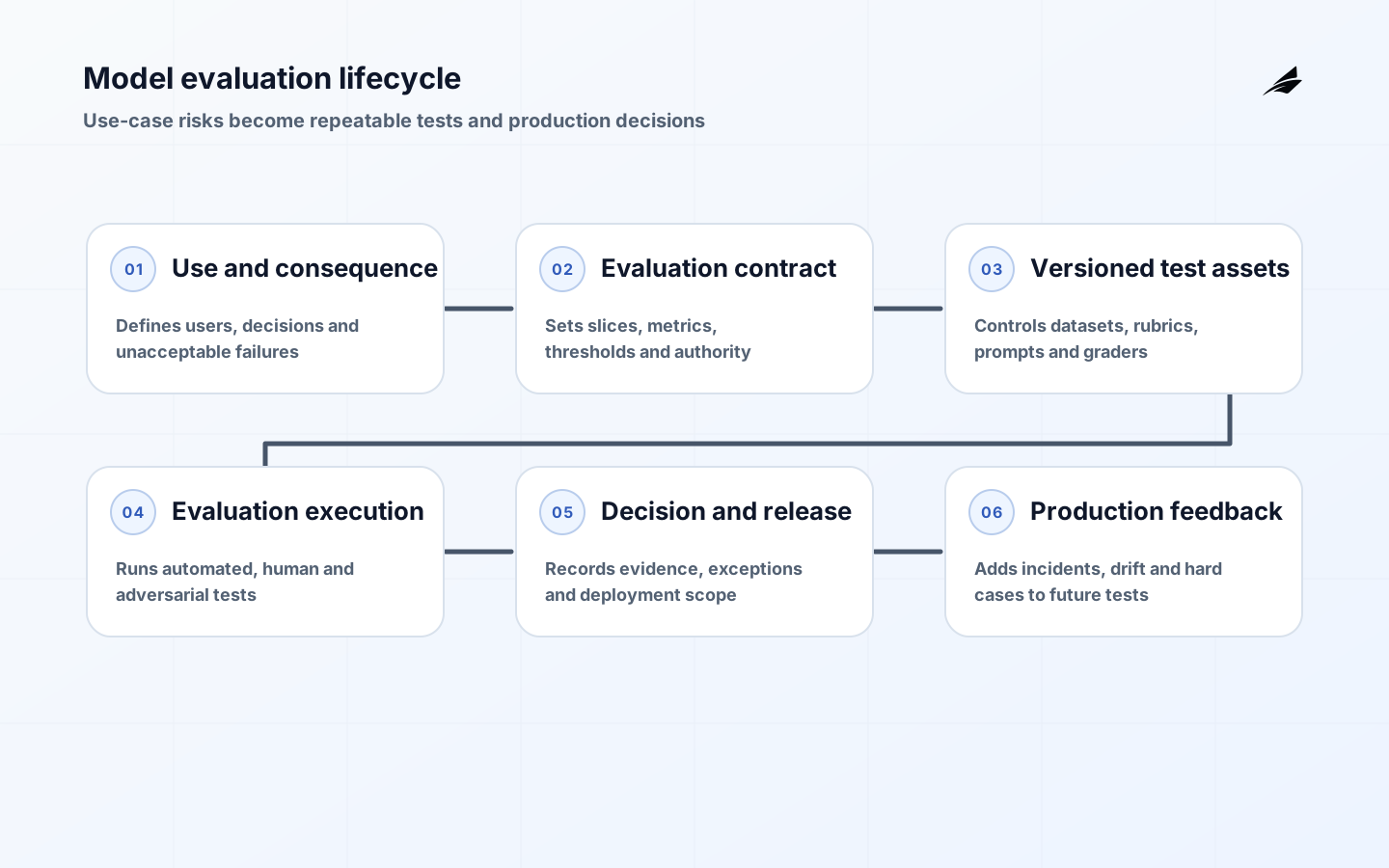
Model evaluation is the discipline of deciding what failure matters, how it will be observed, which datasets and graders approximate that failure before release, and who may ship when evidence is incomplete. In LLM and agent work, evaluation cannot be reduced to one benchmark score. The same system may summarize well, choose tools poorly and behave unpredictably on rare but expensive edge cases. A serious evaluation program therefore starts from the use case and its consequence, then works backward to slices, rubrics, thresholds and release authority.
The important shift is from model comparison to release evidence. Teams need a repeatable way to tell whether a prompt change, retrieval adjustment, model upgrade or tool addition actually improves the workflow they care about. NIST's AI RMF and generative AI profile emphasize lifecycle risk management, pre-deployment testing and incident handling. Platform guidance from OpenAI, Google and Microsoft extends that into datasets, evaluators and production monitoring. Put together, these sources support an evaluation lifecycle that is closer to quality engineering than to leaderboard watching.
Define the use case and the consequence of being wrong
Begin by naming the decision or task the system will support, the person or system affected by the output, and the consequence of a bad result. A summarization model used to create draft meeting notes has a different risk profile from an agent that classifies fraud cases or initiates account changes. This sounds obvious, but many evaluation programs still inherit generic metrics because the team never wrote down what error actually matters. If the cost of failure differs by customer tier, document type, language, product line or escalation state, those slices belong in the evaluation plan from the start.
The unit of evaluation should match the real workflow. Single-response grading may be enough for a standalone answer generator. Multi-turn, tool-using or retrieval-heavy systems need conversation-level or task-level evaluation, because a seemingly good final answer may hide inefficient tool calls, unsupported citations or unsafe intermediate reasoning. Likewise, latency and cost belong in the evaluation frame when they change the practical usefulness of the system. A model that is technically better but too slow or too expensive for the workflow is not better for that use case.
Write an evaluation contract before building graders
An evaluation contract is the document that converts intended use into testable release evidence. It should state the scenario set, relevant slices, metrics, thresholds, sampling method, acceptable uncertainty and exception authority. Some thresholds will be blocking, others advisory. For example, groundedness and safety regressions may block release immediately, while style or verbosity changes may trigger review without stopping deployment. Without this contract, the team tends to backfill metrics after seeing results, which turns evaluation into persuasion rather than governance.
The contract should also define how to compare alternatives. Absolute thresholds answer whether a system is safe enough to use. Relative thresholds answer whether a change is better than the current production version. Good programs keep both. They also distinguish between launch criteria and improvement criteria. A system might meet the minimum to pilot with a constrained cohort yet still fail the bar for broad automation. Writing those decisions down early creates shared language for product, engineering, security and operations teams when results are mixed.
| Contract element | Example | Why it matters |
|---|---|---|
| Use-case statement | Draft first-pass support answers with approved citations | Prevents the team from optimizing a vague goal |
| Failure slices | New product area, multilingual cases, sensitive accounts | Exposes where averages hide risky behavior |
| Metrics | Groundedness, task completion, tool-call accuracy, latency | Keeps evaluation tied to real workflow outcomes |
| Thresholds | No safety regression; citation accuracy must exceed baseline | Turns results into release decisions |
| Authority | Product owner and security lead approve exceptions | Clarifies who may accept residual risk |
| Cadence | Run on every prompt or model change and on sampled production traffic | Keeps evaluation current as the system evolves |
Version prompts, datasets, rubrics and graders as one asset set
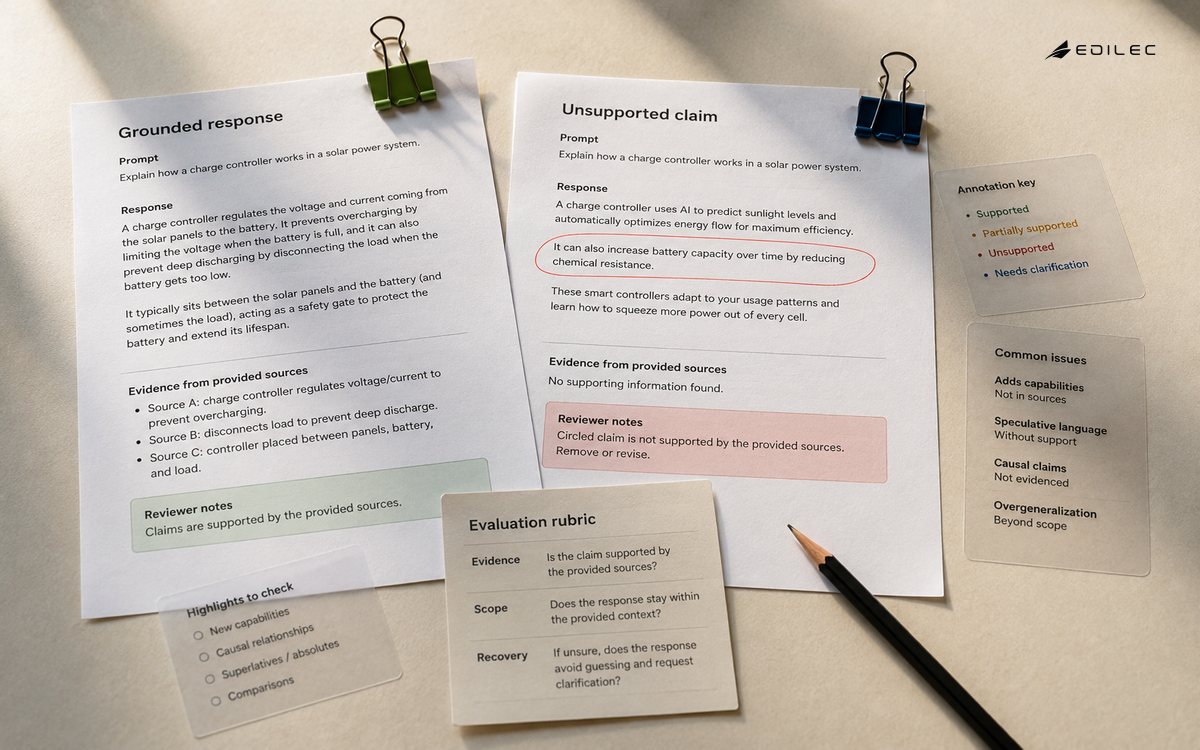
Evaluation assets are not just test data. They include prompts, retrieved context, conversation transcripts, tool schemas, human rubrics, model-based graders, deterministic checks and baseline results. Store them with version history and ownership. A changed rubric can alter scores as much as a changed model can. Teams often underestimate how quickly evaluation quality degrades when prompts, datasets and graders drift independently. If you cannot recreate the exact inputs and grading logic behind a release recommendation, the result is not auditably trustworthy.
Build several dataset classes. Use representative golden examples to estimate normal behavior, hard-case sets to expose known pain points, adversarial or policy cases to probe unsafe behavior, and change-detection sets to compare new model or prompt versions against production history. Keep ground truth honest. Some tasks have one best answer; others require pairwise preference, citation sufficiency or rubric-based human judgment. Do not pretend all tasks fit a single numeric truth label. Evaluation quality depends on choosing the right evidence shape for the task, not on maximizing dataset size for its own sake.
| Asset | Primary purpose | What goes wrong if it is missing |
|---|---|---|
| Golden set | Estimate normal-case quality on representative work | The team overfits to memorable examples |
| Hard-case set | Track known failure patterns and valuable edge cases | Regressions reappear after every model or prompt change |
| Policy and safety set | Test refusal, misuse handling and sensitive topics | Unsafe behavior is discovered by users or auditors |
| Tool-call traces | Check argument quality and action sequencing | Agent evaluations ignore side effects and wasted steps |
| Human rubric | Resolve ambiguous quality questions consistently | Reviewers disagree and scores become unstable |
| Baseline snapshots | Compare candidate changes against current production behavior | A new release ships because it seems better in isolation |
Combine automated checks, human review and adversarial tests
Execution should mix cheap deterministic tests with more expensive human or model-assisted evaluation. Schema validation, citation presence, blocked-topic handling, expected tool schemas and latency budgets are good deterministic checks. They should run on every candidate. Human review remains essential where nuance, legal interpretation, domain correctness or brand tone matter. Model-based graders can increase coverage, but they need calibration against human judgment and periodic inspection for bias or drift. Treat graders as instruments that require maintenance, not as neutral oracles.
Adversarial evaluation belongs in the normal program, not only in a one-time red team. Probe prompt injection, unsupported claims, irrelevant retrieval, harmful instructions, tool misuse and failure to abstain. The generative AI profile is especially useful here because it emphasizes risks unique to or intensified by generative systems, including confabulation and information security issues. When the system uses tools, evaluate the full execution trace: whether the right tool was chosen, whether arguments were bounded correctly, whether retries were sensible, and whether the final answer reflected the actual tool result rather than a guessed narrative.
Use results to make scoped release decisions
Evaluation results should produce a deployment decision with scope, not simply a pass or fail badge. If a candidate improves general quality but regresses in a sensitive slice, the right action may be a limited rollout, not a full rejection or full launch. Compare against the current production baseline, examine slice performance and document residual risks. When exceptions are granted, record the affected user group, the mitigation, the expiry date and the owner responsible for closing the gap. This keeps evaluation tied to operational accountability rather than turning it into a ceremonial approval stage.
Release governance should also distinguish between platform changes and application changes. A model swap can change safety, latency, cost and output format even when prompts stay constant. A retrieval or tooling change can alter citations and task completion even when the model is untouched. Run the evaluation set that matches the changed layer, then run enough cross-layer tests to detect interactions. If teams skip this discipline, production becomes the first integration environment for AI behavior.
Feed production failures back into the next evaluation cycle
Production monitoring is where evaluation proves it is an operating system rather than a pre-launch ritual. Sample real traffic where policy allows, log release identity, collect traces for tool use, and review low-confidence or escalated cases. Investigate which slices are driving manual overrides, user complaints, latency spikes or safety flags. Every consequential production failure should become a future test case if it can be reproduced safely. That is the quickest route from incident learning to better release discipline.
Do not confuse drift with novelty. Some changes come from user behavior, data freshness, seasonality or connected systems rather than from the model itself. The evaluation program should therefore join application telemetry with dataset freshness, retrieval version, prompt version, tool version and model version. When a team can connect a bad outcome to the specific layer that changed, it can improve deliberately. When it cannot, the evaluation program becomes a collection of scores without diagnostic power.
| Production signal | What it may indicate | Next evaluation action |
|---|---|---|
| Manual overrides rise | Model quality or policy fit has degraded for a slice | Add the affected cases to the hard-case and policy sets |
| Latency spikes after a prompt change | Tool path or token usage has shifted | Re-run task-level evaluations with cost and latency gates |
| Citation complaints increase | Retrieval quality or approved-source coverage is weak | Expand source-focused tests and review context construction |
| Safety flags cluster in one workflow | Prompting or review rules do not match user behavior | Add adversarial cases and tighten action boundaries |
| Support queue fills with ambiguous failures | Metrics are not isolating the failure mode | Refine the evaluation contract and slice definitions |
| Scores stay flat while business value stalls | The chosen metrics do not reflect useful completion | Revisit the use-case statement and workflow-level measures |
Budget evaluation as a standing engineering function
Evaluation work does not disappear after launch. Datasets need curation, rubrics need calibration, graders need review and new failure modes need incorporation. Budget time for this ongoing work or the program will quietly collapse into spot checks before major releases. Product, engineering, security and operations leaders should know who owns the evaluation assets, who may change thresholds, how exceptions are reviewed and how much sampled production traffic is analyzed. If nobody owns those decisions, the team will still be evaluating, but informally and with less trustworthy results.
Key takeaways
- Start evaluation from the use case, consequence and failure slices, not from a generic benchmark.
- Write an evaluation contract before comparing prompts, models or agent workflows.
- Version datasets, rubrics, graders and baselines together as release evidence.
- Combine deterministic checks, human review and adversarial testing.
- Use evaluation results to make scoped deployment decisions with named exception owners.
- Feed production failures back into the evaluation assets so the program improves over time.
Frequently asked questions
Are public benchmarks enough to evaluate an enterprise AI system?
No. Public benchmarks can help compare general capabilities, but they rarely express your data boundaries, tool paths, policy rules or business consequences. They are useful context, not sufficient release evidence. A production system needs use-case-specific tasks, slices and operational checks.
Can model-graded evaluation replace human review?
Not completely. Model-based graders can improve coverage and speed, especially for regression checks, but they still need calibration against humans and should not be the only authority for nuanced, high-impact decisions. Use them as instruments within a governed review program.
How often should evaluations run?
Run cheap blocking checks on every meaningful change, larger regression suites before release decisions, and sampled production evaluations continuously or on a regular schedule. The correct cadence follows how often models, prompts, retrieval sources and tools change in your environment.
What should a team do when one important slice fails but the average looks good?
Treat the slice failure seriously if its consequence is material. Averages often hide business-critical harm. The right response may be to narrow rollout scope, add review steps, or block release entirely for that cohort until the failure mode is understood and retested.
Conclusion
Model evaluation becomes valuable when it behaves like release engineering for uncertainty. Define the intended use, encode it in an evaluation contract, maintain versioned assets, combine automated and human evidence, and use production feedback to sharpen the next round of tests. That approach does not eliminate judgment, but it makes judgment inspectable and repeatable enough to ship AI systems more safely.