Data model documentation is not a policy document or a software purchase. It is a way for enterprise data and engineering teams to determine whether people can correctly understand and safely change a model without relying on personal memory or reverse engineering with enough context to act and enough evidence to explain the result later. The work crosses conceptual entities, logical definitions, physical fields, relationships, lineage, quality rules, ownership, and change history. A useful guide begins by identifying the decision, the accountable owner, the records that support it, and the time limit within which the decision must be made. That framing prevents a familiar failure: a technically complete programme that does not change how work is performed.
The practical target is a repeatable operating capability, not perfect paperwork. In this guide, the important objects are business terms, source schemas, transformations, tables, interfaces, data classifications, and downstream reports. The design should make ordinary work easier while making higher-risk changes visible. Start small enough to test with real cases, including incomplete records and failed dependencies. Expand only after owners can show that the agreed living documentation linked to model ownership, deployed artifacts, lineage, and the change process works in routine conditions and that exceptions do not disappear into chat, spreadsheets, or personal inboxes.
Start with the decision contract
Write a one-page decision contract for data model documentation. Describe the question being answered, the person who has authority to decide, the inputs they may rely on, and the consequence of a wrong or delayed result. Include the system boundary: conceptual entities, logical definitions, physical fields, relationships, lineage, quality rules, ownership, and change history. This makes disagreement useful. A finance, legal, security, product, or operations reviewer can challenge an assumption before it becomes an invisible configuration choice. The contract should also name what is outside the first release, because unbounded scope is often mistaken for maturity.
The contract needs observable acceptance criteria. For this subject, decide how current the information must be, which records are authoritative, what constitutes an exception, and when human judgment is required. Avoid a promise such as "all access is reviewed" or "all data is trusted." Replace it with a reviewable statement: a named population, a defined cadence, a completion rule, and an escalation path. Record dependencies and assumptions. When a supplier, identity provider, source application, or team changes, the owner can then see which decision needs reconsideration. For data model documentation, acceptance criteria should cover entity meaning, identifiers, relationships, field rules, owners, lineage, and versioned change impact.
Map the records and boundaries
Inventory business terms, source schemas, transformations, tables, interfaces, data classifications, and downstream reports at the level needed to operate the decision, not at the level that is easiest to export. For every material item, capture an owner, a purpose, a system of record, a stable identifier, sensitivity or consequence, and the expected change path. In data model documentation, unknown ownership is itself a finding. It prevents a reviewer from resolving a conflict and makes decommissioning unsafe. A compact inventory is better than a heroic catalogue that is obsolete before the next release.
| Question | Working answer | Evidence |
|---|---|---|
| What is in scope | conceptual entities, logical definitions, physical fields, relationships, lineage, quality rules, ownership, and change history | Approved boundary and inventory |
| What must be protected or trusted | business terms, source schemas, transformations, tables, interfaces, data classifications, and downstream reports | Owner, classification, and system record |
| What can go wrong | ambiguous field names, undocumented keys, conflicting definitions, unannounced breaking changes, and diagrams that drift from deployed reality | Risk scenario and response owner |
| What makes the control real | living documentation linked to model ownership, deployed artifacts, lineage, and the change process | Test result, decision record, or operating log |
Draw the boundary around an actual workflow. Follow one representative request, record, or release from entry through transformation and outcome. Note where identity is asserted, where data is copied, where a decision is automated, and where someone can override it. The point is not to create a decorative diagram. It is to expose where context can be lost or where a change can bypass review. Use a second, adverse example such as a delayed source update, departed employee, failed integration, or emergency change. Boundaries that survive only the happy path are not operational boundaries. Trace a field from business definition through source schema, transformation, physical table, interface, and downstream report; that is where ambiguous meaning and stale diagrams surface.
Design controls people can operate
Choose controls that match the consequence and the way work is really done. The central control for this guide is living documentation linked to model ownership, deployed artifacts, lineage, and the change process. It should have a named owner, a defined trigger, a minimum evidence set, and a result that can be checked independently. A control that relies on a person remembering an unwritten rule will break under growth, absence, and urgency. Prefer constrained defaults, attributable identities, versioned definitions, and automated checks where they reduce a known failure mode; retain human review where context or accountability cannot be automated safely.
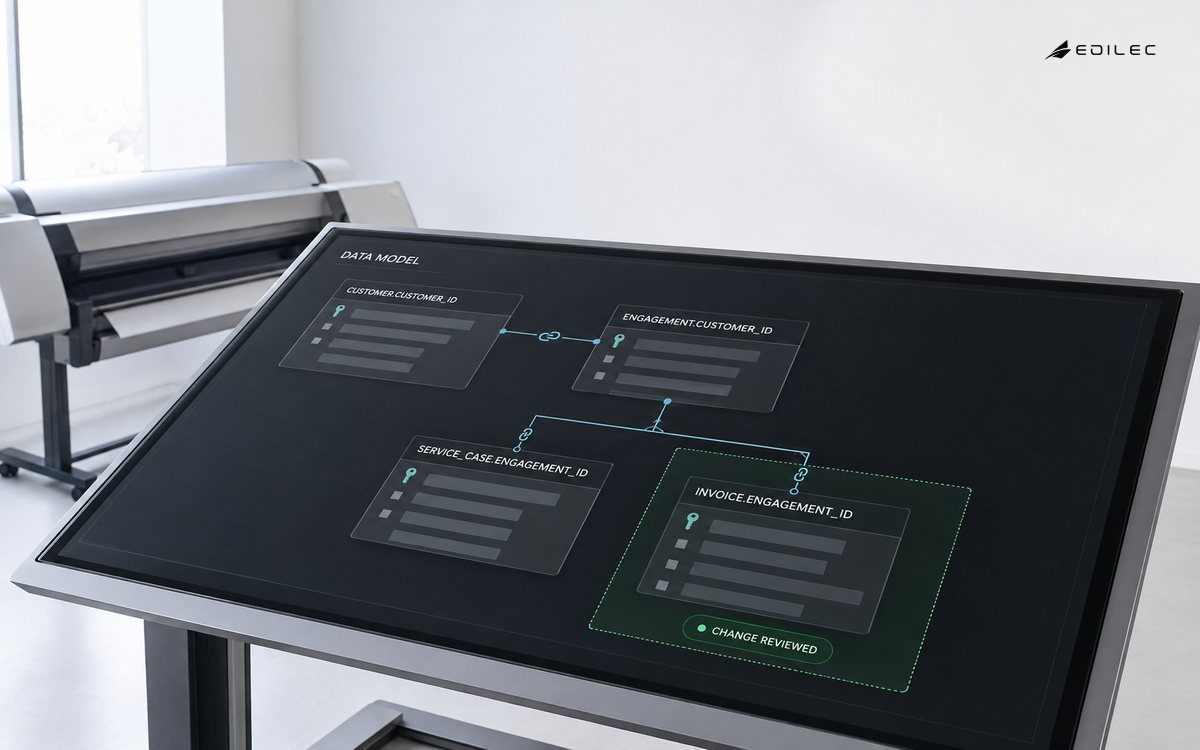
Test the control with normal and adverse cases before broad rollout. A useful test suite includes a legitimate routine case, an unauthorized or invalid case, a stale or incomplete record, and a changed dependency. For data model documentation, ask the operator to explain not only what outcome occurred but why it occurred and where the evidence lives. That exercise reveals whether the control is understandable under pressure. It also distinguishes a control that works in a demo from one that can be handed to an on-call engineer, manager, analyst, or service lead.
Build evidence into ordinary work
Evidence should be a by-product of the workflow, not a scramble after a request arrives. The useful evidence set for data model documentation includes entity definitions, field contracts, relationship rules, lineage links, review records, and versioned change notices. Store enough context to reconstruct material decisions, while minimizing sensitive content and restricting who can inspect it. Dates, versions, actor or service identity, scope, outcome, and a correlation identifier usually matter more than a large unstructured note. Define retention and access rules before evidence begins to accumulate; logs and reports can become sensitive assets in their own right.
| Operating signal | Owner action | Review question |
|---|---|---|
| A required record is missing or stale | Pause, route, or use the documented fallback | Was the decision blocked safely and visibly? |
| A material exception is approved | Record the rationale, expiry, and accountable approver | Has the exception been revisited before expiry? |
| A source or dependency changes | Assess impact and run the affected checks | Which assumptions or downstream users are affected? |
| A control fails in operation | Contain the condition and preserve investigation context | Did the response restore the intended boundary? |
Make review rhythms proportionate. Some controls require a release gate, others a weekly operational review or a quarterly attestation. The frequency should follow the change rate, consequence, and ability to recover, not a calendar inherited from another team. Review documentation coverage, stale records, change-impact lead time, data questions, and defects caused by misunderstood meaning alongside qualitative cases. A completion percentage can look healthy while managers are rubber-stamping access, analysts are working around missing fields, or responders are closing alerts with no durable improvement. Bring a small sample of real cases into every review to keep the numbers honest.
Deliver in evidence gates
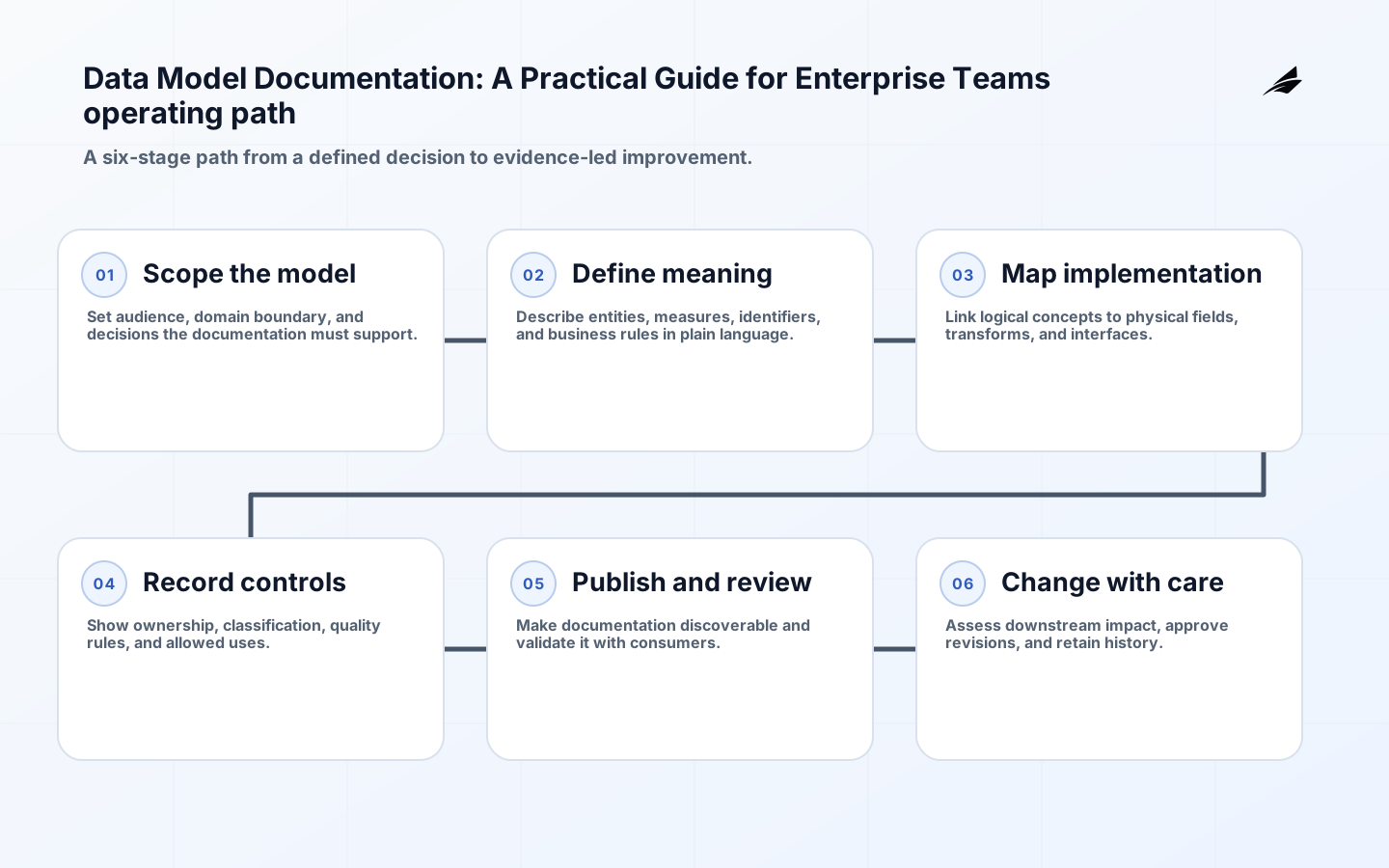
A sensible implementation moves through scope the model, define meaning, and map implementation before it becomes a broad organisational promise. Each gate should answer a narrow question: do we understand the boundary; can the owner perform the work; and does the control behave correctly with representative records? Then use record controls, publish and review, and change with care to establish reliable operation. Publish the exit criteria for every gate and keep a short decision log. This gives sponsors a basis for investing, narrowing scope, or stopping without treating caution as failure.
Start with one workflow that has a willing owner, realistic volume, and consequences the team can explain. Train the people who will receive exceptions or support requests before enabling the new path. Measure the baseline first, including manual effort and defect patterns, so the team can tell whether the change actually improves whether people can correctly understand and safely change a model without relying on personal memory or reverse engineering. When expanding, preserve the original evidence and retest assumptions for each new business unit, system, or data class. Similar-looking workflows frequently differ in ownership, retention, contracts, or recovery options.
Key takeaways
- Data model documentation starts with a decision and an accountable owner, not a generic control list.
- Map business terms, source schemas, transformations, tables, interfaces, data classifications, and downstream reports to real systems, identities, records, and change paths.
- Use living documentation linked to model ownership, deployed artifacts, lineage, and the change process as a testable operating mechanism rather than a statement of intent.
- Capture entity definitions, field contracts, relationship rules, lineage links, review records, and versioned change notices in the workflow so it remains usable when people and systems change.
- Review documentation coverage, stale records, change-impact lead time, data questions, and defects caused by misunderstood meaning with real cases, then improve the process at the source of the exception.
Frequently asked questions
How much process is enough? Begin with the smallest process that can show ownership, scope, evidence, and a recovery path for the defined decision. Add detail when a real failure, increased consequence, or new obligation demonstrates the need. The goal is dependable work, not documentation volume. For data model documentation, begin with a domain undergoing active change so the documentation and change process are proven together.
Can this be automated? Automation is valuable when inputs are reliable, the policy is clear, and a failure can be detected and corrected. Keep escalation and exception paths visible. In data model documentation, an automated outcome without an owner, audit trail, or correction route simply moves the risk out of sight.
Conclusion
Data model documentation becomes sustainable when it is treated as an operating system for a specific decision. Set the boundary, make the control observable, preserve evidence, and use reviews to improve the work rather than to perform certainty. That approach gives enterprise data and engineering teams a clear next step: prove one bounded workflow with real cases, then extend only what the evidence supports.