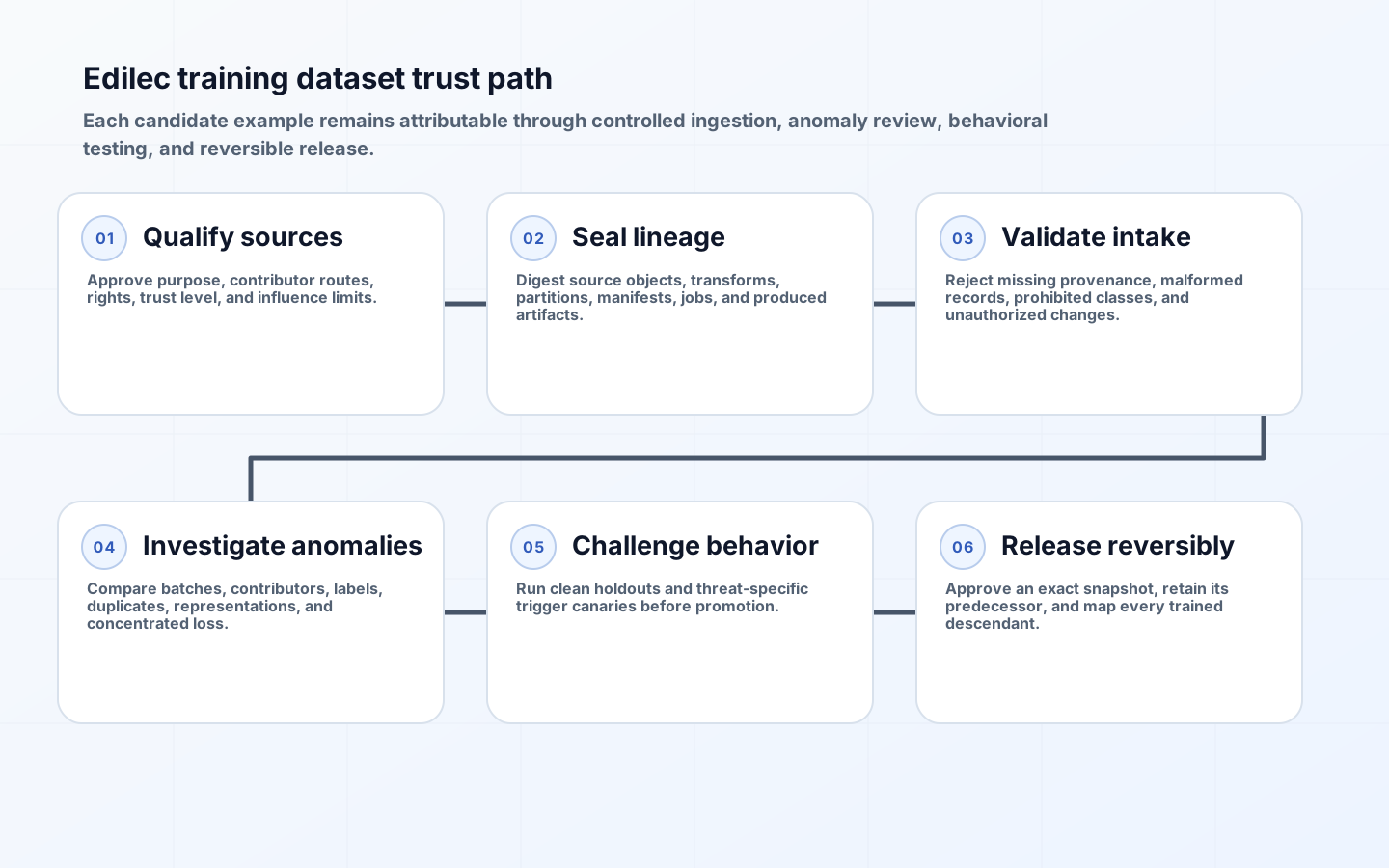
Training data poisoning detection is the discipline of finding malicious or unauthorized influence before a trained or fine-tuned model is promoted. Poisoning can degrade general performance, create a targeted backdoor, bias decisions, insert an attacker-chosen response, weaken safety behavior, or make later extraction easier. The dangerous records may look valid individually. Detection therefore has to connect who contributed data, how it changed, which pipeline transformed it, what behavior it produced, and whether that behavior persists under controlled tests.
Enterprise fine-tuning pipelines are exposed through feedback exports, annotation vendors, support conversations, user uploads, public datasets, synthetic data, preference collection, and internal subject-matter experts. Accidental contamination is more common than a sophisticated attacker, but the same lineage and release controls help with both. A quality filter that removes malformed rows will not catch a rare trigger paired with a plausible target. Treat the dataset as a versioned production dependency, not an anonymous bucket of examples.
Define the poisoning objective and attacker access
NIST's adversarial machine learning taxonomy distinguishes poisoning by lifecycle stage, attacker goal, knowledge and capability. Apply that vocabulary to the threat model. Can an attacker submit one feedback record, control a data source, compromise an annotator account, replace an artifact, or alter the training pipeline? Are they seeking broad availability loss, a targeted integrity failure, privacy leakage or a hidden backdoor? The expected concentration and trigger determine which tests have a chance of working.
| Poisoning pattern | What the record may look like | Likely signal | Release test |
|---|---|---|---|
| Label manipulation | Valid input paired with a wrong target | Contributor, class or time-window disagreement | Clean holdout and adjudicated slice performance |
| Backdoor insertion | Ordinary example containing a rare trigger | Trigger co-occurrence or unusual representation cluster | Trigger variants with and without target context |
| Safety erosion | Benign-looking preference that rewards unsafe completion | Shift in rater or source preference distribution | Fixed safety suite plus adversarial paraphrases |
| Availability poisoning | Outliers or conflicts designed to degrade learning | Loss, gradient or duplicate concentration | Per-slice utility and stability comparison |
| Knowledge manipulation | Authoritative-looking false or stale fact | Source trust, conflict and temporal inconsistency | Grounded domain cases against approved records |
| Artifact substitution | Dataset manifest points to altered bytes | Digest or signature mismatch | Rebuild from immutable manifest and compare outputs |
Build an immutable dataset provenance chain
Every training example should be traceable to a source class, collection purpose, acquisition time, rights or consent basis, contributor or process identity, transformation version, reviewer decision, and dataset snapshot. Use immutable object versions and content digests; generate a manifest that names included partitions and code; sign release manifests where the environment supports it. Preserve tombstones for removed records so an investigation can explain why two snapshots differ without retaining prohibited content indefinitely.

NIST SP 800-218A extends secure software development practices to AI model producers, AI system producers and acquirers. Its lifecycle orientation supports controlled repositories, provenance, protection from unauthorized access and reproducible development. Connect dataset lineage to code, base model, adapter, hyperparameters, environment, evaluation and final artifact. Edilec's data model documentation guide can help define stable entities and ownership for that metadata.
Control contributors and ingestion routes
Inventory every route by which records enter candidate training data. Authenticate contributors, separate source onboarding from bulk import, require review for new or high-impact sources, and cap the influence of any one low-trust contributor. Annotation vendors need named projects, role-based access, quality adjudication, account offboarding and contractual incident support. User feedback should not flow directly into training; stage it for policy, privacy, rights, safety and abuse checks.
Use deterministic schema validation before statistical analysis. Reject malformed encodings, impossible labels, missing provenance, disallowed content classes, unresolved rights, unexpected languages or domains, and records outside collection windows. Normalize only through versioned transforms, because aggressive cleaning can erase the clues needed to identify a campaign. Quarantine rejected batches with access and retention controls rather than mixing them into an analyst's local files.
Layer anomaly detection around the threat model
Start with source and batch comparisons: volume, label distribution, duplicates, near-duplicates, token and length profiles, language, topic, sensitive-data matches, timestamp bursts, reviewer disagreement, and class balance. Examine concentrated loss, unusual embedding neighborhoods, influence or gradient indicators when the model type and scale make them practical. No threshold establishes innocence. Anomaly methods prioritize review and need clean reference data, attacker-aware tests and documented false-positive handling.
Segment findings by source, contributor, time and target class. A global average can hide a precise attack affecting one trigger. Compare candidate data with the last approved snapshot and require explanation for material shifts. Use MITRE ATLAS to build campaign hypotheses across data collection, poisoning and model impact. Analysts should preserve the original batch, query logic and review outcome so later teams can reproduce why records were accepted or excluded.
Test for backdoors with behavioral canaries
A backdoor is ultimately a behavioral property, so dataset inspection must be paired with model tests. Maintain clean utility, safety, privacy and domain holdouts that contributors cannot edit. Add canary triggers representing threat hypotheses: exact and perturbed tokens, formatting, images, metadata, source markers, personas or context combinations. Compare the candidate with the approved baseline on triggered and untriggered cases. A trigger should not be declared causal from one stochastic output; repeat under controlled decoding and inspect adjacent conditions.
Use the release-evidence structure in Edilec's model evaluation guide: version cases, define metrics and thresholds before observing the candidate, preserve failures, and require accountable sign-off. Evaluate clean performance by important slice so a defense does not hide poisoning by making the model broadly worse. When a suspicious behavior appears, retrain with the suspected partition removed and compare; this counterfactual can strengthen or weaken the hypothesis without proving intent.
Use release gates and quarantine decisions
Define gates for provenance completeness, source approval, privacy and rights review, anomaly disposition, clean utility, targeted security tests, reproducibility, and rollback readiness. A reviewer should be able to trace every exception to an owner and expiry. Separate the people who assemble a high-risk dataset from those who approve production promotion. Urgent business demand may justify a smaller fine-tuning scope or delayed source, but should not silently waive the evidence chain.
| Gate | Pass evidence | Quarantine trigger | Accountable owner |
|---|---|---|---|
| Source trust | Approved source, purpose and contributor route | Unknown origin, compromised account or rights conflict | Data product owner |
| Manifest integrity | Digests match immutable snapshot and transform versions | Missing object, mutable reference or digest mismatch | ML platform owner |
| Statistical review | Expected shifts explained and anomalies dispositioned | Concentrated unexplained change | Data science lead |
| Behavioral security | Canaries and targeted slices meet thresholds | New trigger-linked or privacy-relevant failure | AI security owner |
| Utility | Critical clean tasks remain within approved bounds | Broad or high-impact slice degradation | Product owner |
| Rollback | Prior artifact, dataset and routing path tested | No reproducible predecessor or dependent migration | Service owner |
Investigate suspected poisoning and roll back safely
Freeze affected dataset versions, manifests, transforms, training jobs, model artifacts, contributor logs and evaluation results. Stop automatic promotion and isolate suspect sources without deleting evidence. Determine the earliest affected snapshot, models trained from it, downstream distillations, generated synthetic sets and deployments. A poisoned parent can influence descendants even after the original rows are removed. Rotate compromised contributor credentials and preserve access records under the incident policy.
Rollback may mean routing to the last approved model, disabling an adapter, rebuilding from a known dataset, or reverting one domain capability to deterministic handling. Validate both the suspected trigger and ordinary quality before restoring traffic. Update production monitoring with confirmed indicators and watch for the attacker's adaptation. The NIST Generative AI Profile emphasizes ongoing monitoring and incident processes; use the event to improve source governance rather than only deleting a batch.
Production signals should also feed the next data review. Watch for concentrated complaints, trigger-linked failures, sudden slice regressions, source-specific behavior and unexpected safety-policy changes, then preserve examples under controlled access. Edilec's production model monitoring guide explains how to connect signals to accountable decisions. Monitoring cannot prove which training record caused a failure, but it can identify a reproducible behavior, narrow affected releases and trigger a lineage-based investigation before more feedback is recycled into training.
Key takeaways
- Threat-model the attacker's data access, objective, target and expected concentration before selecting detectors.
- Trace each example through source, contributor, review, transformation, snapshot, training job and deployed artifact.
- Use schema, source, statistical and representation checks to prioritize investigation, not certify clean data.
- Pair dataset analysis with fixed clean holdouts and targeted behavioral canaries.
- Quarantine evidence, map descendants and recover from a reproducible trusted snapshot when poisoning is suspected.
Frequently asked questions
Can deduplication prevent training data poisoning?
It can reduce attacks that rely on repeated examples and improve dataset quality, but a rare targeted poison or semantically varied campaign can survive. Keep deduplication as one versioned control inside provenance, review and behavioral testing.
What is the difference between poisoning and ordinary bad data?
Poisoning implies adversarial influence intended to change model behavior. Ordinary errors can produce similar symptoms and deserve correction. Investigators should establish behavior, source and access facts without asserting intent before evidence supports it.
Should synthetic data be considered trusted?
No. Record the generating model, prompt, source context, filters and review. Synthetic data can replicate source errors, encode unsafe preferences, be manipulated through context, or overwhelm real examples through volume.
Conclusion
Training data poisoning detection is not one classifier placed at ingestion. It is a chain of contributor trust, immutable lineage, deterministic validation, anomaly-led review, behavioral testing, controlled promotion and reproducible rollback. Each layer catches a different failure and provides evidence for the next decision.
Begin with the last production fine-tune and try to answer a simple question: which exact records, code and approvals produced it? If the answer requires guesswork, build the manifest and ownership chain first. Better detection depends on knowing what changed and who was allowed to change it.