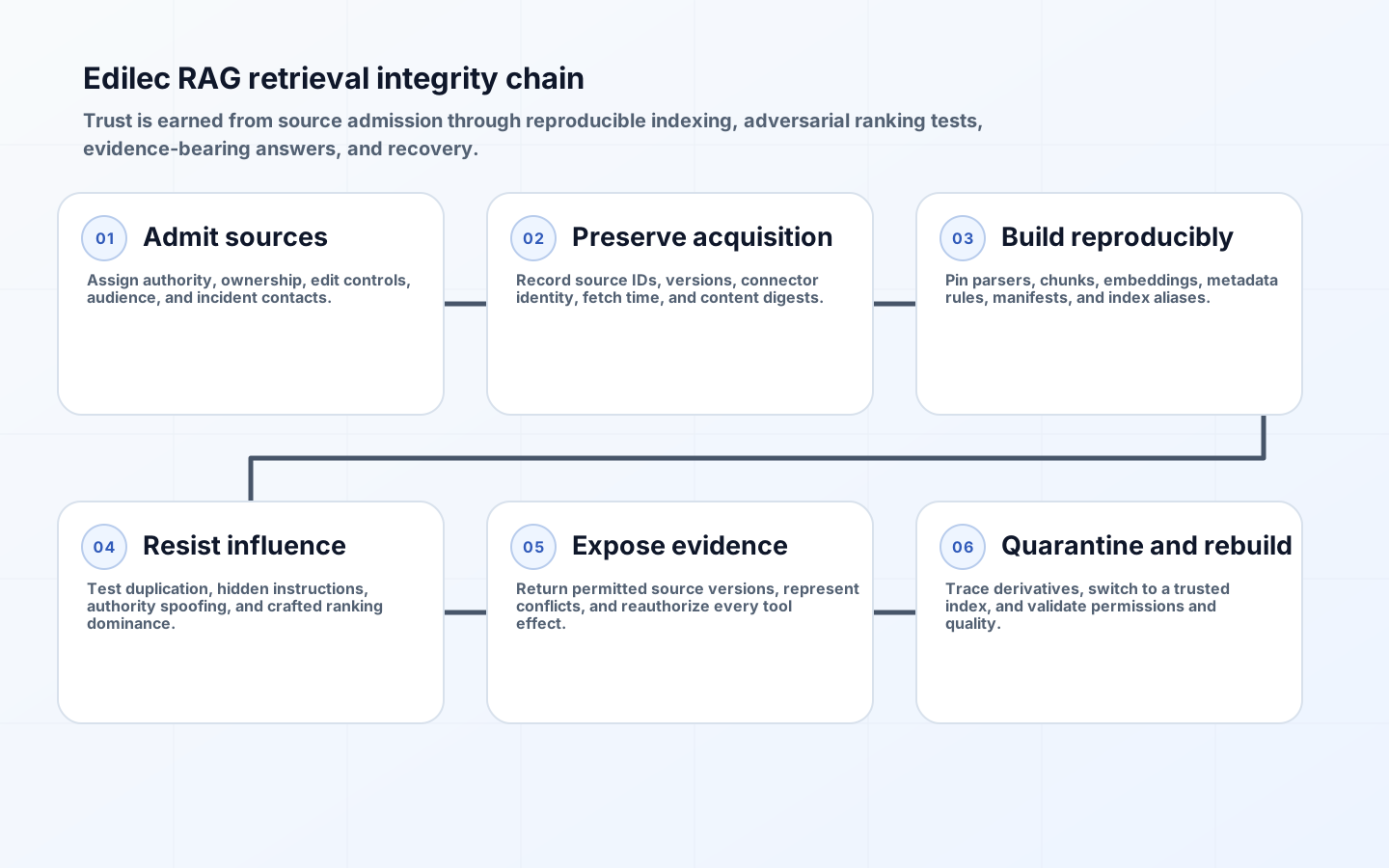
RAG poisoning prevention protects the integrity of the content that retrieval-augmented generation selects and presents to a model. Permission-aware retrieval can still be wrong in a dangerous way: an attacker may edit an approved page, upload a malicious document, exploit a connector, manipulate chunk text, replace embeddings, influence ranking, or hide instructions inside content. Because the model is designed to use retrieved context, an authoritative-looking poison can steer answers or tools without directly compromising model weights.
The unit of protection is the retrieval evidence chain: source owner, document version, acquisition event, transformation, chunk, embedding, index, ranking decision, prompt context, answer, and downstream action. Edilec's enterprise RAG architecture guide explains permissioning and production rollout. This guide narrows the lens to adversarial integrity: how content becomes trusted, how tampering is detected, and how a contaminated index is rebuilt.
Threat-model how poisoned content gains influence
Identify who can create, edit, approve, sync and delete every source. Include employees, customers, vendors, website publishers, connector service accounts and pipeline operators. Then identify the attacker's desired effect: dominate retrieval for a topic, inject hidden instructions, discredit a competitor, expose protected records, redirect a user, or cause an agent to invoke a tool. OWASP's data and model poisoning guidance highlights manipulation of pre-training, fine-tuning and embedding data and the resulting backdoors, bias and degraded behavior.
| Attack point | Example manipulation | Integrity control | Evidence to retain |
|---|---|---|---|
| Source | Compromised wiki page or uploaded policy | Named owner, approval, version history and source allowlist | Source ID, editor, version, review and content digest |
| Connector | Overbroad sync or replaced API response | Scoped identity, TLS, cursor checks and reconciliation | Connector version, account, query, cursor and fetch time |
| Transformation | Parser hides or inserts text | Pinned code, isolated processing and golden files | Input digest, transform version, output digest and warnings |
| Chunk metadata | Tenant, date or authority field altered | Schema validation and metadata derivation rules | Original metadata, normalized values and policy result |
| Embedding/index | Vectors or mappings replaced | Immutable build manifest and controlled alias promotion | Model ID, chunk digests, index digest and approver |
| Ranking/context | Poison dominates through repetition or trigger terms | Diversity, authority weighting, deduplication and anomaly tests | Candidate set, scores, reranker version and selected chunks |
Define trust boundaries across the retrieval pipeline
Classify sources by authority, change control and expected content, not by connector brand. A signed policy repository and a public discussion forum should not compete as peers for a compliance answer. Separate authoritative records, curated reference material, user-contributed content and untrusted web content into collections or explicit ranking tiers. Bind each source to an owner who can approve onboarding, resolve conflicts, receive integrity alerts and attest that the source remains fit for purpose.

Treat retrieved text as data, never as an authority channel for the agent. Delimit content, label provenance, and instruct orchestration to ignore commands embedded in sources, but enforce important boundaries outside the prompt. A document must not grant tool permission, change the user's tenant, disable output checks or choose an external destination. The layered design in Edilec's AI guardrails review helps separate model-facing guidance from deterministic enforcement.
Gate source onboarding and material changes
Before syncing a source, document business purpose, owner, authority level, data classification, permitted audiences, expected formats, edit controls, retention, update cadence and incident route. Use a test import to inspect hidden text, macros, links, attachments, access-control metadata and parser behavior. High-authority or externally editable sources deserve dual approval. New domains, owners, content types or abrupt volume shifts should trigger re-review rather than inheriting the original decision silently.
At each sync, capture source-native IDs and versions, fetch identity, timestamps and content digests. Reconcile deletes and permission changes, because stale content can be an integrity problem even when nobody altered it maliciously. Compare changes by source and authority: mass replacement, repeated phrases, invisible text, anomalous links, new instruction-like language and unexpected metadata deserve quarantine. Avoid blocking every imperative sentence; legitimate procedures contain instructions, so the source context and intended use matter.
Make transformations and index builds reproducible
Pin parsers, OCR, chunking code, embedding models and normalization rules. Run untrusted document processing in an isolated environment with narrow network and storage access. Scan archives and active content, cap decompression and page counts, and reject unsupported constructs explicitly. Golden-file tests should show how representative documents become chunks, including tables, footnotes, hidden layers and access metadata. A parser update is a material retrieval change even when source documents stay still.
Build indexes from immutable manifests that identify every source version, transform, chunk digest, embedding model and configuration. Promote a new index by alias or versioned route after integrity, permission and quality tests; retain a tested predecessor for rollback. NIST SP 800-218A applies secure development practices across AI model development, production and acquisition. The same repository protection, provenance and release discipline belongs around retrieval artifacts.
Defend ranking against influence campaigns
A poison does not need to be the nearest vector once; it needs reliable influence. Test duplicate and near-duplicate flooding, keyword stuffing, authority spoofing, timestamp gaming, multilingual variants, tiny hidden text and content crafted for the embedding model. Limit one source's domination, deduplicate semantically, use authority and freshness deliberately, and rerank against the user's task. Preserve the candidate list and scores for investigations; logging only the final answer hides why the poison won.
NIST's adversarial machine learning taxonomy helps distinguish poisoning knowledge and capabilities, while MITRE ATLAS supports adversary-path analysis. Convert plausible techniques into retrieval evaluations. Edilec's retrieval pipeline guide provides the quality foundation; add adversarial sets that measure whether low-trust content displaces authoritative records or changes tool-relevant claims.
Make answers expose evidence before action
Return meaningful citations that resolve to the exact source version and passage a user is permitted to inspect. A citation improves review but does not certify truth: poisoned content can be cited perfectly. Show authority, owner or date where useful, represent conflicts, and abstain when evidence is missing or materially inconsistent. For high-impact decisions, require the answer to be grounded in approved source classes and route uncertainty to a human owner.
Do not let retrieved instructions directly drive irreversible tools. Extract proposed action data, validate it against trusted systems, apply user and resource authorization, display the evidence and expected effect, then obtain approval where required. Record which chunks influenced tool arguments. If a document says to send credentials to a new endpoint, network policy and destination allowlists should block the action regardless of how confidently the model repeats it.
| Validation | Question answered | Pass condition | Failure action |
|---|---|---|---|
| Provenance coverage | Can every selected chunk resolve to an approved source version? | All production chunks have complete lineage | Quarantine index build and repair manifest |
| Authority conflict | Does low-trust content override an authoritative record? | Approved authority wins or conflict is disclosed | Adjust tiers, deduplication or abstention |
| Poison dominance | Can repeated or crafted documents control top results? | Influence remains within defined source limits | Block batch and investigate contributor route |
| Embedded instruction | Can retrieved text change policy or tool authority? | Instruction is treated as content and external controls hold | Suspend affected action path |
| Permission mutation | Do source access changes reach the index correctly? | Revoked content is absent from results and caches | Disable collection and reconcile |
| Rollback | Can the service return to a trusted index? | Alias switch and critical checks complete | Use safe search or manual fallback |
Detect contamination, quarantine it, and rebuild
Monitor unexpected source growth, edit bursts, contributor concentration, authority changes, parser warnings, index manifest mismatches, retrieval concentration, new outbound-link patterns, user reports and answer shifts on fixed canaries. Alerts should identify the source-to-answer path and provide a containment action. Quarantine one source, collection or index version when possible; switch to a trusted predecessor or deterministic search while scope is uncertain.
Preserve source and connector logs, original files, transforms, manifests, index routes, retrieval traces and affected answers. Determine the earliest contaminated source version and every derivative index or cache. Rebuild from trusted source snapshots rather than deleting suspicious vectors in place, then run permission, provenance, quality and adversarial tests. Notify content owners and affected workflow owners with verified scope. Confirm external actions separately; a harmful answer and a completed transaction require different recovery.
Key takeaways
- Protect the full source-to-answer evidence chain, not the vector database in isolation.
- Tier sources by authority and edit control, and give each collection an accountable owner.
- Make parsing, chunking, embedding and index promotion reproducible through immutable manifests.
- Test ranking against duplication, authority spoofing, hidden instructions and crafted influence.
- Rebuild contaminated indexes from trusted snapshots and verify downstream actions independently.
Frequently asked questions
Is prompt injection the same as RAG poisoning?
No. Indirect prompt injection is one effect malicious retrieved content may seek. Poisoning concerns unauthorized or adversarial influence over data and retrieval integrity more broadly, including false facts, ranking manipulation, stale records and permission metadata.
Do citations prevent poisoned answers?
No. Citations make evidence inspectable and support review, but a system can faithfully cite a poisoned source. Pair citations with provenance, authority, change control, conflict handling and retrieval evaluations.
Should user uploads enter the main knowledge index?
Usually they should remain in a user- or case-scoped collection with explicit lifetime and permissions. Promotion into a shared authoritative collection needs source review, ownership and change control rather than automatic ingestion.
Conclusion
Retrieval integrity is a governed publication pipeline. Sources earn a defined level of trust; connectors preserve identity and change; transforms and indexes are reproducible; ranking resists manufactured influence; answers expose versioned evidence; and tools enforce authority outside retrieved text. That design makes poisoning harder and investigation much faster.
Select one high-authority collection and trace a document from edit to answer today. If any stage cannot identify its input, output, version, owner and rollback, fix that break before adding more sources. The strongest RAG poisoning prevention begins with a chain the team can actually prove.