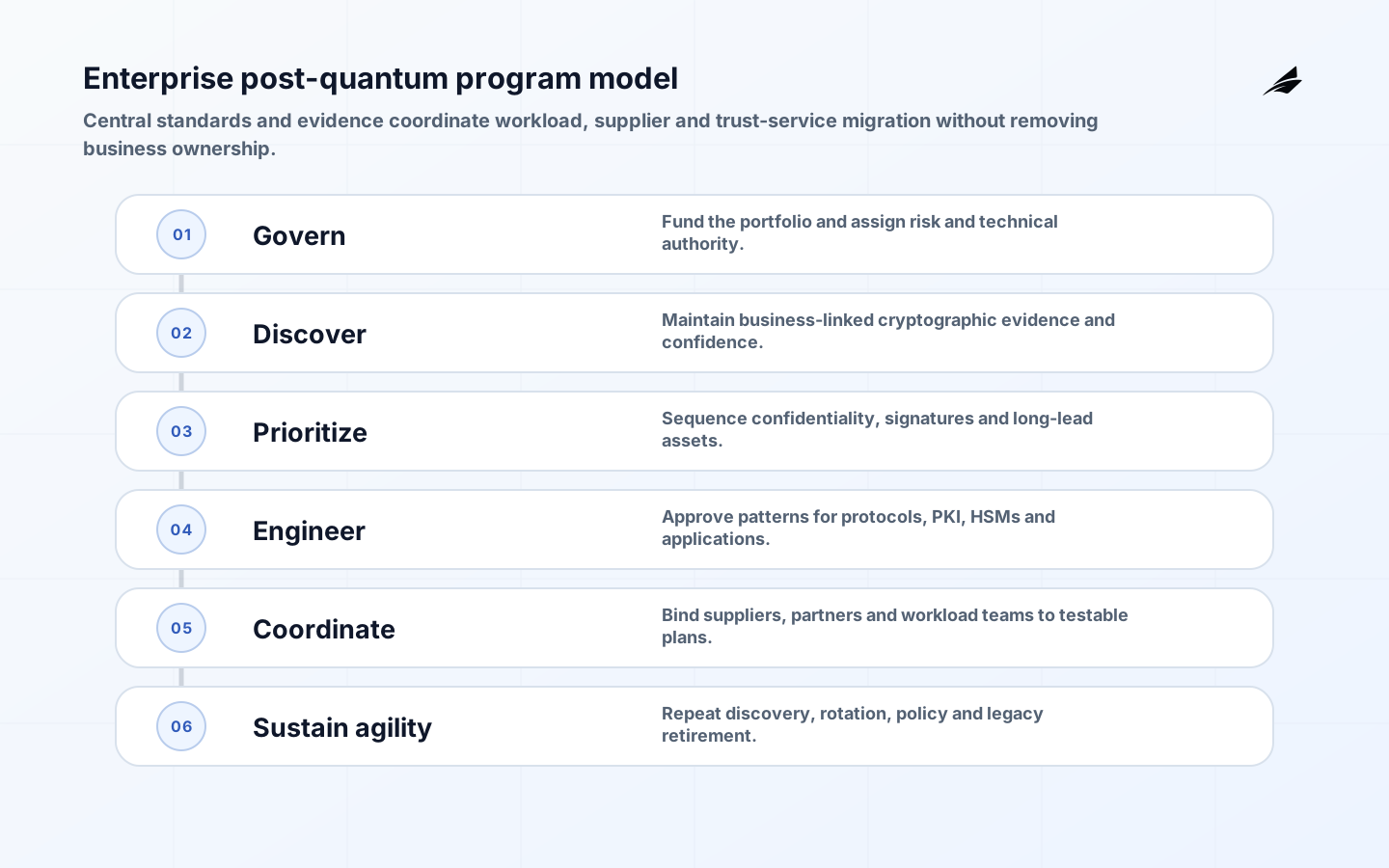
Enterprise quantum-safe transformation is a portfolio program spanning business data, applications, networks, identity, public key infrastructure, code signing, key management, devices and suppliers. The central challenge is not selecting one algorithm. It is coordinating many trust relationships that cannot all change at once. A credible program must expose cryptographic dependencies, protect information with long confidentiality lifetimes, preserve operational continuity and create a durable capability to change cryptography again.
NIST finalized FIPS 203 for ML-KEM, FIPS 204 for ML-DSA and FIPS 205 for SLH-DSA in 2024. These standards make planning more concrete, but they do not create automatic product compatibility or determine an enterprise sequence. NCCoE migration work focuses on discovery, interoperability and performance because real systems depend on protocols, implementations and operational tooling around the algorithms. CISA, NSA and NIST likewise advise organizations to build a quantum-readiness roadmap rather than wait for a precise quantum-computing date.
Define the enterprise program scope
Scope should follow cryptographic services and business processes, not organization charts. Include public-facing and internal transport, workload identity, employee and customer authentication, certificate authorities, software and firmware signing, document signatures, encrypted archives, key wrapping, secure email, virtual private networks, database clients, operational technology and third-party platforms. For each area, state whether the program will discover, assess, design, pilot, migrate, retire or monitor. This prevents an inventory engagement from being mistaken for full remediation.
Separate central capabilities from workload execution. A central team can define approved patterns, operate discovery, negotiate suppliers and provide test environments. Application and infrastructure owners must still validate dependencies, schedule changes and accept service outcomes. Data owners determine confidentiality and integrity requirements. Procurement controls supplier commitments. Risk and audit functions evaluate evidence without becoming substitute engineering owners.
| Workstream | Typical enterprise scope | Primary output |
|---|---|---|
| Discovery | Code, configurations, certificates, traffic, keys and supplier services | Context-rich cryptographic inventory |
| Risk and prioritization | Data lifetime, signature consequence, criticality and lead time | Owned migration waves |
| Architecture | Protocols, libraries, PKI, HSM, KMS and trust models | Approved target patterns |
| Migration delivery | Pilots, production cutovers and legacy retirement | Tested service transitions |
| Crypto agility | Policy, automation, procurement and recurring discovery | Repeatable change capability |
Build governance around decisions and evidence
Establish an executive sponsor for funding and cross-business decisions, a program owner for the roadmap and named domain owners for PKI, identity, networks, software supply chain, cloud, data and devices. Define who approves target profiles, temporary legacy operation, supplier exceptions and production cutovers. A steering committee should resolve dependencies and risk, not attempt to design protocol details. A technical authority should publish versioned patterns and record why each pattern is supported.
Use a common evidence model. Every material item should connect a business service, data owner, cryptographic function, implementation, supplier, target state, migration wave and exception. This allows executive reporting to reconcile with engineering work. It also distinguishes a confirmed runtime dependency from a possible static-code finding. Maintain provenance for discovery results so teams can reproduce them after a product upgrade or acquisition.
Govern standards carefully. FIPS 203, 204 and 205 define foundational algorithms, while protocols and sector profiles determine how they are encoded and negotiated. Product support may mature at different rates. The technical authority should review current NIST publication notes and errata, relevant protocol specifications, implementation status and operational constraints before approving a pattern. Marketing labels such as quantum ready do not replace configuration and interoperability evidence.
Model cost by change surface and dependency
There is no defensible universal price for enterprise post-quantum migration. Cost depends on the number and diversity of cryptographic dependencies, inventory quality, application age, protocol maturity, supplier control, hardware replacement, test coverage and coordination effort. A modern service using centrally managed libraries may adopt a supported pattern through routine releases. An embedded estate with fixed firmware, offline trust anchors and long procurement cycles may require redesign and asset replacement.
Estimate by work package rather than counting certificates alone. Include discovery deployment, data normalization, owner validation, architecture, laboratory environments, performance testing, certificate and key infrastructure, application changes, hardware or appliance upgrades, partner testing, change windows, training, operations and legacy retirement. Reserve capacity for failed interoperability tests and supplier delays. Excluding those activities creates an attractive estimate that cannot fund a complete transition.
| Cost driver | Lower-effort condition | Higher-effort condition |
|---|---|---|
| Inventory confidence | Assets and owners reconcile across systems | Unknown code, traffic and supplier dependencies |
| Cryptographic coupling | Algorithms are abstracted behind supported services | Algorithms are embedded in business logic or formats |
| Protocol readiness | Required peers support an approved construction | Custom protocols or incompatible implementations exist |
| Hardware lifecycle | Platforms can be upgraded in place | HSMs, appliances or devices require replacement |
| External coordination | The enterprise controls both endpoints | Partners and vendors control migration timing |
| Assurance depth | A low-impact internal service has strong test automation | Critical signing or identity paths need extensive validation |
Express estimates as ranges tied to assumptions and decision gates. For example, a discovery phase can be bounded by selected environments and reconciliation criteria. Its output then informs migration-wave estimates. Keep product licenses, specialist services, internal engineering time, hardware refresh and business-change costs visible rather than combining them into one unexplained figure. Update the forecast when inventory confidence improves.
Prioritize the portfolio by business exposure
Confidentiality and integrity create different priorities. Information that must remain secret well into the future may face collection-now, decryption-later exposure. Signature systems protect software, identities, transactions and durable records; their consequence depends on what a successful forgery could authorize. Add service criticality, internet exposure, replacement lead time, supplier readiness and migration reversibility. Avoid a single opaque score that hides assumptions.
Create migration waves with explicit reasons. An early wave may contain observable services that validate tooling and approved patterns. Another may target long-lived confidential archives. A later wave may wait for protocol or vendor support while applying compensating controls and active monitoring. A difficult dependency should not disappear from the roadmap because immediate migration is infeasible; it should gain an owner, supplier action, review date and retirement condition.
| Portfolio question | Evidence to collect | Decision enabled |
|---|---|---|
| What is protected? | Data classification, retention and business process | Confidentiality and integrity priority |
| Where is trust anchored? | Certificate, key, signer and verifier relationships | Complete migration boundary |
| Who controls change? | Product owner, supplier and partner responsibilities | Feasible delivery sequence |
| How long will replacement take? | Release, procurement and hardware lifecycle constraints | Start date and interim treatment |
| Can failure be reversed? | Rollback design and recovery evidence | Pilot and cutover strategy |
Deliver through evidence-based phases
Begin with mobilization: confirm authority, scope, terminology, evidence fields and risk criteria. The next phase establishes discovery coverage and owner validation. Architecture then converts priority use cases into approved protocol and product patterns. Pilots test complete paths in representative environments. Production waves progressively migrate services and retire legacy paths. The final phase embeds recurring discovery, policy enforcement and supplier requirements into normal operations.
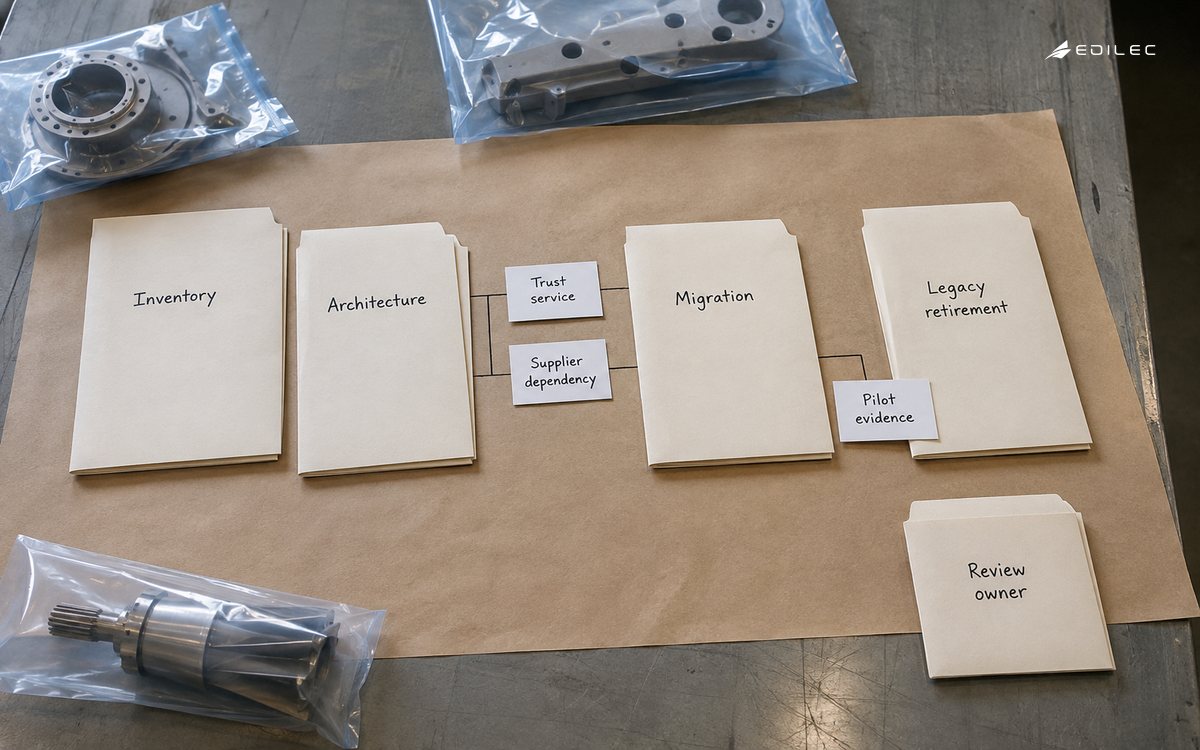
| Phase | Exit evidence | Common stop condition |
|---|---|---|
| Mobilize | Charter, owners, scope and decision rights | No authority to resolve cross-business conflicts |
| Discover | Reconciled inventory with business context | Critical assets or owners remain unknown |
| Design | Approved target patterns and exception rules | Protocol or product support is unproven |
| Pilot | Interoperability, performance, recovery and rollback results | Representative dependencies were omitted |
| Migrate | Production telemetry and controlled legacy retirement | Silent fallback or unacceptable service impact |
| Sustain | Recurring inventory and crypto-agility controls | New systems can bypass approved cryptographic policy |
Set acceptance at the business-service level. A central platform supporting ML-KEM does not prove that customer clients, gateways and monitoring can use it. A new signing key does not prove that every verifier, recovery image and offline process recognizes the signature. Require positive and negative tests, key lifecycle exercises, disaster recovery and observable negotiation. Preserve the result with implementation versions and configuration.
Make suppliers part of the roadmap
Ask suppliers where public-key cryptography is used, which finalized NIST algorithms and protocol constructions are supported, what versions are required and how legacy modes can be identified and disabled. Request interoperability evidence, key and certificate limits, hardware dependencies, performance considerations, patch commitments and migration timelines. Require notice when cryptographic components, validation status or support dates change.
Contract language should preserve customer visibility and exit options. The enterprise needs access to configuration, logs and inventories sufficient to verify its risk position. Avoid promises that depend on an undefined future release. Tie commitments to identifiable product versions, supported modes, documentation and acceptance tests. Procurement should route material exceptions to the program instead of allowing separate business units to accept incompatible assurances.
Control the principal transformation risks
The first risk is false completeness: discovery finds visible certificates but misses code signing, embedded libraries, offline recovery or supplier services. Reconcile multiple sources and sample results with owners. The second is premature standard adoption through experimental or proprietary mechanisms. Use finalized standards through approved protocols and supported implementations. The third is operational failure caused by larger messages, incompatible peers, parsing defects or resource pressure. Test representative paths and retain safe rollback.
Other risks include indefinite hybrid or legacy operation, duplicated tools, unowned exceptions and dependence on specialist knowledge. Give transitional states expiry conditions and telemetry. Choose tools according to evidence coverage and integration rather than feature count. Maintain internal owners even when consultants or managed providers perform discovery and engineering. The enterprise must retain its inventory, decisions, configurations, test records and supplier history.
Measure readiness without claiming certainty
Useful measures describe evidence: inventory coverage for defined environments, validated ownership, priority dependencies with target states, supplier responses, approved patterns, completed interoperability tests, production services using approved configurations and legacy exceptions with retirement conditions. Report unknowns separately. A percentage that treats a low-impact test certificate and a critical signing root as equivalent can obscure more than it reveals.
Measure crypto agility as an operating capability. Can teams locate cryptographic use after a new advisory? Can policy change without rewriting business logic? Can certificates and algorithms rotate through tested automation? Can suppliers provide timely configuration evidence? Can operations detect fallback? These questions keep the program useful even as standards, products and risk assessments evolve.
Key takeaways
- Scope the program across data, trust services, applications, infrastructure and suppliers.
- Fund discovery, architecture, migration and legacy retirement as distinct work.
- Use FIPS 203, 204 and 205 through supported protocols and tested products.
- Prioritize exposure, consequence, lead time and reversibility.
- Retain enterprise ownership of evidence, decisions and crypto agility.
Frequently asked questions
How should an enterprise begin if its cryptographic inventory is incomplete?
Define a representative boundary and combine certificate, traffic, configuration, code, key-management and supplier evidence. Reconcile findings with service owners, document blind spots and improve the inventory model before scaling. Do not wait for perfect enterprise-wide discovery before addressing a confirmed high-consequence dependency.
Can the program be delivered entirely by a specialist provider?
A provider can accelerate discovery, architecture and testing, but the enterprise still owns business priorities, data requirements, production authority, supplier relationships and residual risk. Contracts should return inventories, configurations, scripts, test evidence and decision records in usable formats.
When is an enterprise quantum-safe transformation complete?
Completion should be defined by approved scope and evidence, not a universal label. A migration wave is complete when required trust paths use approved targets, tests and operations meet acceptance criteria, legacy exceptions are controlled and inventories are updated. Recurring crypto-agility work continues afterward.
Conclusion
An enterprise quantum-safe program converts a broad future threat into governable work: discover cryptography, connect it to business consequence, approve supported target patterns, test complete trust paths and migrate through observable gates. The program should make uncertainty visible without pretending that an exact quantum timeline or universal migration cost exists.
The strongest business case is not a one-time claim of quantum readiness. It is reduced exposure for long-lived information, safer trust infrastructure, clearer supplier accountability and a tested ability to replace cryptography while services continue to operate. Those outcomes remain valuable throughout this migration and the transitions that follow it.